A good Ledger security setup should make crypto storage safer, not harder to manage.
That distinction matters.
Many investors buy a hardware wallet because they want better protection, but then they create a system that is either too casual or too complicated. Some leave all assets in one hot wallet and only think about security after a scare. Others overbuild their setup with too many wallets, hidden phrases, notebooks, backups, chains, apps, and rules they cannot realistically maintain.
Both approaches create risk.
Crypto security fails when users either do too little or make the system too complex to follow.
Ledger can be useful because it gives investors a dedicated hardware device for signing transactions and keeping private keys away from internet-connected software wallets. Ledger explains that its hardware wallets store private keys in a secure offline environment and use a Secure Element chip with Ledger’s operating system to help protect crypto assets.
But buying a Ledger is not the full security strategy.
The real question is: How should an investor actually use Ledger without overcomplicating crypto storage?
This article builds a practical Ledger security setup for long-term holders, DeFi users, and investors who want stronger self-custody without turning security into a daily burden.
Table of Contents
Why a Ledger Security Setup Matters
A Ledger security setup matters because crypto ownership is different from holding money in a traditional bank account.
When investors self-custody crypto, they control the keys that control access to their assets. That gives them independence, but it also gives them responsibility.
A hardware wallet is designed to reduce one of the biggest risks in crypto: exposing private keys to an online environment. Ledger Academy explains that a hardware wallet stores private keys offline and allows users to sign transactions while keeping those keys separate from internet-connected devices.
That is the core security benefit.
A browser wallet on a laptop or phone is convenient, but it lives in an online environment. If the device is compromised, if a malicious extension is installed, or if the user signs something dangerous too quickly, the risk increases.
A Ledger device changes the workflow.
Instead of signing only on a software wallet, the user must confirm actions on the physical device. That extra step can reduce impulsive signing and create a stronger boundary between storage and daily activity.
However, the device is only one layer.
A strong Ledger security setup also needs:
- A clean recovery phrase process.
- Wallet separation.
- Careful transaction review.
- Limited DeFi exposure.
- Approval hygiene.
- Safe backup storage.
- A realistic routine the user can maintain.
The goal is not to make crypto security dramatic.
The goal is to make it repeatable.
Step 1: Use Ledger for the Right Purpose
The first mistake is using Ledger for everything.
Ledger is best used as a protected signing and storage layer, not as a wallet for every random dApp interaction.
A strong setup separates use cases.
The Ledger device should protect assets that matter most:
- Long-term BTC holdings.
- Long-term ETH holdings.
- Major portfolio positions.
- Assets not used daily.
- Reserves that do not need frequent DeFi interaction.
- Funds that should not be exposed to experimental apps.
This is where Ledger has the strongest value.
It helps investors avoid keeping their entire portfolio in a hot wallet. It also creates friction before signing transactions, which is useful when the action is important.
But Ledger should not become a “click everything” device.
If a user connects a Ledger-protected wallet to every new token claim, NFT mint, testnet, bridge, and DeFi farm, the setup becomes weaker. The private keys are still protected offline, but the user can still approve risky transactions.
That is why the best Ledger security setup starts with purpose.
Use Ledger for capital that needs protection.
Use separate hot wallets for higher-risk activity.
For a broader framework, see BlockCodex’s guide on “Why Wallet Separation in Crypto Is a Powerful Security Habit: 7 Reasons It Matters”.
Step 2: Choose the Right Ledger Model for Your Profile
Not every investor needs the most expensive hardware wallet.
The right Ledger depends on how the device will be used.
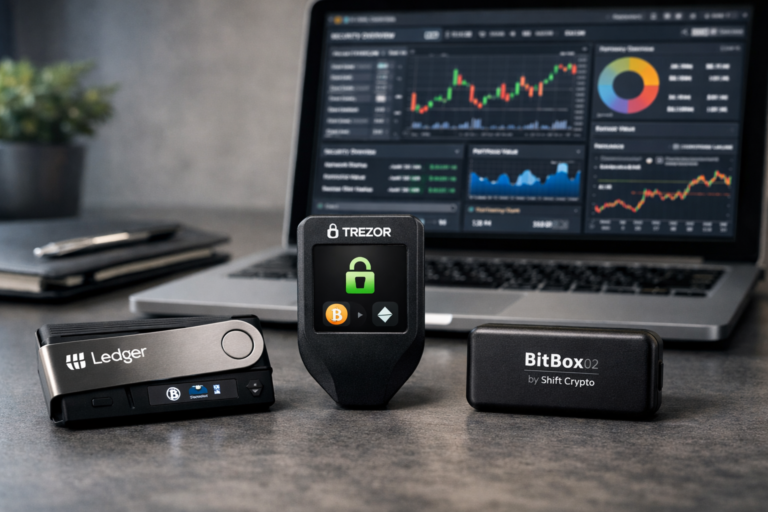
Ledger currently offers several hardware wallet models, including Ledger Nano S Plus, Ledger Nano X, Ledger Flex, and Ledger Stax. The official Ledger store positions these devices around different needs such as affordability, mobile use, larger screens, and premium touchscreen experience.
The better approach is to match the model to the investor profile.
| Investor Profile | Best Fit | Why It Makes Sense |
|---|---|---|
| Beginner long-term holder | Ledger Nano S Plus | Simple, affordable, strong cold storage option. |
| Mobile user | Ledger Nano X | Useful for users who want Bluetooth and mobile flexibility. |
| Investor who wants clearer transaction review | Ledger Flex | Larger screen and more comfortable signing experience. |
| Premium self-custody user | Ledger Stax | Higher-end touchscreen experience for users who want maximum usability. |
For most beginners, the Ledger Nano S Plus is often enough.
It gives the main benefit: keeping private keys offline while allowing secure transaction signing. It is especially relevant for investors who want to move assets away from exchanges and hot wallets without paying for premium design.
The Ledger Nano X is more relevant for investors who manage crypto on mobile and want Bluetooth functionality.
Ledger Flex and Ledger Stax are more attractive for users who value screen clarity, comfort, and premium interaction. This matters because transaction review is not only about security hardware. It is also about whether the user can clearly understand what they are confirming.
A larger and clearer signing experience can reduce mistakes, especially for users who regularly manage different assets.
For a detailed comparison, see BlockCodex’s guide on “Why Wallet Separation in Crypto Is a Powerful Security Habit: 7 Reasons It Matters”.
“If you want a simple hardware wallet for long-term storage, start with Ledger Nano S Plus. If you want a more comfortable signing experience, compare Ledger Nano X, Ledger Flex, and Ledger Stax on the official Ledger store“.
Step 3: Treat the Recovery Phrase as the Real Master Key
A Ledger device is important, but the recovery phrase is even more important.
Ledger Academy explains that a seed phrase, also called a Secret Recovery Phrase, is a group of words that allows users to restore access to their wallet. It represents access to the accounts protected by that wallet.
This means the recovery phrase is not just a backup.
It is the master key.
If someone gets the recovery phrase, they do not need the physical Ledger device to access the funds. They can restore the wallet elsewhere.
That is why the recovery phrase process must be simple and strict.
A clean Ledger security setup should follow these rules:
- Write the recovery phrase offline.
- Never take a photo of it.
- Never store it in cloud notes.
- Never send it by email.
- Never type it into a website.
- Never share it with support.
- Store it somewhere physically secure.
- Consider fireproof or metal backup storage for larger portfolios.
- Make sure trusted recovery instructions exist if needed.
Ledger’s phishing guidance is clear that scammers may ask users to download fake apps or validate transactions, and users should never validate a transaction they did not initiate. Ledger support also warns users never to share the 24-word Secret Recovery Phrase.
This is the non-negotiable part of the setup.
The device can be replaced.
The recovery phrase cannot be exposed.
Step 4: Keep Long-Term Holdings Separate From DeFi Activity
This is where many investors make a serious mistake.
They buy a hardware wallet, move assets to it, and then use the same wallet for DeFi, airdrops, bridges, swaps, liquidity pools, mints, and experimental protocols.
That weakens the setup.
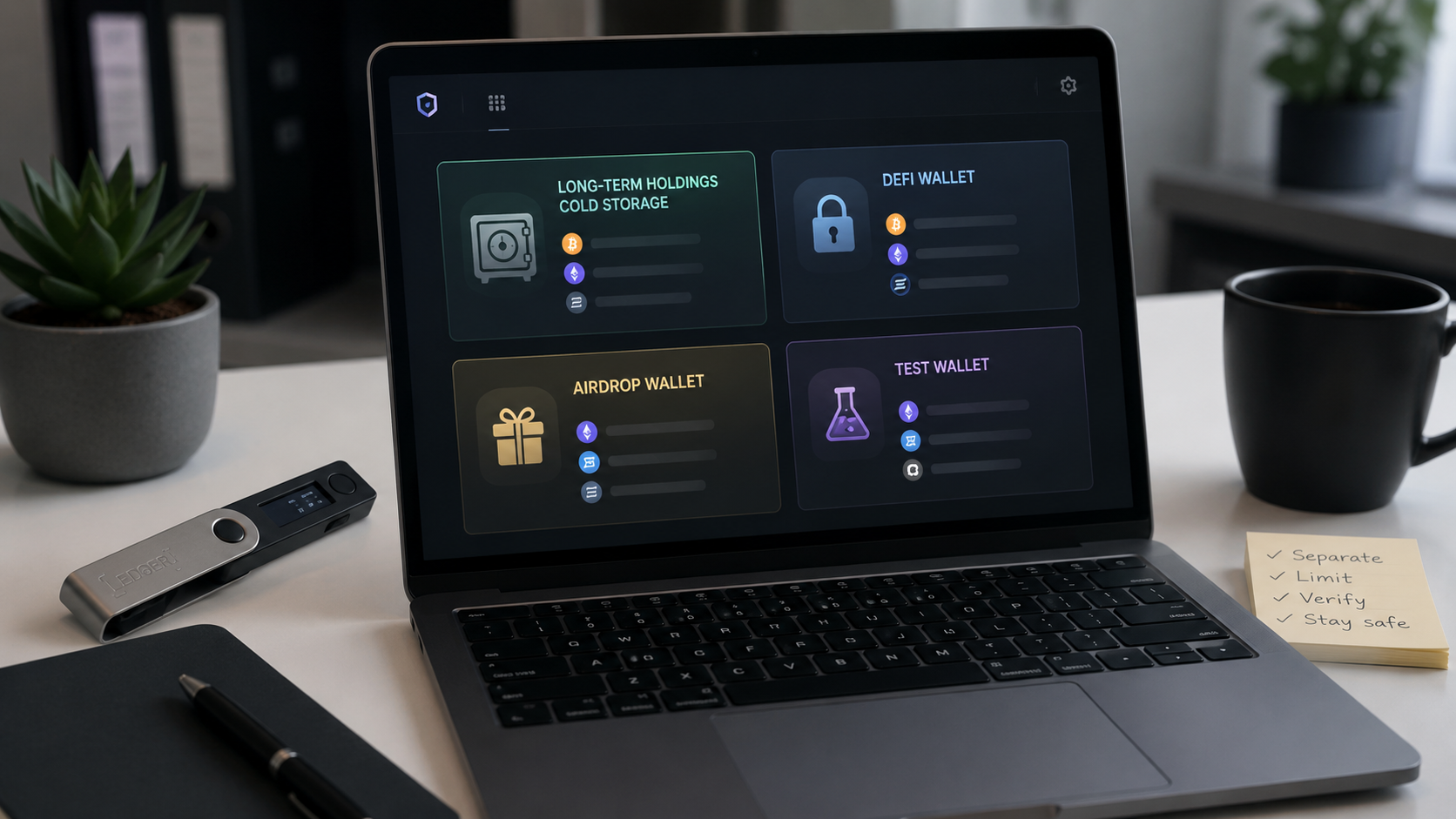
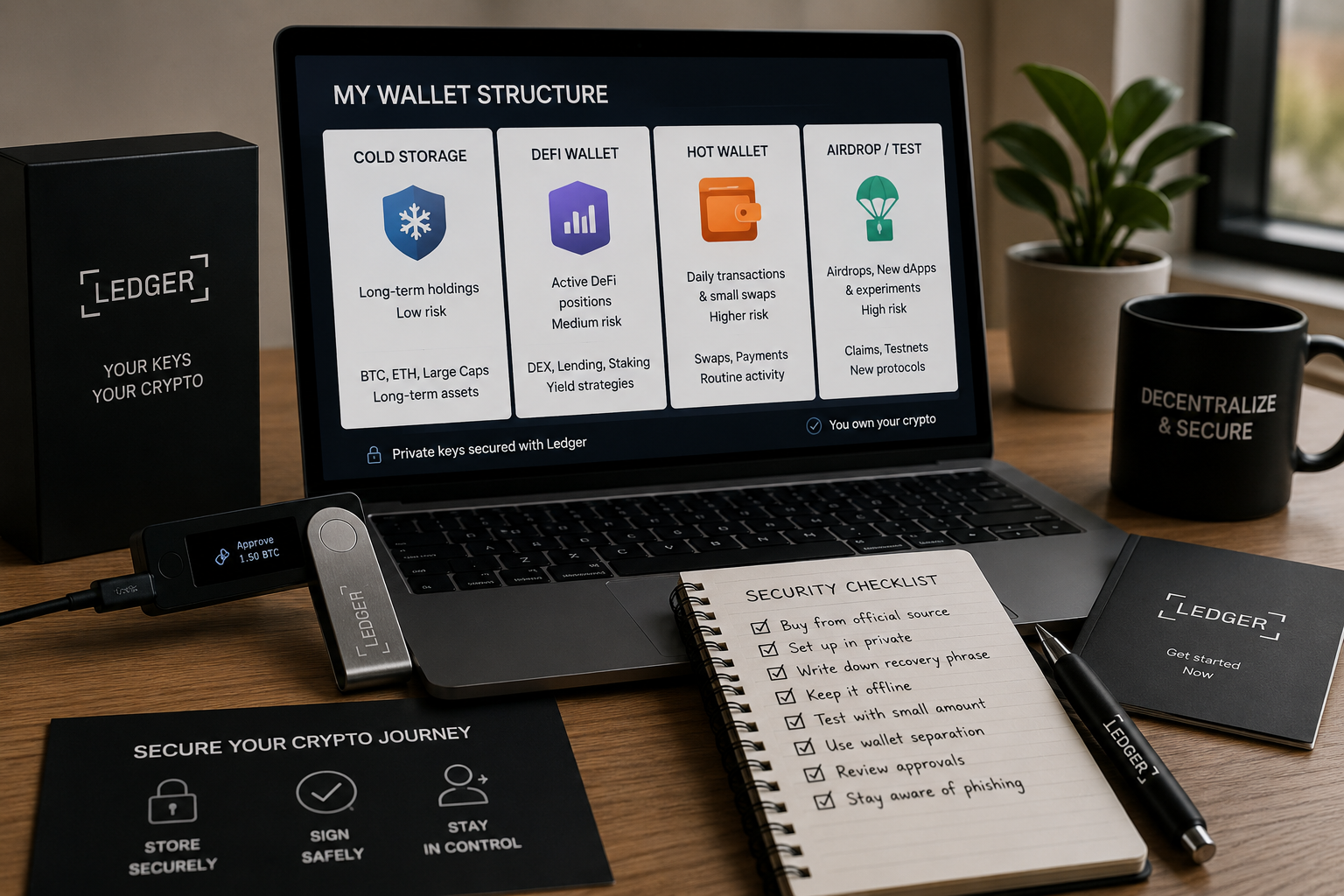
A better Ledger security setup separates long-term holdings from active usage.
A simple structure looks like this:
| Wallet Layer | Purpose | Risk Level |
|---|---|---|
| Ledger cold storage wallet | Long-term holdings and reserves. | Low interaction. |
| Ledger-connected DeFi wallet | Higher-value DeFi positions. | Medium interaction. |
| Hot wallet | Small swaps and routine activity. | Higher interaction. |
| Airdrop wallet | Claims and experimental apps. | High risk. |
| Test wallet | Unknown dApps and testnets. | Very high risk. |
This structure prevents one mistake from exposing everything.
The Ledger cold storage wallet should not be used for every new opportunity. It should mostly receive assets, hold them, and sign only carefully reviewed transactions.
The hot wallet can be used for smaller daily activity.
The airdrop wallet can be used for claim pages and new protocols.
The test wallet can be treated as disposable.
This setup is not complicated. It is just organized.
It also supports better behavior.
Before signing anything, the investor can ask: Is this the right wallet for this action?
That one question can prevent many avoidable mistakes.
For more on this approach, see BlockCodex’s article on “Best Ways to Secure Crypto: 7 Practical Layers Without Overcomplicating It”.
Step 5: Use Ledger to Slow Down Transaction Signing
One underrated benefit of Ledger is friction.
In crypto, friction is often seen as a problem. Users want faster swaps, faster approvals, faster claims, and faster movement across chains.
But security sometimes needs friction.
A Ledger device forces the user to confirm actions physically. That creates a pause between the website request and the signed transaction.
That pause matters.
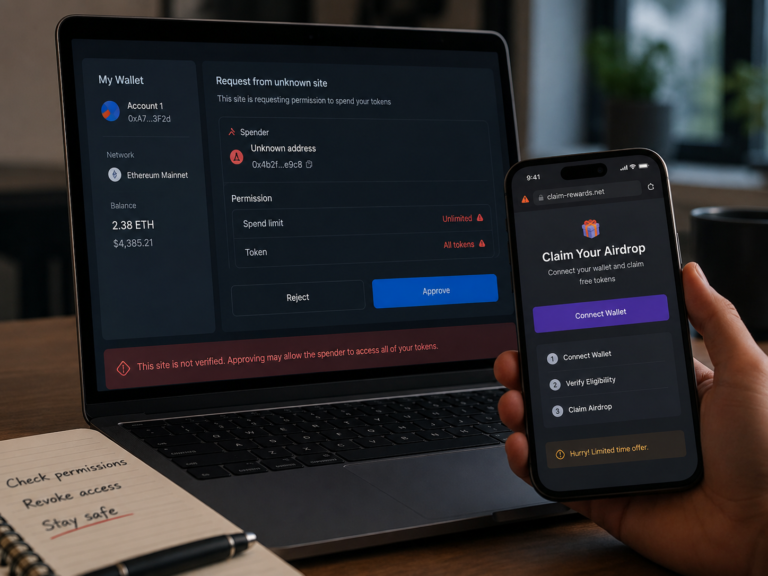
Wallet drainers and phishing pages often succeed because users move too fast. They connect a wallet, click approve, sign the prompt, and realize too late that the transaction was dangerous.
A Ledger security setup should use the device as a decision checkpoint.
Before confirming on the device, ask:
- Did I initiate this transaction?
- Is the receiving address correct?
- Is the amount correct?
- Is the contract expected?
- Is the token approval necessary?
- Is this wallet supposed to interact with this app?
- Is the website official?
- Am I signing because I understand the action, or because I feel rushed?
This is especially important because a hardware wallet does not protect users from every bad decision.
If the user confirms a malicious transaction, the device may still sign it.
The Ledger is a secure signer.
It is not a substitute for judgment.
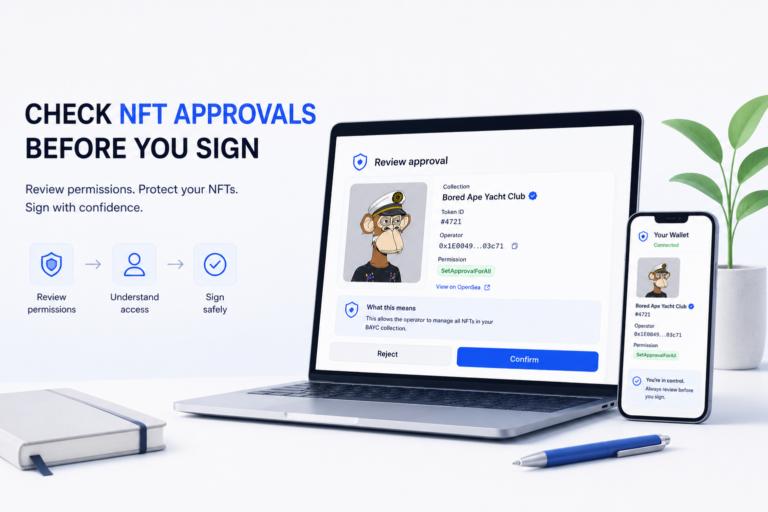
For this reason, investors should combine Ledger with approval checks and wallet separation, especially before using DeFi. BlockCodex covers this in “How to Check Token Approvals Before Using DeFi: 7 Smart Safety Steps”.
Step 6: Do Not Overcomplicate the Backup System
Advanced crypto users sometimes create backup systems that are too complex.
They split phrases across locations, use hidden wallets, add passphrases, create multiple devices, and document procedures in ways that only they understand.
Some of those methods can be useful for advanced users.
But they also create a new risk: self-lockout.
A security setup that the owner cannot reliably recover is not secure.
For most investors, the better approach is simple:
- One primary Ledger device.
- One properly stored recovery phrase.
- One clear backup location.
- One documented recovery process.
- One optional second device for larger portfolios.
- No digital copies of the seed phrase.
- No complicated system that depends on memory alone.
Passphrases can add another layer, but they should not be used casually. If a user forgets the passphrase, access to the hidden wallet can be lost.
The same applies to overly complex storage rules.
Security must survive stress, travel, emergencies, device loss, and time.
A good Ledger security setup is not the setup that looks smartest.
It is the setup that can still be executed correctly years later.
Step 7: Build a Simple Maintenance Routine
Crypto security is not only a one-time setup.
It needs maintenance.
A practical Ledger routine can be light but consistent.
| Frequency | Action |
|---|---|
| After setup | Verify recovery phrase storage and test small transactions. |
| Monthly | Review wallet balances and open approvals on active wallets. |
| Before large transfers | Confirm address, network, and receiving wallet. |
| Before DeFi use | Check whether the right wallet is being used. |
| After DeFi use | Revoke unnecessary approvals. |
| After security news | Review phishing warnings and risky connections. |
| Yearly | Reassess storage locations and device condition. |
The goal is not to create a stressful ritual.
The goal is to avoid silent risk accumulation.
Old approvals, forgotten wallets, unused balances, and unclear backups create problems over time.
A Ledger security setup should stay clean.
Simple maintenance is what keeps it reliable.
Ledger Setup for Different Types of Investors
A differentiated article should not treat every user the same.
Different investors need different levels of security.
The Beginner Holder
This user buys BTC, ETH, and maybe a few large-cap assets. They do not use much DeFi.
Best setup:
- Ledger Nano S Plus.
- Long-term storage wallet.
- Recovery phrase stored offline.
- No regular dApp connections.
- Small hot wallet for experimentation.
Main goal: Move long-term assets away from exchanges and hot wallets without building a complex system.
The Active DeFi User
This user swaps, bridges, lends, stakes, and interacts with protocols.
Best setup:
- Ledger for long-term holdings.
- Separate Ledger-connected DeFi wallet for larger DeFi positions.
- Hot wallet for smaller experiments.
- Regular approval reviews.
- Strong wallet separation.
Main goal: Keep DeFi activity from exposing long-term reserves.
The Airdrop Farmer
This user interacts with new protocols, testnets, bridges, and claim pages.
Best setup:
- Ledger cold storage wallet untouched by airdrops.
- Separate airdrop wallet.
- Separate test wallet.
- Minimal funds on experimental wallets.
- Strong phishing discipline.
Main goal: Avoid turning a claim page into a full-portfolio risk.
The Larger Portfolio Holder
This user holds meaningful capital and needs a more serious process.
Best setup:
- Ledger hardware wallet for reserves.
- Possible second backup device.
- Metal recovery phrase backup.
- Documented recovery instructions.
- Separate wallets by purpose.
- Minimal direct dApp interaction from the cold wallet.
Main goal: Protect assets while keeping recovery practical.
Instead of forcing one product recommendation, the article helps readers choose the right Ledger based on how they actually use crypto.
Common Ledger Security Mistakes
A Ledger device can improve security, but users still make avoidable mistakes.
Mistake 1: Thinking Ledger Makes Every Transaction Safe
Ledger protects private keys from online exposure.
It does not automatically make every signed transaction safe.
If the user signs a malicious approval, the transaction can still be harmful.
Mistake 2: Using Ledger for Every Random dApp
The cold storage wallet should remain low-interaction.
Use other wallets for high-risk activity.
Mistake 3: Storing the Recovery Phrase Digitally
A photo, cloud note, email draft, or password manager entry creates unnecessary exposure.
The phrase should stay offline.
Mistake 4: Ignoring Token Approvals
Ledger users still need to manage approvals.
Old permissions can remain active even after the original transaction is forgotten.
Mistake 5: Choosing the Wrong Model for the Use Case
A beginner may not need the most premium device.
A mobile user may prefer Nano X.
A user who values clearer signing may prefer Flex or Stax.
The best device is the one that supports the user’s behavior.
Mistake 6: Building a Setup That Is Too Complicated
Overcomplication can create confusion, forgotten backups, and recovery failure.
A setup must be secure and usable.
Where Ledger Fits in a Crypto Security Stack
Ledger is not the entire security stack.
It is one important layer.
A complete stack includes:
- Hardware wallet for key protection.
- Wallet separation for risk isolation.
- Recovery phrase discipline.
- Approval management.
- Phishing awareness.
- Secure device habits.
- Exchange withdrawal discipline.
- Clear portfolio structure.
- Regular security reviews.
Ledger is strongest when paired with these habits.
It protects private keys.
Wallet separation limits exposure.
Approval checks reduce smart contract risk.
Phishing awareness protects the human decision layer.
For the full framework, see BlockCodex’s “How to Check Token Approvals Before Using DeFi: 7 Smart Safety Steps”.
Is Ledger Worth It for Beginners?
For beginners holding meaningful crypto, Ledger can be worth it if they are ready to take self-custody seriously.
The key question is not only price.
The question is whether the investor wants to reduce dependence on exchanges and hot wallets.
A Ledger hardware wallet is most useful when:
- The portfolio is large enough to justify stronger protection.
- Assets are held for the long term.
- The user wants control over private keys.
- The user is willing to protect the recovery phrase properly.
- The user can follow a simple wallet separation routine.
It may be less urgent for someone holding a very small amount of crypto or someone who is not ready to manage recovery responsibility.
That honesty is important.
“Ledger is most useful for investors who want long-term self-custody and are willing to protect their recovery phrase carefully. For basic cold storage, Ledger Nano S Plus is usually enough. For mobile use, Nano X is more convenient. For clearer transaction review and premium usability, Ledger Flex or Ledger Stax may be more comfortable”.
Final Ledger Security Setup Checklist
Before using Ledger as your main crypto storage layer, check the full setup:
- Buy only from the official Ledger store or trusted official channels.
- Set up the device in a private environment.
- Write the recovery phrase offline.
- Never store the recovery phrase digitally.
- Send a small test transaction first.
- Use Ledger mainly for long-term holdings.
- Create separate wallets for DeFi, airdrops, and testing.
- Avoid signing under pressure.
- Review transactions on the device before confirming.
- Revoke unnecessary approvals on active wallets.
- Keep the cold storage wallet low-interaction.
- Reassess the setup regularly.
This checklist is simple on purpose.
A setup that users can repeat is stronger than a complex system they abandon.
Conclusion
A Ledger security setup should make crypto storage safer without making it unmanageable.
The strongest approach is not to buy a hardware wallet and then use it carelessly. It is also not to create an overly complex system that becomes impossible to maintain.
The best setup is structured, simple, and realistic.
Use Ledger for long-term protection.
Keep the recovery phrase offline.
Separate long-term holdings from DeFi activity.
Use hot wallets for small experiments.
Review approvals regularly.
Confirm transactions carefully.
Avoid turning security into a system you cannot follow.
Ledger can be a powerful part of a crypto security stack, especially for investors who want stronger self-custody and long-term asset protection.
But the device is only one layer.
The real security improvement comes from combining the hardware wallet with better habits.
That is the difference between owning a Ledger and using it properly.