Solana has become one of the most debated ecosystems in crypto. For some investors, it remains one of the strongest high-performance blockchain networks. For others, its growth is still heavily tied to speculative trading cycles, memecoins, and periods of intense retail attention.
The reality is more nuanced.
Solana growth cannot be judged only by SOL price, social media narratives, or short-term trading volume. A better analysis requires looking at network usage, stablecoin liquidity, DeFi depth, application activity, and whether demand is becoming more durable over time.
Based on current on-chain indicators, Solana still shows clear signs of growth. But the important point is that this growth is not linear. The network appears to be evolving from a purely activity-driven chain into a broader execution layer where DeFi, payments, tokenized assets, consumer applications, and trading infrastructure compete for blockspace.
That distinction matters for investors because not all blockchain growth is equal.
A chain can grow in users but fail to retain capital. It can increase TVL while relying heavily on incentives. It can process millions of transactions while producing limited economic value. The key question is not simply whether Solana is growing, but whether its growth is becoming more resilient.
Table of Contents
Solana Growth Is Still Visible in Network Activity
One of the clearest signs that Solana remains highly active is the scale of its on-chain usage.
According to DeFiLlama’s Solana chain dashboard, Solana recently showed 1.61 million active addresses over 24 hours and 64.11 million transactions over the same period. The key point is not only the raw activity, but the gap between user count and transaction count: Solana’s low-cost architecture allows users and applications to interact frequently without the friction of high fees.
This creates a different usage profile from higher-fee chains. On Solana, users can rebalance positions, trade smaller amounts, interact with consumer apps, mint assets, or use DeFi protocols without treating every transaction as a major cost decision.
That is a real structural advantage.
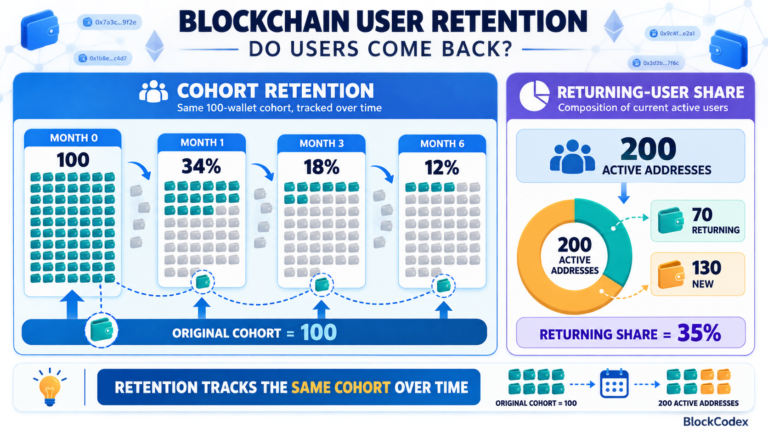
However, high activity does not automatically mean high-quality economic demand. Some Solana activity remains speculative, especially around memecoin trading and short-term liquidity rotations. The deeper question is whether users remain when volatility drops.
The more interesting signal is that Solana activity is no longer limited to one vertical. Trading remains important, but the network also supports activity across DeFi, stablecoins, infrastructure, NFTs, DePIN experiments, and tokenized assets. That makes the ecosystem less dependent on a single narrative than in earlier cycles.
For context, this is exactly why comparing ecosystems requires more than looking at speed or fees. In our internal breakdown, “Solana vs Ethereum (2026): 6 Key Differences That Actually Impact Ecosystem Growth,” we explain why ecosystem growth depends on liquidity, developer incentives, user retention, and application depth — not just throughput.
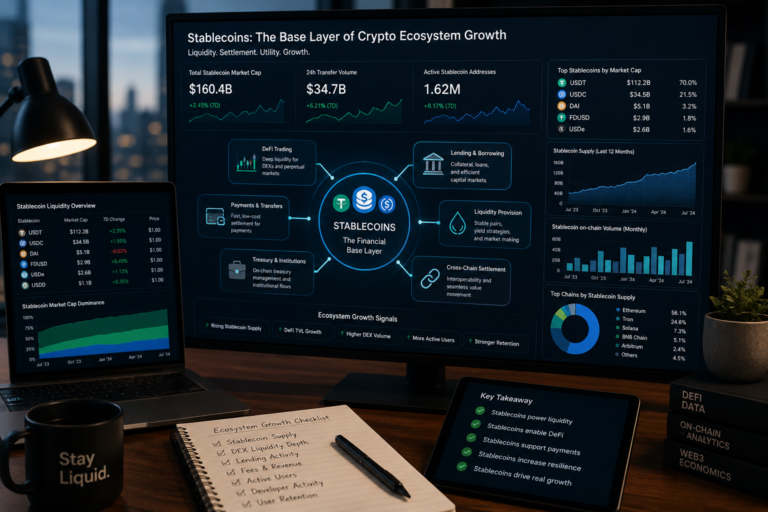
Stablecoin Liquidity Is Becoming a More Important Signal
For any blockchain ecosystem, liquidity is the foundation. Developers build where users and capital exist. Traders go where execution is deep. Payment applications and stablecoin users prefer chains where settlement is fast, cheap, and liquid.
This is where Solana has improved materially.
According to DeFiLlama, Solana’s stablecoin supply recently stood around $14.9 billion, with USDC representing more than half of that supply.
This matters because stablecoins are not passive balances. They are the working capital of crypto. They support:
- trading;
- lending;
- payments;
- treasury management;
- cross-chain settlement;
- DeFi liquidity.
The insight is simple: Solana growth is becoming less dependent on SOL alone.
When stablecoin liquidity expands on a chain, users can stay inside that ecosystem longer. They do not need to bridge out as often to trade, hedge, lend, borrow, or park capital. This increases the chance that applications capture more user activity internally.
For investors, this is important because liquidity depth often comes before ecosystem maturity. A chain with users but weak stablecoin liquidity may struggle to support serious financial activity. A chain with growing stablecoin liquidity has a stronger base for DeFi, payments, and institutional use cases.
Still, stablecoin growth should not be interpreted blindly. Stablecoin liquidity can rise because of real demand, trading activity, incentives, or temporary rotations between ecosystems. The key is to watch whether stablecoin liquidity remains during market pullbacks.
Solana DeFi Shows More Depth, but Still Needs Quality Filters
Solana’s DeFi ecosystem has moved beyond simple token swaps. Today, its DeFi activity spans decentralized exchanges, liquid staking, lending markets, perpetuals, structured products, and yield strategies.
This does not mean Solana DeFi is risk-free. Liquidity can still move quickly between protocols, especially when incentives shift. But the structure of the ecosystem is becoming more complete.
A useful way to understand this is to separate activity from financial depth.
Activity tells us whether users are interacting with the chain. Financial depth tells us whether capital is staying, compounding, and being reused across applications.
Solana’s advantage is that its low-cost environment supports both retail-scale behavior and high-frequency application design. This allows protocols to create experiences that would be more expensive or slower on other chains.
But there is a trade-off.
Low fees can make activity look impressive while compressing direct fee revenue. That means investors should avoid judging Solana only by transaction counts. The better question is whether applications on Solana can convert activity into sustainable revenue, sticky liquidity, and defensible network effects.
A strong Solana DeFi thesis should therefore monitor:
- whether TVL is stable without excessive incentives;
- whether DEX volume translates into fee generation;
- whether lending markets retain deposits during stress;
- whether liquidity is distributed across several protocols;
- whether users return after speculative cycles fade.
This is where portfolio-level analysis becomes important. In “Best Crypto Portfolio Tracking Setups: 7 Practical Frameworks for Real Control,” we explain why investors should track not only asset prices, but also exposure across chains, protocols, liquidity layers, and risk sources.
The Advanced Signal: Solana Is Expanding Into Tokenized Assets
One of the most important but less retail-focused signals is Solana’s expansion into tokenized real-world assets.
Messari reported that RWA value on Solana grew 58.7% quarter-over-quarter to $1.1 billion in Q4 2025, supported by products such as BlackRock’s BUIDL and Figure’s PRIME.
This is a different type of growth from memecoin trading.
RWA adoption suggests that Solana is being tested as infrastructure for financial products that require settlement efficiency, transparency, and composability. It does not prove that Solana has already become an institutional settlement layer, but it does show that the network is being used for more than speculative crypto-native activity.
This is the differentiated insight: Solana’s strongest growth story may no longer be “faster Ethereum.”
It may be the combination of:
- high-throughput consumer activity;
- deepening stablecoin liquidity;
- increasingly mature DeFi infrastructure;
- early institutional-grade settlement experiments.
That mix is rare.
Ethereum still dominates in security perception, institutional familiarity, and high-value DeFi settlement. Layer 2 networks compete on modular scalability. Solana’s positioning is different: one integrated execution environment where liquidity, applications, and speed are tightly connected.
If this model works, Solana could become a chain where both retail and institutional flows coexist. If it fails, the network may remain heavily dependent on speculative bursts.
What Investors Should Watch Next
For investors and analysts, the key is to avoid surface-level Solana analysis.
Price action alone does not explain whether the ecosystem is strengthening.
The most relevant indicators to monitor are:
| Signal | Why It Matters |
|---|---|
| Stablecoin supply | Shows whether usable capital remains inside the ecosystem |
| DeFi TVL quality | Helps separate sticky capital from incentive-driven deposits |
| Application revenue | Indicates whether activity creates economic value |
| RWA adoption | Shows whether Solana is gaining institutional use cases |
| Validator health | Reflects resilience, decentralization, and network credibility |
The last point matters. A fast blockchain is not automatically a resilient blockchain.
Solana’s long-term credibility depends not only on throughput, but also on client diversity, validator sustainability, uptime, and the cost of participating in consensus.
Tools such as DeFiLlama, Artemis, Nansen, and Glassnode can help investors separate real activity from short-lived speculation. The goal is not to find one perfect metric, but to build a dashboard of complementary signals.
The Main Risk: Solana Growth Quality Is Uneven
Solana is growing, but the quality of that growth is not uniform.
Some activity is valuable:
- stablecoin liquidity;
- DeFi depth;
- infrastructure adoption;
- RWA experimentation;
- application-level retention.
Some activity is more fragile:
- memecoin rotations;
- short-term trading spikes;
- airdrop farming;
- speculative liquidity that disappears when incentives fade.
This is why investors should be careful with overly bullish or overly bearish narratives.
Solana is not just a casino chain. But it is also not automatically a guaranteed institutional settlement layer. It is an ecosystem still proving whether high activity can translate into durable economic value.
The strongest bull case is that Solana becomes a high-performance financial and consumer application layer with deep liquidity and strong developer mindshare.
The strongest bear case is that activity remains cyclical, concentrated in speculative verticals, and vulnerable to liquidity outflows during risk-off periods.
Both views can be true at different moments.
Conclusion: Is Solana Still Growing?
Yes, Solana growth remains visible across network activity, stablecoin liquidity, DeFi usage, and emerging RWA adoption.
But the more important conclusion is that Solana’s growth is becoming more complex.
The network is no longer judged only by speed or transaction count. It is increasingly judged by liquidity quality, application revenue, capital retention, and whether institutional and consumer use cases can coexist on the same chain.
For investors, the best question is not whether Solana is “alive” or “dead.” The data clearly shows that the ecosystem remains active.
The better question is whether Solana can convert activity into durable value.
That is the metric that will matter most in the next phase of the cycle.