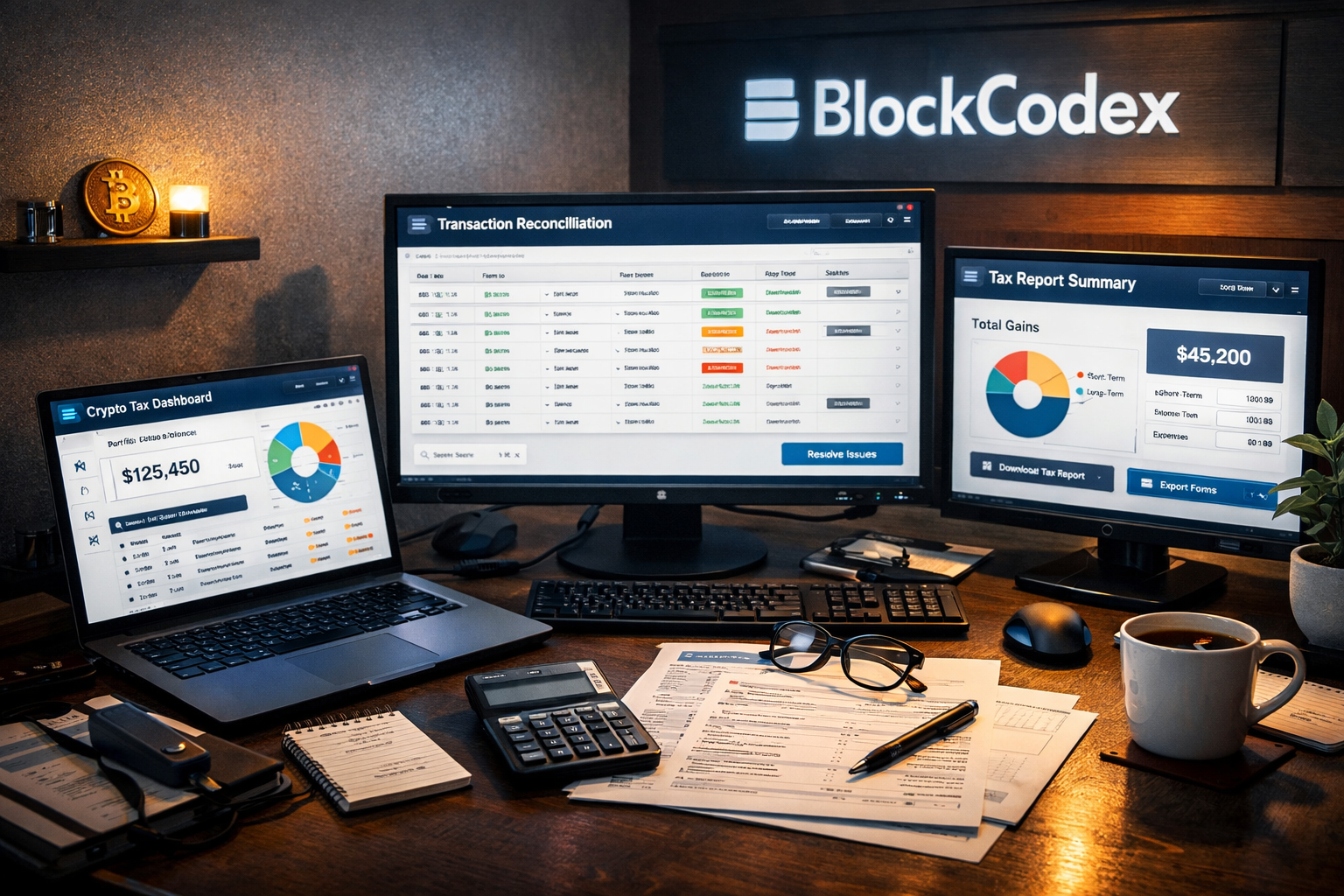
Crypto taxes tend to look simple—until you actually try to calculate them.
A few trades quickly turn into a complex history of transfers, swaps, staking rewards, and interactions across multiple wallets and blockchains. At that point, spreadsheets stop working. This is where understanding the best crypto tax tools compared becomes essential.
But choosing a tool is not just about convenience. It’s about accuracy.
Most errors in crypto tax reporting do not come from tax rules themselves. They come from incomplete data, misclassified transactions, or poor reconciliation between wallets and exchanges.
This article breaks down the best crypto tax tools compared, focusing on what actually matters in practice: data quality, reporting logic, and how each tool handles real-world complexity.
This is exactly why analyzing the best crypto tax tools compared becomes essential for serious investors dealing with complex portfolios.
Table of Contents
Why crypto tax reporting is structurally difficult
Crypto activity is fragmented by design.
An investor might:
- buy assets on an exchange
- transfer them to a wallet
- interact with DeFi protocols
- receive rewards or airdrops
- swap across chains
Each step creates a taxable or trackable event depending on jurisdiction.
The difficulty is not identifying one transaction. It is reconstructing the entire sequence.
This complexity is one of the main reasons why the best crypto tax tools compared focus heavily on data aggregation and reconciliation.
What actually defines a reliable crypto tax tool
If you strip away marketing, most crypto tax tools aim to solve the same problem.
But they don’t solve it equally well.
A reliable tool should be able to:
- connect to multiple exchanges and wallets
- detect transfers (so you’re not taxed twice)
- classify transactions correctly
- allow manual adjustments
- generate clear export reports
The difference lies in how they behave when something goes wrong.
Understanding these criteria helps make sense of the best crypto tax tools compared in real-world conditions.
A quick overview before going deeper
Before going deeper, here’s how the best crypto tax tools compared position themselves at a high level:
| Tool | Positioning | Strength |
|---|---|---|
| Koinly | Balanced | Ease of use + coverage |
| CoinTracking | Advanced | Data control |
| CoinLedger | Practical | Workflow simplicity |
| TokenTax | Premium | Human support |
| ZenLedger | Compliance | Audit-ready reporting |
But this only scratches the surface.
Koinly: where most investors start
Koinly is often the entry point for many investors, and for good reason.
It tries to make a complex process feel manageable.
The interface is designed to guide users step by step:
connect accounts → review transactions → generate reports.
If you want a straightforward way to handle crypto taxes without spending hours on setup, Koinly is often one of the most practical starting points.
In practice, it works well when your activity is structured but not extreme.
Where it shines:
- clean onboarding
- relatively intuitive workflow
- decent coverage of common use cases
Where it struggles:
- edge cases in DeFi
- situations where data is incomplete
It’s not perfect—but for many, it’s “good enough” in the best sense of the word.
CoinTracking: when you want to see everything
CoinTracking feels different from the moment you open it.
Less polished, more technical—but also more transparent.
Instead of hiding complexity, it exposes it.
That’s exactly why some users prefer it.
You can:
- dive into transaction-level data
- customize reports
- track historical performance in detail
It’s not the easiest tool to learn, but it rewards users who want control.
Advanced users who need deeper control over their data often turn to tools like CoinTracking for more detailed reporting and customization.
CoinLedger: the “just works” approach
CoinLedger takes a more modern, streamlined approach.
It’s built around a simple idea:
reduce friction as much as possible.
For users who prefer a clean and efficient workflow, CoinLedger offers a practical way to manage tax reporting across multiple wallets and exchanges.
You connect your wallets, sync your data, and move toward reporting with minimal setup.
This makes it appealing for:
- users with multiple accounts
- investors who want speed
- people who don’t want to spend hours configuring
It’s less about depth, more about efficiency.
TokenTax: when complexity meets support
TokenTax plays in a different category.
It’s not just software—it’s also a service.
For users with complex portfolios, that changes everything.
Instead of trying to fix issues yourself, you can rely on:
- assisted reconciliation
- professional review
- support for complex scenarios
This is especially relevant if:
- you trade heavily
- you use advanced strategies
- you simply don’t trust automated outputs
ZenLedger: built for compliance
ZenLedger leans more toward structure and compliance.
It’s less about “nice interface” and more about:
- documentation
- consistency
- audit readiness
For some users, that’s exactly what matters.
Especially if you’re operating in stricter regulatory environments.
Mini interview: what actually causes tax mistakes
To add a more practical perspective, here’s a simplified insight based on discussions commonly shared by crypto accountants:
Q: What is the most common mistake investors make with crypto taxes?
“It’s not calculation—it’s missing data. People forget wallets, ignore transfers, or import incomplete histories. The software can only work with what it sees.”
Q: Do tools solve everything automatically?
“No. They automate a lot, but users still need to review and clean their data. The best results come from combining automation with manual checks.”
Q: What should investors focus on first?
“Completeness. Before accuracy, make sure all your data is there. Without that, nothing else matters.”
These insights highlight why understanding the best crypto tax tools compared goes beyond features and depends heavily on data quality.
The part most investors underestimate
Even with the best crypto tax tools compared, the biggest risk is not the tool itself.
It’s the assumption that everything is automatic.
In reality:
- tools organize data
- users validate it
The best outcomes come from combining both.
Conclusion
Comparing the best crypto tax tools compared shows one thing clearly:
There is no universal solution.
Each platform reflects a different philosophy:
simplicity, control, compliance, or support.
The right choice depends on your activity—not the ranking.
And once you understand that, crypto taxes stop being a guessing game and become a structured process.
Choosing the right tool depends on your portfolio complexity, but starting with a reliable platform can save significant time during tax season.
For a deeper connection between tax tracking and portfolio analysis, see our guide on “5 Powerful Portfolio Trackers for Serious Investors That Improve Crypto Analysis“.
FAQ
What is the best crypto tax tool?
It depends on your activity. Simpler portfolios need usability, complex ones need depth or support.
Are crypto tax tools reliable?
They are useful, but accuracy depends on data completeness.
Can I do crypto taxes without tools?
Technically yes—but in most cases, it becomes impractical quickly.