At some point, every crypto user realizes the same thing:
Security is not as simple as it first seemed.
In the beginning, everything feels manageable. You create a wallet, write down a seed phrase, maybe leave some funds on an exchange, and move on. Nothing breaks. Everything works.
Then your activity grows.
You start interacting with DeFi. You connect your wallet to different platforms. You sign transactions without thinking too much about them. You test new tools, new chains, new opportunities.
And suddenly, your exposure changes.
Learning how to secure your crypto the right way isn’t about finding a “perfect wallet.” It’s about understanding how risk actually emerges — and how easily a small mistake can lead to irreversible consequences.
This is exactly why understanding how to secure your crypto the right way becomes essential as your activity grows.
Table of Contents
Most crypto losses are not “hacks”
There’s a common assumption that when funds are lost, it’s because something was hacked.
In reality, that’s rarely the case.
Most incidents happen because users unknowingly approve something they shouldn’t have.
- Someone signs a transaction they didn’t fully understand.
- Someone clicks a link that looks legitimate.
- Someone shares information they thought was safe.
From a technical perspective, everything works exactly as intended.
That’s what makes it dangerous.
So instead of asking “Is my wallet secure?”, the better question becomes:
👉 Am I making decisions that reduce risk at every step?
This isn’t just a theoretical risk — it’s reflected in real-world data.
Crypto security risks are often misunderstood.
According to reports from Chainalysis, illicit cryptocurrency addresses received around $24 billion in 2023, with a large share linked to scams, phishing, and compromised wallets rather than direct protocol exploits.
At the same time, security firm CertiK reported that over $1.8 billion was lost to hacks, scams, and exploits in 2023, with phishing and wallet compromises among the most frequent causes.
What stands out across these reports is not just the amount — but the pattern.
A significant portion of these losses is tied to user behavior:
- interacting with malicious interfaces
- signing transactions without verification
- granting excessive permissions
- exposing sensitive access data
In other words, the weakest point is rarely the blockchain itself. It’s the interaction layer.
Recognizing these patterns is a critical part of how to secure your crypto the right way over time.
A more useful way to think about security
Trying to memorize every possible attack is overwhelming — and honestly, not very effective.
A better approach is to simplify.
Every action in crypto can be broken down into three layers:
- where your assets are stored
- how you interact with them
- what you approve or validate
Most problems don’t come from one layer alone.
They appear when those layers overlap.
When everything happens in the same place, one mistake can expose everything. When these layers are separated, the impact of a mistake becomes manageable.
This framework helps simplify how to secure your crypto the right way in real-world situations.
The common mistake: using one wallet for everything
Let’s make this concrete.
Imagine someone keeps all their funds in a single wallet. They also use that wallet to interact with DeFi, test new protocols, and sign transactions across multiple platforms.
At first, nothing goes wrong.
Then one day, they approve something malicious — or interact with a compromised interface.
That’s it.
Everything is exposed in one move.
Now compare that with a slightly different setup.
The main funds are stored in a dedicated wallet that is rarely touched. A separate wallet is used for everyday interactions — connecting to apps, signing transactions, testing things.
Same behavior.
Same ecosystem.
Completely different risk.
This simple separation is one of the clearest real-world examples of how to secure your crypto the right way.
This is exactly where many users fail to understand how to secure your crypto the right way in practice.
What you’re actually doing when you “sign”
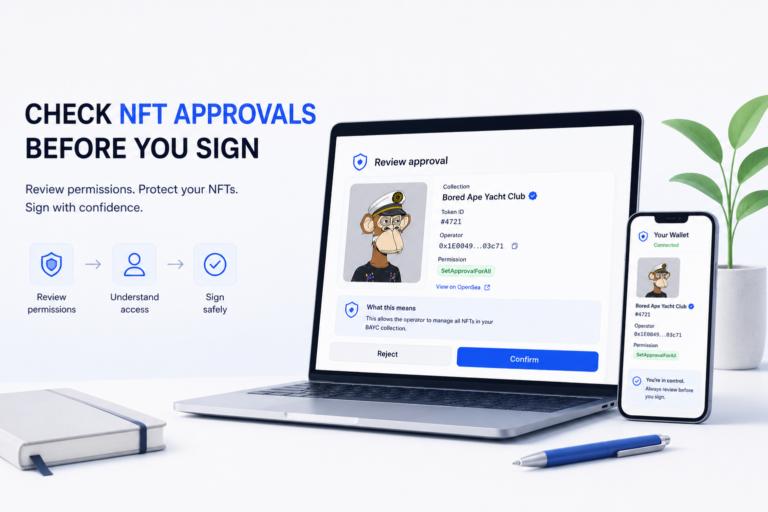
One of the most underestimated risks in crypto is signing transactions without understanding them.
Clicking “Confirm” feels trivial. But behind that click, the action can vary a lot.
Sometimes you’re just sending funds.
Other times, you’re granting permissions — and those permissions can persist long after the interaction is over.
In some cases, you’re effectively allowing a smart contract to access your tokens with no time limit.
The problem is that interfaces don’t always make this obvious.
A simple “Approve” button can represent a long-term authorization that stays active in the background.
Understanding this process is a key part of how to secure your crypto the right way over time.
A real-world example
You land on a website that looks exactly like a legitimate platform.
You connect your wallet.
You approve a transaction to interact with a token.
Nothing happens immediately.
Everything seems fine.
But what you actually did was grant that contract permission to access your tokens later.
Hours — or even days — pass. Then suddenly, the funds are gone.
No exploit. No vulnerability.
Just a permission being used exactly as it was granted.
Situations like this clearly show how to secure your crypto the right way is less about tools and more about understanding permissions.
Why approvals are often ignored
Approvals are part of normal DeFi usage, which is why most users stop paying attention to them.
But they don’t disappear.
They accumulate.
Over time, a user can interact with dozens of platforms, each leaving behind active permissions. Most of them are forgotten.
And that’s where the risk builds quietly.
Taking a few minutes to review and clean these approvals regularly can drastically reduce exposure — but it’s a habit very few people develop early.
The human factor behind most attacks
If you step back and look at how attacks actually happen, a pattern emerges.
They rarely start with code.
They start with context.
A message that looks like support.
A link that resembles an official website.
A situation that feels urgent.
The goal isn’t to break the system.
It’s to influence your decision.
That’s why one simple rule is incredibly effective:
👉 If something feels rushed, unexpected, or emotional — pause.
That moment of hesitation is often enough to prevent the mistake.
The seed phrase: the single point of failure
Everything in your setup ultimately depends on one thing.
Your seed phrase.
It’s not just an important element — it is full control over your wallet.
There’s no partial access. No recovery system. No fallback.
If someone gets it, they get everything.
That’s why the most critical mistakes often happen here.
Not because it’s complicated, but because people choose convenience over discipline.
Storing it digitally, taking screenshots, or keeping it in the cloud might feel easier. But it introduces unnecessary risk.
Keeping it offline, protected, and isolated remains the most reliable approach.
Building a simple security routine
Security doesn’t come from a single decision.
It comes from repetition.
You don’t need a complex system — you need a consistent one.
That might mean:
- occasionally checking your recent transactions
- taking a second to read what you’re signing
- keeping a clear separation between wallets
- avoiding unnecessary connections to unknown platforms
Over time, these actions become habits.
And once they become habits, your overall risk drops significantly.
Over time, these habits become the foundation of how to secure your crypto the right way in a sustainable way.
The role of hardware wallets
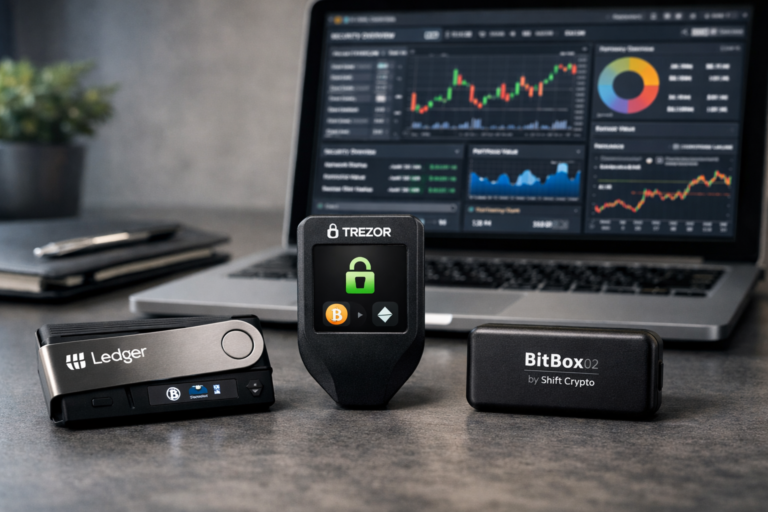
Hardware wallets such as Ledger are widely used because they keep private keys offline and require physical validation for transactions.
They significantly reduce exposure to remote attacks and add a strong layer of protection.
However, they are not a complete solution on their own.
If you sign a malicious transaction, even a hardware wallet will validate it.
Choosing the right device also depends on how you use your assets and what level of control you want over your setup.
If you want to go deeper on that, you can explore our detailed comparison of “Best Hardware Wallets Compared: Ledger vs Alternatives for Secure Crypto Storage“.
For users looking to add a strong layer of protection to their setup, hardware wallets like Ledger can be a practical starting point—especially when combined with proper usage and security habit.
A perspective from experienced users
There’s a pattern that experienced users tend to agree on.
Losses don’t usually come from a lack of tools.
They come from small decisions made without verification.
Over time, confidence builds. People click faster, check less, and assume things are safe.
And that’s usually when the mistake happens.
Conclusion
Learning how to secure your crypto the right way is not about eliminating risk entirel
That’s not realistic.
What matters is building a setup where one mistake doesn’t lead to total loss.
Separating storage from interaction.
Understanding what you approve.
Developing simple, repeatable habits.
In crypto, actions are irreversible.
And that’s exactly why structure matters.
FAQ
Is a hardware wallet enough to secure your crypto?
No. A hardware wallet significantly improves security by keeping private keys offline, but it does not protect against user mistakes such as signing malicious transactions or interacting with compromised platforms.
What is the biggest risk in crypto security today?
The biggest risk is user behavior. Most losses come from phishing, fake interfaces, or approvals that users do not fully understand—not from technical hacks.
How often should I review my wallet security?
A simple approach is to review your setup regularly. This includes checking recent transactions, verifying connected apps, and removing unnecessary permissions from time to time.
Are hot wallets unsafe?
Not necessarily. Hot wallets are useful for daily interactions, but they should not be used to store large amounts. The risk depends more on how they are used than on the wallet itself.
What is the safest way to store a seed phrase?
The safest approach is to keep it offline, written on a physical medium, and stored securely. Avoid storing it digitally or in cloud services.
Can I recover my crypto if I lose my seed phrase?
No. If you lose your seed phrase and no backup exists, access to your funds is permanently lost. Protecting your seed phrase properly is one of the most fundamental aspects of how to secure your crypto the right way.