Liquidity in crypto markets is often reduced to a simple idea: how easily an asset can be bought or sold. In practice, this definition hides a deeper structural reality.
What matters is not just whether liquidity exists, but how it behaves under stress, where it is concentrated, and what incentives sustain it.
This distinction becomes critical during volatile conditions, where apparent liquidity can vanish quickly, exposing underlying fragility.
Table of Contents
Liquidity Is Not Just Volume
A common misconception is equating liquidity with trading volume. While volume reflects activity, it does not necessarily indicate depth or resilience.
A token can show high daily volume while remaining structurally illiquid.
Why?
- Volume can be driven by short-term speculation
- Market makers can temporarily inflate activity
- Wash trading can distort perceived liquidity
In contrast, true liquidity depends on order book depth, capital distribution, and participant behavior.
This is why two assets with similar volume can react very differently to large orders.
The Structural Drivers of Liquidity
To understand liquidity in crypto markets, it’s essential to analyze the mechanisms behind capital allocation.
1. Incentive-Driven Liquidity
A significant portion of crypto liquidity is artificially bootstrapped through:
- liquidity mining programs
- token emissions
- yield incentives
These mechanisms attract capital—but often without long-term commitment.
The result is reactive liquidity, which tends to exit quickly when incentives decline.
2. Organic Liquidity
In contrast, organic liquidity emerges when users interact with a protocol because they need it:
- trading demand
- borrowing and lending
- stablecoin usage
This type of liquidity is more stable and less sensitive to short-term changes.
The challenge is that both forms can coexist—and appear identical when measured superficially.
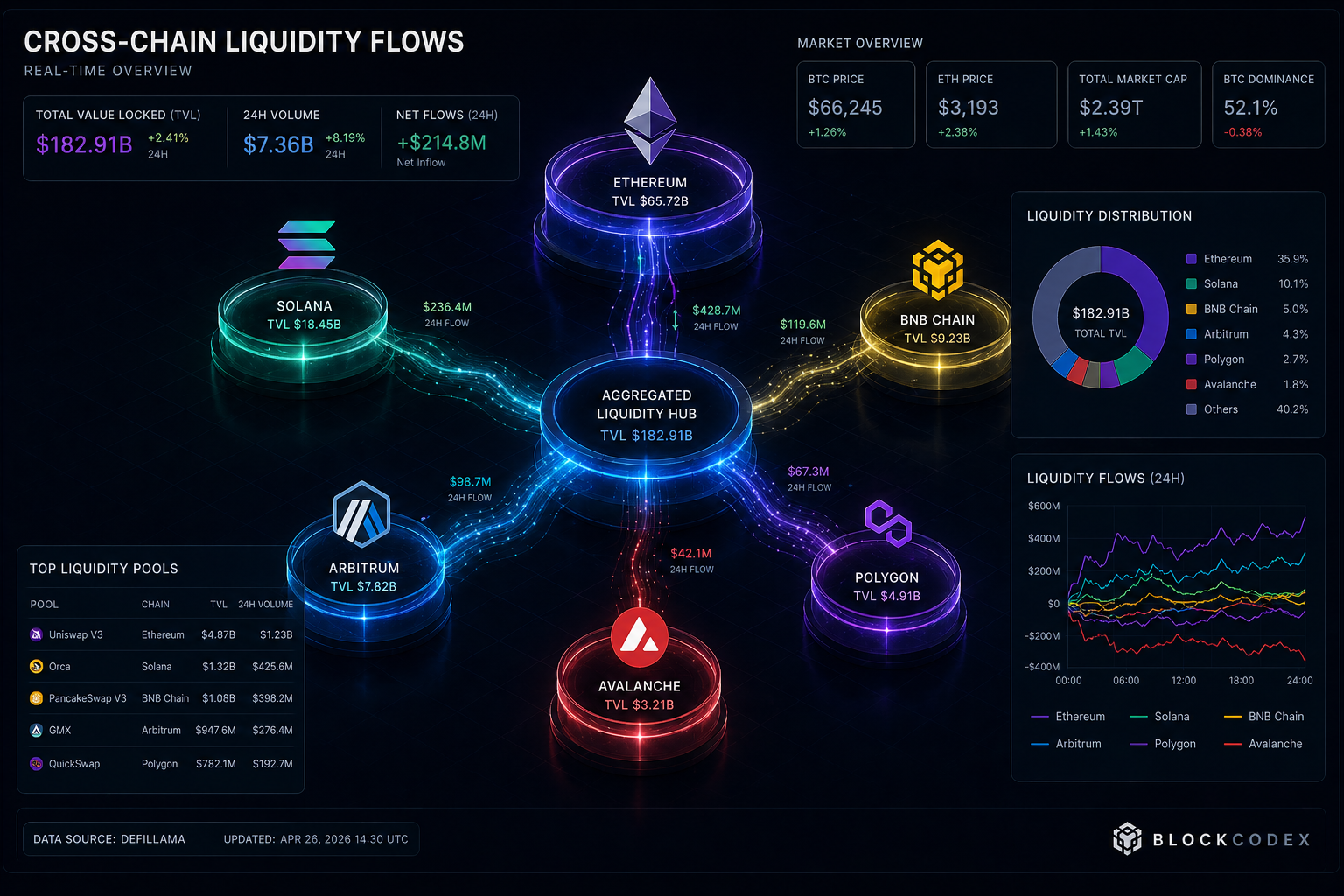
Liquidity Fragmentation Across Chains
One overlooked aspect of liquidity in crypto markets is fragmentation.
Capital is distributed across:
- multiple blockchains
- centralized exchanges
- decentralized protocols
This creates inefficiencies.
For example, liquidity available on one chain cannot always be accessed from another without bridges, which introduces friction and risk.
This fragmentation means that total market liquidity is often overstated, as it is not fully interoperable.
What On-Chain Data Reveals About Liquidity
On-chain data provides a more accurate view of how liquidity behaves.
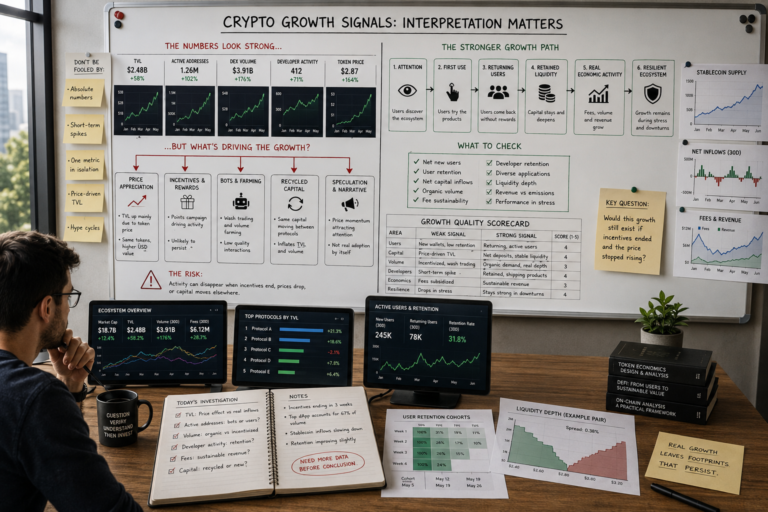
Metrics such as Total Value Locked (TVL) are often used as proxies, but they require context.
According to DeFiLlama analytics dashboard, total value locked (TVL) tracks the aggregate value of assets deposited in DeFi protocols, but this metric often reflects both price fluctuations and incentive-driven capital rather than pure liquidity.
This distinction is critical.
A rise in TVL does not always indicate increased liquidity—it may simply reflect asset appreciation.
For a deeper breakdown of how these metrics should be interpreted, see our guide on: “How to Read TVL in Crypto: What It Really Signals About Capital and Risk.”
Liquidity Under Stress: Where Misconceptions Break
Liquidity is most revealing during market stress.
In stable conditions, markets appear liquid. But during downturns:
- spreads widen
- slippage increases
- order books thin out
This exposes a key reality:
Liquidity is conditional, not constant.
During sharp market moves, participants withdraw, and capital concentration becomes a risk factor.
This is particularly visible in smaller-cap assets, where a few large holders can significantly impact price.
Hidden Liquidity Risks Most Investors Ignore
Liquidity Illusion
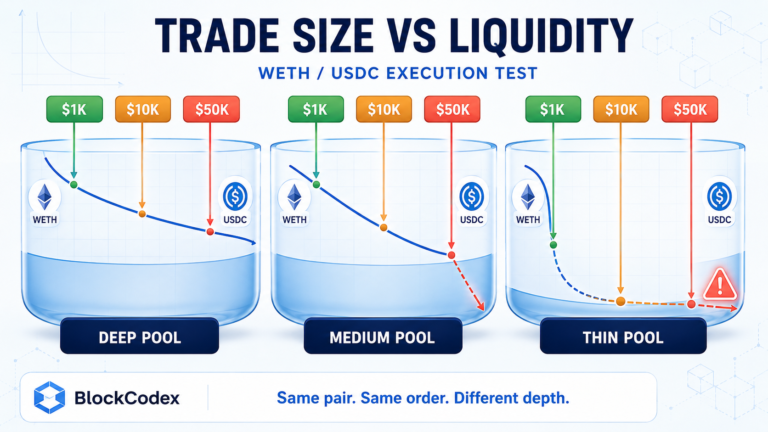
Displayed liquidity (order books, pools) does not always translate into executable liquidity.
Large trades can still move the market significantly.
Concentration Risk
If liquidity is provided by a small number of actors:
- exit risk increases
- volatility amplifies
This is especially relevant in DeFi pools dominated by a few wallets.
Incentive Dependency
Liquidity tied to rewards is inherently unstable.
When incentives decline:
- capital exits
- spreads widen
- protocols weaken
This dynamic is closely linked to token design, as explored in: “7 Powerful Ways to Read Tokenomics Like an Analyst in 2026.”
Liquidity vs Market Structure
Liquidity cannot be separated from market structure.
Crypto markets differ from traditional finance in key ways:
- lower regulation
- higher retail participation
- fragmented infrastructure
This leads to:
- faster liquidity shifts
- higher reflexivity
- more pronounced cycles
For example, liquidity can expand rapidly during bullish phases, then contract sharply as sentiment reverses.
This behavior reinforces volatility and creates feedback loops between price and liquidity.
Practical Interpretation: Reading Liquidity Signals
To interpret liquidity in crypto markets effectively, investors should focus on relationships rather than isolated metrics.
Key Signals to Monitor
- Liquidity vs volume → indicates efficiency
- Liquidity vs incentives → reveals sustainability
- Liquidity distribution → highlights concentration risk
Example
| Scenario | Interpretation |
|---|---|
| High liquidity + high volume | Strong market participation |
| High liquidity + low volume | Idle or inefficient capital |
| Low liquidity + high volume | Potential volatility and slippage |
| Declining liquidity | Risk-off environment |
Implications for Investors
Understanding liquidity provides a structural edge.
Instead of focusing on surface metrics, investors should ask:
- Is liquidity stable or incentive-driven?
- How concentrated is capital?
- Can liquidity absorb large trades?
These questions are more predictive of market behavior than price trends alone.
Conclusion
Liquidity in crypto markets is often misunderstood because it is measured superficially.
In reality, liquidity reflects capital behavior, incentive structures, and market conditions.
It is not static, and it cannot be evaluated through a single metric.
Investors who understand how liquidity forms—and how it breaks—gain a significant advantage, particularly during volatile phases.
The key is to shift perspective:
Not where liquidity is,
but why it is there—and how long it will remain.