Whale activity is one of the most watched signals in crypto — and one of the easiest to misunderstand.
A large wallet moving funds can trigger speculation within minutes. Social accounts post “whale alert” screenshots, traders react, and narratives form quickly. But a large transaction alone does not explain intent.
A whale transfer can mean many things:
- exchange deposit before selling
- custody reshuffling
- OTC settlement
- internal exchange movement
- collateral management
- DeFi liquidity deployment
- long-term accumulation
- distribution into market demand.
That is why learning how to analyze whale activity requires more than tracking big wallet movements. The real edge comes from understanding context: where funds move, which wallet type is involved, whether flows reach exchanges, and how activity compares with liquidity and market structure.
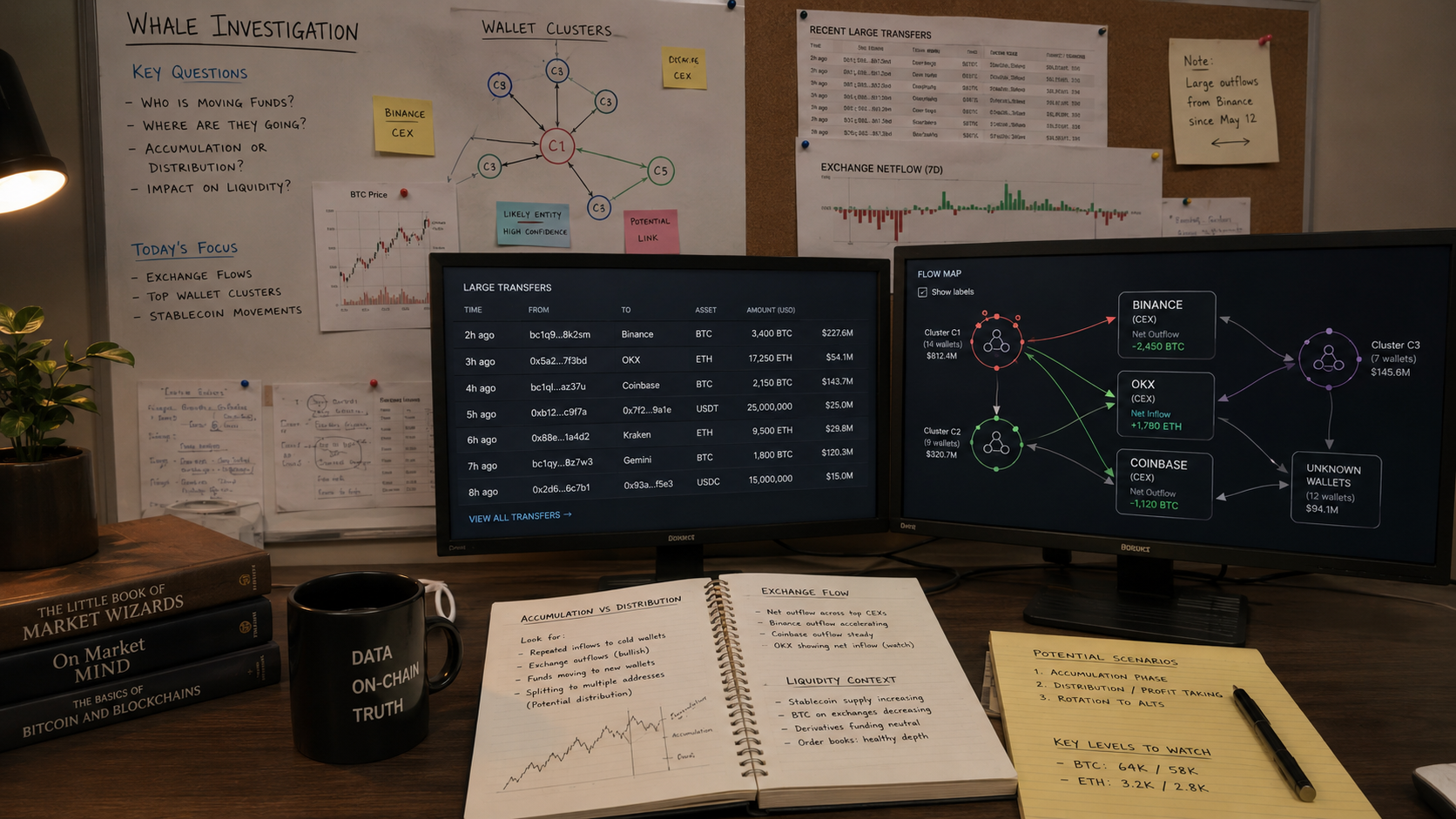
To analyze whale activity properly, investors need to connect large transfers with exchange flows, wallet labels, and liquidity conditions.
Whales matter because they can influence supply, liquidity, and sentiment. But the goal is not to panic every time a large wallet moves. The goal is to separate meaningful capital shifts from noise.
Table of Contents
Why Whale Activity Matters in Crypto Markets
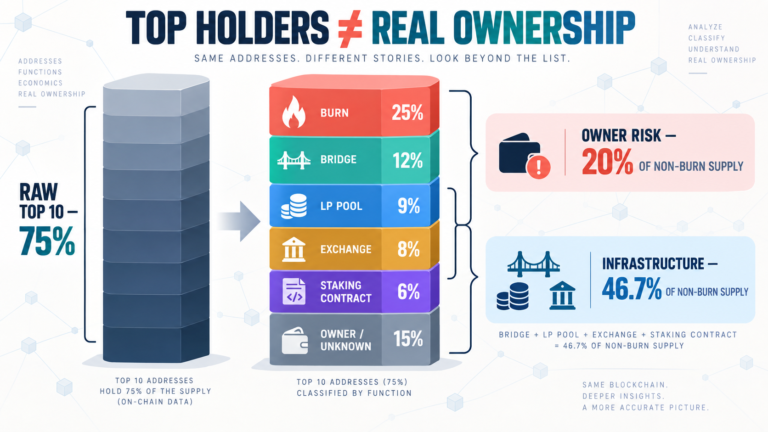
Whales matter because crypto markets are still relatively concentrated compared with many traditional financial markets. Large wallets can influence liquidity, order books, token distribution, and market psychology.
But not all whale activity is directional.
Glassnode’s Bitcoin whale methodology separates whale behavior by large-balance cohorts and explains that positive balance change in the 1k–10k BTC group can suggest accumulation, while negative balance change can indicate distribution or a pause in accumulation.
That distinction is important.
A whale moving coins is not the same as a whale selling. A whale increasing exchange balances is not the same as a whale accumulating in cold storage. A large transaction is only useful when interpreted through a behavioral framework.
For investors, whale activity becomes valuable when it answers three questions:
- Who is moving capital?
- Where is it going?
- Does it change market liquidity or supply pressure?
Without those answers, whale tracking becomes entertainment rather than analysis.
Signal 1: Exchange Inflows vs Exchange Outflows
The first signal to analyze is whether whale funds are moving toward or away from exchanges.
Glassnode provides whale exchange flow metrics that track Bitcoin inflow and outflow volumes associated with whale entities, defined as wallets with 1,000+ BTC aggregate on-chain balance.
This matters because exchange inflows and outflows often carry different implications.
| Whale Movement | Possible Interpretation |
|---|---|
| Whale inflow to exchanges | Potential sell-side pressure or collateral movement |
| Whale outflow from exchanges | Potential accumulation or custody withdrawal |
| Whale net inflow rising | Higher supply available to trade |
| Whale net outflow rising | Lower liquid supply on exchanges |
Exchange inflows do not guarantee selling. Whales may deposit funds for collateral, market-making, hedging, or OTC settlement. But persistent inflows during weak liquidity conditions can increase downside risk.
Similarly, exchange outflows do not guarantee bullish accumulation. They can reflect custody changes or institutional storage.
The strongest signal appears when whale exchange flows align with price, volume, and liquidity conditions.
Signal 2: Wallet Clustering and Entity Labels
One wallet address rarely tells the full story.
Sophisticated actors often control multiple addresses. Exchanges hold funds across clusters. Market makers operate through many wallets. Protocol treasuries may move funds between operational accounts.
That is why wallet labeling matters.
Nansen describes its platform as using on-chain intelligence to analyze wallet flows and key metrics, while its smart money tracking content focuses on wallet profiling, labeled wallets, and capital movement analysis.
This matters because the same transaction can mean different things depending on the entity.
For example:
- a transfer from a project treasury may indicate ecosystem funding
- a transfer from an exchange wallet may be internal reshuffling
- a transfer from a VC-labeled wallet may suggest unlock-related distribution
- a transfer from a DeFi whale may signal yield rotation
- a transfer from a known smart money wallet may indicate strategic positioning.
The insight is simple:
Whale identity changes the meaning of whale activity.
A large transfer without wallet context is incomplete information.
Signal 3: Accumulation vs Distribution Patterns
Whale analysis becomes more useful when it tracks behavior over time.
One large transaction may be noise. A repeated pattern can become a signal.
Accumulation may appear as:
- repeated exchange withdrawals
- rising wallet balances
- transfers to cold storage
- steady purchases during pullbacks
- reduced selling into price weakness.
Distribution may appear as:
- repeated exchange deposits
- declining whale balances
- selling into strength
- transfers after unlock events
- stablecoin rotation after token exits.
Glassnode’s whale cohort analysis highlights the importance of balance change across whale groups rather than focusing on isolated transfers. In its guide, Glassnode notes that different whale sub-groups can behave differently, with one cohort accumulating while another distributes.
That nuance matters.
“Whales are buying” or “whales are selling” is usually too simplistic.
Different whale categories can have different motivations:
- early holders
- miners or validators
- market makers
- venture funds
- protocol treasuries
- exchange entities
- DeFi yield allocators.
The strongest analysis separates these groups instead of treating whales as one unified actor.
Signal 4: Whale Activity Around Token Unlocks
Token unlocks can change whale behavior quickly.
When vested tokens become liquid, early investors, teams, contributors, or treasury wallets may gain the ability to move assets. That does not mean they will immediately sell, but it increases the importance of tracking wallet flows.
Key questions include:
- Are unlock-related wallets moving tokens to exchanges?
- Are tokens being transferred to custody wallets?
- Is liquidity deep enough to absorb potential selling?
- Is price reacting before or after the unlock?
- Are large holders distributing gradually or suddenly?
Whale activity around unlocks is especially important for smaller or mid-cap tokens, where liquidity may not be deep enough to absorb large flows.
For a deeper framework, see BlockCodex’s guide: “7 Powerful Insights on How Token Unlocks Impact Price and Market Behavior.”
The point is not to assume every unlock is bearish.
The point is to monitor whether newly liquid supply actually moves toward markets.
Signal 5: Whale Activity vs Liquidity Conditions
Whale movements matter more when liquidity is thin.
A large transfer during deep market liquidity may have little impact. The same transfer during weak liquidity can create significant volatility.
This is why whale analysis must be combined with:
- order book depth
- DEX pool liquidity
- bid-ask spreads
- slippage
- stablecoin liquidity
- exchange volume quality.
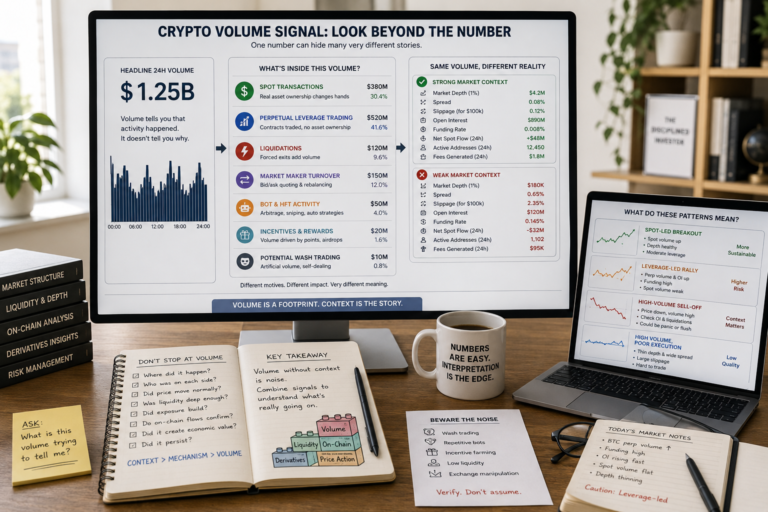
Chainalysis’ 2025 market manipulation research shows how suspicious trading activity can distort perceived market liquidity, including suspected wash trading across select blockchains. The report notes that suspected wash trading may account for up to $2.57 billion in trading volume.
This is relevant because whale activity can look more meaningful when volume is inflated or liquidity is weaker than advertised.
A whale selling into real liquidity is different from a whale selling into shallow markets with artificial volume.
For context, see BlockCodex’s article: “Fake Volume in Crypto: 7 Powerful Signals Investors Should Watch”
Signal 6: Smart Money Is Not Always Smart
Many investors assume that smart money wallets are always correct.
That is dangerous.
Wallet labels can identify sophisticated actors, but they do not guarantee future performance. A fund wallet may sell for mandate reasons. A market maker may move inventory. A profitable trader may hedge. A whale may be early, late, or wrong.
Nansen’s own smart money content emphasizes tracking wallet behavior and accumulation patterns, but the value comes from context rather than copying trades blindly.
The better approach is to ask:
- Is the wallet historically profitable?
- Is the movement repeated or isolated?
- Is the wallet accumulating or rotating?
- Is the asset liquid enough?
- Are other smart wallets doing the same?
- Does the thesis match broader market conditions?
Smart money tracking is useful when it confirms a broader thesis. It becomes risky when it replaces independent analysis.
Signal 7: Whale Alerts Need Filtering
Real-time whale alerts are useful, but they are only the first layer.
Ledger’s educational guide notes that Whale Alert is a widely recognized real-time blockchain transaction tracker that monitors major chains for large-value transfers and often tags known addresses.
That type of alert helps investors notice large movements quickly.
But alerts should be filtered.
A useful workflow:
- Identify the transaction.
- Check whether it involves an exchange, treasury, bridge, or unknown wallet.
- Check whether the movement is part of a larger pattern.
- Compare with price and liquidity conditions.
- Check whether related wallets are moving too.
- Avoid reacting until context is clear.
The mistake is treating every alert as a market signal.
Most alerts are information. Only some become actionable signals.
How to Analyze Whale Activity with a Practical On-Chain Framework
A structured whale activity workflow should look like this:
| Step | Question | Why It Matters |
|---|---|---|
| Identify wallet type | Exchange, whale, treasury, VC, smart money? | Context changes interpretation |
| Check direction | To exchange or from exchange? | Indicates possible supply pressure |
| Compare over time | One transfer or repeated pattern? | Patterns matter more than alerts |
| Review liquidity | Can market absorb the flow? | Determines price impact |
| Check related wallets | Is this isolated or coordinated? | Reduces false signals |
| Compare with catalysts | Unlock, listing, exploit, news? | Explains timing |
| Avoid copying blindly | Is the thesis valid? | Prevents reactive trading |
The goal is to move from “a whale moved funds” to “this movement may affect liquidity, supply, or market structure because…”
That sentence is where real analysis begins.
Using Nansen for Wallet Behavior Analysis
Whale activity is difficult to analyze manually because wallets are fragmented, labels are incomplete, and large actors often use multiple addresses.
This is where an analytics platform like Nansen can fit naturally into the workflow.
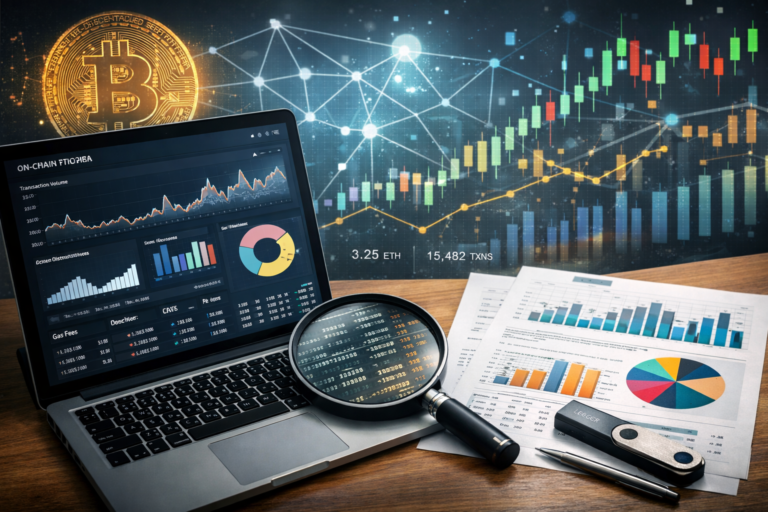
Nansen can help investors monitor wallet behavior, labeled entities, smart money movements, token flows, and accumulation patterns across on-chain ecosystems. It does not eliminate uncertainty, but it reduces blind spots when trying to understand whether whale activity is isolated, coordinated, or part of a broader capital rotation.
A natural affiliate integration could be:
For investors who regularly analyze whale activity, Nansen can be useful as a wallet intelligence layer because it adds labels, flow tracking, and smart money context that simple blockchain explorers often miss.
The key is to position Nansen as a research tool, not a trading signal machine.
For a broader workflow, see BlockCodex’s guide: “Best Crypto Portfolio Tracking Setups: 7 Practical Frameworks for Real Control”.
Conclusion
Learning how to analyze whale activity is not about reacting to every large transfer.
It is about understanding capital behavior.
The best way to analyze whale activity is to treat each large movement as a clue, not as a standalone signal.
A whale movement becomes meaningful only when investors know who is moving funds, where the funds are going, whether the activity is repeated, and whether market liquidity can absorb the flow.
The best whale analysis combines:
- exchange flows
- wallet labels
- accumulation and distribution patterns
- token unlock context
- liquidity depth
- smart money behavior
- real-time alerts.
Whales can influence markets, but whale alerts alone are not a strategy.
The real edge comes from context.
In crypto, large transactions create noise.
On-chain analysis turns that noise into a useful signal.