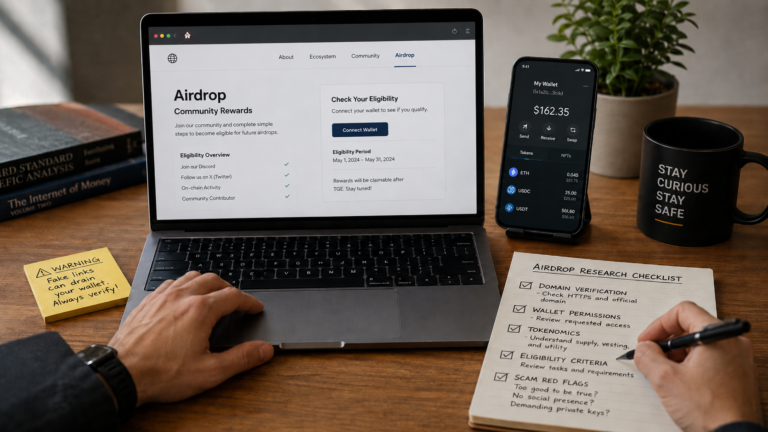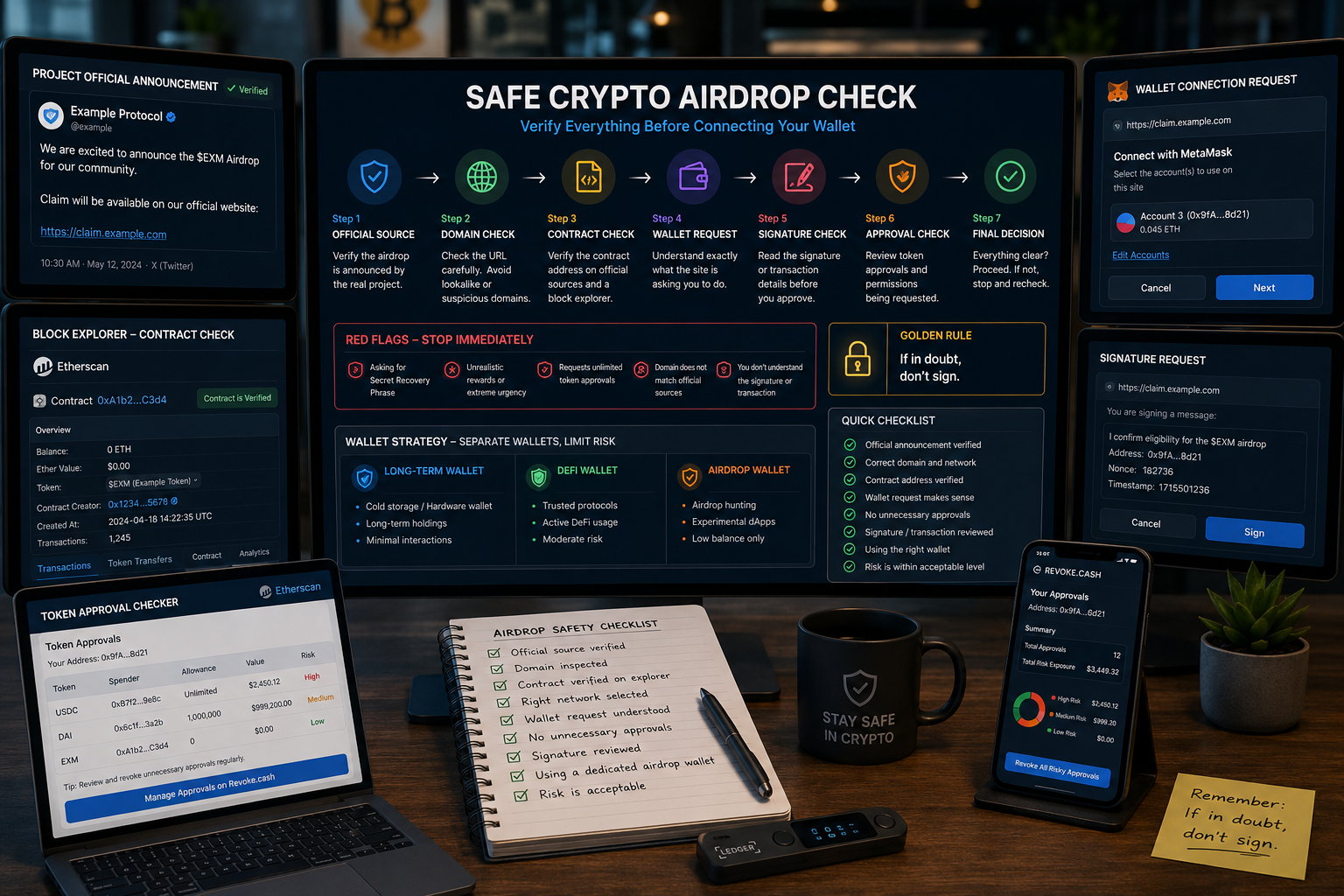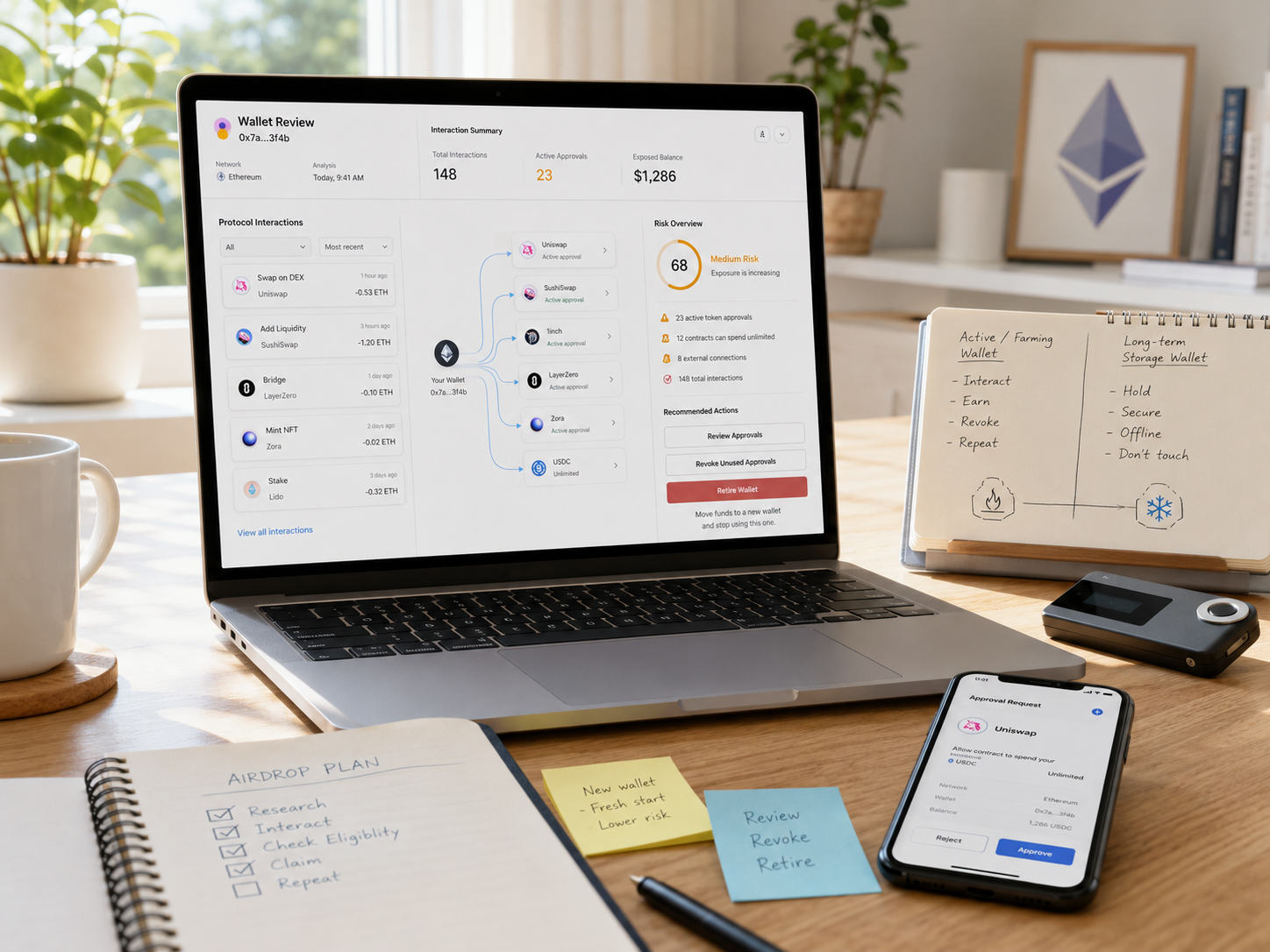
An airdrop wallet is not a lucky wallet.
It is not the wallet that “gets free tokens.” It is not a place where investors should keep long-term holdings, valuable NFTs, stablecoins, or serious DeFi positions.
A better way to think about it is this:
An airdrop wallet is a quarantine zone for uncertain crypto interactions.
That framing changes everything.
Airdrops live in one of the strangest corners of crypto. Some campaigns are legitimate rewards for early users. Others are low-quality marketing. Some are badly executed. Some are phishing traps. Some exist only to push users into signing something they do not understand.
The opportunity can be real, but the environment is noisy.
That is why using a main wallet for airdrop claims is a weak security habit. It turns every claim page, eligibility checker, testnet interaction, and unknown dApp into a portfolio-level risk.
An airdrop wallet creates distance.
It gives the investor a dedicated place to explore higher-risk opportunities without exposing the wallet that holds long-term assets. It does not make scams harmless, and it does not remove the need to verify domains, contracts, signatures, and approvals. But it limits the damage if one interaction goes wrong.
MetaMask warns that fraudulent airdrop sites are commonly used in phishing campaigns, while Ledger describes fake airdrops as scams where attackers may distribute worthless tokens or imitate legitimate campaigns to move users toward malicious claim flows.
That is the real reason airdrop wallets matter.
They are not about chasing more airdrops.
They are about making sure one bad airdrop does not reach the rest of the portfolio.
Table of Contents
The Better Way to Think About an Airdrop Wallet
Most investors describe an airdrop wallet as a “separate wallet for claims.”
That definition is technically correct, but it misses the point.
An airdrop wallet is better understood as a risk container.
It is the wallet you use when you are not fully certain about the environment. Maybe the project is new. Maybe the claim page is legitimate, but the contract is unfamiliar. Maybe you are testing a new ecosystem. Maybe you are checking eligibility for a campaign that could be real, but you do not want your main wallet anywhere near it.
This does not mean the wallet should be used carelessly. It means the wallet is designed with the assumption that higher-risk activity will happen there.
That assumption is important.
A long-term wallet should be boring. It should not connect to random claim pages or sign messages for new protocols. A DeFi wallet may accept more interaction, but it should still be reserved for protocols the user intentionally uses. An airdrop wallet sits in a different category. It is built for limited exposure, frequent verification, small balances, and easy cleanup.
This is why an airdrop wallet fits naturally inside a broader wallet separation strategy. BlockCodex explains this structure in “Wallet Separation in Crypto“, where each wallet has a specific job instead of one address doing everything.
A wallet with one job is easier to defend than a wallet with ten jobs.
An Airdrop Wallet Is About Blast Radius
Security people often talk about “blast radius.”
In simple terms, it means the damage caused when something fails.
If a small test wallet signs a bad approval, the blast radius is small. If a wallet holding long-term assets, NFTs, stablecoins, and DeFi positions signs the same approval, the blast radius becomes much larger.
That is the main argument for an airdrop wallet.
The question is not only:
“Is this airdrop safe?”
The better question is:
“If this interaction is unsafe, what can it reach?”
That question is much more practical.
No investor can perfectly verify every front end, every contract, every signature request, and every project announcement. Even careful users can be rushed, tired, distracted, or manipulated by urgency. The wallet structure should account for that.
An airdrop wallet does not guarantee a good decision.
It makes a bad decision less expensive.
What Should Actually Belong in an Airdrop Wallet?
An airdrop wallet should hold only what it needs to do its job.
That usually means a small gas balance, small amounts for low-risk ecosystem activity, and perhaps minor positions required for eligibility experiments. It should not hold assets that would hurt to lose.
A practical airdrop wallet may contain:
- Small gas balances.
- Small testing amounts.
- Low-value tokens used for ecosystem interaction.
- Claim-related rewards before they are moved elsewhere.
- No major long-term holdings.
- No valuable NFTs.
- No large stablecoin balance.
- No assets that would create emotional pressure if compromised.
This is not about paranoia. It is about matching funds to risk.
A wallet used for claim pages should not look like a savings account. If the wallet balance makes you nervous, it is probably too high for that wallet’s purpose.
A useful rule is simple: An airdrop wallet should be cheap to abandon.
If a wallet becomes too valuable to abandon, it has stopped being an airdrop wallet. At that point, it needs to be cleaned, reduced, or replaced.
What Should Never Happen From an Airdrop Wallet?
Airdrop wallets are useful only if their purpose stays clear.
A dedicated claim wallet should not slowly become a second main wallet. That happens more often than investors admit. A user creates a wallet for airdrops, receives a few tokens, adds more funds for gas, starts using it for DeFi, keeps rewards there, and eventually forgets that the wallet was supposed to be high-risk.
That drift is dangerous.
An airdrop wallet should not be used for:
- Long-term holdings.
- Cold storage.
- Major DeFi positions.
- Large stablecoin balances.
- Valuable NFTs.
- Main identity activity.
- Salary, treasury, or business funds.
- Anything that should not be exposed to experimental interactions.
This is where discipline matters more than tooling.
The wallet is only useful if the user respects its role.
The Four-Wallet Map
A simple investor setup can be built around four wallet roles.
| Wallet Type | Purpose | Interaction Level |
|---|---|---|
| Cold wallet | Long-term holdings and assets that should rarely move. | Very low |
| DeFi wallet | Established protocols and intentional capital deployment. | Moderate |
| Airdrop wallet | Claims, eligibility checks, new ecosystems, testnet-style activity. | High |
| Test wallet | Unknown dApps, suspicious links, disposable experiments. | Very high |
Not every investor needs this full setup from day one.
A beginner may start with two wallets: one for long-term assets and one for airdrop or experimental activity. That alone is better than using one wallet for everything.
As activity increases, the structure can become more precise. The goal is not to create a confusing wallet maze. The goal is to make sure each wallet has a clear reason to exist.
The more valuable the assets, the lower the interaction level should be.
7 Smart Rules for Using an Airdrop Wallet
1. Give the Wallet a Job Description
Every wallet should have a job.
The job of an airdrop wallet is to interact with claim pages, eligibility tools, early protocols, and ecosystem tests with limited funds. That purpose should be clear enough that the user can decide quickly whether an action belongs there.
When a wallet has no job description, it slowly becomes a junk drawer.
It holds a bit of everything, signs a bit of everything, and eventually becomes impossible to reason about. That is exactly what wallet separation is supposed to prevent.
Before connecting, ask: Is this the right wallet for this action?
If the answer is unclear, stop.
2. Keep the Wallet Small Enough to Lose
This is the uncomfortable rule, but it is the most honest one.
An airdrop wallet should never contain more than the user is willing to lose in a worst-case mistake.
That does not mean losses are acceptable. It means the wallet is designed around realistic risk. Claim activity can involve unknown sites, signatures, approvals, and experimental protocols. The wallet balance should reflect that uncertainty.
If an airdrop wallet holds meaningful long-term capital, it is no longer reducing risk. It is only creating the illusion of organization.
3. Move Valuable Rewards Out
A successful airdrop can change the wallet’s risk profile.
A wallet that was once low-value may suddenly receive tokens worth real money. At that moment, the wallet should be reviewed.
The reward does not need to stay in the same address forever.
A practical workflow is to claim rewards, verify the transaction, review approvals, then move meaningful value to a safer wallet when appropriate. The airdrop wallet can keep small operational funds, but it should not become a storage wallet just because one campaign worked.
Rewards should graduate out of the high-risk environment.
Dust can stay. Value should be protected.
4. Do Not Fund It Carelessly From Cold Storage
Funding patterns matter.
If an airdrop wallet is directly funded from a cold wallet holding long-term assets, the two addresses may become easier to associate publicly. This does not create a direct technical compromise by itself, but it reduces separation from a privacy and operational perspective.
Airdrop wallets are not perfect privacy tools. On-chain behavior can still link addresses through timing, funding sources, bridge routes, exchange withdrawals, ENS names, NFT transfers, and repeated habits.
Still, avoid making the link obvious when there is no need.
The basic idea is simple: do not turn wallet separation into wallet theater.
The structure should reduce exposure, not just create more addresses.
5. Treat Approvals Like Open Doors
Airdrop activity often creates approvals or permissions that users forget about.
That is risky because token approvals can allow a dApp or contract to spend approved tokens depending on the allowance granted. MetaMask explains that token approvals give dApps permission to access or move specific tokens, and Revoke.cash describes approvals as permissions that can remain active until revoked.
An airdrop wallet makes approval cleanup easier because the wallet’s history should be narrower.
After a claim, check whether anything new was approved. If the approval is unnecessary, suspicious, or no longer needed, revoke it through a relevant approval checker such as Revoke.cash or the approval checker on a block explorer. Revoke.cash supports approval review and revocation across more than 100 networks.
Disconnecting a site is not the same as revoking token approvals.
This is one of the most common misunderstandings in wallet security.
6. Keep Notes Instead of Trusting Memory
Airdrop hunters often interact with many protocols over time.
After a few months, it becomes difficult to remember which wallets were used, which campaigns were tested, which networks were bridged to, which approvals were granted, and which rewards were claimed.
A small research note can prevent confusion.
Track simple details:
| Item | Why It Helps |
| Protocol tested | Avoids repeating unclear interactions. |
| Wallet used | Keeps activity mapped. |
| Network | Helps review approvals and balances later. |
| Claim date | Helps reconstruct activity. |
| Contract or claim link | Helps verify what happened. |
| Post-claim action | Shows whether rewards were moved or approvals reviewed. |
This does not need to be complicated.
A simple spreadsheet or note is enough.
The point is to avoid turning airdrop activity into a blur of disconnected transactions.
For a broader airdrop research process, see BlockCodex’s guide on How to Find Legit Crypto Airdrops.
7. Retire Dirty Wallets
Some wallets should not be cleaned forever.
If an airdrop wallet has connected to too many unknown sites, accumulated confusing approvals, received suspicious tokens, interacted with questionable contracts, or become difficult to audit, it may be better to retire it.
Retiring does not mean throwing away access. It means stopping new activity from that wallet, moving legitimate value elsewhere, and treating the address as historical.
This is a useful habit because airdrop wallets can become messy over time.
A fresh wallet with a clear purpose is often safer than an old wallet with years of unclear interactions.
The goal is not to maintain one airdrop wallet forever.
The goal is to maintain a clean risk boundary.
Airdrop Wallet vs Test Wallet
An airdrop wallet and a test wallet are close, but they are not identical.
An airdrop wallet is for campaigns that appear potentially legitimate after basic verification. It may be used for official claim pages, eligibility checks, or known ecosystems where the user wants limited exposure.
A test wallet is for interactions where trust is much lower.
If the site is unknown, the contract is unclear, the claim is suspicious, or the user is only exploring, a test wallet is more appropriate. It should hold almost nothing.
| Wallet | Best Use |
| Airdrop wallet | Claim pages and eligibility checks that have passed basic verification. |
| Test wallet | Unknown links, suspicious pages, very early dApps, or disposable experiments. |
This distinction keeps the airdrop wallet from becoming too risky.
Not every claim deserves the same wallet.
A Realistic Airdrop Wallet Workflow
A practical workflow is more useful than a perfect theory.
Before interacting with a claim page, start from the official project source instead of a random link. Check the domain carefully, compare the claim route with official documentation, and confirm whether the campaign is real.
Then choose the wallet.
If the claim is from a known project and the domain checks out, the airdrop wallet may be appropriate. If the claim is unclear or suspicious, use a test wallet or do not interact at all.
When the wallet prompt appears, slow down.
Check what the site is asking for. A simple claim transaction is different from a token approval, NFT permission, permit-style signature, or message you cannot interpret. If the request does not match the purpose of the claim, stop.
After the interaction, review what changed.
Check the transaction, approvals, balances, and any received tokens. If the reward has meaningful value, move it to a safer wallet. If a permission is unnecessary, revoke it. If the wallet now feels messy, retire it and start clean for future campaigns.
This workflow may feel slower than simply clicking “Claim.”
That is the advantage.
Scams benefit from speed.
Security benefits from friction.
The Biggest Mistake: Using Wallet Separation as an Excuse to Click Faster
There is one trap with airdrop wallets.
Because the wallet holds limited funds, users may become careless. They may connect faster, sign faster, approve faster, and stop verifying details because “it is only the airdrop wallet.”
That defeats the purpose.
An airdrop wallet is not permission to ignore security.
It is a second line of defense.
The first line remains judgment: verifying sources, checking domains, reading wallet requests, understanding approvals, and avoiding interactions that do not make sense.
Airdrop wallets reduce consequences.
They do not improve bad decisions automatically.
This distinction is important enough to repeat: a wallet structure can contain risk, but it cannot think for the user.
When an Airdrop Wallet Is Not Enough
An airdrop wallet does not protect against every mistake.
It will not help if the user enters a Secret Recovery Phrase on a phishing site. It will not make a malicious transaction safe. It will not guarantee that a contract is legitimate. It will not automatically remove approvals. It will not prevent a user from sending funds to the wrong address.
Ledger warns users never to validate a transaction they did not initiate and notes that phishing campaigns may try to trick users into downloading fake apps or approving malicious actions.
Airdrop wallets should therefore be part of a broader security stack that includes official-source verification, domain checks, approval review, wallet separation, hardware storage for long-term assets, and careful transaction review.
BlockCodex covers the broader framework in “Best Ways to Secure Crypto Without Overcomplicating It“.
The wallet is one layer. The process is the real defense.
Common Airdrop Wallet Mistakes
Keeping Too Much Value in the Wallet
If losing the wallet would be financially painful, it holds too much.
Forgetting to Move Valuable Rewards
A successful claim can turn a low-risk wallet into a high-value target.
Mixing Airdrops With DeFi Positions
The wallet becomes harder to audit when it does too many jobs.
Ignoring Old Approvals
An old approval can remain active long after the claim is forgotten.
Using the Same Wallet Forever
Airdrop wallets can become messy. Some should be retired.
Treating Unexpected Tokens as Real Rewards
Unexpected tokens or NFTs can be used to push users toward phishing sites. MetaMask warns that unsolicited tokens and NFTs can redirect users toward deceptive websites or scam interactions.
Believing the Airdrop Wallet Makes Everything Safe
It limits exposure, but it does not verify the interaction for you.
Final Thoughts
An airdrop wallet is one of the simplest ways to make airdrop activity less dangerous.
Not because it makes airdrops safe, and not because it guarantees better decisions. It works because it changes the structure of risk. It keeps claim pages, eligibility checks, early protocols, and experimental interactions away from the wallet that holds long-term assets.
That separation matters.
The best airdrop wallet is small, focused, easy to review, and cheap to abandon. It holds only what it needs, signs only what makes sense, and gets cleaned or retired when its history becomes too messy. Valuable rewards should move out. Unnecessary approvals should be revoked. Suspicious claim pages should be ignored, not tested with more confidence.
Airdrops can be useful opportunities, but they should never make investors lower their security standards.
The wallet used for the claim is part of the decision.
If the reward is uncertain, the wallet exposure should be limited.
That is the real value of an airdrop wallet.