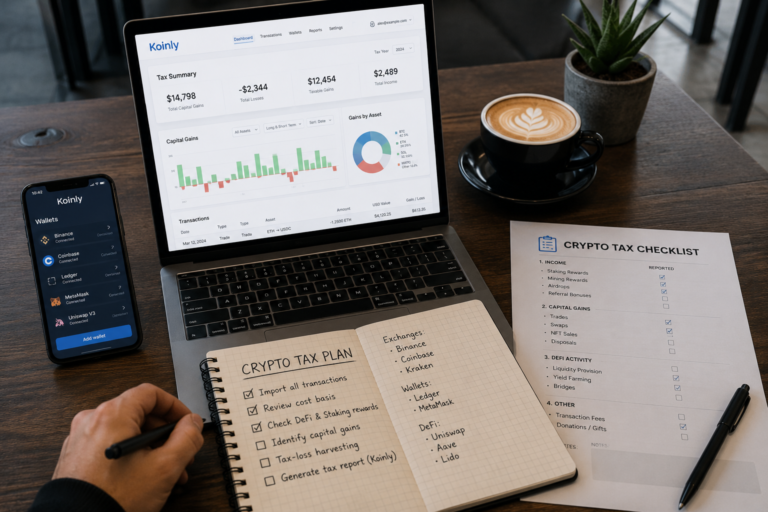
Koinly portfolio tracking is most useful when a crypto portfolio has become too fragmented to manage comfortably by hand.
A simple portfolio may begin with one exchange account and a few long-term holdings. Over time, the structure often becomes more complicated. Assets move to self-custody wallets, trades happen across several exchanges, tokens are bridged between networks, staking rewards arrive, DeFi positions are opened, and transaction history becomes spread across multiple platforms.
The problem is not necessarily knowing how much BTC or ETH is currently worth. Most market apps can show that.
The harder problem is reconstructing the complete history behind the portfolio: where assets came from, how much was originally invested, which transfers were internal, which transactions created gains or income, and whether all wallets and exchanges are represented correctly.
That is where Koinly fits.
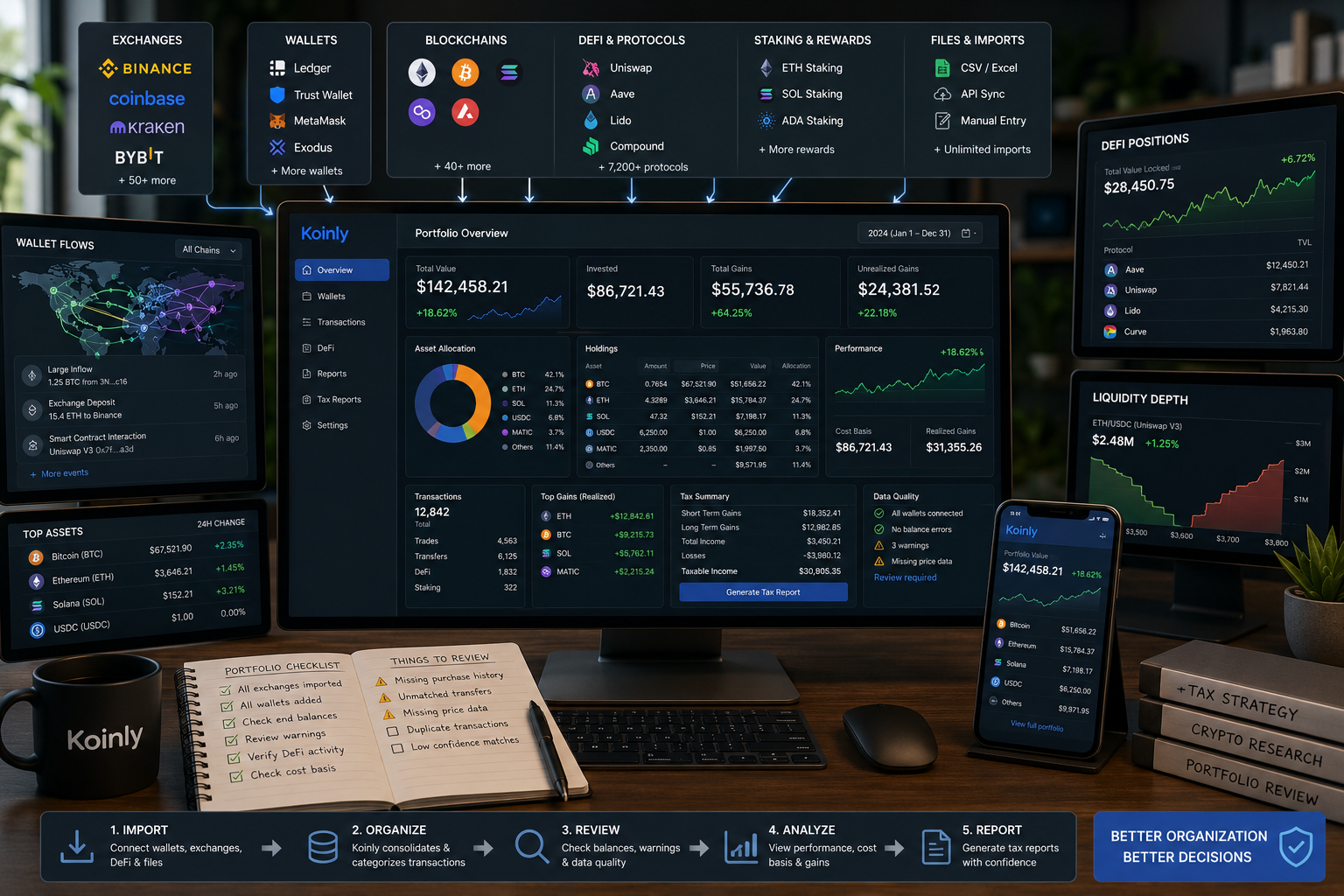
Koinly combines portfolio tracking with transaction reconciliation and tax-oriented accounting. It imports activity from connected exchanges, wallets, blockchain addresses, DeFi protocols, and files, then attempts to organize that activity into one transaction history.
The value proposition is straightforward: instead of maintaining separate spreadsheets for every wallet and exchange, the investor gets one place to review holdings, historical activity, cost basis, gains and losses, and tax-related data.
That convenience is real, but it comes with an important condition. Koinly can organize the data it receives; it cannot guarantee that every source has provided a complete and perfectly classified history. A useful Koinly workflow therefore combines automation with review.
This guide explains where Koinly portfolio tracking is genuinely useful, how to structure the setup properly, and where investors still need blockchain explorers and manual verification.
Table of Contents
What Koinly Portfolio Tracking Actually Does
Koinly sits between a basic portfolio tracker and a dedicated crypto tax workflow.
A basic tracker normally answers questions such as:
- What assets do I hold?
- What is the portfolio worth today?
- How has the portfolio performed?
- Which assets gained or lost value?
Koinly adds another layer by organizing the transaction history behind those balances.
According to Koinly’s official portfolio tracker, users can monitor total holdings and portfolio growth across wallets and accounts, review invested fiat and ROI, and view realized and unrealized gains.
Its integration directory also connects the tracking layer with a much broader data-import workflow covering exchanges, blockchain addresses, wallets, DeFi protocols, and CSV files.
In practice, this means Koinly can help connect several parts of the same portfolio story.
An exchange purchase may be followed by a withdrawal to a self-custody wallet, a bridge transaction to another chain, a DeFi deposit, staking rewards, and finally a disposal months later. Looking at each platform independently makes the history difficult to reconstruct.
Koinly attempts to connect those events into a consistent timeline.
This makes it particularly relevant for investors whose main problem is portfolio fragmentation, rather than simply price tracking.
For a broader framework on structuring portfolio data, see BlockCodex’s guide on Best Crypto Portfolio Tracking Setups.
1. Koinly Helps Create a Complete Wallet and Exchange Map
The first practical benefit of Koinly portfolio tracking is visibility.
Before calculating gains or preparing tax data, an investor needs to know where activity happened. That sounds obvious, but multi-year crypto activity can be surprisingly difficult to reconstruct.
An investor may have used:
- Centralized exchanges.
- Hardware wallets.
- Mobile wallets.
- Browser wallets.
- Multiple addresses on the same blockchain.
- Layer 2 networks.
- DeFi protocols.
- Staking services.
- NFT marketplaces.
- Bridges.
- Closed or abandoned accounts.
The first useful Koinly workflow is therefore not tax calculation. It is inventory.
Create a list of every exchange, wallet, blockchain address, and major platform used during the relevant history, then connect or import them into Koinly.
Koinly’s official integration page currently describes auto-sync across more than 1,000 direct integrations and more than 7,200 DeFi protocols, alongside CSV import support. Coverage is broad, but investors should still check the specific instructions and known limitations for each integration.
This matters because the quality of the final portfolio view depends on the completeness of the input history.
Suppose an investor imports Exchange A but forgets the wallet that received withdrawals from it. Koinly may see assets leaving the exchange without being able to reconstruct what happened afterward.
The dashboard may still look organized, but the history is incomplete.
A better setup begins with a portfolio map before any report is trusted.
A simple table can help:
| Source | Import Method | Status | Review Needed |
|---|---|---|---|
| Main exchange | API sync | Connected | Check balances |
| Hardware wallet | Public addresses | Connected | Check all chains |
| DeFi wallet | Blockchain addresses | Connected | Review DeFi activity |
| Old exchange | CSV | Imported | Check historical gaps |
| NFT wallet | Public address | Connected | Review classifications |
This preparation takes time once, but it makes the rest of the workflow more reliable.
2. Koinly Combines Different Import Methods in One Workflow
Crypto activity does not come from one standardized source.
Centralized exchanges hold internal account data. Public blockchains expose address activity. Some services offer APIs, others provide CSV files, and unsupported sources may need custom imports or manual entries.
Koinly supports several of these import methods.
For compatible exchanges, users may be able to connect through API synchronization or upload transaction history files. For supported blockchains, public wallet addresses can be used to import on-chain activity.
The important security distinction is that tracking a public blockchain address does not require sharing a private key.
Koinly’s integration page explicitly states that its import workflow does not require private keys.
That is important because a portfolio or tax tracker should never need the recovery phrase controlling a self-custody wallet.
The practical advantage of combining import methods is that users can reconstruct a portfolio even when the history is distributed across very different systems.
For example, one portfolio might include:
- Binance activity through API sync.
- A historical exchange account through CSV.
- Ethereum addresses through public-address sync.
- Solana activity through a supported blockchain integration.
- Additional transactions through manual or custom import.
Koinly then places these sources into one history.
However, integration does not mean perfect interpretation. Exchange APIs can have limitations, files can omit activity, and some complex transactions may require review.
Automation reduces manual work.
It does not eliminate responsibility for checking the result.
3. Koinly Can Help Reconcile Transfers Between Your Own Wallets
One of the easiest ways to create bad portfolio and tax data is to misread transfers between your own wallets.
Suppose an investor buys ETH on an exchange and later withdraws it to a hardware wallet.
Economically, ownership has not changed. The asset has simply moved from one place controlled by the investor to another.
If only the exchange is imported, the withdrawal may look like an unexplained departure. If only the receiving wallet is imported, the ETH may appear without its complete acquisition history.
When the relevant sources are imported correctly, Koinly’s calculation workflow attempts to match transfers between the user’s own wallets.
This is one reason complete wallet mapping matters so much.
The same principle applies when assets move between:
- An exchange and a hardware wallet.
- A hot wallet and cold storage.
- Two personal addresses.
- Different wallet applications.
- Supported chain environments.
For complex on-chain activity, the best practice is to use Koinly and blockchain explorers together.
Koinly helps organize the portfolio-wide history, while a blockchain explorer helps verify what actually happened in a specific transaction.
BlockCodex explains this verification layer in Blockchain Explorers: 7 Powerful Ways to Read On-Chain Data Like a Pro.
The two tools solve different problems. Koinly provides organization across the portfolio; explorers provide transaction-level evidence.
4. Koinly Makes DeFi Activity Easier to Organize, but Not Effortless
DeFi is where crypto transaction history becomes significantly more complicated.
A single user can:
- Swap tokens.
- Bridge assets.
- Supply liquidity.
- Receive LP tokens.
- Stake positions.
- Claim rewards.
- Lend assets.
- Borrow against collateral.
- Repay loans.
- Unstake assets.
- Interact with several smart contracts in one strategy.
The challenge is that the blockchain records transactions, while the investor needs an economic interpretation of those transactions.
Koinly supports DeFi, staking, NFTs, and other modern crypto activity, and its integration coverage includes thousands of DeFi protocols. That gives active DeFi users a much better starting point than reconstructing everything manually in a spreadsheet.
Still, complex DeFi history should be reviewed carefully.
Koinly’s own support documentation contains guidance for activities such as staking and farming because some transactions may require specific treatment or adjustment depending on how they are imported and the nature of the activity.
This is an important limitation to understand.
The presence of a transaction in Koinly does not automatically prove that its classification matches the investor’s intention, local tax treatment, or the full economic structure of a complex strategy.
For example, a user should check whether:
- Staking rewards are represented correctly.
- Transfers have been matched properly.
- LP-related activity is complete.
- Deposits and withdrawals correspond to the correct protocol.
- Bridge activity is not duplicated.
- Imported balances match actual holdings.
- Missing transaction warnings have been resolved.
Koinly portfolio tracking reduces the organizational burden of DeFi, but active users still need a review process.
That is especially true for portfolios that interact frequently with new protocols or complex strategies.
5. Portfolio Tracking Becomes More Useful When Cost Basis Is Included
Many portfolio apps can show current value.
That is useful, but incomplete.
Suppose two investors each hold $20,000 worth of the same token. One invested $5,000 and the other invested $25,000. Their current balances are identical, but their portfolio situations are completely different.
This is where transaction history and cost basis add context.
Koinly tracks the acquisition history behind imported assets and uses transaction data to calculate gains and losses according to the relevant account settings and tax rules.
That can help investors distinguish between:
- Current market value.
- Amount invested.
- Realized gains.
- Unrealized gains.
- Capital losses.
- Income-related transactions.
- Potential tax liabilities.
This makes the portfolio view useful for more than checking daily performance.
It also creates continuity between investing records and tax preparation.
A trade made today becomes part of tomorrow’s tax history. A transfer that is not tracked correctly can create confusion later. A missing acquisition can affect cost basis calculations when an asset is eventually disposed of.
This is why BlockCodex’s Best Crypto Tax Strategies emphasizes organization throughout the year rather than waiting until the filing deadline.
Good tax preparation begins with good transaction records.
Koinly is useful because those two workflows are connected rather than maintained separately.
6. Koinly Can Surface Data Problems Before Tax Season
One of Koinly’s most valuable features is not a chart.
It is the ability to surface inconsistencies.
Koinly’s official support documentation recommends reviewing imported transactions after calculations finish. Users should verify that all wallets have been added, compare calculated end balances with actual balances, and resolve warnings such as missing purchase history.
These warnings matter.
A missing purchase history can indicate that Koinly sees a disposal but cannot find the corresponding acquisition. Its documentation explains that missing acquisition data can lead to a zero cost basis being assumed for the affected asset, potentially increasing calculated gains.
That does not automatically mean Koinly itself made an error. The underlying cause may be incomplete input data.
Common problems can include:
- A forgotten wallet.
- Missing exchange history.
- An incomplete API sync.
- A CSV file that does not cover the full period.
- An unsupported transaction.
- A transfer that was not matched.
- Duplicate imports.
- Incorrect transaction classification.
A good Koinly portfolio tracking workflow treats warnings as research prompts rather than notifications to dismiss.
For each significant warning, ask:
- Is every relevant wallet imported?
- Does the wallet balance match reality?
- Is part of the exchange history missing?
- Can the transaction be verified on-chain?
- Is the source integration known to have a limitation?
- Does the classification reflect what actually happened?
This is another area where blockchain explorers remain important.
If Koinly shows an unexpected on-chain transaction, verify the hash and addresses directly before making a manual correction.
Portfolio software should organize evidence.
The blockchain remains the source for verifying on-chain events.
7. Koinly Connects Year-Round Tracking With Tax Reporting
The strongest case for Koinly is not necessarily that it is the most detailed daily trading dashboard.
It is that portfolio organization and tax preparation use the same underlying transaction history.
An investor can import activity throughout the year, monitor holdings and gains, review warnings as they appear, and then use the reconciled history when tax reporting becomes necessary.
This is more efficient than beginning from zero at the end of the year.
The worst time to discover that an exchange export is incomplete is when a filing deadline is approaching. The same is true for a forgotten wallet, an old API connection, or a DeFi transaction that nobody remembers well enough to classify months later.
A better workflow is continuous:
- Add new wallets when they are created.
- Keep exchange connections current.
- Review balance discrepancies.
- Check missing purchase warnings.
- Verify unusual transactions.
- Keep DeFi activity understandable.
- Review realized gains periodically.
- Prepare reports only after the transaction history has been checked.
Koinly allows users to begin importing and organizing activity before purchasing a tax report. Paid plans are needed when users want to generate downloadable tax reports within the applicable plan structure.
For investors who want to organize fragmented transaction data before tax season, Koinly can therefore be useful even before the final reporting stage.
The benefit is continuity.
Portfolio tracking and tax preparation no longer start from separate datasets.
A Practical Koinly Portfolio Tracking Workflow
A structured setup is better than connecting accounts randomly and trusting the first dashboard result.
Stage 1: Create the Portfolio Map
List every exchange, wallet, blockchain, and service used.
Do this before importing anything.
Stage 2: Import the Full History
Use the appropriate connection method for each source:
- API sync where suitable.
- Public addresses for supported blockchain wallets.
- CSV files for historical or unsupported sources.
- Manual entries only when necessary.
Historical completeness matters more than having a beautiful dashboard quickly.
Stage 3: Wait for Processing
Koinly needs to process imported activity, match transfers, fetch market values, identify certain activity types, detect inconsistencies, track cost basis, and calculate gains.
Do not review the portfolio while a major sync is still incomplete.
Stage 4: Compare Balances
Check whether the balances calculated in Koinly correspond to reality.
A major discrepancy is often a sign that some history is missing or duplicated.
Stage 5: Review Warnings
Pay particular attention to:
- Missing purchase history.
- Missing prices.
- Balance errors.
- Incomplete syncs.
- Unmatched transfers.
- Unusual transaction classifications.
Stage 6: Verify Complex Transactions
Use blockchain explorers for significant DeFi interactions, large transfers, or transactions that do not make sense.
Do not manually edit activity without understanding what happened first.
Stage 7: Maintain the System
Update the portfolio throughout the year rather than rebuilding the history during tax season.
That is where Koinly portfolio tracking becomes more useful: the platform becomes a maintained record rather than a one-time tax tool.
What Koinly Does Well
Koinly is particularly strong when the investor’s main problem is fragmented transaction data.
Its most useful strengths are:
Broad Integration Coverage
The ability to combine exchanges, wallets, public blockchain addresses, DeFi activity, and CSV imports makes it relevant to multi-platform portfolios.
Portfolio and Tax Data in One Place
The same transaction history supports both portfolio visibility and tax calculations.
Cost Basis Context
Investors can see more than current prices because acquisition history and gains are connected to the portfolio data.
Error Visibility
Warnings can reveal missing history, balance problems, or other issues that need investigation.
Year-Round Organization
Users can build the transaction record gradually rather than beginning tax reconstruction at the end of the year.
These strengths are most valuable when the portfolio has moved beyond one exchange and a small number of transactions.
Where Koinly Has Limits
A balanced Koinly article should also explain what the software cannot do.
It Depends on Complete Input Data
Koinly can only calculate from the data that has been imported.
A forgotten exchange or missing wallet can affect the history.
Automation Still Needs Review
The platform’s own documentation recommends checking imported transactions, balance accuracy, and warnings before relying on reports.
Complex DeFi Activity May Need Attention
DeFi creates economic situations that are not always simple to classify automatically. Complex staking, farming, bridging, liquidity provision, and unusual protocols deserve review.
It Does Not Replace Blockchain Verification
Koinly organizes transactions, but a blockchain explorer is still better for investigating a specific on-chain event directly.
It Does Not Replace Professional Tax Advice
Tax rules differ by jurisdiction and individual situation. Software can organize data and calculate according to configured rules, but complex cases may require a qualified local professional.
These are not reasons to avoid Koinly.
They define the conditions under which the tool is useful.
Koinly vs Blockchain Explorers: Different Jobs
Koinly and blockchain explorers should not be viewed as alternatives.
They answer different questions.
| Research Need | Koinly | Blockchain Explorer |
| View total multi-wallet holdings | Strong | Limited to addresses or chains |
| Organize exchange and wallet history | Strong | No centralized exchange account history |
| Track cost basis | Strong | Not the primary purpose |
| Review gains and losses | Strong | Requires external calculation |
| Verify a transaction hash | Secondary | Strong |
| Inspect contract interactions | Limited context | Strong |
| Review raw token transfers | Organized view | Direct on-chain evidence |
| Prepare tax-oriented reports | Strong | Not designed for this |
A disciplined workflow uses both.
Koinly provides portfolio-wide organization. Explorers provide transaction-level verification.
This distinction prevents a common mistake: expecting one tool to solve every research problem.
Who Is Koinly Portfolio Tracking Best For?
Koinly is most relevant for investors whose activity has become difficult to reconstruct manually.
It may be a strong fit for:
- Investors using several exchanges.
- Users holding assets across multiple wallets.
- DeFi participants.
- Stakers receiving recurring rewards.
- Investors with multi-year transaction history.
- Users who want portfolio tracking connected to tax records.
- Investors who have outgrown manual spreadsheets.
It may be less necessary for someone with a very small portfolio, one exchange account, and almost no transaction history.
The value increases with complexity.
An investor who has fifty simple transactions can probably reconstruct history more easily than one with thousands of swaps, transfers, staking rewards, exchange trades, and DeFi interactions.
The decision should therefore be based on the problem Koinly solves, not simply on the fact that tax software exists.
For a broader comparison of portfolio structures rather than one specific platform, see Best Crypto Portfolio Tracking Setups.
How to Decide Whether Koinly Is Worth Using
Ask a few practical questions.
| Question | Why It Matters |
| Do I use several wallets or exchanges? | Fragmentation increases organizational value. |
| Do I use DeFi or staking? | Transaction history becomes more complex. |
| Can I reconstruct my cost basis manually? | Missing history creates tax problems later. |
| Do I review portfolio gains and losses? | Koinly connects performance and transaction history. |
| Is my spreadsheet becoming difficult to maintain? | Automation may save significant time. |
| Am I preparing tax data from several sources? | Consolidation becomes more valuable. |
| Will I actually review warnings and balances? | Automation is only useful when checked. |
For investors who answer yes to several of these questions, Koinly is worth testing as an organizational layer before deciding whether a paid tax report is necessary.
The free tracking workflow makes the decision easier because users can first see how well their activity imports and whether the organized history solves a real problem.
Common Koinly Portfolio Tracking Mistakes
Mistake 1: Importing Only Current Wallets
Historical wallets and old exchange accounts may still matter for acquisition history.
Mistake 2: Ignoring Balance Differences
A portfolio dashboard should be checked against actual holdings.
Mistake 3: Dismissing Missing Purchase Warnings
These warnings can indicate incomplete history and can affect calculated cost basis.
Mistake 4: Assuming Every DeFi Transaction Is Automatically Perfect
Complex activity deserves review, especially when the economic meaning is not obvious.
Mistake 5: Editing Transactions Before Verifying Them
Check the source data or blockchain transaction first.
Mistake 6: Waiting Until Tax Season
Reconstructing several years of crypto history under deadline pressure is much harder than maintaining records gradually.
Mistake 7: Treating Koinly as a Complete Research Platform
Koinly is useful for portfolio organization and tax-oriented data. It does not replace on-chain analytics, protocol research, liquidity analysis, or blockchain explorers.
Understanding the role of the tool is part of using it well.
Final Thoughts
Koinly portfolio tracking is most useful when crypto activity has become fragmented across exchanges, wallets, blockchains, and DeFi protocols.
Its main advantage is not simply displaying portfolio value. The stronger benefit is that it connects current holdings with transaction history, cost basis, gains and losses, and tax-oriented data inside one workflow.
That can save substantial time for investors who would otherwise reconstruct the same history across several spreadsheets and exports. However, the workflow remains dependent on complete imports and careful review. Missing wallets, incomplete exchange data, unmatched transfers, and complex DeFi activity can still require investigation.
The most effective approach is therefore a combination of automation and verification. Use Koinly to organize the portfolio-wide history, review warnings before they accumulate, and keep tax records connected to ongoing activity. Use blockchain explorers when a specific on-chain transaction needs direct verification.
For investors managing several wallets, exchanges, and DeFi positions, that combination can turn a fragmented transaction history into a much more manageable system.
Good portfolio organization is not only about knowing what you own today.
It is also about understanding how you got there.