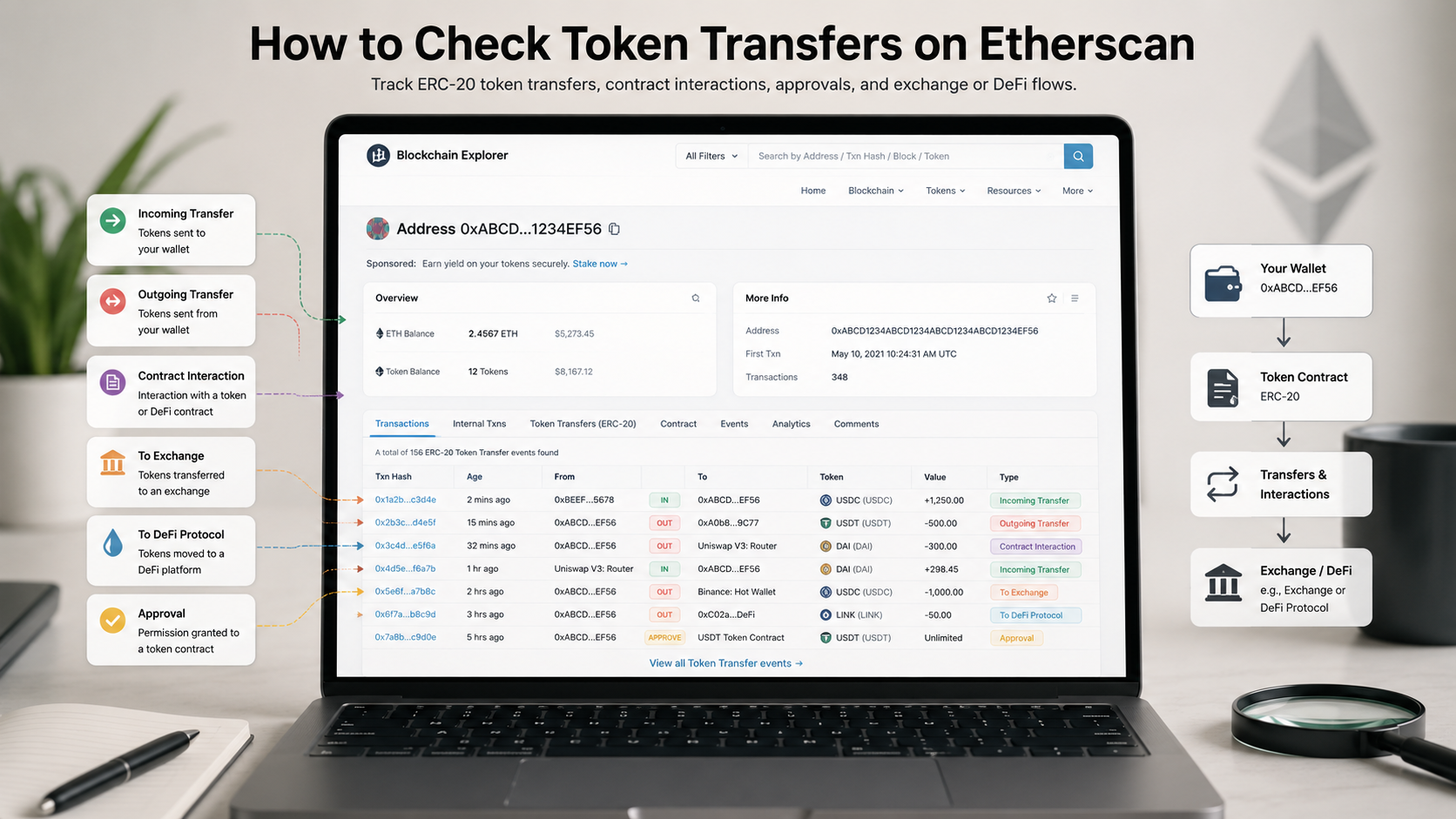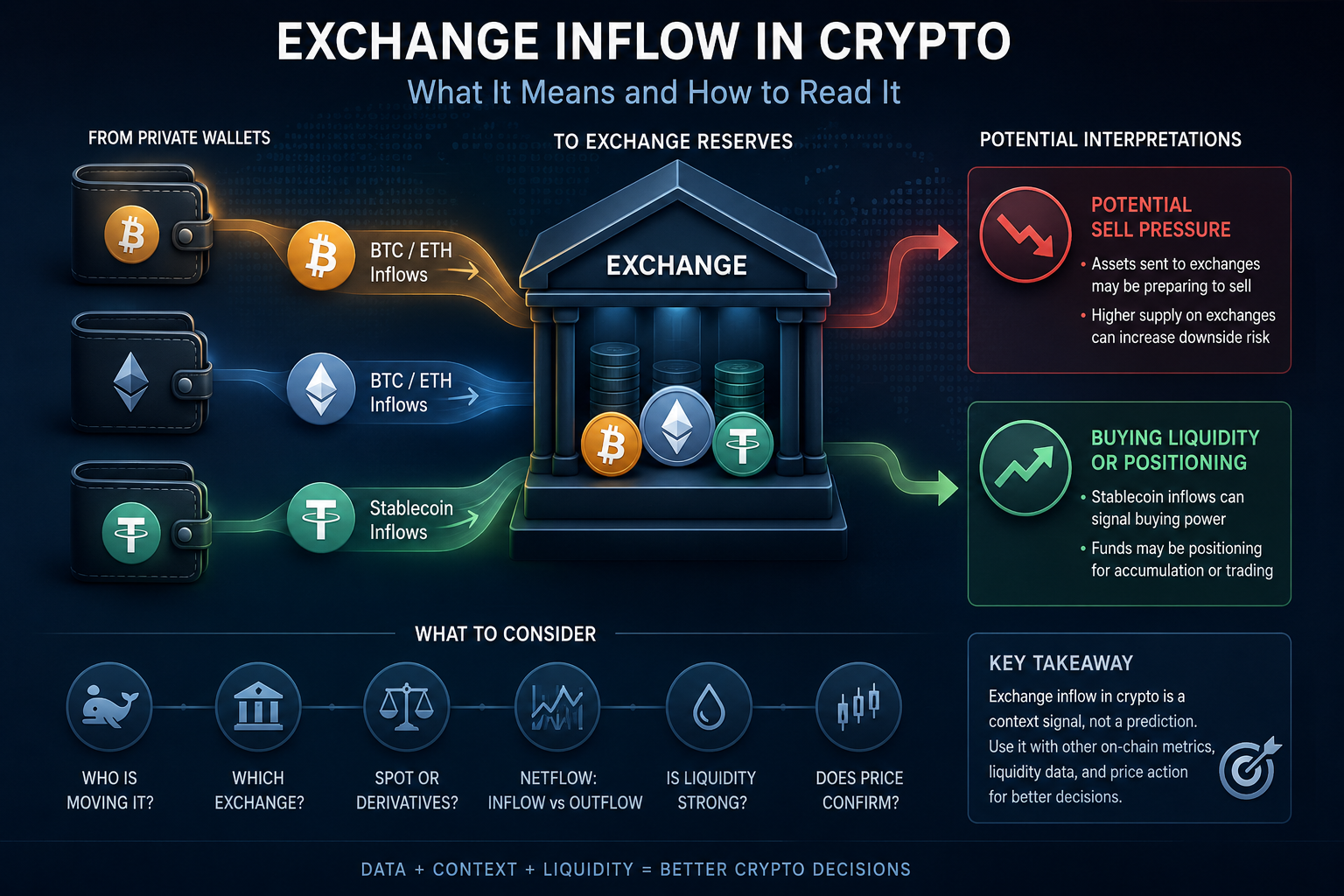
Exchange inflow in crypto refers to coins or tokens moving from external wallets into exchange wallets.
In simple terms, when investors send Bitcoin, Ethereum, stablecoins, or other assets to a centralized exchange, that movement is counted as an exchange inflow.
At first glance, this sounds easy to interpret. If coins move to exchanges, investors may be preparing to sell. If coins leave exchanges, investors may be moving assets into self-custody. But in real market analysis, exchange inflow is more nuanced.
A rise in exchange inflow can suggest potential selling pressure, but it does not prove that selling has already happened. This is why exchange inflow in crypto should be treated as a context signal rather than a direct price prediction. Assets can move to exchanges for many reasons: trading, collateral, market making, OTC settlement, rebalancing, hedging, liquidity management, or internal exchange operations.
That is why exchange inflow should never be read alone.
The useful question is not only:
“Are coins moving to exchanges?”
The better question is:
“Who is moving them, where are they going, and can the market absorb the flow?”
Table of Contents
What Exchange Inflow in Crypto Actually Measures
Exchange inflow measures the amount of crypto transferred into exchange wallets over a given period.
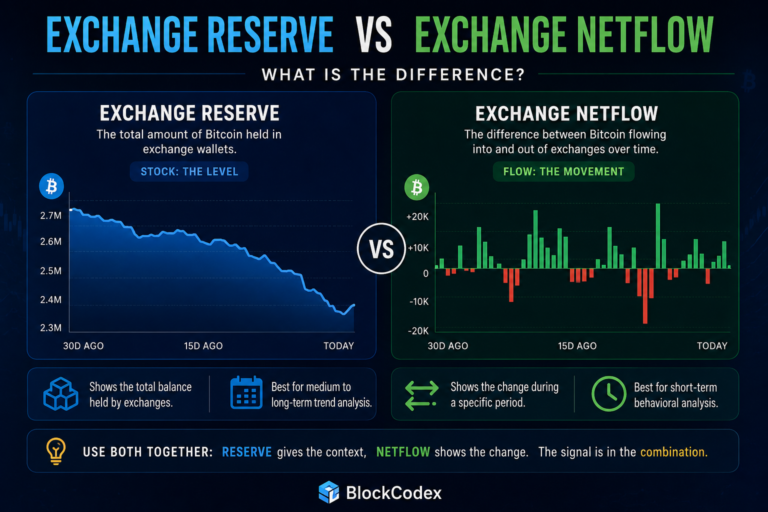
CryptoQuant defines exchange inflow as the amount of coins deposited into exchange wallets, while exchange outflow refers to coins withdrawn from exchange wallets. It also defines exchange netflow as inflow minus outflow.
This means there are three related metrics investors should understand:
| Metric | Meaning | Basic Interpretation |
|---|---|---|
| Exchange inflow | Coins moving into exchanges | Potential trading or selling readiness |
| Exchange outflow | Coins leaving exchanges | Potential self-custody or accumulation |
| Exchange netflow | Inflow minus outflow | Whether exchange balances are rising or falling |
A positive netflow means more assets are entering exchanges than leaving. A negative netflow means more assets are leaving exchanges than entering.
But this is only the starting point.
The interpretation depends on asset type, market conditions, wallet identity, exchange type, and liquidity.
Why Exchange Inflow in Crypto Can Signal Selling Pressure
The most common interpretation is simple: when investors move assets to exchanges, they may be preparing to sell.
That logic makes sense.
Most crypto selling happens on exchanges. If a holder wants to convert BTC into stablecoins, rotate ETH into another asset, or take profit after a rally, they often need to deposit assets into an exchange first.
CryptoQuant states that a high exchange inflow value can indicate higher selling pressure in spot exchange contexts, while stablecoin inflows can indicate buying pressure.
This distinction is important.
A BTC inflow to a spot exchange can suggest potential supply entering the market. But a USDT or USDC inflow can suggest buying power entering the exchange.
So the meaning changes depending on what is flowing in.
Example
If BTC inflows rise sharply:
- some holders may be preparing to sell;
- profit-taking may increase;
- exchange reserves may rise;
- short-term volatility may increase.
If stablecoin inflows rise sharply:
- traders may be preparing to buy;
- liquidity may be waiting on the sidelines;
- market participants may be positioning for rotation.
That is why “exchange inflow is bearish” is too simplistic.
The asset matters.
Exchange Inflow Does Not Always Mean Selling
A common mistake is assuming that every inflow equals immediate sell pressure.
That is not accurate.
Glassnode explains that exchange inflows can indicate increased trading activity, profit-taking, or portfolio rebalancing to reduce risk.
That means exchange inflow can reflect several behaviors:
- Selling preparation;
- Collateral deposits;
- Market-making inventory;
- OTC settlement;
- Internal exchange wallet movement;
- Hedging;
- Rebalancing;
- Liquidity provision;
- Derivatives margin management.
This is why exchange inflow must be interpreted as potential supply, not confirmed selling.
A whale depositing BTC to an exchange may sell.
But the same whale may use BTC as collateral.
A fund may move assets for custody reasons.
An exchange may reshuffle wallets internally.
A market maker may rebalance inventory across venues.
The transaction is real.
The intent is not always visible.
That distinction matters because many investors panic when they see large inflows without checking context.
Exchange Inflow vs Exchange Netflow
Exchange inflow tells investors how much is entering exchanges.
Exchange netflow tells investors whether exchange balances are increasing or decreasing after accounting for outflows.
CryptoQuant defines exchange netflow as the difference between coins flowing into and out of exchanges, with positive values indicating that reserves are increasing.
This makes netflow more useful than inflow alone.
For example:
| Scenario | Inflow | Outflow | Netflow | Interpretation |
|---|---|---|---|---|
| Large inflow, larger outflow | High | Higher | Negative | More assets leaving overall |
| Large inflow, low outflow | High | Low | Positive | Exchange balances rising |
| Low inflow, high outflow | Low | High | Negative | Possible accumulation/self-custody |
| High inflow, high outflow | High | High | Neutral | High activity, unclear direction |
A high inflow may look bearish until outflows are considered.
If inflows and outflows both rise, the market may simply be experiencing high activity, rebalancing, or volatility. If inflows consistently exceed outflows, potential sell-side pressure becomes more relevant.
For serious analysis, netflow is often the cleaner starting point.
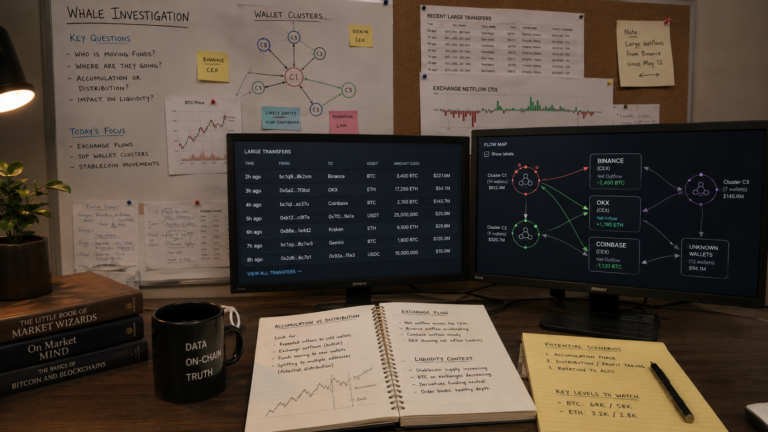
How Whale Exchange Inflows Change the Signal
Not all inflows are equal.
A small retail inflow has limited market impact. A large whale inflow can matter more, especially if liquidity is thin.
Glassnode provides whale exchange flow metrics based on whale entities, defined as wallets with 1,000+ BTC aggregate on-chain balance. These metrics track inflow and outflow volumes associated with whale entities.
The key issue is scale.
If a whale sends a large amount of BTC or ETH to an exchange during a low-liquidity period, traders may interpret it as potential selling pressure. But even then, the signal needs confirmation.
Useful questions include:
- Is the receiving exchange a spot exchange or derivatives venue?
- Is the wallet known, labeled, or connected to a fund?
- Has this wallet deposited repeatedly before selling in the past?
- Is the movement linked to a token unlock?
- Are other whales moving assets too?
- Is liquidity deep enough to absorb the potential supply?
This connects directly with BlockCodex’s guide “How to Analyze Whale Activity: 7 On-Chain Signals Investors Should Track”.
The point is simple: whale inflows matter most when they are repeated, directed toward liquid trading venues, and aligned with weaker market conditions.
Why Liquidity Context Matters
Exchange inflow becomes more important when liquidity is weak.
A $50 million inflow may be easy for the market to absorb during deep liquidity. The same inflow can create serious pressure during thin order books, weak bids, or low spot demand.
This is where many investors misread on-chain data.
They see a large exchange inflow and assume price must fall. But the price impact depends on whether buyers exist.
A better framework combines exchange inflow with:
- Order book depth;
- Bid-ask spreads;
- Spot volume;
- Derivatives leverage;
- Stablecoin liquidity;
- Market maker activity;
- Slippage;
- Broader market sentiment.
This is why exchange inflow is not only an on-chain metric. It is also a market structure signal.
For a deeper breakdown, see BlockCodex’s article “Liquidity in Crypto Markets: 7 Critical Misconceptions Investors Still Get Wrong”.
Stablecoin Exchange Inflows Mean Something Different
Stablecoin inflows deserve separate treatment.
When BTC or ETH flows into an exchange, investors often think about sell-side pressure. When stablecoins flow into an exchange, the interpretation can be the opposite.
Stablecoin inflows may suggest that capital is entering exchanges and preparing to buy risk assets.
However, stablecoin inflows are not always bullish either.
They can also reflect:
- Market makers moving liquidity;
- Traders preparing for hedging;
- Exchange reserve management;
- Users moving stablecoins for withdrawals or settlement;
- Defensive positioning before volatility.
Stablecoins are not only “dry powder.” They are also settlement, collateral, and liquidity infrastructure.
This is why investors should separate:
- BTC / ETH inflows;
- Stablecoin inflows;
- Exchange netflows;
- Spot exchange flows;
- Derivatives exchange flows.
A single inflow chart cannot explain the whole market.
Exchange Inflow and Derivatives Markets
Exchange inflow also changes meaning when assets move to derivatives exchanges.
CryptoQuant notes that in derivative exchange contexts, inflows can be used to open both long and short positions, so rising inflows may indicate possible high volatility rather than simple selling pressure.
That is a critical distinction.
A BTC inflow to a spot exchange may indicate potential selling.
A BTC inflow to a derivatives exchange may indicate collateral for leveraged positions.
That collateral can support:
- Long positions;
- Short positions;
- Hedging strategies;
- Basis trades;
- Liquidation risk;
- Volatility expansion.
So when derivatives inflows rise, the key question becomes:
Is leverage building?
If derivatives inflows rise together with open interest and aggressive funding rates, market risk may increase. The direction is not always obvious, but the probability of volatility can rise.
This connects with BlockCodex’s article “Crypto Market Cycles Explained: 7 On-Chain Signals Investors Should Track”, because derivatives activity often changes how cycles behave.
Practical Framework: How to Read Exchange Inflow
A clean exchange inflow workflow should answer six questions.
1. Which asset is flowing in?
BTC, ETH, SOL, and stablecoins do not carry the same interpretation.
Crypto asset inflow may signal potential sell-side pressure. Stablecoin inflow may signal buying power or liquidity positioning.
2. Which exchange is receiving the funds?
Spot exchange inflows and derivatives exchange inflows have different meanings.
A spot inflow may matter for selling. A derivatives inflow may matter more for leverage and volatility.
3. Is netflow positive or negative?
Inflow alone is incomplete.
If outflows are higher than inflows, exchange balances may still be declining.
4. Is the movement isolated or repeated?
One large deposit can be noise.
Repeated deposits from the same wallet or cohort carry more weight.
5. Is liquidity strong enough?
Large inflows matter more when order books are thin and stablecoin liquidity is weak.
6. Does price confirm the signal?
If inflows rise but price holds strongly, buyers may be absorbing supply.
If inflows rise and price weakens on poor liquidity, sell-side pressure may be more relevant.
Common Mistakes Investors Make
Investors often misread exchange inflow because they use it as a shortcut.
Common mistakes include:
- Assuming every inflow means immediate selling;
- Ignoring stablecoin inflows;
- Ignoring exchange outflows;
- Confusing spot and derivatives exchange flows;
- Reacting to whale alerts without wallet context;
- Ignoring liquidity;
- Reading one data point without trend confirmation;
- Using exchange inflow without checking price behavior.
The biggest mistake is treating exchange inflow as a prediction tool.
It is not.
Exchange inflow is a risk signal. It tells investors that supply, liquidity, or trading activity may be changing. It does not guarantee what price will do next.
How Exchange Inflow Supports Better On-Chain Analysis
Exchange inflow is most useful when it becomes part of a broader on-chain framework.
It can help investors understand:
- Potential sell-side pressure;
- Capital movement between wallets and exchanges;
- Whale behavior;
- Stablecoin positioning;
- Derivatives risk;
- Market cycle transitions;
- Liquidity stress.
But it works best with other signals.
A strong analysis might combine:
| Signal | What It Adds |
|---|---|
| Exchange inflow | Potential supply entering exchanges |
| Exchange outflow | Assets leaving exchanges |
| Netflow | Direction of exchange reserves |
| Whale flows | Large holder behavior |
| Stablecoin flows | Available liquidity |
| Order book depth | Absorption capacity |
| Price reaction | Market confirmation |
This is exactly why investors should avoid one-metric analysis.
For a broader framework, see BlockCodex’s article “On-Chain Data: 7 Critical Reasons Most Investors Misread Blockchain Signals”.
Conclusion
Exchange inflow in crypto means assets are moving into exchange wallets.
It can signal potential selling pressure, especially when BTC, ETH, or other volatile assets move into spot exchanges. But it does not prove that selling has already happened.
The meaning depends on context.
Stablecoin inflows may suggest buying power. Derivatives inflows may suggest leverage and volatility. Whale inflows may matter more than small transfers. Netflow can be more useful than inflow alone. Liquidity determines whether the market can absorb the movement.
The right way to read exchange inflow is not to panic.
It is to ask better questions:
- What asset is moving?
- Which exchange received it?
- Is netflow positive?
- Is a whale involved?
- Is liquidity strong?
- Does price confirm the signal?
Used correctly, exchange inflow helps investors understand market pressure before it becomes obvious in price.
Used blindly, it becomes another misleading on-chain metric.
The best way to use exchange inflow in crypto is to compare it with netflow, whale behavior, stablecoin movement, liquidity depth, and price reaction.
In crypto, the data is visible.
The edge comes from interpreting it correctly.