Fake volume in crypto is one of the most dangerous distortions investors face.
At first glance, high trading volume looks positive. It suggests demand, liquidity, attention, and market confidence. But in crypto markets, volume can be manufactured, inflated, or temporarily boosted by incentives, bots, market makers, or wash trading.
That creates a serious problem.
If investors treat fake volume as real demand, they may overestimate liquidity, underestimate exit risk, and enter assets that look active but cannot absorb meaningful selling pressure.
The key is not to assume every high-volume token is manipulated. The goal is to understand how real volume behaves compared with artificial activity.
Real volume usually leaves traces: depth, spreads, organic wallet activity, consistent liquidity, and durable user demand. Fake volume often looks loud on the surface but weak underneath.
Table of Contents
Why Fake Volume in Crypto Is a Major Market Risk
Fake volume does not just make markets look busier than they are. It changes how investors interpret risk.
A token with inflated volume may appear:
- easier to trade than it really is
- more popular than it actually is
- less risky than its liquidity profile suggests
- more suitable for listings or ranking algorithms.
That matters because many investors still use volume as a shortcut for confidence.
The problem is structural: crypto trades across fragmented venues, including centralized exchanges, decentralized exchanges, perpetual markets, and low-liquidity pairs. This fragmentation makes it harder to verify whether trading activity reflects genuine demand.
Research from the National Bureau of Economic Research found abnormal trading patterns on unregulated crypto exchanges, including first-digit anomalies, suspicious trade-size rounding, and distribution patterns consistent with manipulation. The study introduced systematic tests across 29 crypto exchanges to detect fake transactions.
The implication is simple: volume is not a trust signal by itself.
It needs verification.
Signal 1: Volume Without Liquidity Depth
The first red flag is high volume with weak liquidity depth.
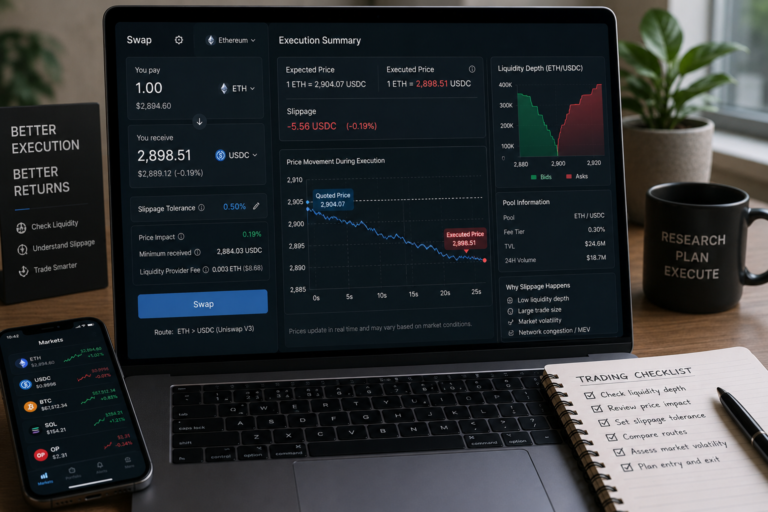
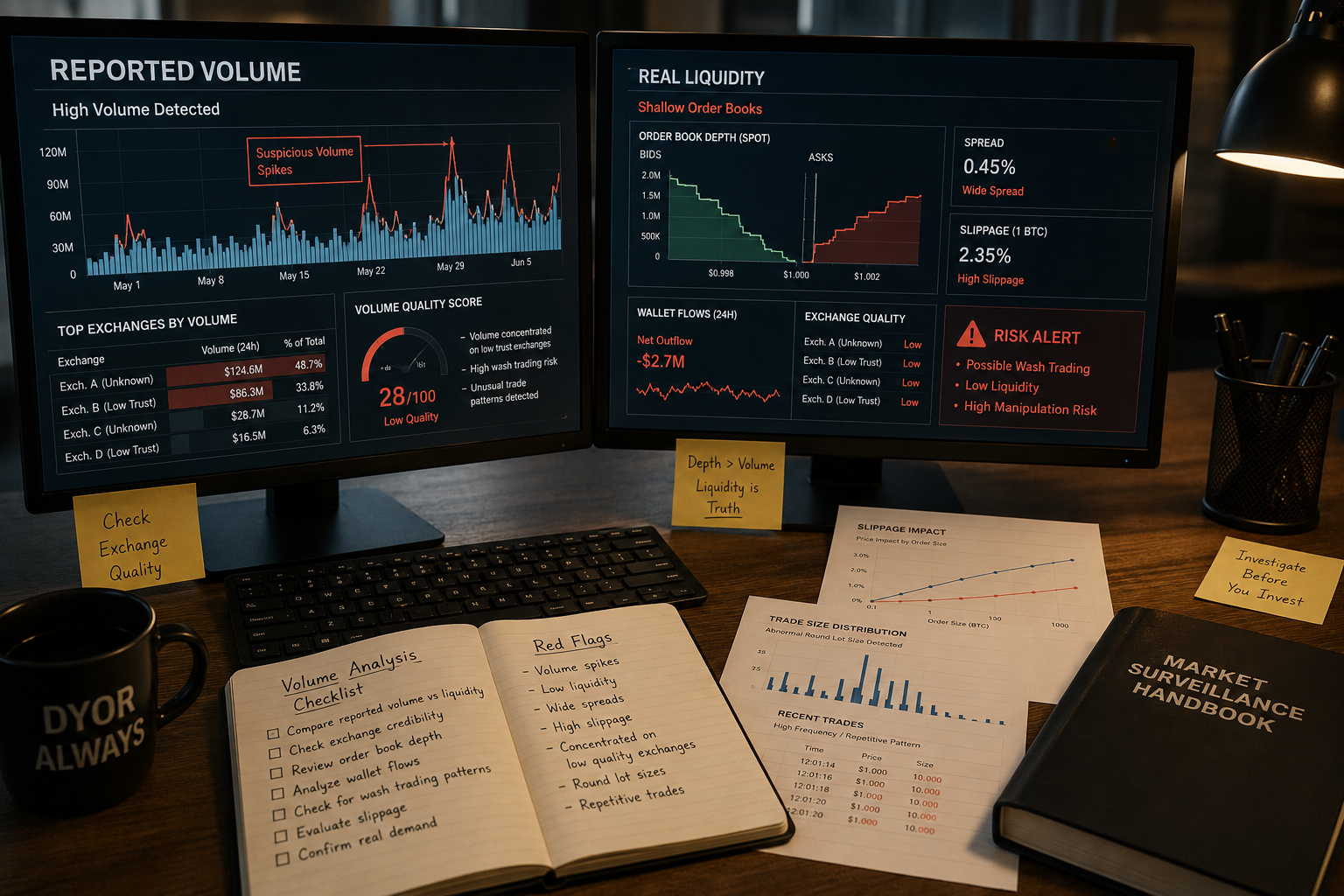
A token may report millions in daily volume, but the order book may still be thin. That means even a moderate sell order could create heavy slippage.
Real liquidity usually shows:
- deep order books
- tight spreads
- consistent bid and ask support
- enough depth across several price levels.
Fake or low-quality volume often shows:
- large reported volume
- shallow order books
- wide spreads
- sudden gaps between bids and asks.
The key insight:
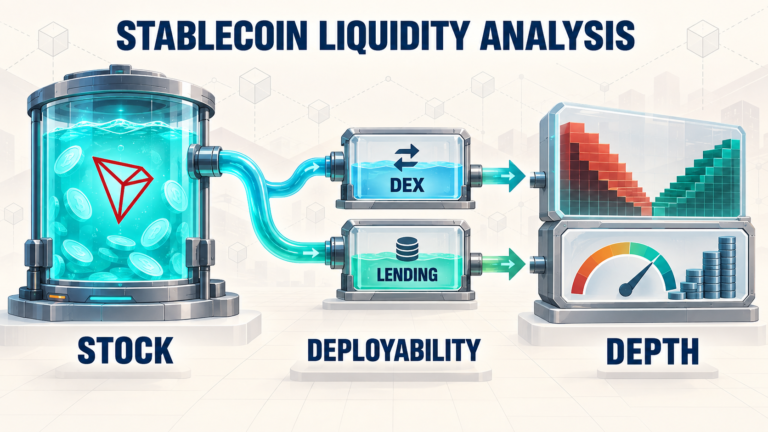
Volume shows activity. Depth shows whether that activity can absorb size.
If a token has high volume but poor depth, investors should treat the volume as suspicious or at least low quality.
For a deeper breakdown of liquidity behavior, see BlockCodex’s guide on “Liquidity in Crypto Markets: 7 Critical Misconceptions Investors Still Get Wrong.”
Signal 2: Volume Spikes Without News or On-Chain Activity
Real volume usually has a reason.
It may follow:
- protocol news
- token unlock events
- exchange listings
- airdrop announcements
- governance changes
- major market rotations
- ecosystem growth.
Suspicious volume often appears without any clear catalyst.
The stronger warning appears when trading volume rises but on-chain activity does not.
For example, if a token’s volume jumps sharply while:
- active addresses remain flat
- transfers do not increase
- DEX liquidity does not improve
- social attention remains weak
- protocol usage is unchanged
then the volume may be exchange-driven rather than user-driven.
This does not prove manipulation, but it reduces confidence in the signal.
Real market interest usually spreads across multiple indicators. Fake volume often concentrates in one metric.
Signal 3: High Volume Concentrated on Low-Quality Venues
Not all exchanges provide the same signal quality.
Volume concentrated on transparent, regulated, or deeply liquid venues carries more weight than volume concentrated on obscure exchanges with weak market structure.
A useful question is:
Where is the volume happening?
If most reported volume comes from one or two low-quality venues, investors should be cautious.
CoinGecko’s 2025 crypto industry reporting shows how concentrated crypto trading can be, with top centralized exchanges processing trillions in quarterly spot volume. For example, CoinGecko reported that the top centralized exchanges recorded $5.1 trillion in spot trading volume in Q3 2025.
That level of concentration matters because it creates a gap between headline market activity and venue-level quality.
A token may look liquid across the market, but if real volume is concentrated in weak venues, the exit risk remains high.
Signal 4: Wash Trading Patterns
Wash trading happens when the same actor, or coordinated actors, trade with themselves to create artificial volume.
The goal is usually to:
- inflate perceived demand
- improve rankings
- attract retail buyers
- qualify for exchange incentives
- manipulate token visibility
- create false liquidity signals.
Chainalysis reported that in 2024, the average suspected wash trade volume for one controller address was around $3.66 million, while the maximum suspected volume controlled by one address reached over $313 million.
That shows how large fake activity can become when markets are fragmented and surveillance is weak.
Common wash trading clues include:
- repetitive trades of similar size
- rapid buy/sell activity without price impact
- volume spikes without liquidity improvement
- activity concentrated in limited wallets or venues
- abnormal trade distributions.
Investors do not need to prove wash trading legally. They only need to recognize when volume quality is weak enough to avoid trusting it.
Signal 5: Volume That Does Not Convert Into Fees or Revenue
For protocols and decentralized exchanges, volume should usually connect to economic value.
If a protocol reports strong trading activity but generates weak fees, low revenue, or poor liquidity retention, the activity may not be durable.
A useful framework:
| Signal | Healthy Pattern | Warning Pattern |
|---|---|---|
| Volume | Supported by users and liquidity | Spikes without depth |
| Fees | Rise with activity | Stay flat despite volume |
| Liquidity | Stable or growing | Leaves after incentives |
| Users | Returning participants | One-time or bot-like activity |
| Slippage | Reasonable for size | High despite high volume |
This is where DeFi volume analysis becomes more useful than headline trading numbers.
If volume creates no meaningful protocol economics, it may be activity without value.
For related analysis, see BlockCodex’s guide on “How to Read TVL in Crypto: What It Really Signals About Capital and Risk.”
Signal 6: Incentive-Driven Volume
Not all artificial volume is outright manipulation. Some of it comes from incentives.
Protocols may encourage trading activity through:
- reward campaigns
- points programs
- liquidity mining
- fee rebates
- leaderboard competitions
- airdrop speculation.
This can generate real transactions but weak long-term demand.
The distinction matters.
Incentive-driven volume is not necessarily fake, but it can be misleading if investors interpret it as organic adoption.
The key question is:
What happens when the incentive ends?
If users disappear, liquidity leaves, and volume collapses, the activity was rented.
If volume remains after incentives fade, the protocol may have stronger product-market fit.
This is especially important in early-stage DeFi ecosystems, where activity can be temporarily amplified by airdrop farming or points campaigns.
Signal 7: Slippage Tells the Truth
Slippage is one of the most practical ways to test volume quality.
If an asset claims high volume but a relatively small trade causes large price movement, then liquidity is weaker than advertised.
Investors should compare:
- reported volume
- order book depth
- bid-ask spread
- slippage for realistic trade sizes
- DEX pool liquidity
- available liquidity across venues.
Real liquidity survives execution.
Fake volume often disappears when a real buyer or seller needs to trade.
This is why serious investors do not only ask:
“How much volume does this token have?”
They ask:
“How much can I buy or sell without moving the market?”
That is the difference between visible activity and usable liquidity.
Practical Checklist to Identify Fake Volume in Crypto
Before trusting a token’s trading activity, check:
- Does volume match liquidity depth?
- Are spreads tight or wide?
- Is volume spread across reliable venues?
- Is there a real catalyst behind volume growth?
- Is on-chain activity increasing too?
- Are fees or revenue rising with activity?
- Does liquidity remain after incentives fade?
- Does slippage match reported volume?
- Are trades repetitive or bot-like?
- Is activity concentrated in suspicious wallets or venues?
No single signal proves fake volume.
But when several red flags appear together, investors should be cautious.
Using Analytics Tools to Verify Volume Quality
Identifying fake volume manually is difficult because data is fragmented across exchanges, wallets, DEXs, and protocols.
This is where analytics tools can help.
A platform like Nansen can be useful when investors want to examine wallet behavior, token flows, and smart money activity behind market movement. It does not automatically prove whether volume is fake, but it can help reveal whether activity is supported by real wallet participation or concentrated in unusual patterns.
For market structure analysis, tools like Kaiko, CoinGecko, DeFiLlama, and Token Terminal can also help investors compare volume with liquidity, fees, and protocol fundamentals.
The goal is not to rely on one dashboard. The goal is to cross-check signals.
For investors managing multiple tools and wallets, BlockCodex also covers workflow design in “5 Powerful Portfolio Trackers for Serious Investors That Improve Crypto Analysis”
Conclusion
Fake volume in crypto is not always easy to prove, but it is often possible to detect weak volume quality.
The mistake is treating volume as a standalone signal.
Real market demand usually appears across several layers: liquidity depth, tight spreads, on-chain activity, fee generation, user retention, and lower slippage.
Fake or low-quality volume often shows the opposite: loud headline activity, weak depth, poor execution, concentrated venues, and limited economic value.
For investors, the goal is not to catch every manipulation.
The goal is to avoid being misled by numbers that look strong but fail under real execution.
In crypto, volume tells part of the story.
Liquidity, behavior, and market structure tell the rest.