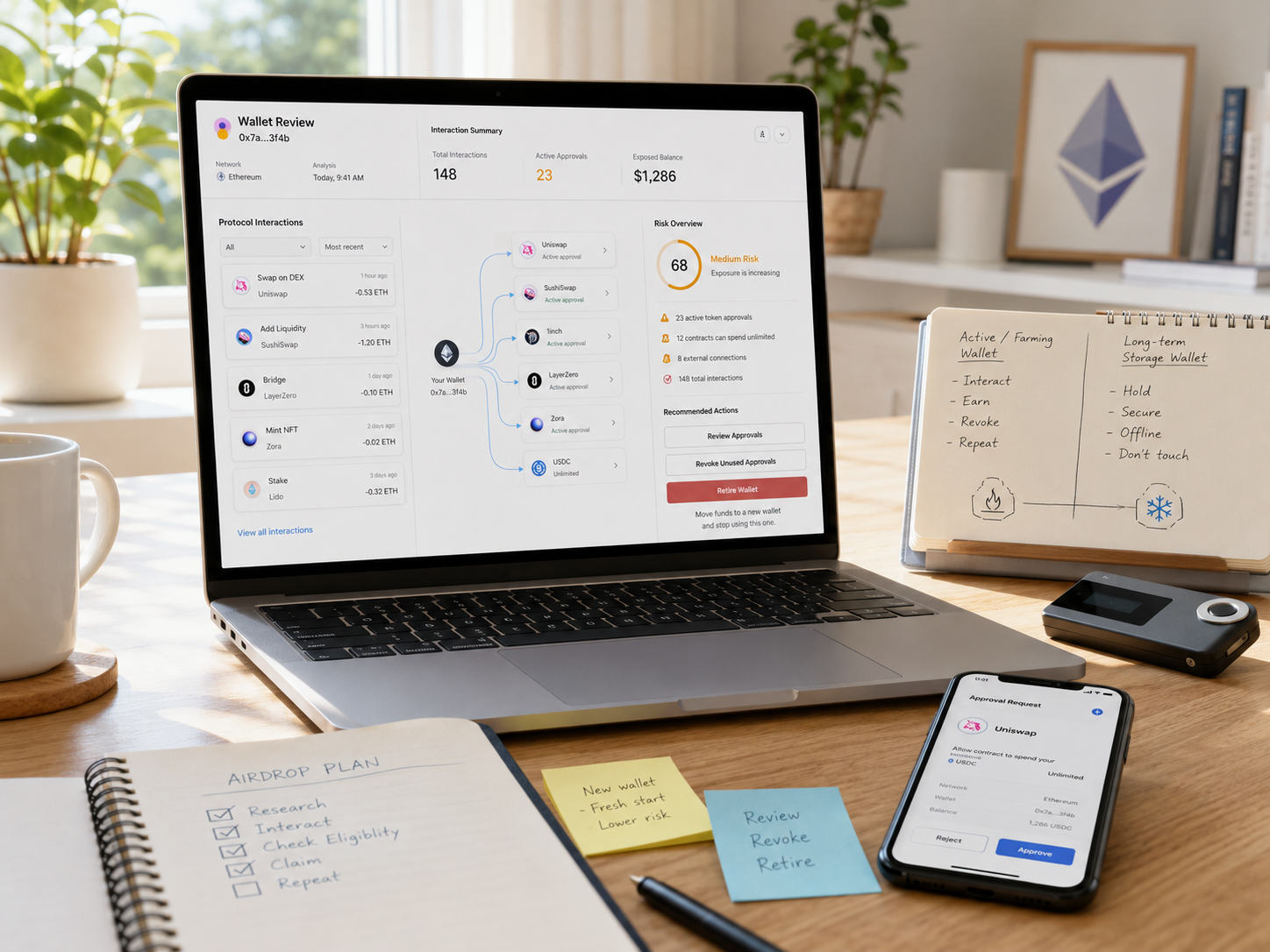
The greatest danger in airdrop farming is rarely one obviously malicious website.
It is the accumulation of ordinary-looking interactions.
A farmer may bridge assets to a new network, trade on an unfamiliar DEX, provide a small amount of liquidity, sign an eligibility message, mint a test asset, approve a token, and return several weeks later to repeat the process. Each action may appear reasonable on its own, especially when the protocol is gaining attention and thousands of other users are doing the same thing.
Over time, however, the wallet becomes harder to understand. It collects approvals, signatures, contract interactions, bridge routes, unknown tokens, and positions spread across several ecosystems. The owner may still control the wallet, but the number of assumptions required to trust it keeps increasing.
That is the real airdrop farming wallet risk.
Airdrop farming rewards activity. Good wallet security usually rewards restraint. Farmers are encouraged to interact early, use more features, return frequently, and experiment with new protocols, while secure wallet management favors fewer contracts, smaller exposed balances, clear wallet roles, and deliberate signing.
The conflict between those two incentives explains why even experienced users can slowly weaken their security without noticing a single dramatic failure.
Airdrop Farming Changes the Wallet’s Risk Profile
A normal investment wallet might receive assets, make occasional transfers, and interact with a limited number of established services. Its history remains relatively easy to review.
A farming wallet behaves differently. It may interact with several bridges, DEXs, lending protocols, staking platforms, testnets, points programs, NFT applications, and claim interfaces in the same month. It is frequently connected to new front ends and asked to approve actions that look similar to previous transactions.
This creates more than technical exposure. It creates operational pressure.
The user has to remember which campaign is genuine, which network is expected, which contract was previously approved, which address belongs to which project, and what each signature is intended to authorize. The more campaigns enter the workflow, the harder it becomes to apply the same level of attention to every interaction.
Airdrop farming wallet risk therefore grows in two directions at once:
- The wallet interacts with more technical systems.
- The person controlling it becomes more likely to rely on habit.
The second problem is often more dangerous than the first.
The Farmer’s Paradox
Airdrop farmers are often rewarded for behaviors that security professionals would normally try to limit.
| Early protocol interaction | Waiting for more verification |
| More transactions | Fewer unnecessary transactions |
| Multiple ecosystems | Controlled network exposure |
| Repeated signatures | Deliberate signing |
| Capital deployment | Limited exposed balances |
| Long activity histories | Simple and auditable wallets |
| Fast campaign discovery | Independent source verification |
This does not mean that every farming activity is unsafe. It means that the incentives are misaligned.
A user may interact with a protocol not because the product is useful, but because inactivity could reduce eligibility. They may leave capital deposited longer than planned because snapshots are unpredictable. They may repeat low-value transactions simply to create visible activity.
The possible reward remains unknown, but the gas costs, permissions, contract exposure, and time commitment are immediate.
This is the farmer’s paradox: the actions that may improve eligibility can also make the wallet progressively harder to secure.
1. Repetition Makes Sensitive Actions Feel Routine
A wallet signature should be treated as an authorization event.
During intensive farming, it can start to feel like a login button.
The user connects, selects an account, checks the network, sees a familiar interface, and confirms. After dozens of similar interactions, the sequence becomes automatic. Instead of reading what is being requested, the user recognizes the visual pattern and assumes that the next action is equivalent to the previous one.
That is exactly when a misleading request becomes dangerous.
A button labelled “Verify,” “Check Eligibility,” or “Claim” does not describe the actual permission being authorized. The webpage controls the wording on the screen, while the wallet request determines what the user is really signing.
A legitimate claim may require a normal transaction or a harmless eligibility signature. A malicious page may request token access, an unfamiliar contract interaction, or a signature with consequences that are not immediately visible.
The more frequently a farmer signs, the more important it becomes to separate the website’s explanation from the wallet’s request.
Familiarity should never replace interpretation.
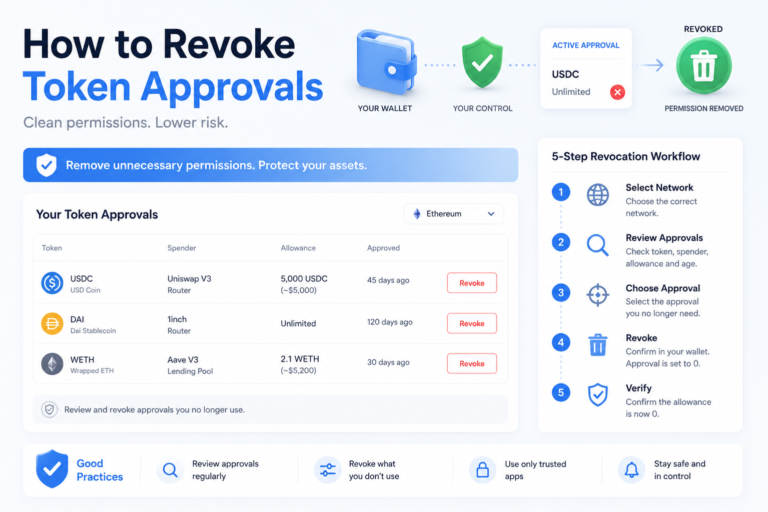
2. Token Approvals Create Permission Debt
Many DeFi interactions require token approvals. A user may need to authorize a router, staking contract, bridge, marketplace, or lending protocol before the requested action can occur.
These approvals are not automatically suspicious. They are part of normal Web3 activity.
The problem is accumulation.
A farming wallet may approve one contract for a swap, another for a bridge, another for liquidity provision, and several more for campaigns that are abandoned a few weeks later. Some permissions remain active even after the user disconnects from the website or stops using the protocol.
This creates permission debt.
Permission debt is the growing collection of authorizations that the wallet owner can no longer explain confidently. The user may remember the project name but not the spender contract, the approved amount, or whether the permission is still necessary.
An old approval does not guarantee a future loss. The risk is that the wallet’s security now depends on contracts and permissions that are no longer being actively monitored.
The problem becomes more serious if the farming wallet later receives valuable tokens. A permission that once applied to an almost empty wallet may suddenly become relevant after a successful claim or a new deposit.
Approval management should therefore be part of the campaign lifecycle, not an emergency reaction after an exploit.
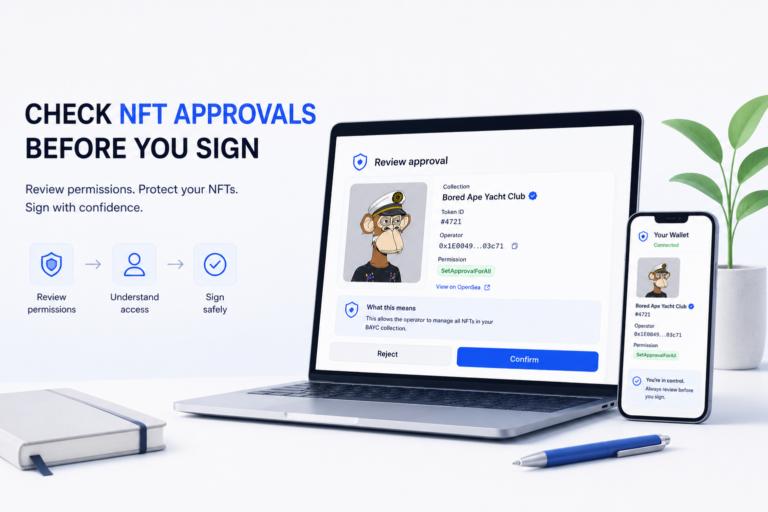
BlockCodex explains the review process in How to Check Token Approvals Before Using DeFi.
3. The Wallet Becomes Too Complicated to Audit
A healthy operational wallet should be understandable.
The owner should be able to explain which protocols it uses, why its main approvals exist, where its funds are deployed, and what recent transactions were intended to accomplish.
A heavily farmed wallet can lose that clarity.
Its history may include:
- Bridges across several networks.
- Small deposits in forgotten protocols.
- Multiple token approvals.
- Permit-style signatures.
- Testnet-related activity.
- Unclaimed rewards.
- Spam tokens and NFTs.
- Positions that no longer appear in the original interface.
- Contracts that have since been renamed, migrated, or abandoned.
Nothing in that list proves that the wallet is compromised. The issue is that the owner can no longer distinguish normal complexity from abnormal activity quickly.
This is interaction debt: the accumulated history of actions that remains technically visible but practically difficult to reconstruct.
When a suspicious transaction appears, the owner has to search through months of unrelated farming activity. That delay makes incident response harder and increases the chance of misclassifying a real warning as another harmless interaction.
The most dangerous farming wallet is not always one that has already lost funds. It may be one whose owner no longer understands well enough to trust.
4. Incentives Can Override Normal Risk Judgment
Points systems, seasons, streaks, multipliers, referrals, and speculative snapshots are designed to influence behavior.
They give users a reason to return, try additional features, increase volume, or keep funds inside a protocol. The final reward may not yet exist, and the eligibility rules may remain unclear, but the fear of missing out encourages continued participation.
This can distort normal decision-making.
A farmer may use a bridge they would not otherwise trust, deposit capital into a protocol they have barely researched, or sign an unfamiliar request because the campaign is approaching a rumored deadline. They may also continue interacting after the expected value of the reward has fallen below the cost and risk of participation.
A useful question is: Would I perform this action if no airdrop were expected?
A “no” does not automatically mean the action should be avoided. It does reveal that the incentive, rather than the product’s usefulness, is driving the decision.
That distinction matters because hypothetical rewards can make real exposure feel less important than it is.
For a better way to filter opportunities before adding them to a wallet, see How to Find Legit Crypto Airdrops.
5. Multiple Wallets Do Not Automatically Create Real Separation
Farmers sometimes create several wallets to increase eligibility or separate campaigns.
More addresses can reduce exposure, but only when the wallets are managed independently.
If ten wallets receive funds from the same source, interact with the same applications in the same order, transact within similar time windows, and send rewards to one destination, they may form an obvious behavioral cluster.
The wallets are technically separate but operationally connected.
This has two consequences.
First, projects may identify the pattern as coordinated or Sybil-like activity and exclude the wallets from distribution. Second, the public transaction history may reveal relationships between addresses that the owner intended to keep separate.
A wallet structure is only as strong as the behavior around it.
Meaningful segmentation requires more than clicking “Create Account.” It requires clear roles, controlled funding routes, separate balances, accurate records, and deliberate movement between wallets.
6. Successful Farming Can Turn a Disposable Wallet Into a Valuable Target
Most farming wallets begin with a sensible design.
They hold a small gas balance, limited testing capital, and no important long-term assets. The owner can abandon them without serious financial damage.
Then a campaign pays.
The wallet receives a meaningful allocation. The user decides to keep the tokens there while waiting for a better price. Another reward arrives later, followed by a staking position or a small DeFi strategy. Gradually, the wallet designed for uncertain interactions becomes valuable.
Its balance changes, but its security history does not.
The wallet still contains old approvals, experimental contract interactions, unknown tokens, and signatures accumulated during months of farming. What was once a low-value operational wallet has become a high-value wallet with a high-interaction history.
That transition should trigger action.
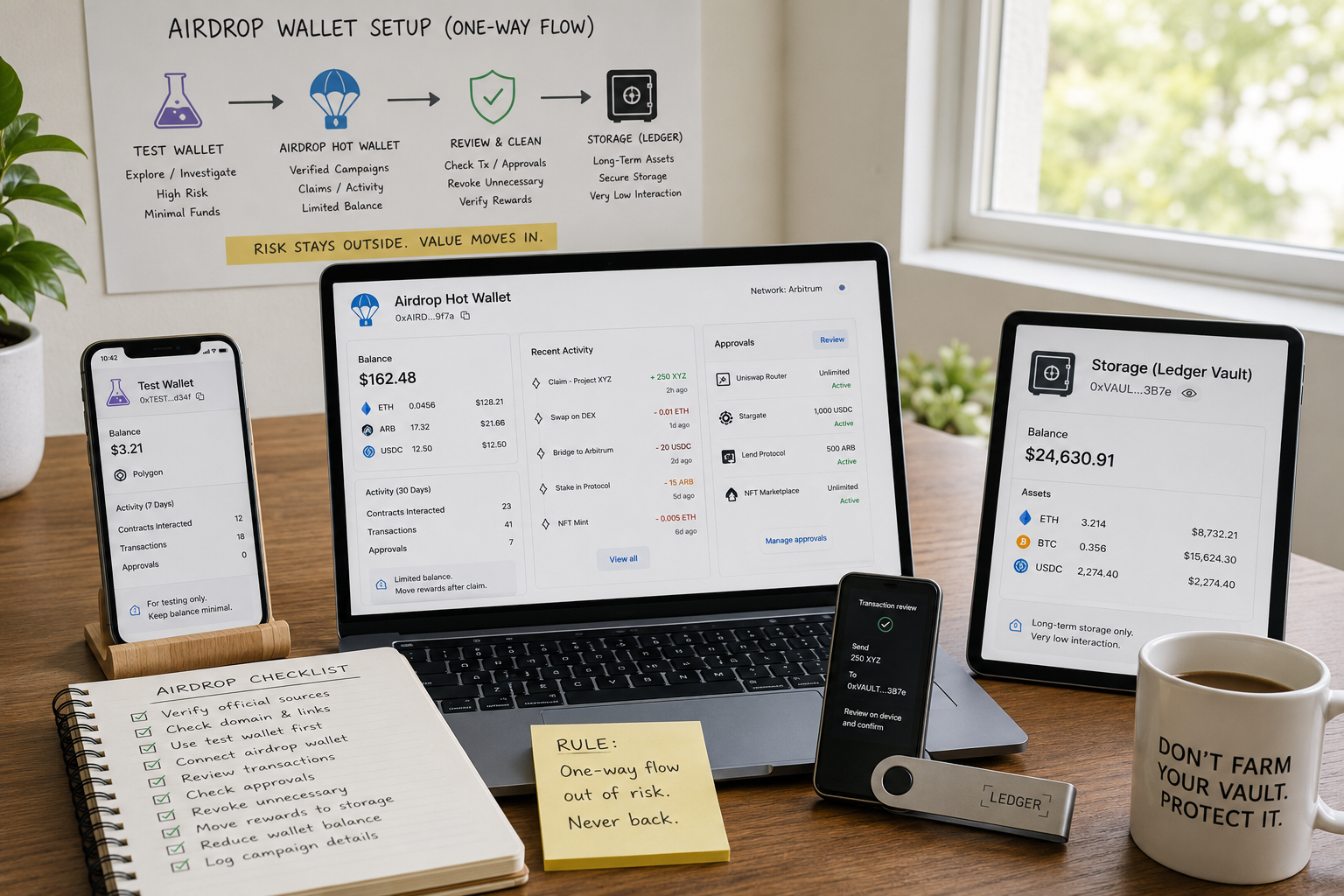
Meaningful rewards should normally be moved to a wallet designed for safer storage after the claim has been verified and any necessary review completed. The farming wallet can then return to a limited operational balance.
An airdrop wallet should remain a quarantine zone for uncertain interactions, not evolve into a second main portfolio.
A wallet’s role should determine what it holds.
A successful claim should not erase that distinction.
7. Campaign Sprawl Creates Verification Fatigue
Airdrop farming can involve dozens of information sources:
- Official websites.
- Documentation pages.
- X accounts.
- Discord servers.
- Telegram channels.
- Community spreadsheets.
- Eligibility tools.
- Bridge interfaces.
- Portfolio dashboards.
- Token approval checkers.
- Claim calendars.
The user must distinguish real announcements from impersonation, verify domains, identify the correct network, track wallet eligibility, and remember which campaign belongs to which address.
This creates verification fatigue.
A fraudulent page does not need to fool the user every day. It needs to appear convincing during one distracted moment. The more campaigns the farmer follows, the more opportunities exist for that moment to occur.
The solution is not necessarily a larger tracking system.
It is often a narrower research funnel.
A strong farmer rejects most opportunities early. They prioritize campaigns with credible teams, meaningful products, understandable eligibility logic, established official channels, and a reasonable relationship between potential reward and required exposure.
Following fewer campaigns can produce a cleaner wallet, lower gas costs, stronger verification, and better risk-adjusted outcomes.
More activity is not always better farming.
Treat Every Farming Wallet as a Temporary Environment
A farming wallet should not be assumed to remain trustworthy forever.
Its role is temporary and operational. It exists to interact with a defined group of campaigns while holding limited value. As its history grows, the cost of reviewing and maintaining it also grows.
A better model gives each wallet a lifecycle:
- Creation: The wallet receives a clear purpose and a limited budget.
- Active use: Campaigns and protocol interactions are recorded.
- Review: Approvals, balances, signatures, and positions are checked regularly.
- Cleanup: Unnecessary permissions are removed and rewards are transferred.
- Retirement: New activity stops when the wallet becomes too complex or exposed.
This model avoids the common assumption that one farming wallet should be used indefinitely.
A clean replacement may eventually be safer than continuing to repair a wallet whose history has become difficult to interpret.
Give Every Wallet a Risk Budget
Farmers usually define a gas budget and a capital budget.
They should also define a risk budget.
A practical risk budget can include four limits:
| Risk Limit | Question to Answer |
|---|---|
| Capital limit | How much value may remain before rewards must be moved? |
| Interaction limit | How many unfamiliar protocols should the wallet use? |
| Permission limit | Can every active approval still be explained? |
| Complexity limit | Can the wallet’s recent activity be reconstructed confidently? |
These limits do not need to be identical for every investor. Their purpose is to make wallet deterioration visible before an incident occurs.
For example, a user might decide that a farming wallet will never hold more than a defined amount, that approvals will be reviewed after each campaign, and that the wallet will be retired at the end of a farming season.
That is more effective than relying on a vague promise to “be careful.”
A risk budget turns security into an operating rule.
Every Campaign Needs a Closing Procedure
Farmers are usually disciplined about entering campaigns. They are less consistent about closing them.
A campaign should not be considered finished when the claim transaction confirms. It should be considered finished when the resulting exposure has been reviewed.
A practical closing procedure includes:
- Verify the claim transaction on the correct block explorer.
- Confirm that the received token matches the official contract.
- Review new token and NFT permissions.
- Revoke permissions that are clearly unnecessary.
- Move meaningful rewards to an appropriate wallet.
- Record whether any positions or balances remain in the protocol.
- Decide whether the farming wallet remains suitable for future use.
This process prevents a completed campaign from leaving permanent, forgotten exposure behind.
It also makes future tax, portfolio, and security reviews easier because the user retains a record of what happened and why.
When a Farming Wallet Should Be Retired
A wallet does not need to be visibly compromised before retirement becomes reasonable.
Retirement may be the better option when:
- Its active approvals are difficult to explain.
- It has interacted with too many unfamiliar contracts.
- Its transaction history has become confusing.
- The owner cannot reconstruct old signatures.
- It contains persistent spam assets or suspicious interactions.
- Its wallet relationships reveal more than intended.
- It has become too valuable for continued experimentation.
- Reviewing it takes more effort than replacing it.
Retirement does not mean deleting the wallet or abandoning legitimate assets. It means stopping new activity, transferring meaningful value, resolving relevant permissions, and keeping the address only as a historical record.
The purpose is to restore a clear risk boundary.
A Practical Airdrop Farming Security Standard
A disciplined farming setup should meet a simple standard:
- Every wallet has one defined role.
- Long-term holdings do not interact with farming campaigns.
- Farming balances remain intentionally limited.
- Campaigns are verified through official channels.
- Wallet requests are interpreted before approval.
- Active token permissions are reviewed regularly.
- Each campaign has a closing procedure.
- Valuable rewards leave the farming environment.
- Wallet relationships are managed deliberately.
- Complex or dirty wallets are retired.
- Opportunities are filtered by quality, not only potential reward.
No system can make experimental crypto activity risk-free.
The objective is to prevent dozens of small uncertainties from accumulating unnoticed inside one increasingly valuable wallet.
The Human Layer Remains the Main Control
Hardware wallets, security alerts, approval tools, simulations, and block explorers can all improve protection.
None of them can decide whether an action makes sense for the user.
A wallet can accurately display the contract, network, token, and requested permission while the user still approves the wrong action. Private keys can remain perfectly protected while a malicious transaction is authorized from the legitimate device.
That is why many crypto security failures occur at the decision layer rather than through direct key theft.
Self-custody requires more than protecting access.
It requires protecting intent.
Airdrop farming increases the number of moments in which that intent must be expressed correctly. The best defense is therefore a combination of limited exposure, clear wallet roles, independent verification, and enough friction to prevent automatic signing.
Final Thoughts
Airdrop farming wallet risk rarely arrives as one dramatic event. It builds through repetition.
Every new protocol, bridge, signature, approval, and campaign adds another assumption to the wallet. Most of those interactions may remain harmless, but the owner must still understand and maintain the exposure they create.
The strongest farming strategy treats wallets as temporary operational environments. Each wallet has a limited balance, a defined purpose, a permission budget, and a retirement plan. Campaigns are verified before interaction and closed with a review afterward, while valuable rewards move away from high-interaction addresses.
This approach may reduce the number of campaigns an investor can farm at once. That is not necessarily a disadvantage. Fewer, better-researched opportunities can produce a cleaner workflow and a stronger relationship between potential reward and actual risk.
Airdrop farming rewards activity.
Security depends on knowing when enough activity has already occurred.