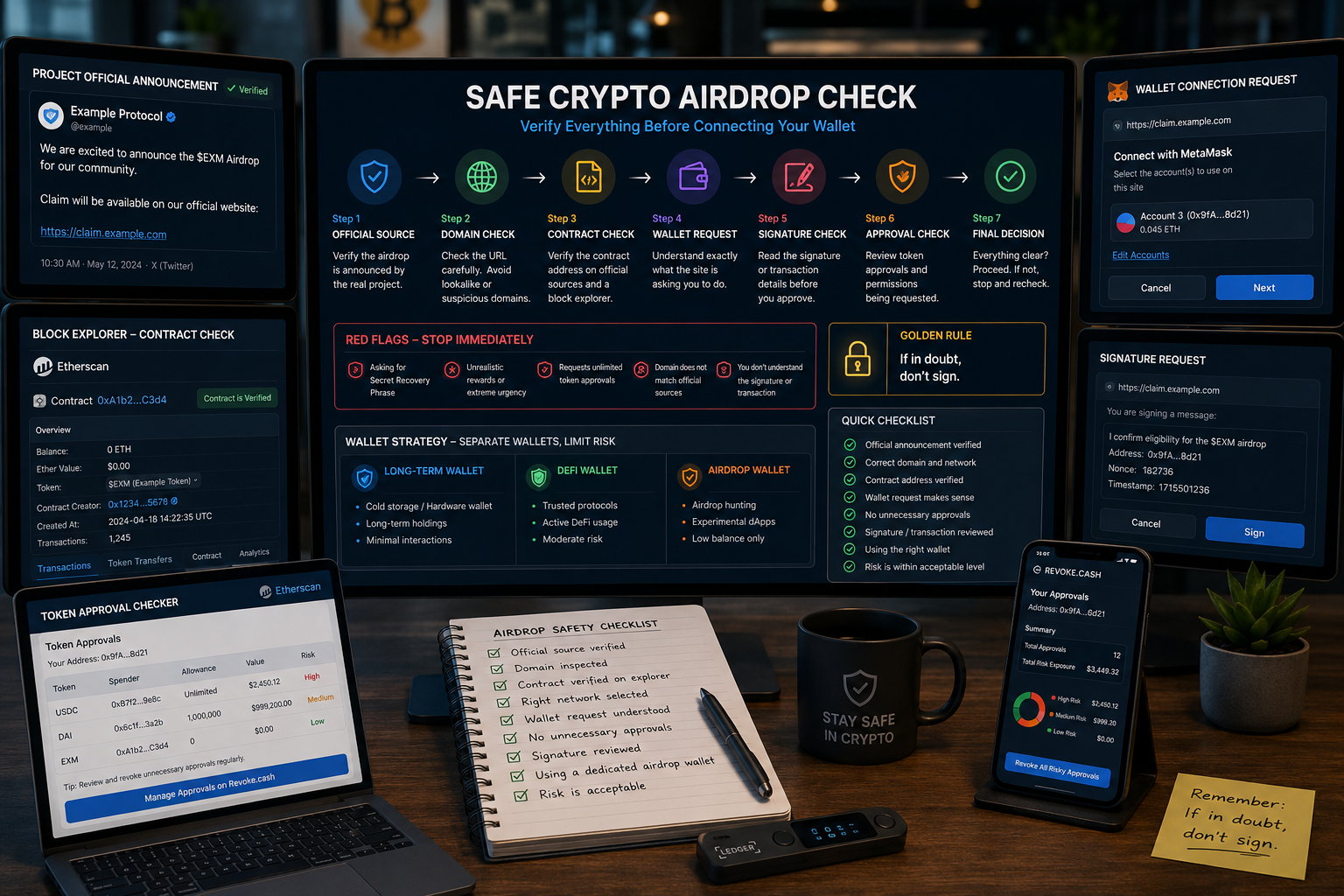
A safe crypto airdrop check should happen before the wallet connection, not after a suspicious signature request appears.
That distinction matters because fake airdrops are designed to create momentum. The user sees an eligibility announcement, a countdown, an unexpected token allocation, or a message claiming that a claim window is about to close. The page may look polished, the branding may be convincing, and the wallet connection button may feel like a routine step.
The real risk often appears later in the interaction.
A fraudulent page may impersonate a legitimate project, redirect users toward a fake claim interface, request access to unrelated tokens, or persuade the wallet owner to sign a transaction or message that has consequences they do not understand. MetaMask specifically warns that fake airdrops are commonly used in phishing and scam campaigns, while Ledger advises users to verify airdrop campaigns through official channels and remain cautious of fraudulent sites designed to imitate legitimate claims.
The safest approach is therefore not to ask only whether an airdrop looks genuine.
The better question is:
Can I independently verify the project, claim route, contract, wallet request, and risk exposure before I interact?
This guide provides a repeatable process for doing exactly that.
Table of Contents
What a Safe Crypto Airdrop Check Should Actually Verify
A proper safe crypto airdrop check is broader than checking the project name on X or searching for the token on CoinGecko.
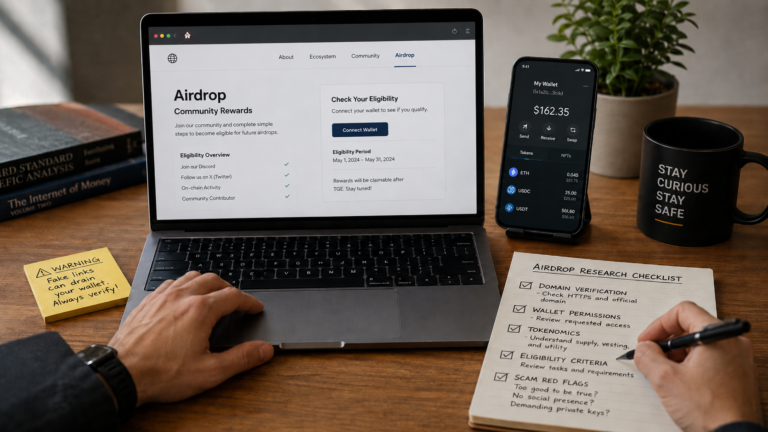
A useful process should verify several independent layers:
| Check | What You Are Trying to Confirm |
|---|---|
| Announcement source | The campaign was actually announced by the real project. |
| Domain | The claim page belongs to the legitimate project. |
| Eligibility route | The claim method matches official documentation. |
| Contract | The interacting contract is the expected one. |
| Wallet request | The requested action makes sense for the claim. |
| Token approvals | The site is not asking for unnecessary spending permissions. |
| Signature context | The message or transaction matches the intended action. |
| Wallet exposure | A mistake would not expose long-term holdings. |
| Post-claim permissions | No unnecessary approval remains active afterward. |
The objective is not to prove that every smart contract is mathematically safe. Most users cannot independently audit contract code, and even MetaMask notes that there is no simple method that guarantees a smart contract is safe without deep technical review. The purpose of the checklist is to identify contradictions, unnecessary permissions, impersonation signals, and avoidable wallet exposure before they become losses.
Step 1: Start From the Official Project, Not the Claim Link
The safest way to investigate an airdrop is to work backward from the official project presence.
Do not begin by trusting the link that introduced you to the opportunity.
An airdrop link may arrive through:
- X or another social network.
- Telegram.
- Discord.
- Email.
- A sponsored search result.
- A direct message.
- A community group.
- An unexpected token or NFT in a wallet.
- A copied article or unofficial claim guide.
Even when the message appears to come from a known project, verify the campaign independently. Social accounts can be impersonated, community accounts can spread copied links, and phishing pages can reproduce the visual identity of legitimate protocols.
Ledger’s current wallet security guidance identifies fake airdrop announcements as a phishing method and warns that scammers may use sponsored advertisements and social media distribution while copying the branding of legitimate projects.
A better process is:
- Open the project website through a source you have independently verified.
- Navigate to its official documentation or announcement page.
- Confirm that the airdrop or claim event is actually mentioned.
- Compare the official claim domain with the link you received.
- Check whether the project explains eligibility, dates, supported networks, and claim steps consistently.
This may feel slower than clicking directly on a trending link.
That is the point.
Airdrop scams benefit from speed. Verification benefits from friction.
For a broader opportunity-research framework, see BlockCodex’s guide on “How to Find Legit Crypto Airdrops“.
Step 2: Inspect the Domain Character by Character
A professional-looking website proves very little.
Modern phishing pages can reproduce logos, fonts, dashboards, wallet connection flows, token allocation screens, and countdown timers convincingly. The domain is therefore one of the first details that deserves direct attention.
Before connecting a wallet, check:
- The spelling of the main domain.
- The top-level domain.
- Whether there are additional words or hyphens.
- Whether the site uses an unexpected subdomain.
- Whether the official documentation links to that exact claim page.
- Whether you arrived through a redirect.
- Whether the wallet prompt displays the expected site origin.
MetaMask’s signature-phishing guidance recommends checking the URL shown when a site requests a signature and conducting additional research when the origin is unexpected or differs from the site the user intended to interact with.
Do not judge a URL by how close it looks to the original.
Compare it exactly.
For example, the difference between an official project domain and a phishing page may be one substituted character, an extra word, or an unfamiliar extension. The visual design can be copied almost perfectly while the domain remains the clearest contradiction.
Bookmarks can help for protocols you use regularly. When an important claim becomes available, navigating from a previously verified official site is safer than searching for the claim page under time pressure.
Step 3: Check Whether the Claim Process Makes Sense
A legitimate airdrop claim should have an understandable relationship between the campaign and the requested action.
Suppose a protocol says that historical users can claim a governance token. It may be reasonable for the site to ask the user to connect the eligible wallet, verify the address, and execute a claim transaction.
By contrast, the following situations deserve immediate scrutiny:
- A claim page asks to approve spending of USDC.
- An NFT airdrop requires access to unrelated fungible tokens.
- A free token claim asks for an unlimited token allowance.
- The site asks for a Secret Recovery Phrase.
- The requested network differs from the campaign network.
- The transaction involves an unfamiliar asset unrelated to the claim.
- The wallet request changes significantly after connecting.
MetaMask explains that token approvals give a dApp permission to access and move a specific token, and it advises users to check the requesting dApp, contract address, and spending cap before granting approval.
The safest principle is simple: the requested wallet action should be logically connected to the action you intend to perform.
When the relationship is unclear, stop before signing.
Step 4: Understand the Difference Between Connecting and Approving
Many users treat every wallet interaction as one thing, but connecting a wallet and granting spending permission are different actions.
According to MetaMask, connecting a wallet to a dApp allows the site to see the public account address and the publicly visible information associated with that address. A basic connection alone does not give the site permission to move tokens; moving assets requires additional consent, such as a token approval or signed transaction.
This distinction helps investors react proportionately.
A suspicious wallet connection should still be disconnected and investigated, but the first question after a potentially risky interaction should be:
What did I actually sign or approve?
Review:
- Token approvals.
- NFT operator approvals.
- Transactions.
- Signed messages.
- Permit-style authorizations.
- Network used.
- Contract involved.
The risk depends on the interaction.
This is particularly important because modern phishing attacks do not always look like traditional token approval transactions. Signature-based phishing can also create harmful permissions, which is why the content and context of a signature request matter. MetaMask documents several signature-phishing patterns and advises users to verify the requesting URL and revoke harmful permissions where applicable.
Connecting is not a reason to stop thinking.
It is the point where scrutiny should increase.
Step 5: Verify the Contract and Token on a Block Explorer
When an airdrop involves an on-chain contract, a blockchain explorer can add an important verification layer.
For Ethereum, Etherscan allows users to search addresses, transactions, tokens, and contracts. Its token pages can show information such as transfers, holders, supply, and related token data, while verified-contract pages provide additional context for contract review.
A practical contract check can include:
- Does the official project documentation publish a contract address?
- Does the address match the one shown by the wallet?
- Is the contract verified on the explorer?
- Does the contract have a recognizable label or history?
- When was it deployed?
- What does recent activity look like?
- Are there suspicious comments or warnings?
- Does the token contract match official project sources?
MetaMask recommends looking up smart-contract addresses on the relevant block explorer and comparing the contract information with official project sources. It also notes that contract verification is useful context but should not be treated as an absolute guarantee of safety.
The strongest verification comes from consistency across independent sources.
The project documentation, wallet request, explorer contract page, and campaign announcement should tell the same story.
A mismatch between them is more important than a polished claim page.
Step 6: Review Token Approvals Before and After the Claim
Token approvals deserve special attention because an airdrop scam may use the promise of a reward to obtain spending permissions over valuable assets.
MetaMask defines a malicious token approval as excessive or dangerous permission granted to a malicious dApp or contract. Its guidance notes that such approvals can provide unauthorized spending access, with unlimited allowances increasing potential exposure when granted to a malicious spender.
Before claiming, review the existing approval environment of the wallet.
After claiming, check whether a new permission was created.
Useful tools include the Etherscan Token Approval Checker for Ethereum and Revoke.cash for multi-network approval management. Etherscan lists contracts approved to spend an address’s tokens and displays the assets potentially exposed to approved spenders, while Revoke.cash supports approval review and revocation across more than 100 networks.
Look for:
- Unknown spenders.
- Unexpected approvals.
- Unlimited allowances.
- Permissions involving unrelated tokens.
- Approvals created during the claim process.
- Old permissions from sites you no longer use.
A useful approval review does not mean revoking every permission automatically. Some reputable DeFi applications legitimately use approvals, including large allowances for operational convenience.
The analytical question is whether the permission is necessary, understandable, and granted to the intended contract.
For a full workflow, see BlockCodex’s guide on “How to Check Token Approvals Before Using DeFi“.
Step 7: Treat Unexpected Tokens and NFTs as Leads, Not Gifts
One dangerous assumption in crypto is that anything appearing in a wallet belongs to the user in a meaningful economic sense.
Public wallet addresses can receive unsolicited tokens or NFTs. Scammers exploit this by sending assets that contain promotional names, URLs, or instructions designed to move users toward fraudulent websites.
MetaMask explicitly advises users not to interact casually with unexpected NFTs and warns that such assets may direct users toward phishing sites that request a Secret Recovery Phrase or fraudulent signature. Its token-safety guidance similarly warns that unsolicited tokens can be used to redirect users toward deceptive sites.
Ledger also documents malicious or unknown NFT campaigns and advises users to avoid interacting with suspicious assets received unexpectedly.
When an unexpected asset appears:
- Do not visit the URL displayed in its name or description.
- Do not attempt to “unlock” its value through an unknown website.
- Do not enter a recovery phrase anywhere.
- Verify whether the real project announced a distribution.
- Check the contract through an explorer if investigation is necessary.
- Avoid unnecessary interaction with the asset.
The safest response to an unexpected token is often to leave it alone until its origin and purpose are understood.
Curiosity is valuable in research.
It should not automatically become wallet interaction.
Step 8: Use Wallet Separation to Limit the Consequences of a Mistake
No checklist removes all risk.
A fake site can be sophisticated. A legitimate project can have a compromised front end. A user can misunderstand a wallet prompt. A rushed decision can happen even after years of experience.
That is why wallet architecture matters.
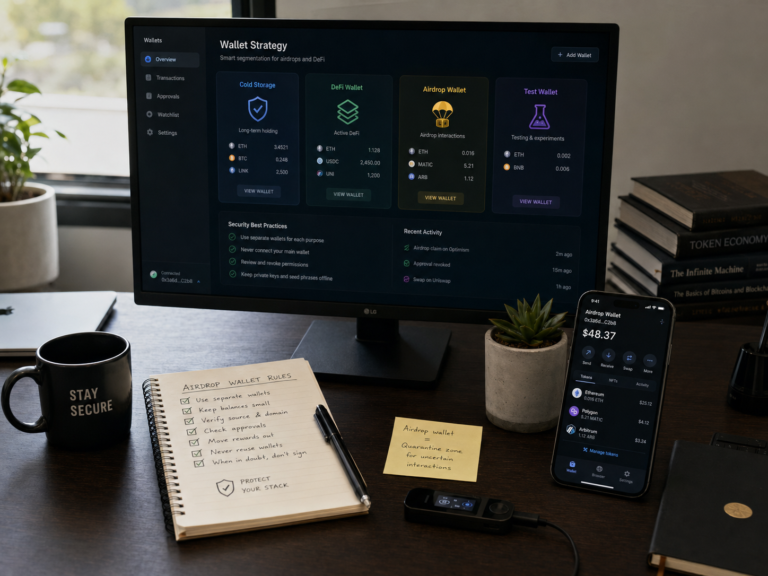
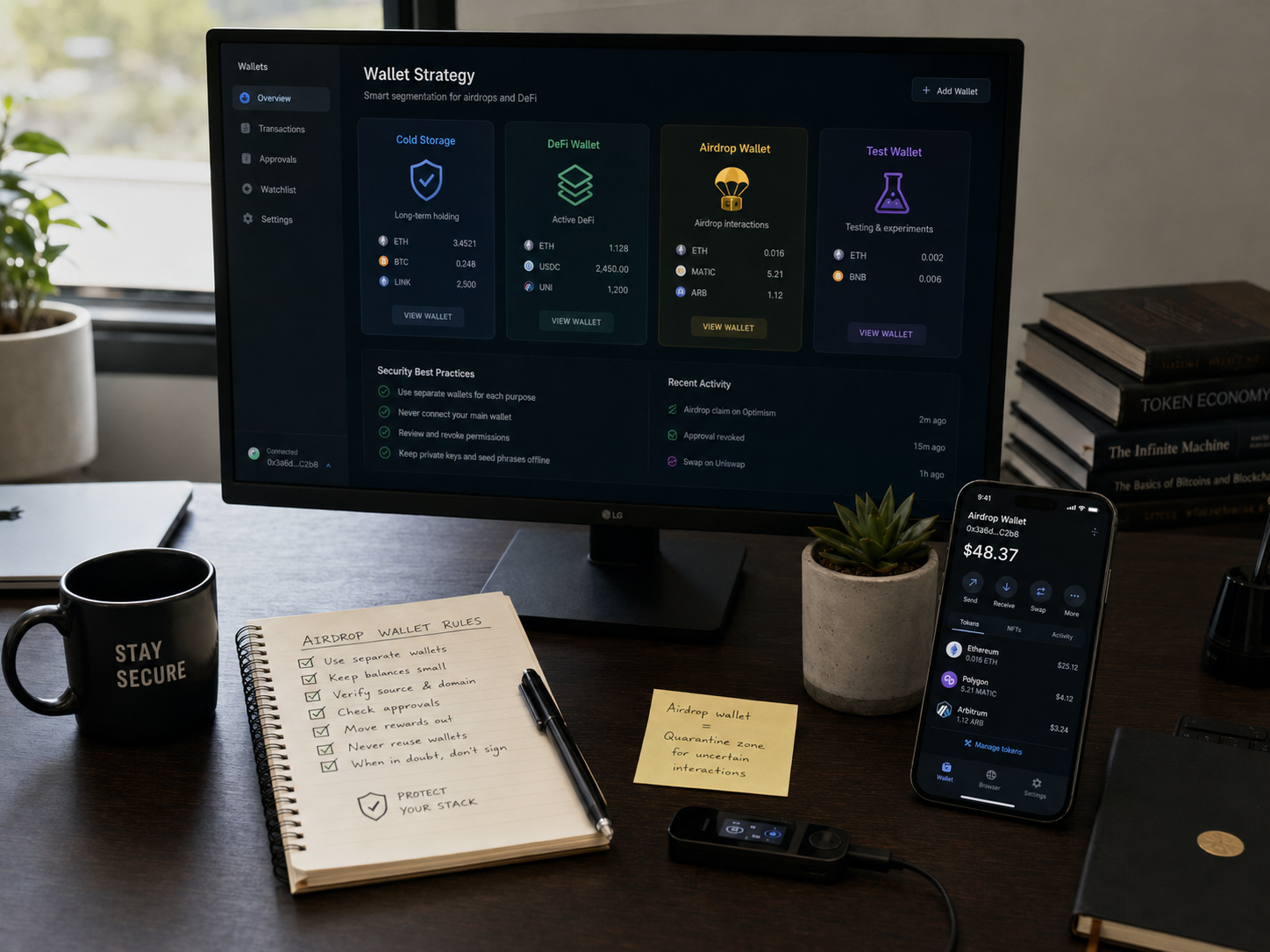
The wallet used for airdrop hunting should not automatically be the same wallet that holds long-term assets.
A practical structure may include:
| Wallet Type | Main Purpose | Interaction Level |
|---|---|---|
| Cold storage wallet | Long-term holdings | Very low |
| DeFi wallet | Established protocol activity | Moderate |
| Airdrop wallet | Claims and eligibility activity | Higher |
| Test wallet | Unknown or experimental dApps | Very high |
The objective is not to create a complicated collection of addresses.
It is to reduce the blast radius of a mistake.
An airdrop opportunity worth a few hundred dollars should not require exposing a wallet holding a significant long-term portfolio. Even when the campaign is legitimate, unnecessary concentration creates avoidable risk.
This approach is covered in more depth in BlockCodex’s article on “Wallet Separation in Crypto“.
A good security process assumes that mistakes remain possible.
The portfolio structure should prevent one mistake from becoming a total loss.
Step 9: Perform a Final Safe Crypto Airdrop Check Before Signing
The final safe crypto airdrop check should happen when the wallet request is visible.
At this stage, pause and compare the full interaction with the information you verified earlier.
Check:
- Am I on the exact official domain?
- Did I independently confirm the campaign?
- Is the wallet address eligible through an official source?
- Am I connected to the expected network?
- Does the contract match official documentation?
- Does the transaction match a claim action?
- Is the page asking for access to unrelated tokens?
- Is a spending limit involved?
- Does the wallet show a security warning?
- Am I using the correct wallet for this level of risk?
MetaMask’s current security-alert system can display warnings for suspected phishing, impersonation, malicious addresses, and risky transactions. The company notes that these alerts use on-chain analysis and threat intelligence, but also makes clear that alerts are informational safeguards rather than guarantees that all threats will be detected.
Security warnings should be treated seriously, but the absence of a warning is not proof that a site is safe.
Your own verification process remains necessary.
Red Flags That Should Stop the Claim Process
Some signals are strong enough to justify stopping immediately.
The Site Requests Your Secret Recovery Phrase
A claim site does not need your recovery phrase.
MetaMask states that its wallet does not routinely require users to enter a Secret Recovery Phrase except in legitimate wallet setup or recovery circumstances. Any airdrop page requesting the phrase should be treated as hostile.
The Approval Does Not Match the Claim
A token claim should not require unexplained spending access to unrelated assets.
When the requested permission and intended action are disconnected, do not proceed.
The Domain Differs From Official Sources
A familiar logo cannot compensate for a mismatched domain.
The Campaign Exists Only Through DMs or Replies
A significant airdrop should be independently verifiable through official project channels.
The Page Creates Extreme Urgency
MetaMask identifies urgency, unrealistic rewards, impersonation, and unexpected messaging among warning signs associated with malicious approval scams.
An Unexpected NFT or Token Directs You to a Website
Treat the asset as unsolicited content rather than proof of eligibility.
The Wallet Requests a Signature You Cannot Explain
Do not sign simply because the button says “Verify,” “Check Eligibility,” or “Claim.” The wallet action matters more than the label on the webpage.
What to Do If You Already Connected to a Suspicious Airdrop Site
If you connected a wallet but did not approve or sign anything, first disconnect the site and review the wallet’s recent activity and permissions. A basic connection does not by itself authorize token movement, but you should confirm whether any additional approvals, signatures, or transactions were created during the interaction.
If you signed or approved something suspicious:
- Stop interacting with the site.
- Review recent transactions on a blockchain explorer.
- Check token and NFT approvals.
- Revoke suspicious permissions where possible.
- Consider moving exposed assets to a clean wallet when risk remains.
- Preserve transaction hashes and relevant evidence.
- Report the phishing domain through the relevant wallet, browser, project, or ecosystem reporting channels.
Revoke.cash explains that revocation removes active spending permissions but cannot recover funds that have already been stolen. Revocation is an on-chain action and therefore requires a transaction on the relevant network.
If the interaction appears related to a wallet drainer, BlockCodex’s guide on “What Is a Wallet Drainer in Crypto?“ explains how malicious claim pages and transaction requests can turn ordinary wallet interaction into an asset-loss path.
Safe Airdrop Research vs Safe Wallet Interaction
It is useful to separate two different questions.
The first is:
Is the project or campaign legitimate?
The second is:
Is this specific wallet interaction safe and necessary?
A real project does not automatically make every link claiming to represent it legitimate. Scammers frequently impersonate existing protocols precisely because users already recognize and trust the brand.
Similarly, an announced airdrop does not mean every claim interface is official.
Good airdrop research therefore has two stages.
Campaign Verification
Research:
- Official announcement.
- Eligibility criteria.
- Distribution mechanism.
- Timeline.
- Token contract.
- Official claim route.
Interaction Verification
Review:
- Exact domain.
- Connected network.
- Contract address.
- Wallet request.
- Signature content.
- Token approvals.
- Wallet exposure.
- Post-claim permissions.
This separation prevents a common mistake: proving that the airdrop exists and then assuming that the link in front of you must be safe.
Both layers need verification.
A Practical Airdrop Safety Workflow
A repeatable workflow is more reliable than relying on intuition.
Before Visiting the Claim Page
Confirm the campaign through official project sources and locate the claim route independently.
Before Connecting
Check the domain, network, campaign details, contract information, and the wallet being used.
After Connecting
Read every request carefully. Confirm that the action matches the claim process you verified.
Before Signing
Review the contract, token involved, spending permission, amount, network, and transaction purpose.
After Claiming
Verify the result on-chain, check new token approvals, and revoke permissions that are clearly unnecessary.
This workflow is intentionally slower than blind claiming.
Airdrop safety is not about being first to click.
It is about being able to explain every step before authorizing it.
How a Security Stack Supports Safer Airdrop Activity
Airdrop safety is stronger when it is part of a broader security system.
Useful layers include:
- Separate wallets by risk level.
- Hardware storage for long-term holdings.
- Offline recovery phrase protection.
- Browser and wallet security alerts.
- Approval review.
- Blockchain explorer verification.
- Reliable bookmarks for frequently used protocols.
- Limited balances in experimental wallets.
- Regular permission cleanup.
No single layer solves every problem.
A hardware wallet can protect private keys, but it cannot decide whether a transaction is sensible. An approval checker can reveal permissions, but it cannot prevent every phishing interaction. Wallet separation limits exposure, but it does not make a malicious site safe.
The purpose of a security stack is to prevent one failure from becoming catastrophic.
BlockCodex covers the broader framework in “Best Crypto Security Stack“.
Common Airdrop Safety Mistakes
Mistake 1: Trusting a Link Because the Project Is Real
A legitimate project can still be impersonated.
Mistake 2: Believing Wallet Connection and Approval Are the Same
They create different levels of access and should be investigated separately.
Mistake 3: Using a Main Wallet for Every Claim
This turns a small speculative opportunity into a portfolio-level security risk.
Mistake 4: Reading the Website Button Instead of the Wallet Request
“Claim” on the webpage does not tell you what the transaction actually authorizes.
Mistake 5: Treating Unexpected Tokens as Free Money
Unsolicited assets can be used to push users toward phishing pages.
Mistake 6: Ignoring Existing Approvals
A wallet with years of DeFi activity may already have extensive permissions before a new claim begins.
Mistake 7: Assuming No Warning Means No Risk
Security alerts help, but detection systems are not guarantees.
Mistake 8: Rushing Because the Claim Window Appears Limited
Time pressure weakens verification precisely when verification is most important.
Final Thoughts
A safe crypto airdrop check is not about finding one badge, one website, or one tool that guarantees an opportunity is legitimate.
A reliable process combines independent campaign verification with careful wallet interaction. The project announcement, domain, contract, network, transaction request, token approvals, and wallet exposure should form one consistent story. When those elements contradict each other, the contradiction deserves more attention than the promised reward.
The strongest habit is to slow the process down before authorization. Research the campaign through official sources, inspect the exact wallet request, verify important contracts through blockchain explorers, and keep long-term assets separated from higher-risk claim activity.
Airdrops can be legitimate opportunities, but the possibility of receiving free tokens should never lower the standard of evidence required before signing.
The most important question is not whether the claim looks profitable.
It is whether you understand exactly what your wallet is being asked to authorize.