Knowing whether a blockchain ecosystem growing is not as simple as checking token price.
A token can rise because of speculation while the ecosystem remains weak.
A chain can process many transactions while real economic activity stays limited.
A protocol can attract TVL because of incentives, not durable demand.
A community can look active on social media while users are not returning on-chain.
That is why investors need a clearer framework.
A blockchain ecosystem is growing when more users, developers, applications, liquidity, stablecoins, fees, and real use cases begin reinforcing each other over time.
Growth is not one metric.
It is a pattern.
DeFiLlama tracks chain-level TVL, fees, revenue, DEX volume, stablecoin market cap, active addresses, new addresses, and transactions across hundreds of blockchains, which makes it useful for comparing ecosystem-level activity.
But even those metrics need interpretation.
A growing ecosystem should not only look active.
It should become more useful, more liquid, more resilient, and more economically relevant.
The real question is:
Are users and capital doing more inside the ecosystem over time?
That question is the foundation of ecosystem analysis.
Table of Contents
What Blockchain Ecosystem Growth Really Means
Blockchain ecosystem growth means that a network is developing beyond basic token speculation.
It usually includes several layers:
- More active users.
- More returning users.
- More useful applications.
- More developer activity.
- More stablecoin liquidity.
- More DeFi depth.
- More transaction demand.
- More fees from real usage.
- More integrations.
- Better liquidity across protocols.
- Stronger retention after incentives fade.
A weak ecosystem may have short bursts of activity.
A stronger ecosystem builds repeatable activity.
That difference matters.
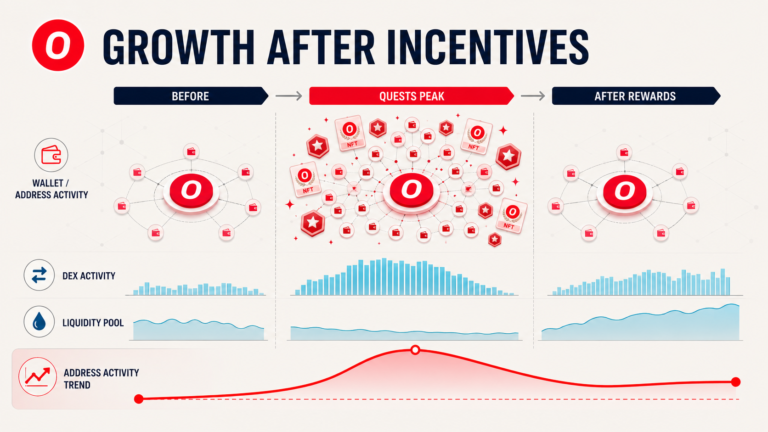
For example, a chain may launch a large incentive campaign and attract temporary liquidity. That can boost TVL and transactions quickly. But if users leave when rewards decline, the growth was not durable.
A better signal appears when users stay, applications keep generating activity, stablecoin liquidity improves, developers continue shipping, and fees or revenue increase with usage.
This is why BlockCodex’s article on What Drives Growth in Crypto Ecosystems? focuses on the interaction between users, liquidity, developers, infrastructure, and applications.
Ecosystem growth is not about one spike.
It is about the system becoming more useful.
Blockchain Ecosystem Growing Signals to Track
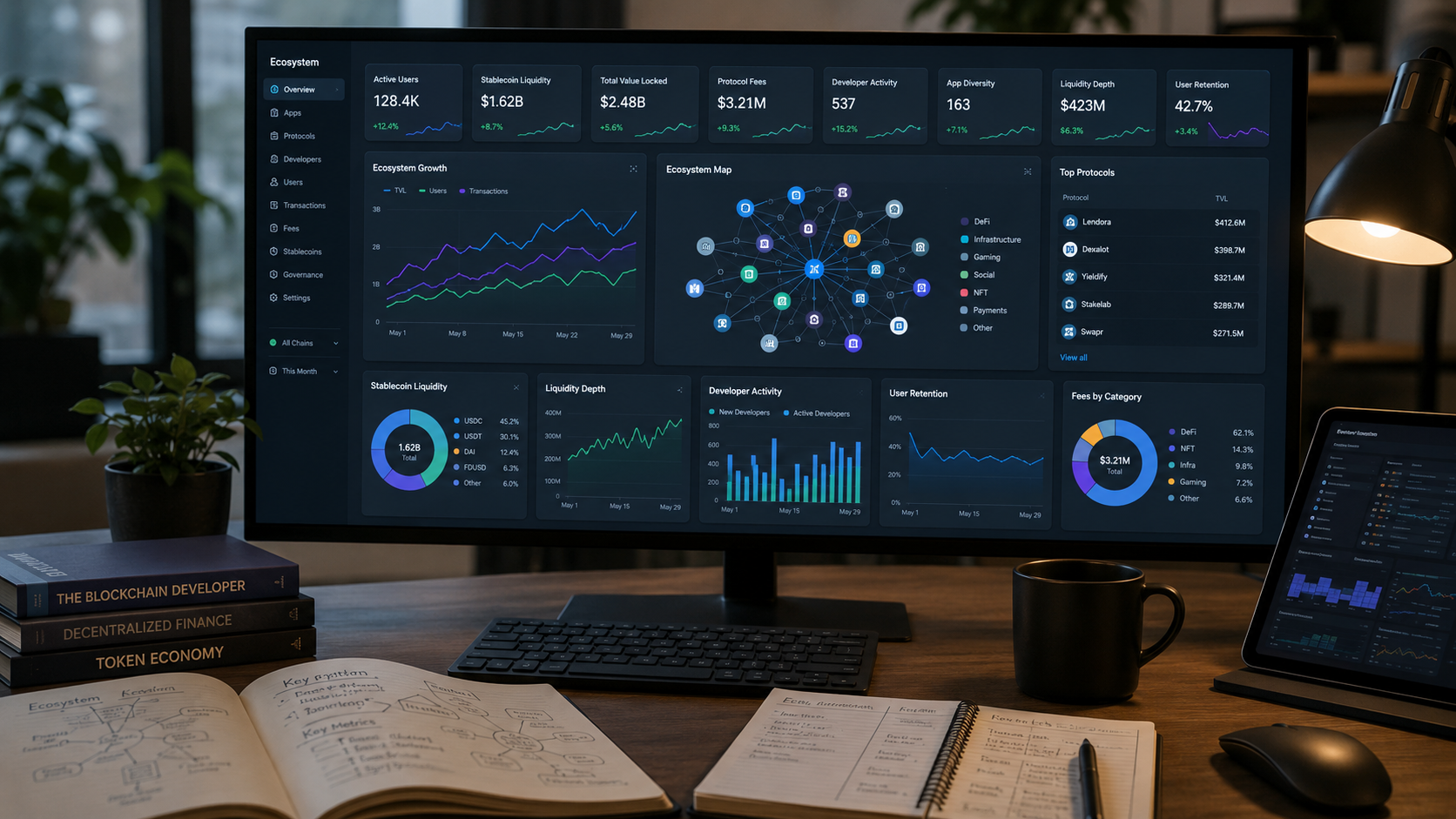
Blockchain ecosystem growing signals should be tracked together.
No single metric is enough.
The most useful signals include:
| Signal | What It Shows | Main Risk |
|---|---|---|
| Active users | Whether people are using the chain. | Bots or temporary campaign activity. |
| Returning users | Whether activity is durable. | One-time users may inflate growth. |
| Stablecoin liquidity | Whether the ecosystem has usable capital. | Supply may be idle or fragmented. |
| TVL | Whether capital is deposited. | TVL can be incentive-driven or price-driven. |
| Fees and revenue | Whether users pay for activity. | Fees may spike during stress. |
| DEX volume | Whether trading activity exists. | Volume may be noisy or artificial. |
| Developer activity | Whether the ecosystem keeps improving. | GitHub activity can be superficial. |
| App diversity | Whether growth depends on one use case. | Concentration risk. |
| Liquidity depth | Whether users can enter and exit efficiently. | Headline liquidity may be misleading. |
The strongest signal comes from convergence.
If users, liquidity, fees, developers, applications, and stablecoins all improve together, the ecosystem is more likely to be growing in a meaningful way.
If only one metric rises, investors should be careful.
1. Active Users Are Increasing
Active users are one of the first signals investors check.
They help show whether people are interacting with the ecosystem.
Token Terminal defines daily active users as unique addresses that make a revenue-generating transaction with a project, application, or blockchain.
That definition is useful because it connects activity to economic interaction rather than only raw address count.
But active users are not perfect.
One person can control many wallets.
Bots can create transactions.
Airdrop campaigns can inflate activity.
Low-cost chains can produce high transaction counts with limited economic value.
So investors should ask:
- Are active users rising consistently?
- Are users returning over time?
- Are transactions linked to real applications?
- Is activity spread across multiple apps?
- Are fees or revenue rising with usage?
- Does activity continue after incentives fade?
A chain with rising users and rising fees may show stronger demand than a chain with rising users but no economic activity.
This is why active users should be read with context.
Growth is not only more wallets.
It is more meaningful participation.
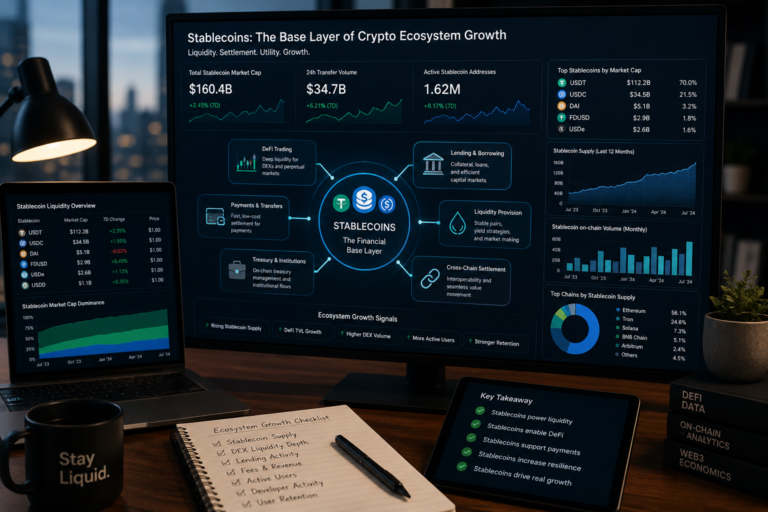
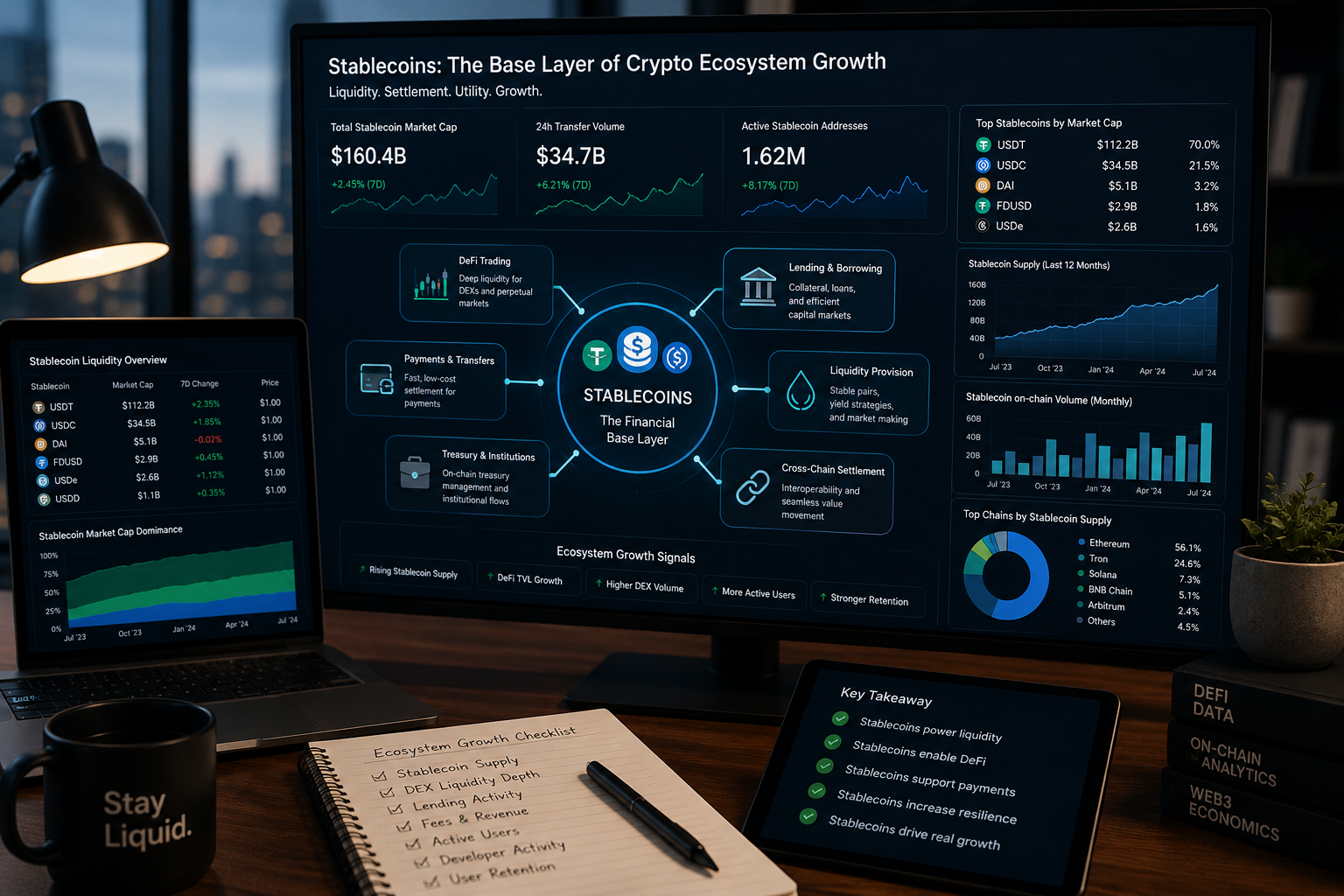
2. Stablecoin Liquidity Is Expanding
Stablecoin liquidity is one of the strongest signs that a blockchain ecosystem is becoming financially useful.
Stablecoins provide dollar-like liquidity for trading, lending, borrowing, collateral, payments, market making, and exits.
A chain can be active without deep stablecoin liquidity, but serious DeFi growth usually needs stablecoins.
DeFiLlama tracks stablecoin market cap, circulating supply, inflows, peg stability, and stablecoin distribution across chains.
Stablecoin liquidity can show whether capital is entering the ecosystem.
Strong signals include:
- Rising stablecoin supply.
- Persistent stablecoin inflows.
- Deep USDC or USDT pools.
- Active lending markets.
- Stablecoin usage across multiple protocols.
- Lower slippage in stablecoin pairs.
- Better exit routes during volatility.
Weak signals include:
- Stablecoin outflows.
- Liquidity concentrated in one pool.
- Heavy reliance on bridged assets.
- Thin lending markets.
- High slippage when exiting volatile assets.
- Stablecoins sitting idle in a few wallets.
This is why BlockCodex’s article on What Is Stablecoin Liquidity in a Crypto Ecosystem? treats stablecoin depth as a core ecosystem signal.
A blockchain ecosystem growing without stablecoin liquidity may still be early.
A blockchain ecosystem growing with stablecoin depth is usually more useful.
3. TVL Is Growing for the Right Reasons
TVL can help show whether capital is being deposited into the ecosystem.
But TVL is easy to misread.
TVL can rise because more users deposit assets.
It can also rise because token prices increased.
It can rise because incentives temporarily attracted capital.
It can rise because the same capital is reused across several protocols.
A 2025 academic paper on TVL verifiability found that TVL computation is not always standardized or easy to independently verify. In a case study of 400 protocols, the authors found that their verifiable TVL estimates aligned with published figures for 46.5% of protocols.
That does not mean TVL is useless.
It means investors should ask better questions:
- Is TVL rising in dollar terms only, or also in native asset terms?
- Is TVL growing across several protocols?
- Are deposits sticky after incentives decline?
- Is TVL supported by fees and volume?
- Is capital concentrated in one protocol?
- Is stablecoin liquidity growing with TVL?
- Can users exit without heavy slippage?
For deeper interpretation, see BlockCodex’s guide on How to Read TVL in Crypto?.
TVL growth is strongest when it reflects useful, sticky, and productive capital.
4. Fees and Revenue Are Becoming Meaningful
Fees and revenue help investors separate real usage from empty activity.
If users are willing to pay to use applications, infrastructure, trading venues, bridges, lending markets, or blockspace, the ecosystem has a stronger economic signal.
DeFiLlama defines App Revenue as the sum of revenue across protocols on a chain, excluding stablecoins, liquid staking apps, and gas fees. It describes App Revenue as a measure of economic activity on a chain that can be used to evaluate how active an ecosystem is.
This matters because transactions alone can be misleading.
A chain may have many low-cost transactions but limited fees.
Another chain may have fewer transactions but stronger economic demand.
A protocol may attract activity through incentives but generate little revenue.
Investors should track:
- Chain fees.
- App fees.
- App revenue.
- Protocol revenue.
- Fees per user.
- Fee growth across applications.
- Whether fees persist after incentives fade.
Token Terminal also provides crypto fundamentals and metrics that help investors measure blockchains and applications through financial-style indicators such as fees and active users.
A blockchain ecosystem is stronger when activity converts into economic value.
5. Developer and Application Activity Is Increasing
A growing ecosystem needs builders.
Users may come for incentives, but developers create the applications that make users stay.
Developer activity can include:
- New protocols launching.
- Existing apps improving.
- More integrations.
- Better wallets and infrastructure.
- More developer tools.
- More SDKs and documentation.
- More audits and security processes.
- More serious teams building long-term products.
Application activity is just as important.
A chain with only one successful app is more fragile than an ecosystem with several active sectors.
Healthy app diversity can include:
- DEXs.
- Lending markets.
- Stablecoin apps.
- Perpetual exchanges.
- NFT infrastructure.
- Payments.
- Gaming.
- Social apps.
- RWAs.
- Wallet infrastructure.
- Data and analytics tools.
This is where ecosystem growth becomes more durable.
If developers keep shipping and users keep returning, the ecosystem has more than hype.
It has an operating base.
6. Liquidity Depth Is Improving
Liquidity depth shows whether users can trade, borrow, lend, and exit efficiently.
It is different from headline TVL.
A chain can have high TVL but poor execution quality if liquidity is concentrated, fragmented, or shallow.
Strong liquidity depth usually means:
- Lower slippage.
- Deeper DEX pools.
- Better stablecoin routes.
- More efficient liquidations.
- Better borrowing and lending markets.
- More reliable exits during volatility.
- Stronger market maker participation.
Weak liquidity depth means users may face expensive exits.
That becomes especially important during stress.
BlockCodex’s article on Why DeFi Liquidity Looks Strong Until Stress Hits? explains why liquidity should be judged by how it behaves when users rush to exit, not only by how it looks in calm markets.
A blockchain ecosystem growing in a healthy way should not only attract capital.
It should make that capital usable.
7. Growth Is Spread Across Multiple Use Cases
A blockchain ecosystem is stronger when growth is not concentrated in one narrative.
If all activity comes from one airdrop campaign, one memecoin cycle, one yield farm, or one app, the ecosystem may be fragile.
A more durable ecosystem has multiple active pillars.
Examples include:
- Trading.
- Lending.
- Stablecoins.
- Payments.
- Staking.
- NFTs.
- Gaming.
- Social applications.
- Developer infrastructure.
- Institutional or enterprise use cases.
- Real-world assets.
- Consumer apps.
Diversity matters because crypto narratives rotate quickly.
If one sector slows down, another can continue supporting activity.
This is why BlockCodex’s article on Why Some Crypto Ecosystems Fail? is important. Ecosystems often fail when they depend too much on incentives, speculation, one application, or one short-lived narrative.
A growing ecosystem should become broader over time.
Not narrower.
How to Tell If Growth Is Real or Temporary
Not every growth signal is durable.
Investors should separate real growth from temporary activity.
Temporary Growth Often Looks Like This
- TVL jumps after incentives launch.
- Transactions rise during an airdrop campaign.
- Wallet count increases but users do not return.
- DEX volume spikes around one token.
- Stablecoin inflows leave quickly.
- Social activity rises faster than on-chain usage.
- One app drives most of the ecosystem.
- Fees do not increase with activity.
Real Growth Often Looks Like This
- Users return consistently.
- Stablecoin liquidity increases.
- TVL grows across several protocols.
- Fees and revenue become more meaningful.
- Developers keep launching useful apps.
- Liquidity depth improves.
- More use cases appear.
- Activity persists after incentives decline.
- The ecosystem becomes easier to use.
The difference is persistence.
Temporary growth creates spikes.
Real growth creates a base.
Practical Checklist: Is This Blockchain Ecosystem Growing?
Use this checklist before assuming that an ecosystem is truly expanding.
| Question | Stronger Signal | Weaker Signal |
| Are active users increasing? | Users return over time. | One-time wallets dominate. |
| Is stablecoin liquidity growing? | Inflows and deep pools increase. | Supply is idle or fragmented. |
| Is TVL growing for the right reasons? | Sticky deposits across protocols. | Incentive-driven deposits. |
| Are fees and revenue rising? | Users pay for real activity. | Activity is free or subsidized. |
| Are developers shipping? | More useful apps and integrations. | Few updates or copy-paste apps. |
| Is liquidity depth improving? | Lower slippage and better exits. | Thin pools and fragile routes. |
| Is growth diversified? | Multiple use cases expand. | One narrative drives everything. |
| Does activity persist? | Growth continues after rewards fade. | Metrics fall when incentives end. |
The more boxes an ecosystem checks, the stronger the case.
The fewer boxes it checks, the more cautious investors should be.
Common Mistakes When Reading Ecosystem Growth
Mistake 1: Treating Token Price as Ecosystem Growth
Token price can rise for reasons unrelated to real usage.
Mistake 2: Trusting Transactions Without Context
High transaction count can come from bots, low-cost spam, or airdrop farming.
Mistake 3: Reading TVL as Trust
TVL may be temporary, incentive-driven, or price-driven.
Mistake 4: Ignoring Stablecoin Liquidity
Without stablecoins, DeFi depth and exit routes may remain weak.
Mistake 5: Ignoring Fees and Revenue
Activity that generates no economic value may be less durable.
Mistake 6: Confusing Hype With Developer Activity
Social attention is not the same as useful applications.
Mistake 7: Ignoring Concentration Risk
An ecosystem dependent on one app, one token, or one incentive campaign can weaken quickly.
Final Thoughts
A blockchain ecosystem growing in a meaningful way does not rely on one metric.
It shows improvement across users, liquidity, developers, applications, stablecoins, fees, TVL, and real activity.
The strongest ecosystems do more than attract attention.
They become financially deeper, easier to use, more useful for builders, and more resilient when incentives or narratives change.
That is why investors should avoid simple shortcuts.
Token price is not enough.
Transactions are not enough.
TVL is not enough.
Social hype is not enough.
A real ecosystem grows when users return, capital stays useful, developers keep building, and activity becomes economically meaningful.
The best question is not:
“Is the token going up?”
It is:
“Is the ecosystem becoming more useful over time?”
That question leads to better analysis.