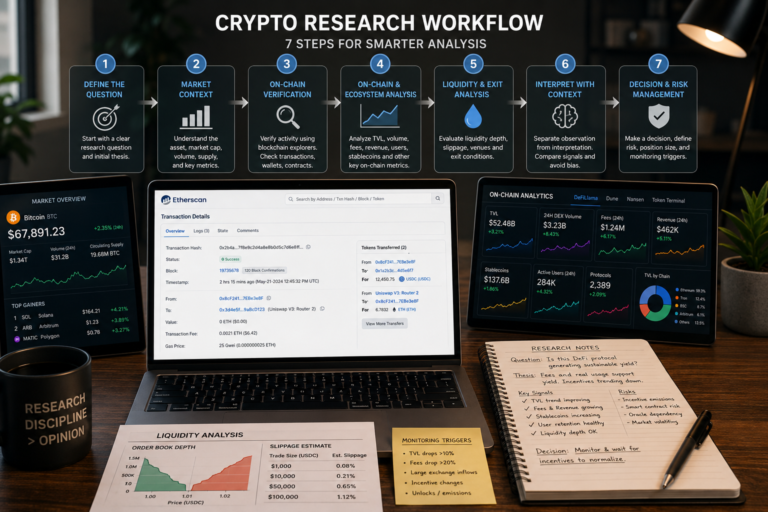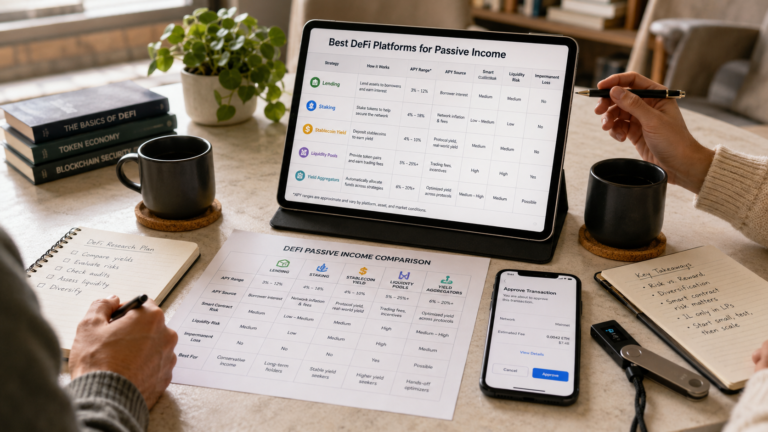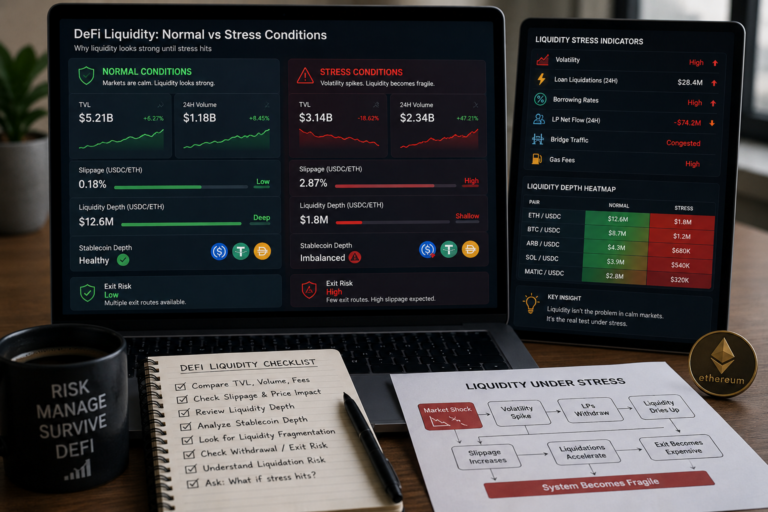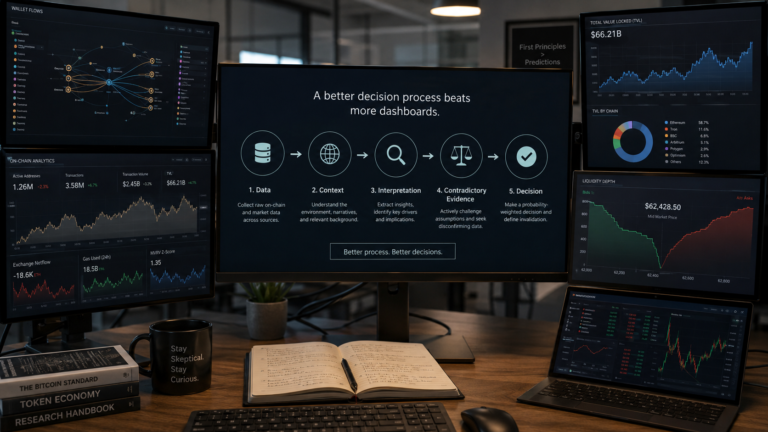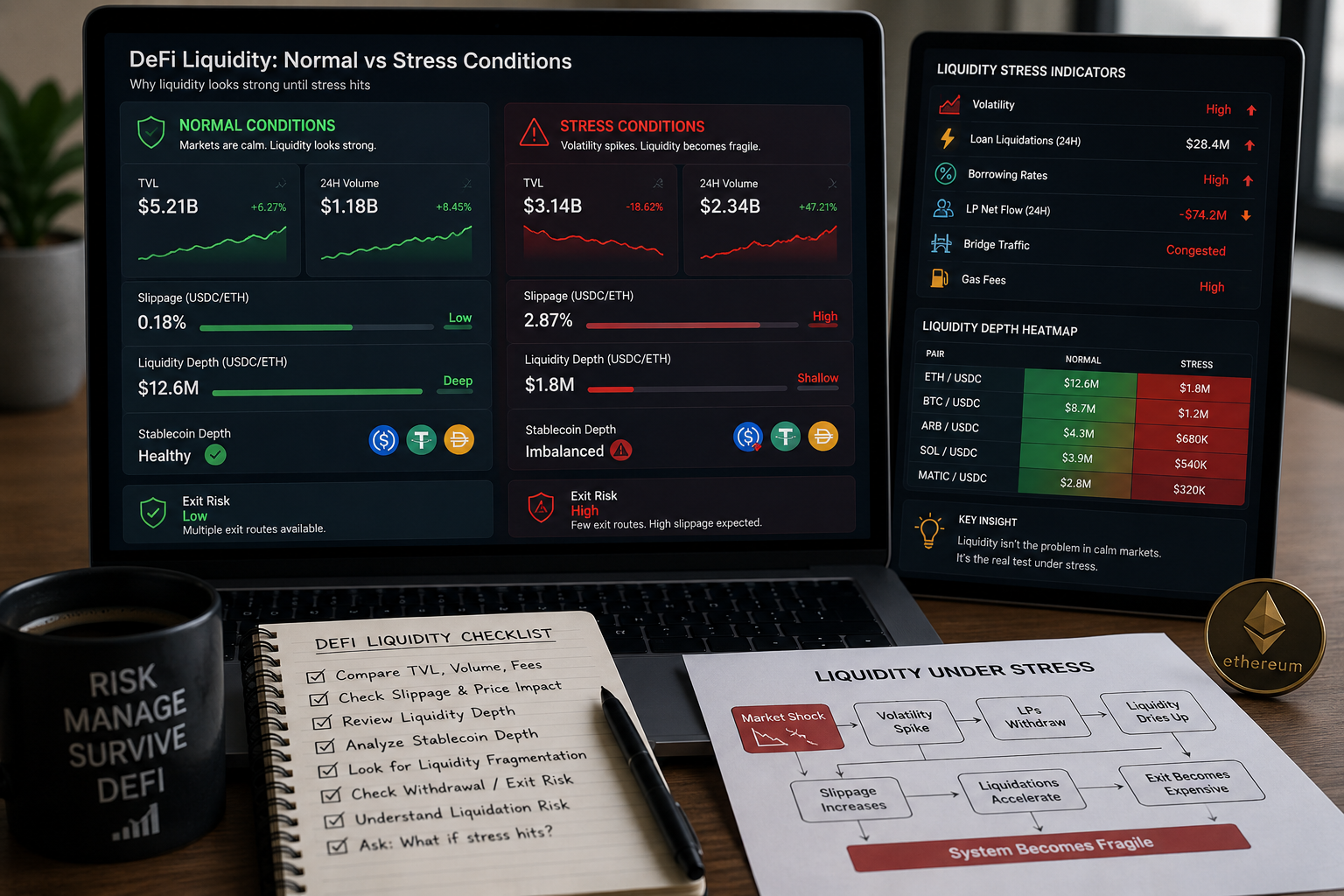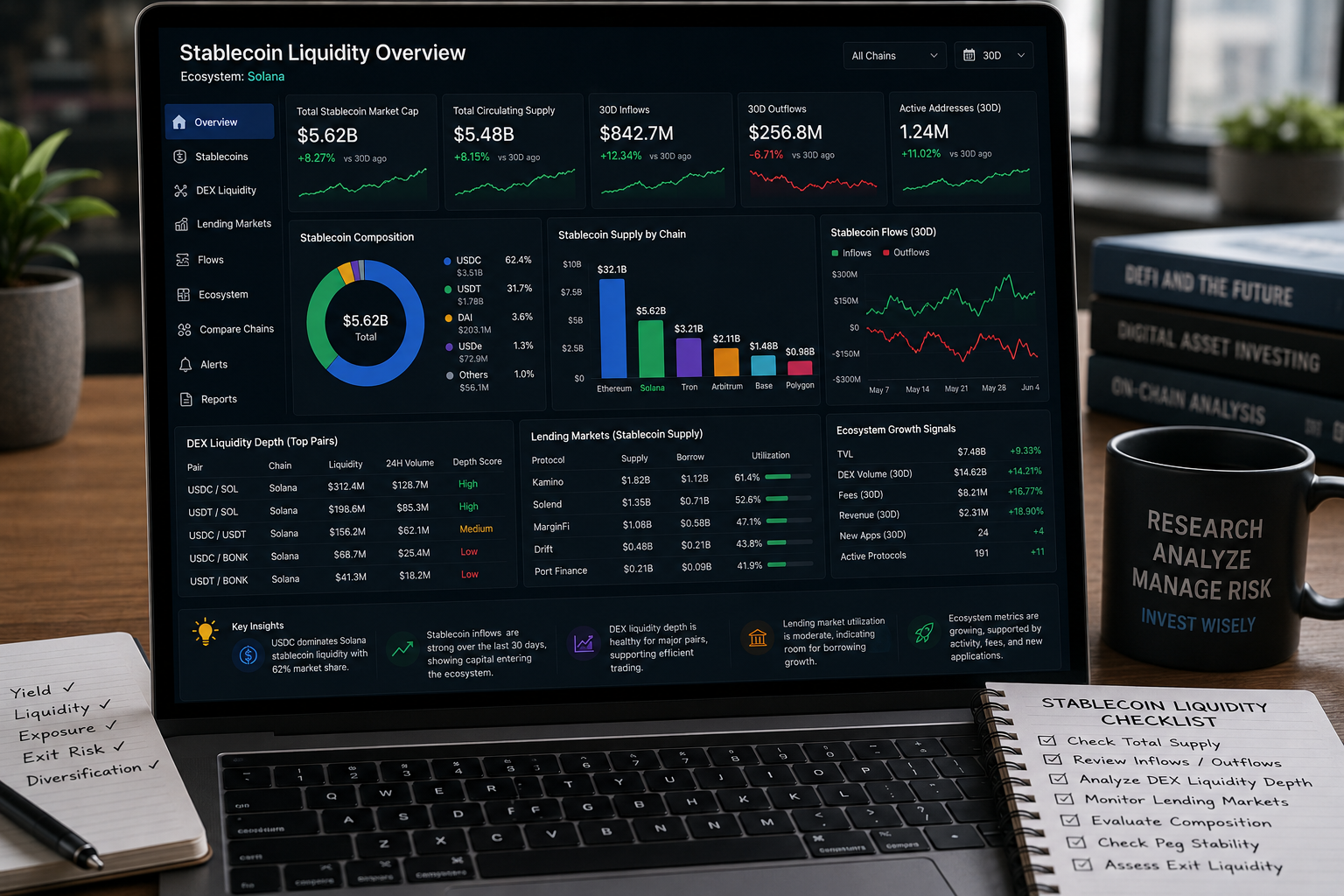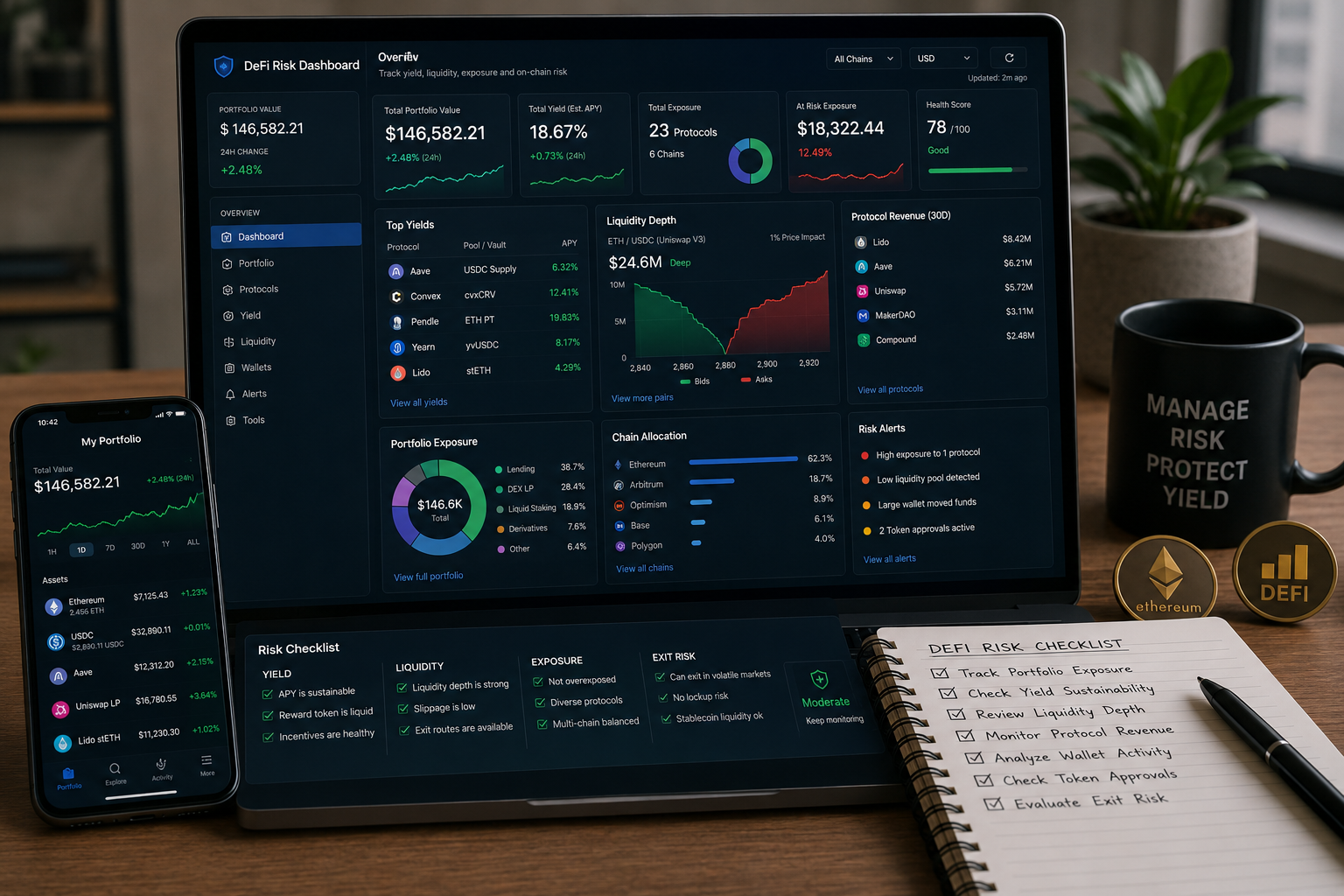
DeFi risk tools are becoming essential because yield alone does not tell investors enough.
A protocol can offer attractive APY while hiding weak liquidity, smart contract exposure, unstable incentives, fragile collateral, shallow exit routes, or poor revenue quality. A portfolio can look profitable while being concentrated in one chain, one token, one lending protocol, or one liquidity pool.
That is the problem.
Most DeFi dashboards show opportunity.
Fewer tools help investors understand risk.
The best DeFi risk tools do not remove uncertainty. They make risk more visible. They help investors ask better questions before depositing capital, chasing yield, providing liquidity, or holding exposure across multiple chains.
A useful DeFi risk stack should help answer:
- Where is my capital deployed?
- Which protocols am I exposed to?
- Is the yield sustainable?
- Is liquidity deep enough to exit?
- Are fees and revenue supporting activity?
- Are wallet flows changing?
- Is the protocol growing organically?
- Are incentives masking weakness?
- Is my portfolio too concentrated?
- What happens if market stress hits?
This article compares practical DeFi risk tools for tracking yield, liquidity, protocol exposure, wallet activity, portfolio visibility, and on-chain signals.
The goal is not to find one perfect dashboard.
The goal is to build a risk workflow that helps investors avoid blind DeFi exposure.
Table of Contents
What DeFi Risk Tools Should Actually Track
DeFi risk tools should not only track token prices.
Price is just one part of the picture.
A serious DeFi risk workflow should monitor several layers:
| Risk Layer | What to Track |
|---|---|
| Portfolio exposure | Wallet balances, DeFi positions, NFTs, LP tokens, staked assets, chain allocation. |
| Yield exposure | APY, reward tokens, incentives, yield source, sustainability. |
| Liquidity risk | TVL, pool depth, volume, slippage, exit routes, stablecoin depth. |
| Protocol quality | Fees, revenue, users, incentives, economic activity. |
| Wallet activity | Whale flows, smart money behavior, treasury movement, exchange flows. |
| Security exposure | Token approvals, risky contracts, wallet permissions, scam interactions. |
| Market context | Price, volume, volatility, funding, liquidity rotation. |
No single tool covers everything perfectly.
That is why investors should think in layers.
A DeFi portfolio tracker helps with exposure.
A DeFi analytics dashboard helps with protocol context.
A wallet intelligence tool helps with flows.
A revenue platform helps with fundamentals.
A security tool helps with permissions.
The strongest setup combines tools rather than relying on one dashboard.
For deeper context on why this matters, see BlockCodex’s guide on “Best DeFi Platforms for Passive Income: 7 Smart Ways to Evaluate Yield“.
Passive income is not only about finding yield.
It is about understanding the risk behind the yield.
1. DeFiLlama: Best Free Starting Point for Liquidity and Protocol Risk
DeFiLlama is usually the first DeFi risk tool most investors should learn.
It is not only a TVL dashboard. It also helps investors compare DeFi protocols through TVL, fees, revenue, volume, stablecoins, yields, and chain-level data.
This makes DeFiLlama useful for risk visibility because it shows whether capital, usage, and economics are moving together.
Investors can use DeFiLlama to check:
- TVL by protocol.
- TVL by chain.
- DEX volume.
- Protocol fees.
- Protocol revenue.
- Stablecoin liquidity.
- Yield opportunities.
- Chain-level activity.
- Historical protocol trends.
The main value of DeFiLlama is that it gives investors a broad market map.
If a yield opportunity looks attractive, DeFiLlama can help answer basic questions:
- Is the protocol’s TVL stable or falling?
- Are fees and revenue meaningful?
- Is the chain liquid enough?
- Is volume consistent or spiky?
- Is stablecoin liquidity deep?
- Is the yield unusually high compared with similar protocols?
The limitation is that DeFiLlama does not make the risk decision for you.
It gives the data. The investor still needs to interpret it.
A protocol with high TVL may still have weak exit liquidity. A protocol with high volume may still be incentive-driven. A yield pool may look attractive but depend on volatile reward tokens.
That is why DeFiLlama works best as the foundation of a DeFi risk stack, not the entire stack.
For TVL interpretation, see BlockCodex’s article on “How to Read TVL in Crypto: What It Really Signals About Capital and Risk”.
2. Zerion: Best for Simple Multi-Chain DeFi Portfolio Tracking
Zerion is useful for investors who want to see their DeFi exposure in one place.
Its DeFi portfolio tracker supports wallet tracking across multiple EVM chains and helps users monitor tokens, DeFi positions, NFTs, liquidity positions, and rewards.
This matters because one of the biggest DeFi risks is losing visibility.
An investor may have assets spread across Ethereum, Arbitrum, Base, Optimism, Polygon, and other networks. They may also have tokens in wallets, lending markets, liquidity pools, staking positions, vaults, and reward contracts.
Without a portfolio tracker, risk becomes fragmented.
Zerion is useful for:
- Tracking wallet balances.
- Viewing DeFi positions.
- Monitoring LP positions.
- Seeing staked assets.
- Tracking rewards.
- Following multi-chain exposure.
- Understanding where capital is deployed.
For beginners and intermediate users, this visibility is valuable.
If you cannot see your exposure clearly, you cannot manage risk properly.
The limitation is that portfolio tracking is not the same as risk analysis.
Zerion can show where assets are. It does not automatically tell whether a protocol is safe, whether yield is sustainable, whether liquidity is deep, or whether a position is overexposed.
That means Zerion is best paired with DeFiLlama, Token Terminal, and approval-checking tools.
Use Zerion to answer:
“Where is my capital?”
Then use other tools to answer:
“Is that exposure worth the risk?”
For broader wallet structure, see BlockCodex’s guide on “Best Crypto Portfolio Tracking Setups: 7 Practical Frameworks for Real Control“.
3. DeBank: Best for EVM Portfolio Visibility and Wallet-Level Context
DeBank is another strong option for Web3 portfolio visibility, especially for EVM users.
Its mobile app description presents DeBank as a Web3-native portfolio tracker covering tokens, DeFi protocols, and NFTs across EVM chains. It also emphasizes real-time balances and detailed wallet profile information.
That makes DeBank useful for understanding wallet-level exposure.
Investors can use it to check:
- Token balances.
- DeFi positions.
- NFTs.
- Protocol interactions.
- Wallet profiles.
- Multi-chain EVM exposure.
- Activity history.
DeBank is especially useful when an investor wants to understand a wallet quickly.
That wallet could be their own wallet, a public wallet, or a wallet they are researching.
From a risk perspective, this helps with concentration.
If one wallet is heavily exposed to one protocol, one chain, or one asset, the risk may be higher than it appears from price alone.
The limitation is similar to Zerion.
DeBank improves visibility, but visibility is not the same as full due diligence.
A wallet may look diversified but still hold correlated assets. A DeFi position may look profitable but still depend on fragile liquidity. A protocol may appear active but lack strong revenue.
DeBank is best used as a wallet visibility layer, not a complete risk engine.
A useful workflow is:
- Use DeBank or Zerion to see wallet exposure.
- Use DeFiLlama to check protocol and chain liquidity.
- Use Token Terminal to check economic activity.
- Use approval tools to check wallet permissions.
This turns portfolio tracking into actual risk management.
4. Token Terminal: Best for Fees, Revenue, and Protocol Fundamentals
Token Terminal is useful because it translates crypto protocol activity into financial metrics.
It tracks historical on-chain metrics such as fees, revenue, and other key metrics across projects and chains.
This matters because DeFi investors often chase yield without checking whether a protocol has real economic activity.
A protocol can attract TVL through incentives.
It can generate volume through rewards.
It can attract users through points.
It can still have weak fee capture or poor revenue quality.
Token Terminal helps investors ask deeper questions:
- Are users paying to use the protocol?
- Are fees growing?
- How much revenue does the protocol retain?
- Is activity economically meaningful?
- Is the protocol dependent on incentives?
- How does it compare with similar protocols?
- Is usage converting into fundamentals?
For DeFi risk, fees and revenue are important because they separate surface activity from economic demand.
If a protocol has high TVL but weak fees, the capital may be passive.
If a DEX has high volume but weak revenue quality, activity may be thin or incentive-driven.
If a lending protocol generates consistent fees, that may suggest real borrowing demand.
Token Terminal is not a replacement for liquidity analysis.
It does not tell investors everything about smart contract risk, exit liquidity, or wallet permissions.
But it is valuable for understanding whether a protocol is only attracting capital or actually producing economic activity.
For readers comparing TVL, volume, and revenue, this tool fits naturally with BlockCodex’s guide on “TVL vs Volume in DeFi: 7 Critical Differences Investors Should Understand”.
.
5. Nansen: Best for Smart Money, Wallet Flows, and On-Chain Behavior
Nansen is a more advanced DeFi risk tool because it focuses on wallet intelligence and on-chain behavior.
Nansen describes its platform as an on-chain intelligence tool for analyzing wallet flows, tracking key metrics, and trading with on-chain data. Its educational content also emphasizes wallet labels and smart money tracking.
This matters because DeFi risk is not only about protocols.
It is also about who is moving capital.
Wallet behavior can reveal:
- Large deposits.
- Whale withdrawals.
- Smart money accumulation.
- Exchange movements.
- Fund flows.
- Treasury activity.
- Early rotation into or out of protocols.
- Liquidity migration across chains.
This is useful for investors who want to understand whether important wallets are increasing or reducing exposure.
For example, if TVL looks stable but large wallets are quietly exiting, that can be a warning sign. If a new protocol attracts capital only from a small cluster of aggressive wallets, the risk profile may be different from broad organic adoption.
The limitation is that Nansen can be too advanced or expensive for beginners.
It is not the first tool every DeFi investor needs.
But for active investors, fund-flow analysis can add a valuable layer.
Nansen helps answer:
“What are sophisticated wallets doing?”
That question should not be used blindly. Smart money can be wrong. Wallet labels are helpful, but they do not remove the need for context.
For whale and wallet interpretation, see BlockCodex’s guide on “How to Analyze Whale Activity: 7 On-Chain Signals Investors Should Track”.
6. Arkham: Best for Entity Intelligence and Wallet Investigation
Arkham is useful when investors need to investigate wallets, entities, and transaction flows more deeply.
Arkham describes itself as a blockchain intelligence platform that identifies people and companies behind blockchain wallets and transactions. It also provides tools for blockchain analytics, wallet tracking, and crypto intelligence.
This makes Arkham relevant for DeFi risk in several cases:
- Tracking large wallets.
- Investigating suspicious flows.
- Following exchange-related movements.
- Monitoring entity exposure.
- Studying protocol treasury activity.
- Reviewing exploit-related fund movement.
- Mapping transaction paths.
Arkham is not a traditional DeFi yield dashboard.
Its value is investigative.
If DeFiLlama shows protocol data, and Zerion shows your portfolio, Arkham can help investigate where certain flows are coming from or going.
That matters when risk becomes event-driven.
For example, if a protocol faces a hack, exploit, liquidity crisis, whale exit, or treasury movement, entity-level wallet intelligence becomes more useful.
The limitation is that Arkham requires careful interpretation.
Entity labels and wallet flows can be powerful, but they can also be misread. A wallet movement does not automatically mean selling. A transfer does not automatically mean panic. A known entity moving funds may reflect custody, market making, treasury operations, or internal management.
Arkham is strongest when used for investigation, not quick conclusions.
7. De.Fi: Best for Combining Yield Discovery With Security Awareness
De.Fi is relevant because it combines DeFi discovery, portfolio tracking, and security-oriented tools.
Its website presents De.Fi Explore as an APY aggregator tracking thousands of liquidity pools and vaults across hundreds of protocols and chains. It also positions itself around portfolio tracking and crypto wallet security.
This makes it useful for users who want to discover opportunities while keeping risk visible.
De.Fi can help investors look at:
- Yield pools.
- Vaults.
- APY opportunities.
- Protocol categories.
- Chain exposure.
- Portfolio positions.
- Security checks.
- Wallet risk signals.
The important point is that yield discovery should not be separated from risk review.
A high APY should trigger more questions, not less.
Before entering a yield strategy, investors should check:
- Where does the yield come from?
- Is APY reward-driven?
- Is the reward token liquid?
- How deep is the pool?
- What happens on exit?
- Is the protocol audited?
- Are token approvals required?
- Is the strategy exposed to bridges or oracles?
- Is liquidity concentrated?
- Are incentives temporary?
De.Fi can be useful as a discovery layer, but investors should still validate opportunities with DeFiLlama, protocol documentation, approval tools, and portfolio trackers.
A DeFi risk tool should help users slow down before chasing yield.
Not push them toward the highest APY.
Best DeFi Risk Tools by Use Case
The best DeFi risk tools depend on the question being asked.
| Use Case | Best Tool Type | Strong Options |
| Track TVL, liquidity, and yields | DeFi analytics dashboard | DeFiLlama, De.Fi |
| Track your DeFi portfolio | Portfolio tracker | Zerion, DeBank |
| Analyze fees and revenue | Protocol fundamentals tool | Token Terminal, DeFiLlama |
| Track wallet flows | Wallet intelligence platform | Nansen, Arkham |
| Investigate suspicious activity | Blockchain intelligence tool | Arkham, Nansen |
| Discover yield opportunities | Yield discovery platform | De.Fi, DeFiLlama |
| Review exposure across chains | Multi-chain portfolio tracker | Zerion, DeBank |
| Understand protocol economics | Fundamentals dashboard | Token Terminal |
This is why the best workflow is usually a stack, not a single tool.
A beginner does not need every platform immediately.
A practical starting stack could be:
- DeFiLlama for protocol and liquidity data.
- Zerion or DeBank for portfolio tracking.
- Token Terminal for protocol fundamentals.
- De.Fi for yield discovery and security awareness.
More advanced investors can add:
- Nansen for smart money and wallet flows.
- Arkham for entity-level investigation.
The key is to avoid tool overload.
Use the tool that answers the specific risk question.
How to Build a Practical DeFi Risk Workflow
A practical DeFi risk workflow should move from visibility to judgment.
Step 1: Map Your Exposure
Start with your own portfolio.
Use Zerion or DeBank to see where capital is deployed across wallets, chains, and protocols.
Ask:
- Which assets do I hold?
- Which protocols am I using?
- Which chains am I exposed to?
- Which positions are active?
- Which rewards or LP tokens are included?
If you cannot map exposure, you cannot manage risk.
Step 2: Check Protocol Liquidity
Use DeFiLlama to review TVL, volume, stablecoins, yields, and protocol trends.
Ask:
- Is TVL stable?
- Is volume consistent?
- Is stablecoin liquidity strong?
- Are yields unusually high?
- Is the protocol growing organically?
This helps separate real liquidity from surface-level opportunity.
Step 3: Check Economic Activity
Use Token Terminal or DeFiLlama fees and revenue dashboards.
Ask:
- Does the protocol generate fees?
- Does it retain revenue?
- Are users paying for the product?
- Is activity economically meaningful?
Yield without economic support may depend too heavily on incentives.
Step 4: Check Wallet and Flow Behavior
Use Nansen or Arkham for wallet-level context.
Ask:
- Are large wallets entering or exiting?
- Are funds moving to exchanges?
- Are protocol treasuries active?
- Are known entities changing exposure?
- Are suspicious wallets involved?
This adds behavioral context.
Step 5: Check Security and Approval Risk
Use De.Fi, wallet security tools, and approval checkers.
Ask:
- What permissions have I granted?
- Are there old approvals?
- Are contracts verified?
- Is the protocol audited?
- Am I using the right wallet?
For approval hygiene, see BlockCodex’s article on “How to Check Token Approvals Before Using DeFi: 7 Smart Safety Steps“.
Step 6: Ask the Exit Question
Before entering any DeFi position, ask:
How do I exit if liquidity worsens?
This is the most important risk question.
A yield strategy is not attractive if exit liquidity is fragile.
For deeper context, see BlockCodex’s article on “DeFi Liquidity Risk: 7 Critical Reasons Liquidity Fails Under Stress“.
How to Evaluate a DeFi Risk Tool
Not every tool deserves equal trust.
Before relying on a DeFi risk tool, check:
- Data coverage.
- Supported chains.
- Protocol coverage.
- Update frequency.
- Transparency of methodology.
- Whether it tracks positions accurately.
- Whether it separates TVL, volume, fees, and revenue.
- Whether it shows historical trends.
- Whether it supports wallet-level visibility.
- Whether it helps identify risk or only promotes yield.
This last point matters.
Some platforms are designed to highlight opportunities.
Others are designed to help users understand exposure.
The best DeFi risk tools do both carefully.
They show opportunity, but they also make the risk visible.
Affiliate Angle: Where Monetization Fits Naturally
This article can support affiliate monetization without becoming promotional.
The safest affiliate placements are around tools that solve a clear user problem.
Good placements include:
- Portfolio tracker recommendations.
- Yield discovery platforms.
- Paid analytics tools.
- Smart money dashboards.
- Wallet intelligence platforms.
- Security and approval review tools.
- Hardware wallet recommendations when discussing self-custody risk.
The important rule is transparency.
If a tool has an affiliate link, the article should still explain who it is best for, who it is not best for, and what its limitations are.
That makes the recommendation more credible.
A useful affiliate CTA could be:
If you actively manage DeFi positions across multiple chains, start by using a portfolio tracker to map your exposure, then compare liquidity and protocol metrics before chasing yield.
That type of CTA is safer than:
Use this tool to find the best APY.
The goal is risk visibility, not hype.
Common Mistakes When Using DeFi Risk Tools
Mistake 1: Chasing the Highest APY
High yield often means higher risk.
A DeFi risk tool should help explain the risk behind the yield.
Mistake 2: Using Only One Dashboard
One dashboard rarely covers portfolio exposure, liquidity, wallet flows, revenue, and security risk.
Use a stack.
Mistake 3: Ignoring Exit Liquidity
Entering a position is easy.
Exiting under stress is the real test.
Mistake 4: Confusing TVL With Safety
High TVL does not guarantee deep exit liquidity.
Mistake 5: Ignoring Fees and Revenue
If users are not paying to use the protocol, yield may be incentive-driven.
Mistake 6: Not Tracking Wallet Permissions
Approvals can become hidden exposure.
Mistake 7: Overreacting to Wallet Flows
Large wallet movements need context.
Not every transfer is a sell signal.
Final Thoughts
DeFi risk tools are not about predicting the future perfectly.
They are about seeing exposure more clearly.
A strong DeFi risk workflow should help investors track yield, liquidity, wallet exposure, protocol fundamentals, smart money flows, approval risk, and exit conditions.
DeFiLlama is useful for market-wide liquidity and protocol data. Zerion and DeBank help investors understand portfolio exposure. Token Terminal adds protocol fundamentals. Nansen and Arkham provide wallet and entity intelligence. De.Fi helps connect yield discovery with security awareness.
None of these tools removes risk.
But together, they make risk harder to ignore.
That is the real value.
The best DeFi risk tools do not tell investors what to buy.
They help investors understand what they are exposed to before they commit capital.