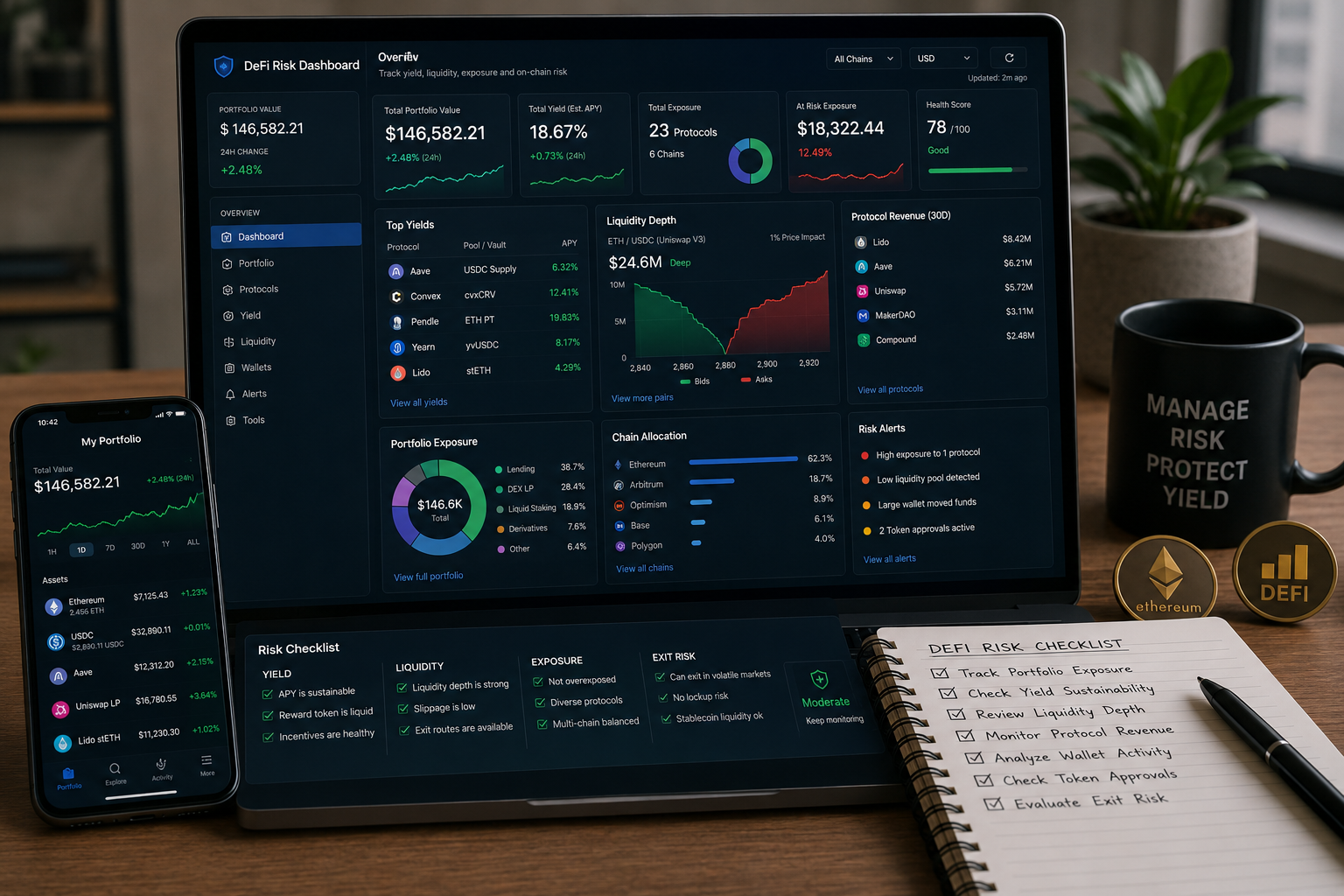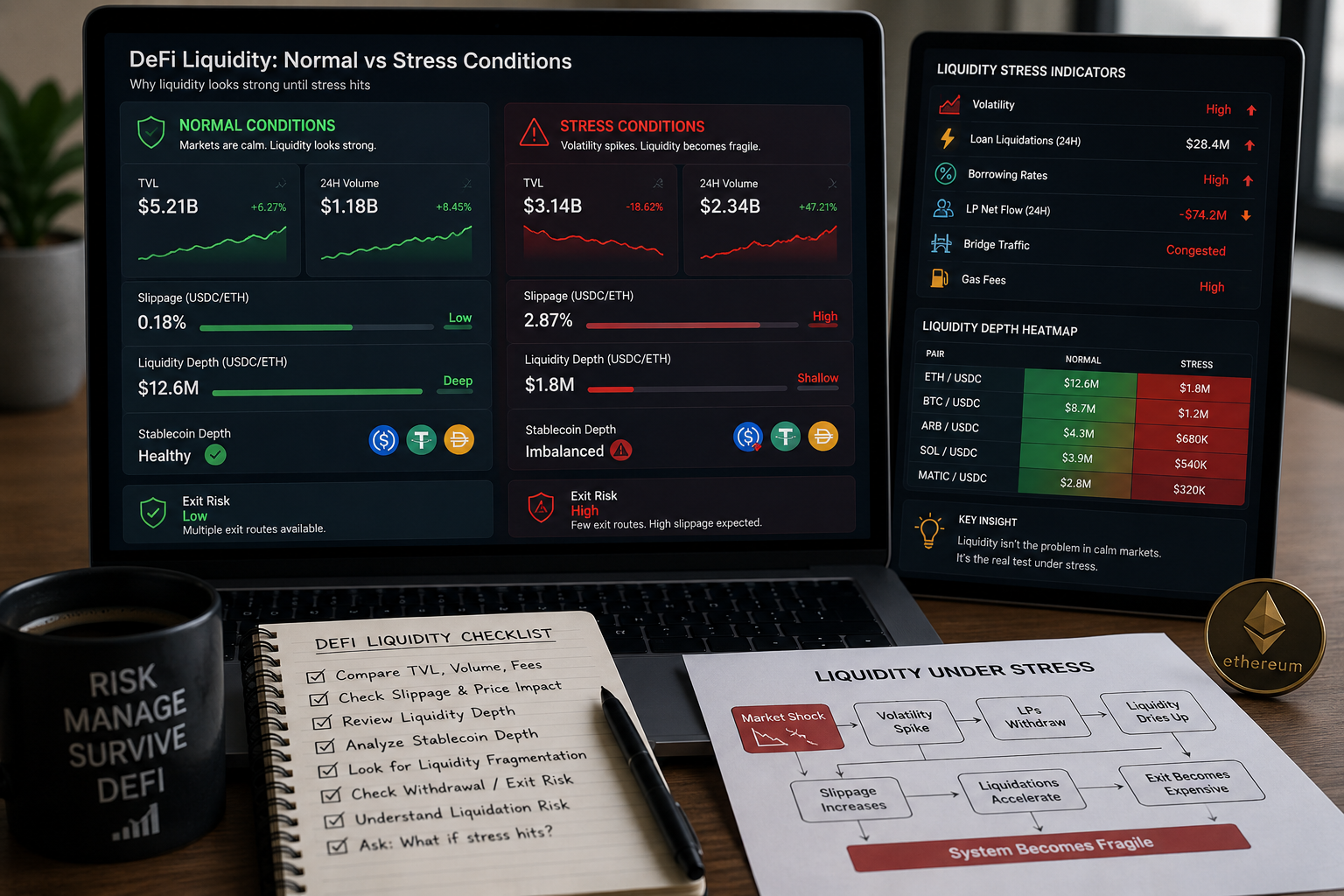
DeFi liquidity risk is often invisible when markets are calm.
On a normal day, a protocol may look healthy. TVL is high. Trading volume is active. Yields are attractive. Liquidity pools appear deep. The dashboard looks stable.
Then stress hits.
A major asset drops. Borrowers rush to reduce leverage. Liquidity providers withdraw capital. Stablecoin liquidity moves to safer venues. Traders try to exit at the same time. Slippage widens. Liquidations accelerate. Bridges become slower or more expensive. Pools that looked deep suddenly feel thin.
That is when DeFi liquidity risk becomes visible.
The problem is not that liquidity never existed.
The problem is that liquidity is conditional.
It is present when users are comfortable, incentives are attractive, and market direction is manageable. But under stress, liquidity can become defensive, fragmented, expensive, or unavailable exactly when users need it most.
This is why investors should not judge DeFi liquidity only by TVL or volume.
The better question is:
Can this liquidity absorb exits when everyone wants to leave at the same time?
That is the difference between visible liquidity and resilient liquidity.
Table of Contents
What DeFi Liquidity Risk Means
DeFi liquidity risk is the risk that users cannot enter, exit, borrow, repay, swap, or liquidate positions efficiently when market conditions change.
It can appear in several ways:
- Higher slippage.
- Wider price impact.
- Shallow liquidity pools.
- Fragmented liquidity across chains.
- Liquidity provider withdrawals.
- Borrowing markets drying up.
- Stablecoin liquidity concentrating in safer assets.
- Liquidations becoming more expensive.
- Exit routes becoming congested or inefficient.
Liquidity risk is not only about whether capital exists.
It is about whether that capital is available, usable, and deep enough when stress appears.
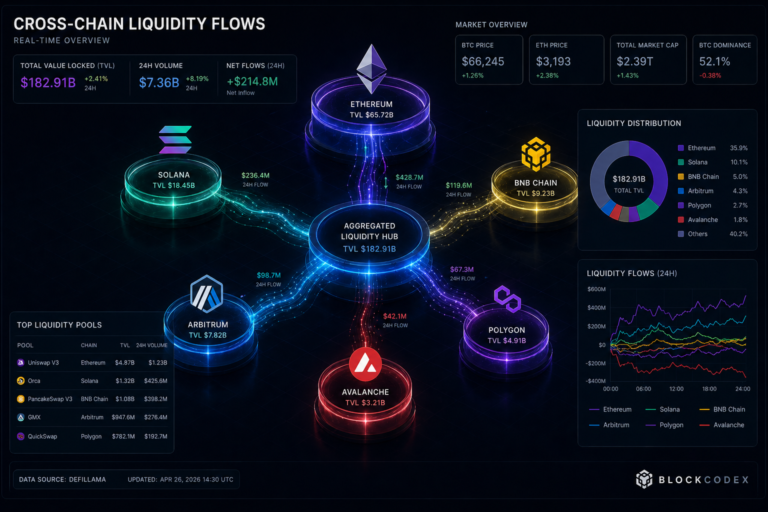
DeFiLlama tracks TVL, fees, revenue, volume, and yields across thousands of DeFi protocols and hundreds of chains, which makes it useful for observing capital and activity across the DeFi ecosystem. DeFiLlama
But TVL alone does not answer the stress question.
A protocol can have high TVL and still face weak exit liquidity.
A DEX can show high volume and still have poor depth for larger trades.
A lending market can look stable until collateral prices fall and liquidations begin.
For this reason, DeFi liquidity risk should be analyzed through multiple signals, not one headline number.
Why Liquidity Looks Strong in Calm Markets
Liquidity usually looks strongest when it is least tested.
During calm markets, users are less likely to exit aggressively. Liquidity providers are more willing to supply capital. Borrowers feel safer using leverage. Yield incentives attract deposits. Traders assume execution will remain smooth.
This creates a stable appearance.
But calm liquidity can be misleading.
In calm markets:
- Slippage may stay low.
- Liquidity providers may remain in pools.
- Lending utilization may look manageable.
- Stablecoins may circulate normally.
- Bridges may work efficiently.
- Volume may appear consistent.
- Liquidations may remain limited.
The issue is that none of this proves resilience.
It only proves that the system works under normal conditions.
A bridge is not truly tested until users rush to move capital.
A lending market is not fully tested until collateral falls quickly.
A liquidity pool is not fully tested until a large exit tries to pass through it.
A yield strategy is not fully tested until incentives weaken or risk rises.
This is why BlockCodex’s article on “Liquidity in Crypto Markets: 7 Critical Misconceptions Investors Still Get Wrong” emphasizes that liquidity is not just the presence of capital. It is the ability of a market to absorb activity without breaking execution quality.
Under stress, that ability changes fast.
1. TVL Can Overstate Real Exit Liquidity
High TVL can make DeFi liquidity look stronger than it is.
TVL measures value deposited in a protocol, chain, or application. It is useful, but it does not automatically show how easily users can exit.
A lending protocol may have high TVL, but much of that capital may be supplied as collateral rather than immediately available exit liquidity.
A yield vault may have high TVL, but withdrawals may depend on strategy liquidity.
A DEX pool may have high TVL, but liquidity may be concentrated around certain price ranges.
A restaking or looping strategy may show large deposits, but the same underlying capital may be reused across several layers.
That is why investors should avoid treating TVL as a direct liquidity score.
A 2024 academic paper argued that TVL can be inflated through double counting, including wrapping and leveraging, and proposed Total Value Redeemable as a more conservative alternative for assessing underlying DeFi value.
The key question is not only:
“How much value is locked?”
It is:
“How much value can exit without major losses, delays, or cascading effects?”
For a deeper breakdown, see BlockCodex’s guide on “How to Read TVL in Crypto: What It Really Signals About Capital and Risk“.
TVL is a starting point.
Exit liquidity is the real test.
2. Volume Can Hide Fragile Liquidity
Volume can also create false confidence.
A DeFi protocol may show high trading activity, but volume does not always mean deep liquidity.
Volume can come from:
- Arbitrage.
- Incentive farming.
- Liquidations.
- Bot activity.
- Market maker activity.
- Short-term speculation.
- Wash trading.
- Reward-driven transactions.
Some of that activity can be legitimate. But it does not always prove that users can exit efficiently under stress.
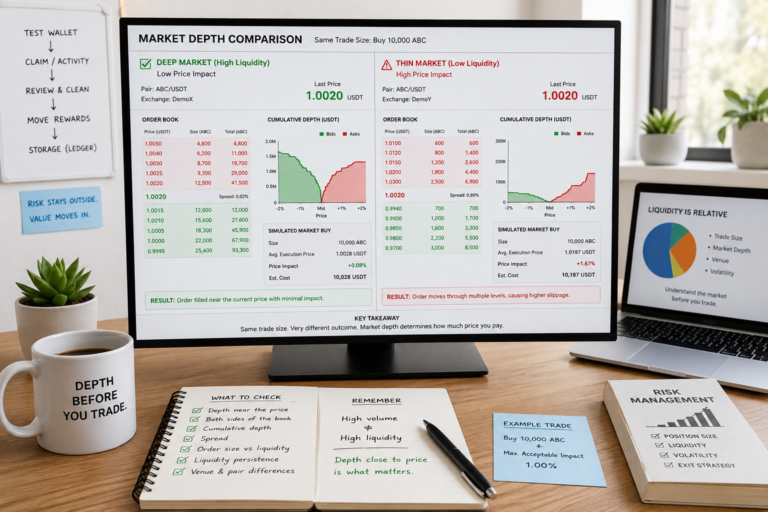
A market can process large volume over time while still having poor depth at a specific moment.
This distinction matters.
Volume measures activity.
Liquidity depth measures how much the market can absorb.
Slippage shows the cost of execution.
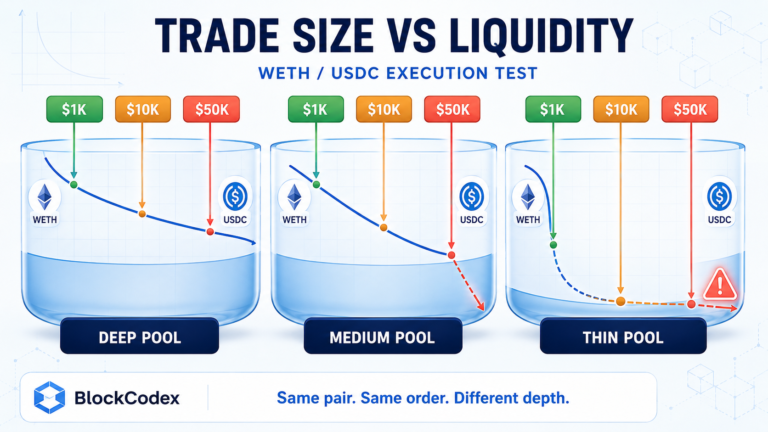
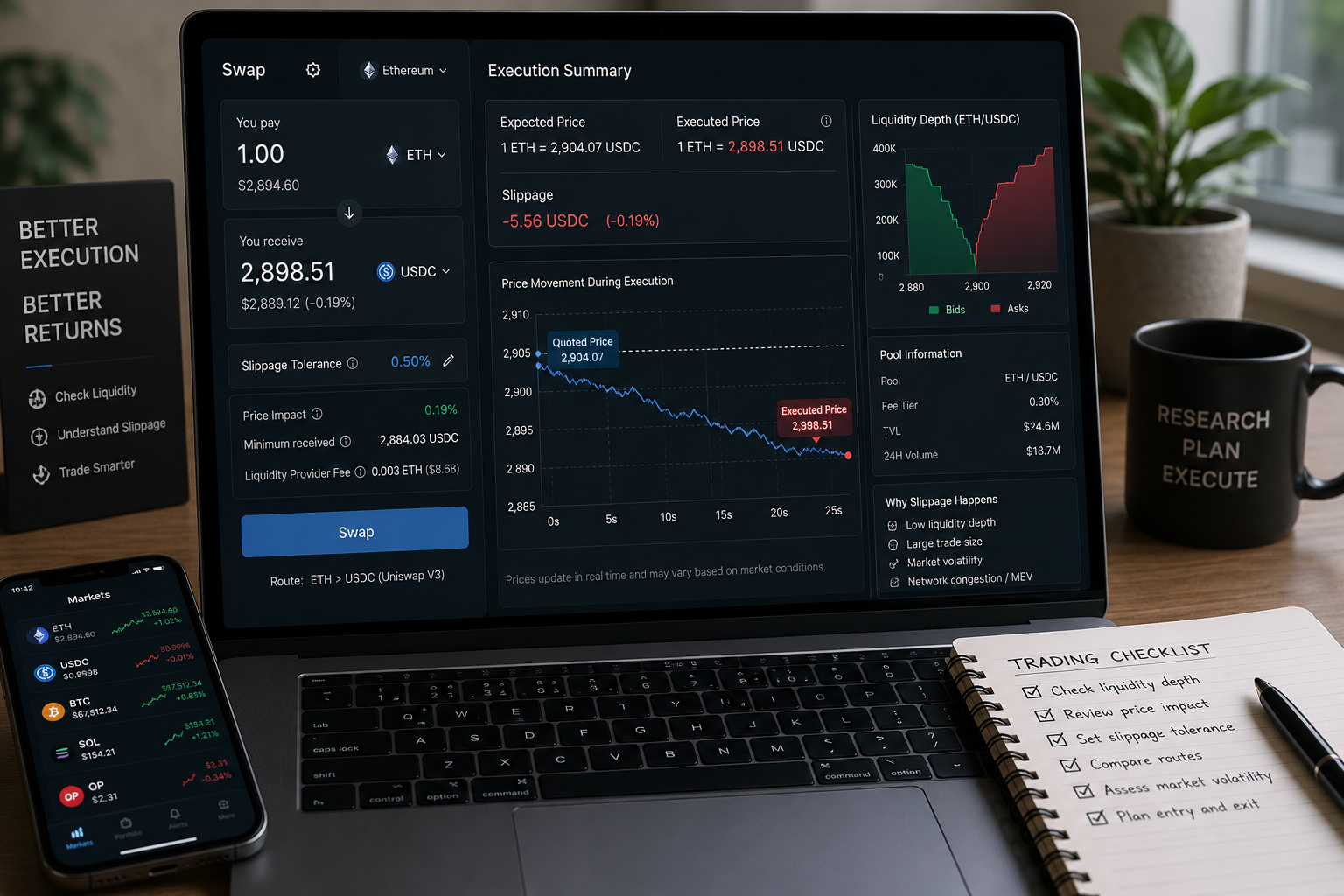
Chainlink explains that slippage happens when a trade executes at a different price than expected, often when the trade is large relative to the liquidity pool. Low liquidity makes smaller pools inefficient for large transactions.
That is why investors should not treat volume as proof of safety.
A token can show high 24-hour volume but still punish a large exit with heavy slippage.
This connects directly to BlockCodex’s article on “Slippage in Crypto: 7 Critical Reasons It Matters for Investors“.
Volume tells you that activity happened.
Slippage tells you what activity costs.
3. Liquidity Providers Can Leave When Risk Rises
DeFi liquidity depends on liquidity providers.
That creates an important difference from traditional market structure.
In many DeFi pools, liquidity is supplied by users who are seeking fees, rewards, yield, or market exposure. If the risk-reward balance changes, those users can withdraw.
That withdrawal can happen before or during stress.
Liquidity providers may leave when:
- Volatility increases.
- Impermanent loss risk rises.
- Token rewards decline.
- Pool fees no longer compensate risk.
- A protocol faces security concerns.
- A stablecoin loses confidence.
- A bridge or chain faces congestion.
- Better yield appears elsewhere.
Chainlink explains that impermanent loss occurs when the price of tokens in a liquidity pool changes compared with when they were deposited. The loss reflects the difference between providing liquidity and simply holding the assets.
When volatility rises, liquidity providers may become more defensive.
This can reduce pool depth precisely when traders need liquidity most.
That is why DeFi liquidity risk is partly behavioral.
Liquidity is not a fixed wall of capital.
It is supplied by participants who can change their minds.
4. Concentrated Liquidity Can Create Hidden Gaps
Concentrated liquidity improves capital efficiency, but it can also create hidden liquidity gaps.
Uniswap v3 introduced concentrated liquidity, where liquidity providers allocate capital within custom price ranges instead of distributing it evenly across all prices.
This design can make liquidity more efficient around active price levels.
But under stress, price can move outside the ranges where liquidity is concentrated.
When that happens, execution quality can deteriorate quickly.
A pool may look deep near the current price, but shallow beyond it.
That matters during sharp moves.
If many liquidity providers choose similar ranges, the market may have good depth in normal conditions but weaker depth when price breaks through those ranges.
This is why investors should not only ask whether liquidity exists.
They should ask where liquidity is located.
A 2024 study of Uniswap liquidity found that market depth depends not only on total value locked but also on liquidity concentration, external liquidity, volatility, fee revenue, and other pool-level factors.
That is a more realistic way to think about DeFi liquidity.
The shape of liquidity matters as much as the amount.
5. Fragmented Liquidity Makes Exits Harder
Liquidity fragmentation is one of the biggest reasons DeFi liquidity can look stronger than it is.
A token may have liquidity across many places:
- Ethereum.
- Arbitrum.
- Base.
- Solana.
- BNB Chain.
- Multiple DEXs.
- Centralized exchanges.
- Bridges.
- Lending protocols.
- Perpetual markets.
On paper, total liquidity may look large.
In practice, users can only execute through the venues and routes available to them at that moment.
If liquidity is spread across many pools, chains, and bridges, each individual venue may be shallow.
That can increase slippage, routing complexity, bridge dependency, and execution risk.
This is why fragmented liquidity is especially dangerous during stress.
Users may all try to exit through the same route.
The route then becomes crowded, expensive, or inefficient.
In stress conditions, liquidity fragmentation becomes more than an inconvenience.
It becomes an exit risk.
6. Lending Markets Can Amplify Liquidity Stress
DeFi liquidity risk is not limited to DEXs.
Lending markets also face stress when collateral prices fall, borrowing demand changes, or liquidations accelerate.
In lending protocols, users deposit collateral and borrow against it. If collateral value drops, positions can become undercollateralized. Liquidators then step in to repay debt and claim discounted collateral.
This mechanism is necessary.
But during volatility, it can create pressure.
An empirical study of DeFi liquidations found that liquidation mechanisms can incentivize liquidators but may also sell excessive amounts of discounted collateral at borrowers’ expense, creating risks and instabilities in lending systems.
This matters because liquidations can interact with liquidity depth.
If many positions need liquidation during a sharp move, liquidators must be able to sell or hedge collateral efficiently.
If market liquidity is thin, liquidation pressure can worsen price moves.
That can trigger more liquidations.
This is how stress becomes circular.
Lower prices create liquidations.
Liquidations create selling pressure.
Selling pressure worsens liquidity.
Weaker liquidity increases slippage.
Higher slippage makes exits harder.
This is why lending protocol liquidity should be analyzed alongside collateral quality, liquidation depth, oracle design, stablecoin liquidity, and market volatility.
7. Stablecoin Liquidity Becomes Defensive Under Stress
Stablecoins are the settlement layer of DeFi.
They support trading, lending, borrowing, liquidity pools, leverage, and risk management.
But under stress, stablecoin behavior changes.
Users may move from riskier stablecoins to more trusted ones. Liquidity may concentrate in a few pairs. Some pools may lose balance. Lending rates may spike. Borrowers may rush to repay. Traders may seek stablecoin exits.
This can create pressure across DeFi.
A pool that looks balanced in calm markets can become imbalanced when users rush into or out of one asset.
Stablecoin liquidity is especially important because it affects exit routes.
If users cannot efficiently move from volatile assets into stablecoins, the exit becomes more expensive.
If stablecoin pools become imbalanced, swaps can become less efficient.
If stablecoin lending liquidity dries up, borrowers may face higher costs or liquidation pressure.
This is another reason DeFi liquidity risk should not be analyzed only through TVL.
The composition of liquidity matters.
Not all liquidity is equally useful under stress.
How to Identify Strong DeFi Liquidity Before Stress Hits
Investors should look for liquidity quality before stress appears.
Useful signals include:
- Deep liquidity near active price levels.
- Moderate slippage for realistic trade sizes.
- TVL supported by real fees and usage.
- Volume that persists beyond incentives.
- Liquidity spread across reliable venues.
- Stablecoin depth in major pairs.
- Low dependence on one pool or chain.
- Healthy withdrawal behavior.
- Limited concentration among few wallets.
- Strong oracle and liquidation design.
- Clear risk controls in lending markets.
No single metric is enough.
The strongest signal comes from convergence.
If TVL, volume, fees, revenue, liquidity depth, stablecoin availability, and user behavior all support each other, the protocol is more credible.
If one metric looks strong but the others are weak, caution is needed.
Practical DeFi Liquidity Risk Framework
A simple framework can make DeFi liquidity risk easier to analyze.
Step 1: Start With TVL
Check the size and trend of deposited capital.
Then ask whether the capital is sticky, incentive-driven, or price-driven.
Step 2: Compare Volume
Check whether activity is consistent or spiky.
Spiky volume may reflect volatility, incentives, or liquidations rather than sustainable usage.
Step 3: Test Slippage
Estimate how much a realistic trade size would move the price.
This is often more useful than looking at headline liquidity.
Step 4: Check Liquidity Location
Ask whether liquidity is concentrated in one pool, one chain, one range, or one venue.
Step 5: Review Stablecoin Depth
Stablecoin liquidity matters because it supports exits, collateral, and trading.
Step 6: Look at Fees and Revenue
Fees and revenue help show whether activity is economically meaningful.
DeFiLlama tracks protocol revenue and fees, which can help investors compare whether usage creates real economic output. DeFiLlama Revenue
Step 7: Ask the Stress Question
The final question is the most important:
What happens if many users try to exit at the same time?
If that question has no clear answer, the liquidity may be weaker than it looks.
Common Mistakes Investors Make With DeFi Liquidity
Mistake 1: Treating TVL as Exit Liquidity
TVL shows value locked, not necessarily value that can exit smoothly.
Mistake 2: Trusting Volume Without Slippage
Volume shows past activity. Slippage shows execution cost.
Mistake 3: Ignoring Liquidity Fragmentation
Liquidity spread across many venues may still be weak at the execution point.
Mistake 4: Ignoring Stablecoin Composition
Stablecoin depth affects exits, repayments, lending, and risk management.
Mistake 5: Assuming Liquidity Providers Will Stay
LPs can withdraw when volatility or risk rises.
Mistake 6: Forgetting Concentrated Liquidity Ranges
Liquidity may disappear quickly when price moves outside active ranges.
Mistake 7: Ignoring Lending Market Liquidations
Liquidation pressure can amplify stress when market depth is weak.
Final Thoughts
DeFi liquidity can look strong until stress hits because much of it is conditional.
It depends on incentives, confidence, volatility, liquidity provider behavior, stablecoin depth, market routing, and user willingness to stay in the system.
That is why DeFi liquidity risk should not be judged by TVL alone.
TVL shows deposited value.
Volume shows activity.
Slippage shows execution cost.
Liquidity depth shows absorption capacity.
Stablecoin liquidity shows exit quality.
Lending liquidations show stress transmission.
The strongest DeFi protocols are not only the ones that attract liquidity.
They are the ones that keep liquidity usable when conditions worsen.
For investors, that is the real test.
A protocol does not prove its liquidity during calm markets.
It proves it when everyone wants the exit.