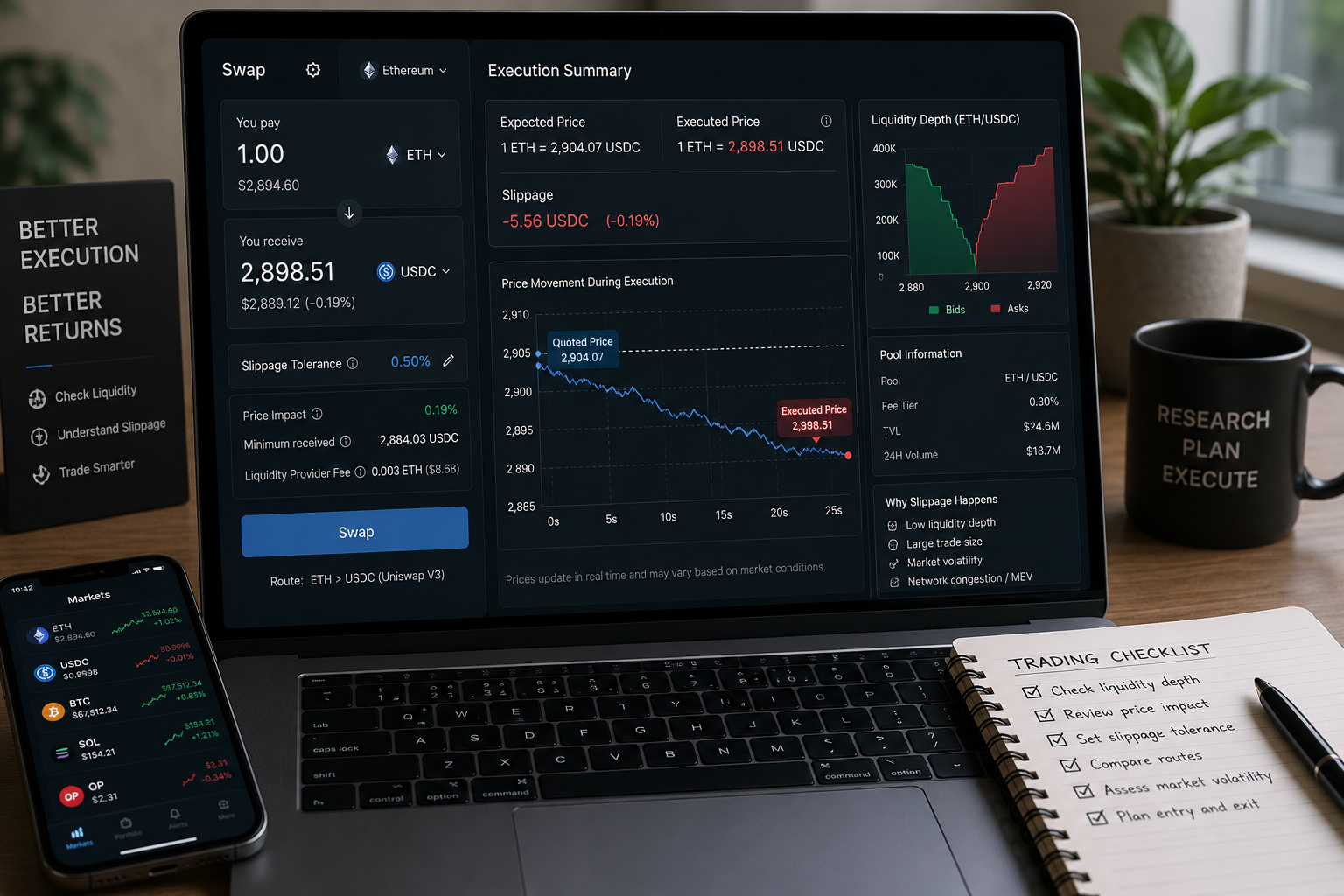
Slippage in crypto is the difference between the price a trader expects and the price at which the trade actually executes.
It is one of the most important execution risks in crypto, especially in decentralized finance.
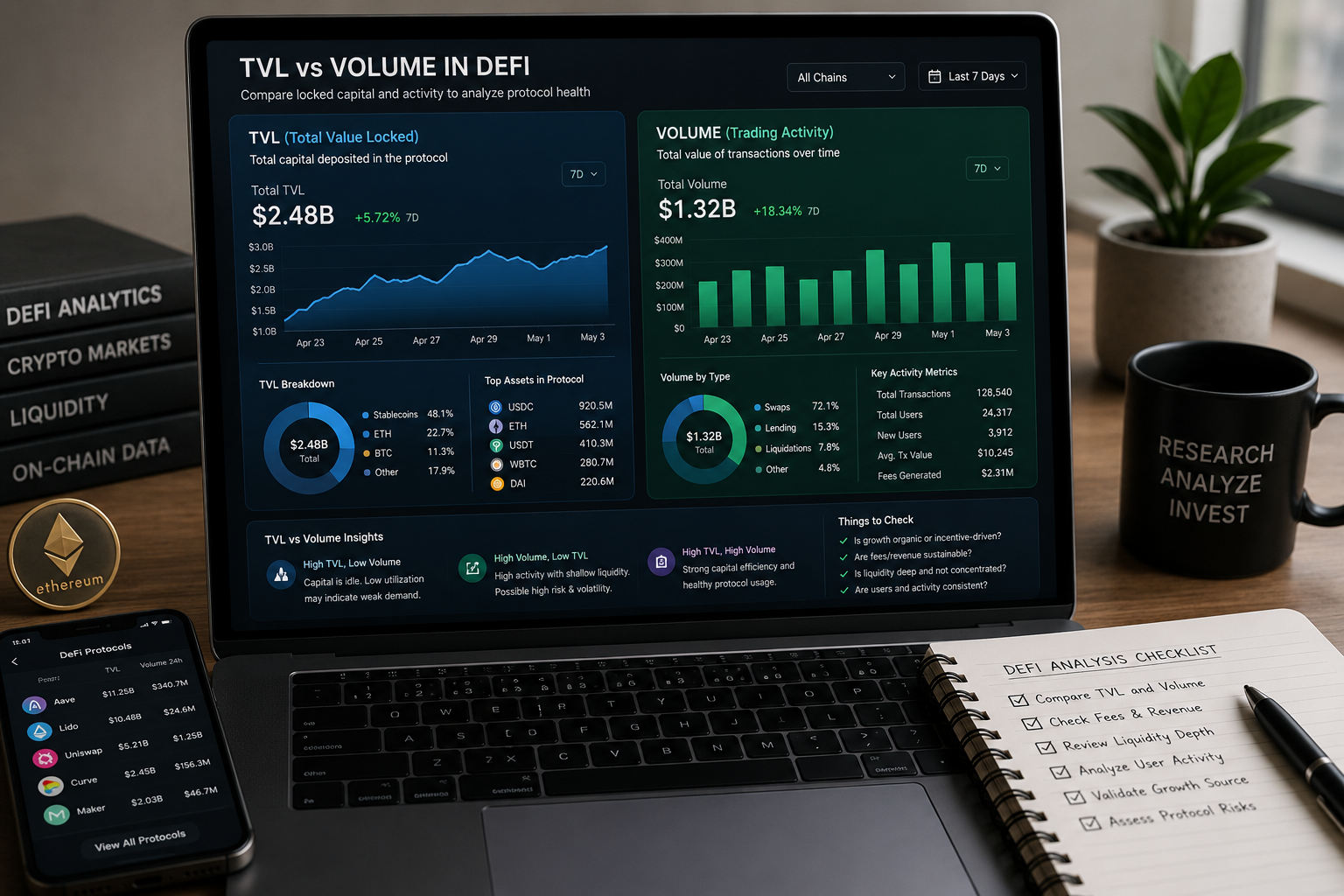
Many investors focus on token price, market cap, TVL, yield, or volume. Those metrics matter, but they do not always show whether a trade can actually be executed efficiently.
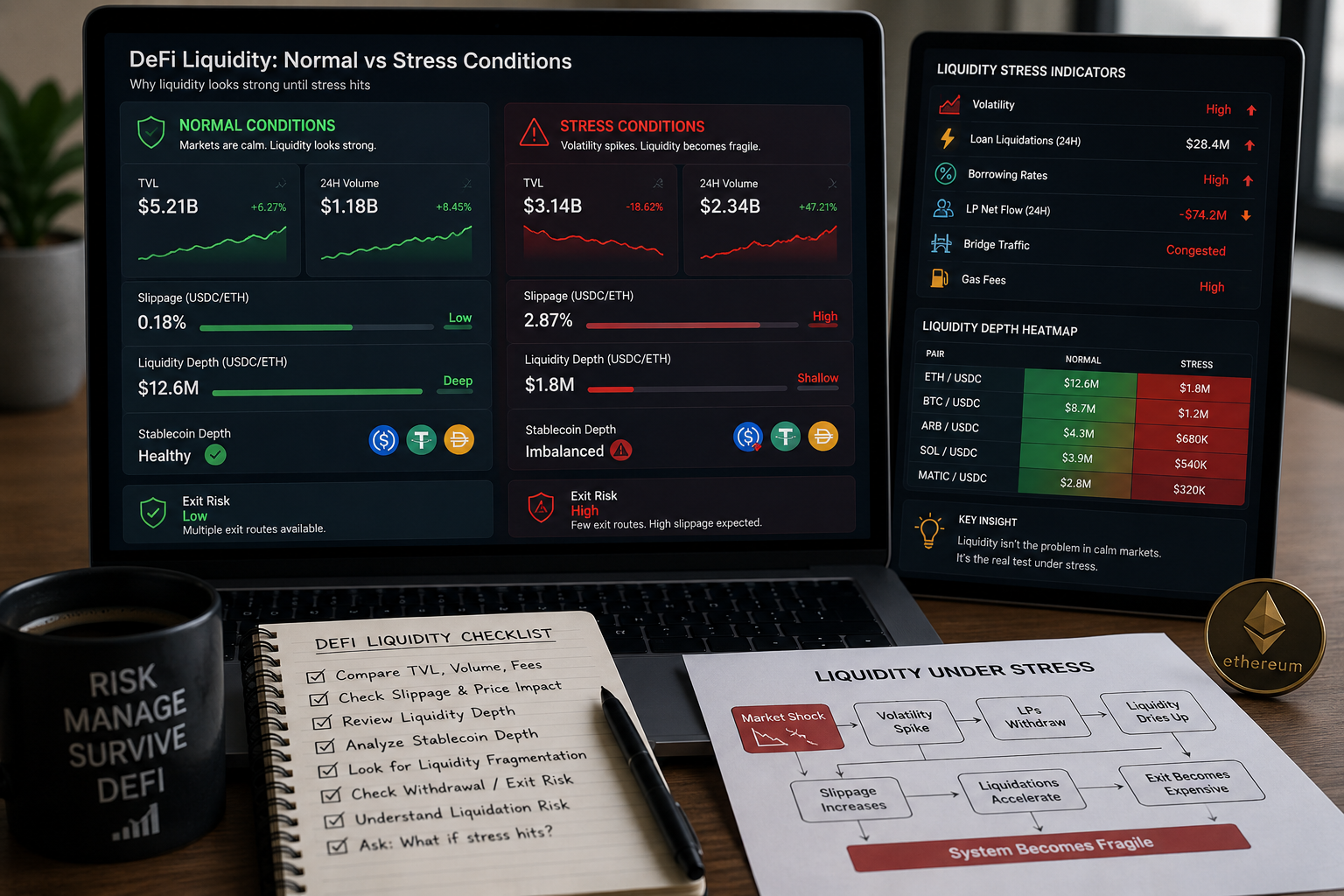
A token can look liquid on the surface and still create bad execution.
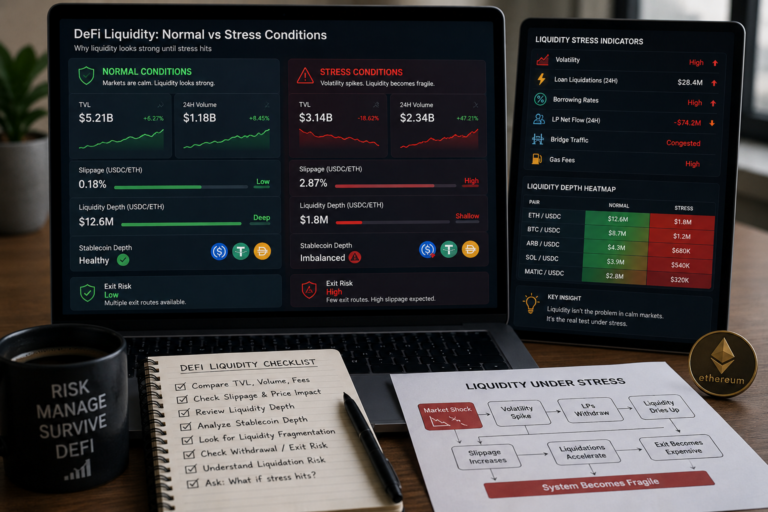
A DeFi pool can show high TVL and still produce poor pricing for larger swaps.
A market can show high volume and still become expensive to trade during volatility.
That is where slippage matters.
Slippage shows the gap between quoted price and real execution. In simple terms, it answers a practical question:
If I try to buy or sell now, how much worse could the final price be?
CoinGecko defines slippage as the difference between the expected price of a trade and the actual price at which the trade is executed. This difference can happen because prices move during execution or because liquidity is not deep enough to absorb the order smoothly.
For investors, slippage is not just a trading detail.
It is a signal about market quality.
Table of Contents
Why Slippage in Crypto Happens
Slippage in crypto happens when the execution price changes between the moment a trade is submitted and the moment it is completed.
This can happen for several reasons.
The most common causes are:
- Low liquidity.
- Large trade size.
- Fast price movement.
- Volatile markets.
- Thin order books.
- Small liquidity pools.
- Delayed execution.
- Network congestion.
- MEV and transaction ordering.
- Poor routing across exchanges or pools.
In centralized exchanges, slippage usually happens when an order consumes several price levels in the order book.
In decentralized exchanges, slippage often happens when a swap changes the balance of a liquidity pool. Chainlink explains that slippage is heavily influenced by liquidity pool depth and market volatility, especially in automated market maker environments.
This means slippage is not random.
It is usually the result of a relationship between trade size, liquidity depth, market speed, and execution design.
A small trade in a deep market may have almost no slippage.
A large trade in a shallow pool can move the price significantly.
That difference matters more than many beginners realize.
Slippage vs Price Impact
Slippage and price impact are often confused.
They are related, but they are not the same.
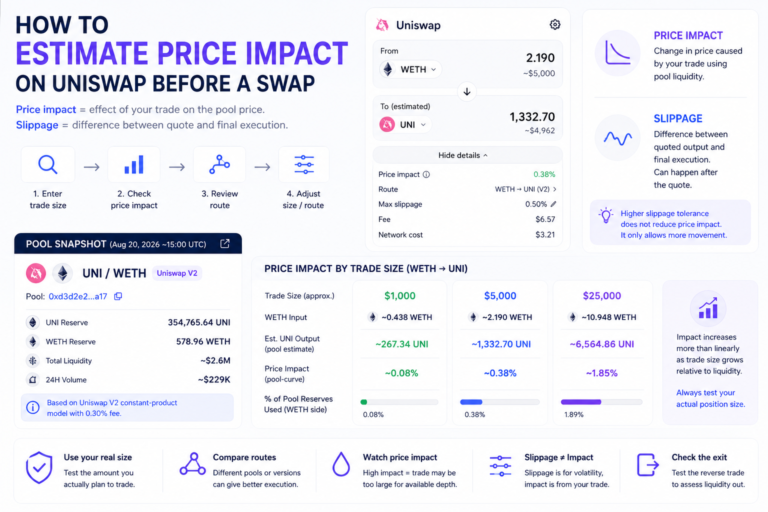
Uniswap explains that price impact is the price change caused by your own trade, while slippage refers to the difference between the expected price and the final execution price.
The distinction is important.
| Concept | Meaning | Main Cause |
|---|---|---|
| Price impact | How much your own trade moves the market. | Trade size versus liquidity depth. |
| Slippage | Difference between expected and executed price. | Price movement, liquidity, execution delay, or MEV. |
For example, if you place a large swap in a small DeFi pool, your own trade may move the price. That is price impact.
If the price changes between quote and confirmation, or the transaction executes at a worse price than expected, that is slippage.
In practice, traders feel both as worse execution.
But investors should understand the difference because it helps diagnose the problem.
If price impact is high, the trade may be too large for the available liquidity.
If slippage is high, the market may be moving quickly, the pool may be shallow, or the execution route may be inefficient.
This is why BlockCodex’s article on “Liquidity in Crypto Markets: 7 Critical Misconceptions Investors Still Get Wrong“ is important. Liquidity quality determines how much trading activity a market can absorb without large execution costs.
Why Slippage Matters for DeFi Traders
Slippage matters in DeFi because decentralized exchanges rely on liquidity pools rather than traditional order books.
In an automated market maker, users trade against a pool of assets. The price changes as the pool balance changes.
If the pool is deep, trades can execute with less price movement.
If the pool is shallow, even moderate trades can create worse execution.
Chainlink explains that slippage often happens when a trade is large relative to the size of the liquidity pool. Low liquidity can make small pools inefficient for large transactions.
This is why DeFi users should not only ask:
“What is the token price?”
They should also ask:
“Can I actually trade this size without losing too much to slippage?”
That question is especially important for:
- New tokens.
- Small-cap assets.
- Low-liquidity pools.
- Meme coins.
- Long-tail DeFi tokens.
- Yield farming tokens.
- Cross-chain assets.
- Tokens with fragmented liquidity.
A token may show attractive upside, but if liquidity is thin, entering and exiting the position can become expensive.
This is also why passive income strategies in DeFi require caution. A high APY is less attractive if entering or exiting the position creates heavy slippage.
For more context, see BlockCodex’s guide on “Best DeFi Platforms for Passive Income: 7 Smart Ways to Evaluate Yield“.
Yield is not the only factor.
Execution quality matters too.
Slippage in Crypto as a Liquidity Signal
Slippage in crypto is one of the clearest signs of liquidity quality.
A liquid market allows users to buy or sell without significantly changing the price. CoinGecko describes liquidity as the ability to trade in either direction without significant slippage.
This makes slippage useful beyond the trade itself.
It can reveal whether a market is actually deep.
A token with low slippage usually has:
- Deeper liquidity.
- More efficient routing.
- Better market depth.
- More competitive pricing.
- More active liquidity providers.
- Lower execution risk.
A token with high slippage may have:
- Shallow liquidity.
- Concentrated liquidity in one pool.
- Weak market depth.
- Poor routing.
- High volatility.
- Fragmented liquidity across chains or venues.
This is why investors should treat slippage as a liquidity test.
If a token looks attractive but produces high slippage for a normal trade size, the market may not be as healthy as it appears.
Fragmented liquidity can make execution worse because capital is split across chains, pools, bridges, and venues. A token may appear to have liquidity overall, but the specific pool or route used for the trade may still be weak.
Slippage reveals that weakness.
Slippage Tolerance Explained
Slippage tolerance is the maximum price difference a trader is willing to accept before a transaction fails.
On many decentralized exchanges, users can set slippage tolerance before confirming a swap.
For example, a 1% slippage tolerance means the transaction can execute if the final price stays within 1% of the quoted price. If the price moves beyond that range, the transaction fails.
Uniswap’s developer documentation explains that slippage tolerance establishes a margin of acceptable price change. If the execution price ends outside the accepted range, the swap will not occur.
This setting creates a trade-off.
A low slippage tolerance gives better price protection, but the transaction may fail more often.
A high slippage tolerance improves the chance of execution, but the user may accept a much worse price.
That balance matters.
| Slippage Tolerance | Benefit | Risk |
|---|---|---|
| Low tolerance | Better price protection. | Higher chance of failed transaction. |
| High tolerance | Higher chance of execution. | Greater risk of poor execution. |
Beginners often increase slippage tolerance because a transaction fails.
That can be dangerous.
If the trade keeps failing, the problem may not be the setting.
The problem may be low liquidity, high volatility, bad routing, or a risky token.
A failed transaction can be annoying.
But a badly executed transaction can be more expensive.
7 Critical Reasons Slippage in Crypto Matters
1. Slippage Shows Whether Liquidity Is Real
A market may look active, but slippage shows whether liquidity can actually absorb trades.
This is important because headline volume can be misleading.
If a token shows strong volume but creates poor execution, the market may be weaker than it looks.
For this reason, slippage is closely related to BlockCodex’s article on “Fake Volume in Crypto: 7 Powerful Signals Investors Should Watch“.
Real market quality is not only about how much trading is reported.
It is about whether trades can happen efficiently.
2. Slippage Can Turn a Good Trade Into a Bad Trade
A trade can look profitable before execution and become unattractive after slippage.
This is especially true for small-cap tokens, illiquid DeFi pools, or volatile assets.
If a trader expects a 3% gain but loses 2% to slippage entering and another 2% exiting, the trade no longer has the same risk-reward profile.
Slippage affects both entry and exit.
Ignoring it can make a strategy look better on paper than it is in practice.
3. Slippage Increases During Volatility
Crypto markets can move quickly.
During volatility, prices can change between the moment a transaction is submitted and the moment it is executed.
This is especially relevant on-chain, where swaps may wait for block confirmation.
If the market moves sharply during that time, the final execution price may differ from the initial quote.
This is why volatile tokens often require more caution.
The more unstable the price, the more carefully traders should manage slippage tolerance and position size.
4. Slippage Reveals Poor Market Depth
Market depth measures how much buying or selling a market can absorb at different price levels.
Poor market depth leads to higher slippage because there is not enough liquidity near the quoted price.
This matters for both centralized and decentralized exchanges.
A token can have a visible price, but that price may only apply to a small amount of liquidity.
The larger the trade, the more the price may move.
This is why investors should not judge a token only by market cap or last traded price.
They should check whether the market can support the size they want to trade.
5. Slippage Can Be Worse Across Fragmented Liquidity
Liquidity fragmentation happens when liquidity is spread across multiple pools, chains, bridges, or exchanges.
This can make trading less efficient.
A token may have liquidity on Ethereum, Arbitrum, Base, Solana, and centralized exchanges, but if each venue has shallow liquidity, the user may still face poor execution on any single route.
DEX aggregators try to solve this by routing trades across multiple pools or venues, but routing cannot always remove the problem.
If liquidity is fragmented and shallow, slippage can remain high.
This is one reason liquidity fragmentation matters for investors and DeFi users.
6. Slippage Can Expose Users to MEV Risk
In DeFi, transactions are often visible before they are confirmed.
This can expose users to MEV-related risks, including sandwich attacks, where bots place trades around a user’s transaction to extract value.
A research paper on Uniswap trading costs found that transaction costs vary significantly depending on trade characteristics, and that for large swaps, price impact and slippage can represent a major share of total cost. It also found that adversarial slippage was higher for a popular memecoin than for a more mature asset pair.
This does not mean every swap is attacked.
But it shows that slippage is not always just a natural market movement.
Sometimes execution can be affected by transaction ordering and market structure.
This is another reason to avoid unnecessarily high slippage tolerance.
7. Slippage Affects DeFi Yield Strategies
Slippage matters when entering and exiting DeFi positions.
For example, a user may need to swap tokens before depositing into a liquidity pool, vault, or yield strategy. Later, they may need to unwind that position and swap back.
Each swap can create slippage.
If the yield is small but the execution cost is high, the strategy may not be worth it.
This matters for passive income strategies because APY does not show the full cost of participation.
A yield opportunity should be judged alongside:
- Entry slippage.
- Exit slippage.
- Gas fees.
- Pool depth.
- Token volatility.
- Reward token liquidity.
- Impermanent loss risk.
- Withdrawal conditions.
A high yield is not automatically attractive if the exit is expensive.
How to Reduce Slippage in Crypto
Slippage cannot always be eliminated, but it can often be reduced.
Use Smaller Trade Sizes
Large trades create more price impact.
Splitting a trade into smaller parts may reduce execution pressure, although it can increase gas costs.
Trade in Deeper Pools
Deeper liquidity usually reduces slippage.
Before swapping, compare liquidity across pools, DEXs, and chains.
Use DEX Aggregators Carefully
Aggregators can route trades across multiple pools to improve pricing.
However, users should still check the final quote, route, fees, and slippage settings.
Avoid Trading During Extreme Volatility
Fast market moves increase execution uncertainty.
If the market is moving aggressively, slippage risk rises.
Set Slippage Tolerance Carefully
Do not automatically increase slippage tolerance just to force a transaction through.
If a swap requires very high tolerance, it may indicate poor liquidity or high volatility.
Check Price Impact Before Confirming
Most DeFi interfaces show price impact.
If price impact is high, the trade may be too large for the pool.
Avoid Illiquid Reward Tokens
Yield farming tokens can be difficult to exit if liquidity is weak.
Always check whether reward tokens can be sold efficiently.
Common Mistakes Investors Make With Slippage
Mistake 1: Ignoring Slippage on Small-Cap Tokens
Small-cap tokens often have weaker liquidity.
Even moderate trades can create large slippage.
Mistake 2: Confusing Volume With Liquidity
High volume does not always mean a trade will execute efficiently.
Volume can be noisy, temporary, or fragmented.
Mistake 3: Setting Slippage Tolerance Too High
High tolerance can expose users to poor execution and MEV-related risks.
Mistake 4: Ignoring Exit Liquidity
Investors often check entry price but forget exit conditions.
A position is only useful if it can be exited efficiently.
Mistake 5: Using One Pool Without Comparing Routes
Different pools may offer different execution quality.
A better route can reduce slippage.
Mistake 6: Treating APY as Net Return
Yield is not net return if gas, slippage, volatility, and exit risk are ignored.
Mistake 7: Assuming Slippage Is Always Small
In deep markets, slippage may be minor.
In thin markets, it can be the difference between a good trade and a bad one.
Practical Slippage Checklist Before Trading
Before confirming a crypto trade, ask:
- What is the expected execution price?
- What is the slippage tolerance?
- What is the price impact?
- Is the pool deep enough?
- Is liquidity fragmented across venues?
- Is the token volatile right now?
- Is the trade size too large for the pool?
- Are there better routes?
- Can I exit the position later?
- Is the potential return still attractive after slippage?
This checklist is simple, but it prevents many bad trades.
The goal is not to avoid every imperfect execution.
The goal is to understand the cost before accepting the trade.
Final Thoughts
Slippage in crypto matters because it shows the difference between a quoted price and real execution.
It is not just a technical detail. It is a practical signal about liquidity, market depth, volatility, routing quality, and execution risk.
A market with low slippage is usually easier to trade.
A market with high slippage requires more caution.
For DeFi investors, slippage is especially important because liquidity pools, automated market makers, MEV risk, fragmented liquidity, and volatile tokens can all affect final execution.
The key lesson is simple:
Do not judge a trade only by the displayed price.
Check the execution quality.
A good crypto investment is not only about choosing the right asset.
It is also about entering and exiting that asset without losing too much to poor liquidity.