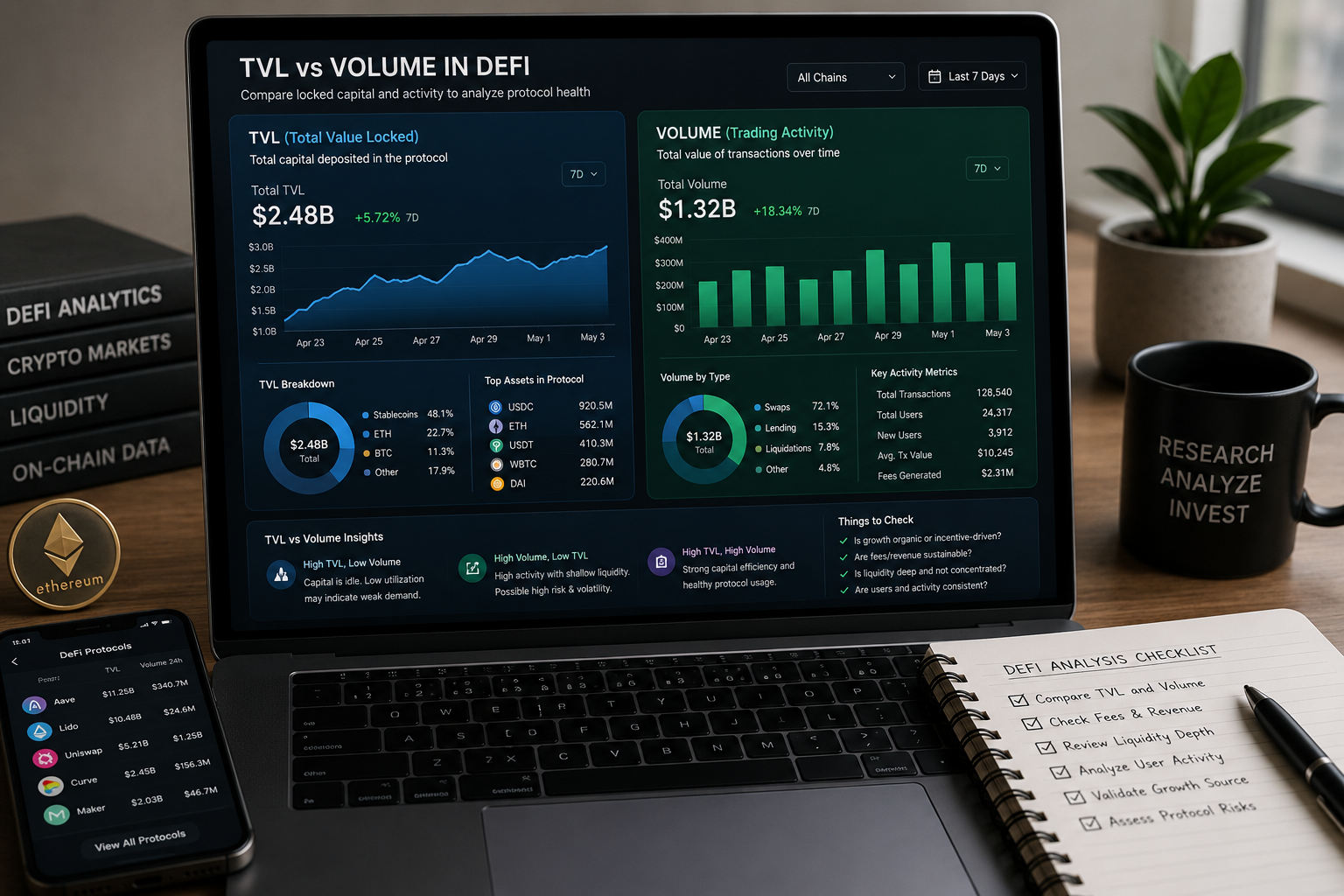
TVL vs volume in DeFi analysis is one of the simplest ways to avoid misreading protocol activity.
Many investors look at one metric and treat it as the full story.
If TVL is high, they assume the protocol is trusted.
If volume is high, they assume the protocol is growing.
If both rise, they assume the project is healthy.
That can be true.
But it is not always true.
TVL and volume measure different things. TVL shows how much value is deposited or locked inside a protocol. Volume shows how much activity flows through a protocol during a period.
One metric reflects capital presence.
The other reflects usage intensity.
A DeFi protocol can have high TVL but weak activity. Another can have strong volume but fragile liquidity. A third can show both rising, but only because incentives temporarily attract capital and trading.
That is why investors should not compare TVL and volume as competing metrics.
They should compare them as two different signals.
The real question is not: “Which number is bigger?”
The better question is: “What does the relationship between locked capital and actual activity reveal?”
Table of Contents
What TVL Means in DeFi
TVL stands for Total Value Locked.
It is used to estimate the value of assets deposited into a DeFi protocol, chain, or application. DeFiLlama tracks TVL, fees, revenue, volume, and yields across thousands of DeFi protocols and hundreds of chains, making it one of the most widely used dashboards for DeFi analysis. (defillama.com)
In simple terms, TVL helps investors understand how much capital is sitting inside a protocol.
That capital may be used for:
- Lending.
- Borrowing.
- Liquidity pools.
- Staking.
- Collateral.
- Vaults.
- Yield strategies.
- Derivatives margin.
- Cross-chain liquidity.
High TVL can suggest that users are willing to deposit assets into the protocol.
But TVL does not automatically mean sustainable adoption.
TVL can rise because asset prices increased.
It can rise because incentives attracted temporary deposits.
It can rise because capital is looped or recursively reused.
It can rise because a few large wallets deposited funds.
It can rise because liquidity is concentrated in one pool.
This is why BlockCodex’s guide on “How to Read TVL in Crypto: What It Really Signals About Capital and Risk“ treats TVL as a capital quality signal, not a simple trust score.
TVL is useful.
But it needs interpretation.
What Volume Means in DeFi
Volume measures activity.
In DeFi, volume usually refers to the value of transactions processed through a protocol, market, or exchange over a specific period. For decentralized exchanges, DeFiLlama tracks DEX swap volume and trading activity across hundreds of decentralized exchanges, with 24-hour and 7-day comparisons. (defillama.com)
CoinGecko defines trading volume as a reference point for how active a market is, noting that higher trading volume generally implies more traders in the market and stronger liquidity. (coingecko.com)
In DeFi, volume can come from:
- Token swaps.
- DEX trading.
- Perpetual futures.
- Lending activity.
- Liquidations.
- Bridge transfers.
- NFT marketplace trades.
- Arbitrage.
- Market-making.
- Incentivized transactions.
Volume shows movement.
But movement is not always healthy.
High volume can reflect real demand, but it can also reflect short-term speculation, incentives, wash trading, arbitrage loops, bot activity, or volatile liquidation periods.
That is why volume should not be read alone.
A protocol with high volume but weak liquidity may be difficult to trade through safely. A DEX with sudden volume spikes may look active, but the activity may not persist after incentives disappear.
For a deeper explanation of this risk, see BlockCodex’s guide on “Fake Volume in Crypto: 7 Powerful Signals Investors Should Watch“.
Volume matters.
But it needs context.
TVL vs Volume in DeFi: The Core Difference
The core difference in TVL vs volume DeFi analysis is simple:
TVL measures capital sitting inside the system. Volume measures activity moving through the system.
That distinction changes everything.
| Metric | What It Measures | What It Suggests | Main Risk |
|---|---|---|---|
| TVL | Deposited or locked capital. | Capital presence and liquidity base. | Can be inflated or passive. |
| Volume | Transaction or trading activity. | Usage intensity and market demand. | Can be temporary or artificial. |
TVL answers: “How much capital is committed?”
Volume answers: “How much activity is happening?”
A strong DeFi protocol usually needs both.
TVL without volume may show idle capital.
Volume without TVL may show shallow activity.
Both metrics rising together may suggest stronger usage, but only if the activity is organic and persistent.
That is why TVL vs volume DeFi analysis is useful.
It forces investors to compare capital depth with actual usage.
Why High TVL Can Mislead Investors
High TVL can make a protocol look safer than it really is.
Investors often assume that if many assets are deposited, the protocol must be trusted. That assumption can be dangerous.
TVL can be distorted by several factors.
Asset Price Inflation
If ETH, SOL, or other deposited tokens rise in price, TVL can increase even if no new users deposit capital.
The protocol may look like it is growing, while the actual number of deposits remains flat.
Incentive-Driven Deposits
Protocols often offer token rewards to attract liquidity.
This can increase TVL quickly.
But if capital leaves when rewards fall, the TVL was not sticky. It was rented.
Double Counting
TVL can sometimes overstate the amount of underlying capital because assets may be wrapped, restaked, borrowed, redeposited, or reused across protocols.
A 2024 academic paper argued that TVL can be inflated through double counting, including wrapping and leveraging, and proposed Total Value Redeemable as a more conservative alternative for assessing underlying DeFi value. (arxiv.org)
Whale Concentration
A protocol can have high TVL because a few large wallets supply most of the capital.
That creates fragility.
If those wallets exit, liquidity can disappear quickly.
Passive Capital
Some TVL is not active.
It may sit in a vault, pool, or staking contract without generating meaningful usage, fees, or revenue.
This is why TVL should be connected to volume, fees, revenue, and user behavior.
High TVL is not automatically strong.
It is only strong when the capital is useful, sticky, and economically active.
Why High Volume Can Mislead Investors
High volume can also create false confidence.
A protocol with rising volume may look like it has strong product-market fit. But volume can be noisy.
Incentivized Trading
Some protocols reward users for trading.
That can increase volume without proving genuine demand.
If users trade mainly to farm rewards, the activity may disappear when incentives end.
Bot and Arbitrage Activity
DeFi markets naturally attract bots and arbitrageurs.
Some of this activity is healthy because it improves pricing efficiency. But it can also make volume look stronger than human user demand.
Wash Trading
Volume can be manipulated.
Wash trading creates artificial activity by repeatedly trading assets to inflate reported numbers.
This is why BlockCodex’s guide on “Fake Volume in Crypto: 7 Powerful Signals Investors Should Watch” is important for investors comparing DeFi activity.
Liquidation Spikes
Volume can rise during market stress because positions are liquidated.
That may show market activity, but it does not necessarily show healthy protocol growth.
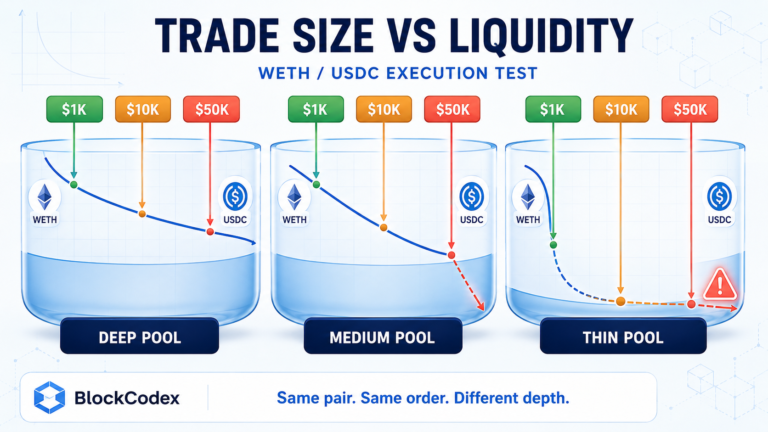
Thin Liquidity
High volume does not always mean deep liquidity.
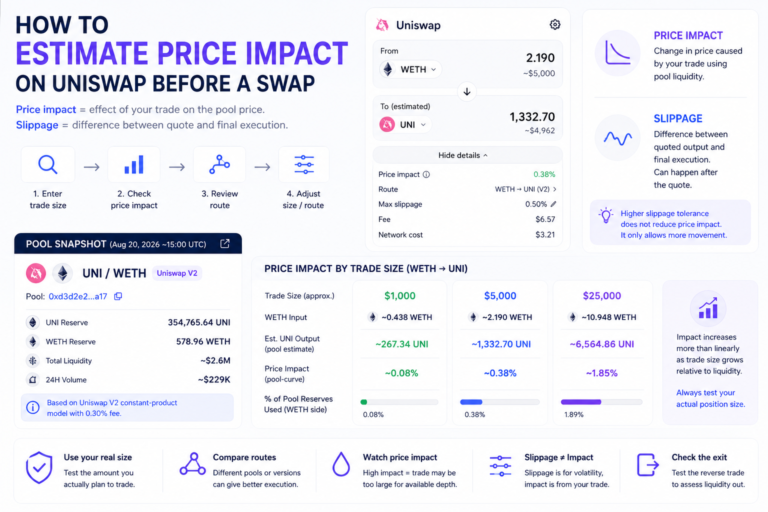
A market can process large activity over time but still suffer from poor execution, high slippage, or weak depth at specific price levels.
This is why volume should be compared with TVL and liquidity quality.
High volume is useful only when it reflects real, repeatable, and economically meaningful activity.
The TVL-to-Volume Relationship
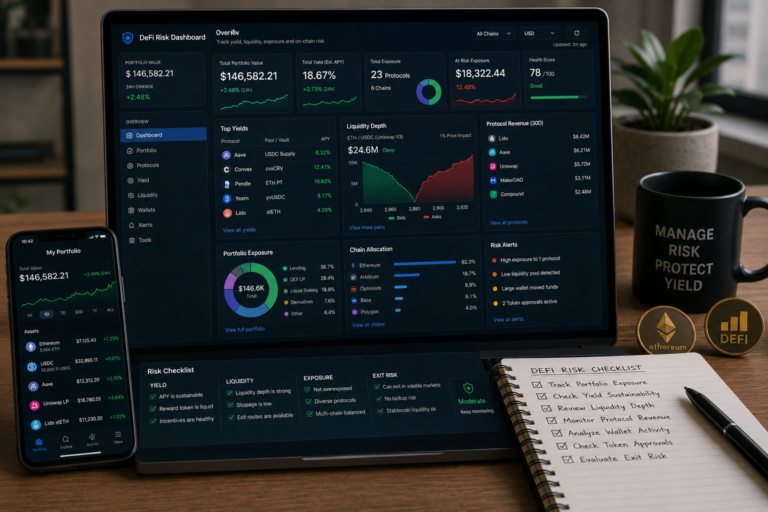
The relationship between TVL and volume can reveal how efficiently capital is being used.
A basic way to think about it:
Volume relative to TVL shows how active the deposited capital is.
This does not need to become a complicated formula for most investors.
The logic is enough.
If TVL is high and volume is low, capital may be passive.
If TVL is low and volume is high, activity may depend on shallow liquidity, fast turnover, or short-term trading demand.
If TVL and volume both rise steadily, the protocol may be building stronger usage.
If volume spikes but TVL does not follow, activity may be temporary.
If TVL rises but volume stays flat, capital may be deposited for yield rather than real usage.
This is where TVL vs volume DeFi analysis becomes more useful than either metric alone.
Investors are not just asking whether a number is high.
They are asking whether the metrics confirm each other.
7 Practical Differences Between TVL and Volume
1. TVL Shows Capital Depth, Volume Shows Activity
TVL tells investors how much value is deposited.
Volume tells investors how much value is moving.
A lending protocol can have high TVL because users deposited collateral. A DEX can have high volume because traders are actively swapping assets.
Both are useful, but they do not mean the same thing.
2. TVL Can Be Passive, Volume Can Be Noisy
TVL may sit idle.
Volume may be inflated.
This is why both metrics need context.
A protocol with passive TVL and low fees may not be as strong as it looks. A protocol with noisy volume and weak liquidity may not be as useful as it appears.
3. TVL Is More About Capital Confidence
When users deposit assets into a protocol, they are showing some level of trust or incentive-driven willingness.
But this confidence may be temporary.
TVL should be checked against retention, withdrawals, incentives, and protocol risk.
4. Volume Is More About Usage Intensity
Volume helps show how much activity the protocol handles.
This is especially important for DEXs, perpetual exchanges, and marketplaces.
But volume should be compared with fees, liquidity, and user growth.
5. TVL Can Rise Without New Users
If token prices increase, TVL can rise even without more deposits.
This is why investors should look at TVL in native token terms or compare TVL with user and transaction data when possible.
6. Volume Can Rise During Market Stress
Volume often increases during volatility.
That can reflect real demand, but it can also reflect liquidations, panic selling, arbitrage, and short-term speculation.
Not all volume growth is positive.
7. The Best Signal Comes From Convergence
The strongest signal appears when TVL, volume, fees, revenue, users, and liquidity all improve together.
DeFiLlama provides separate dashboards for TVL, DEX volume, fees, and revenue, which helps investors compare whether capital, activity, and economics are moving in the same direction. (defillama.com) (defillama.com)
This is the difference between headline growth and healthier protocol activity.
How to Compare TVL and Volume by Protocol Type
Different DeFi protocols require different interpretations.
DEXs
For decentralized exchanges, volume is especially important.
A DEX exists to facilitate trades.
High TVL can support liquidity, but trading volume shows whether users are actually using the market.
A strong DEX should ideally show:
- Deep liquidity.
- Consistent volume.
- Reasonable fees.
- Low slippage.
- Diverse trading pairs.
- Organic trader activity.
If TVL is high but volume is weak, capital may be underused.
If volume is high but TVL is weak, execution quality may be fragile.
Lending Protocols
For lending protocols, TVL is more central.
Deposits and collateral matter because lending depends on supplied assets.
However, volume-like activity also matters through borrowing demand, repayments, liquidations, and interest generation.
A strong lending protocol should show:
- Stable deposits.
- Healthy borrowing demand.
- Sustainable utilization.
- Controlled liquidation risk.
- Fee or revenue generation.
- Diversified collateral.
High TVL without borrowing demand may mean capital is idle.
Yield Protocols
For yield protocols, TVL can grow quickly when rewards are attractive.
But investors should ask whether deposits are sticky.
A strong yield protocol should show:
- Sustainable yield sources.
- Clear risk disclosure.
- Real revenue or fees.
- Low dependency on emissions.
- Retention after incentives decline.
If TVL depends mainly on token rewards, the protocol may be fragile.
Perpetual DEXs
For perpetual DEXs, volume is critical.
High volume can show trader demand, but it must be checked against open interest, liquidity, fees, funding, liquidations, and risk controls.
DeFiLlama also tracks perpetual DEX and futures trading volume across derivatives protocols. (defillama.com)
In this category, TVL alone is not enough.
Execution quality and trading demand matter heavily.
What Investors Should Look For
When comparing TVL and volume, investors should avoid simple conclusions.
Instead, ask better questions:
- Is TVL growing because of deposits or token price appreciation?
- Is volume persistent or only a short-term spike?
- Are fees and revenue increasing with activity?
- Is liquidity deep enough to support real trades?
- Are incentives driving the metrics?
- Are users returning?
- Is volume concentrated in one pair or market?
- Is TVL concentrated in a few wallets?
- Does the protocol still look strong after rewards decline?
- Do TVL and volume confirm each other?
The best DeFi analysis is not built on one metric.
It is built on relationships between metrics.
This is why BlockCodex’s article on “Liquidity in Crypto Markets: 7 Critical Misconceptions Investors Still Get Wrong“ is an important companion to TVL analysis.
Liquidity explains whether capital can actually absorb activity.
Practical Investor Framework
A simple framework can help investors compare TVL and volume without overcomplicating the process.
Step 1: Identify the Protocol Type
A DEX, lending protocol, yield vault, and derivatives platform should not be judged the same way.
Step 2: Check TVL Direction
Is TVL rising, falling, or flat?
Then ask why.
Is it price-driven, deposit-driven, incentive-driven, or whale-driven?
Step 3: Check Volume Direction
Is volume consistent or spiky?
Persistent activity is usually more meaningful than one-day surges.
Step 4: Compare TVL With Volume
Does the protocol have capital but no usage?
Does it have activity but weak liquidity?
Do both metrics move together?
Step 5: Add Fees and Revenue
Activity becomes more meaningful when users pay to use the protocol.
Fees and revenue help separate usage from noise.
Step 6: Check Incentives
If rewards are driving deposits or volume, the signal may weaken when incentives end.
Step 7: Review Liquidity Quality
Look beyond headline TVL.
Check depth, slippage, concentration, and whether liquidity is usable.
This framework keeps TVL vs volume DeFi analysis practical and repeatable.
Final Thoughts
TVL and volume are both useful DeFi metrics, but they answer different questions.
TVL shows capital presence.
Volume shows activity.
Neither is enough alone.
High TVL can hide passive or incentive-driven capital. High volume can hide noisy, temporary, or artificial activity. The strongest signal usually appears when TVL, volume, fees, revenue, users, and liquidity quality improve together.
That is why TVL vs volume DeFi analysis matters.
It helps investors move beyond headline metrics and ask better questions about protocol health.
A strong DeFi protocol should not only attract capital.
It should put that capital to work through real, repeatable, economically meaningful activity.