The best crypto security stack is not the most complicated one.
Many investors assume crypto security means buying several devices, using multisig immediately, running custom nodes, or following highly technical setups designed for institutions. Those tools can be useful, but they are not always the right starting point.
For most investors, the real security problem is simpler:
- Too much capital sits in hot wallets
- Seed phrases are stored badly
- Wallet approvals are ignored
- Phishing links are clicked too quickly
- Long-term holdings and experimental DeFi activity use the same wallet
- Users trust interfaces without verifying transactions.
Crypto security works best when it is layered.
No single tool protects against every risk. A hardware wallet helps protect private keys, but it does not stop a user from signing a malicious transaction. A strong password manager helps secure exchange accounts, but it does not protect a seed phrase stored in cloud notes. Token approval reviews reduce smart contract exposure, but they do not fix poor wallet separation.
The goal is to build a practical security stack where one mistake does not destroy the entire portfolio.
The best crypto security stack should reduce key exposure, signing risk, and behavioral mistakes without making the setup too difficult to maintain.
Table of Contents
Why a Crypto Security Stack Matters
Crypto losses are not only theoretical.
Chainalysis reported that $2.2 billion was stolen from crypto platforms in 2024, and private key compromises accounted for 43.8% of stolen crypto that year. That detail matters because private key compromise is not always a smart contract failure. It is often a custody, access-control, or operational security failure.
CertiK’s 2024 Web3 Security Report also identified private key compromises as a major loss category, with $855,385,570 stolen across 65 incidents.
The lesson is clear: security is not only about avoiding risky protocols. It is about protecting the full path between the user, the wallet, the device, the signature, and the transaction.
A strong stack should reduce three types of risk:
| Risk Type | Example | Security Layer |
|---|---|---|
| Key risk | Seed phrase leak, malware, private key theft | Hardware wallet, offline backup |
| Signing risk | Malicious approvals, fake dApps | Approval review, transaction verification |
| Behavior risk | Phishing, urgency, poor wallet separation | Security routine, separate wallets |
The best setup is not one that looks advanced. It is one that reduces the most common failure points.
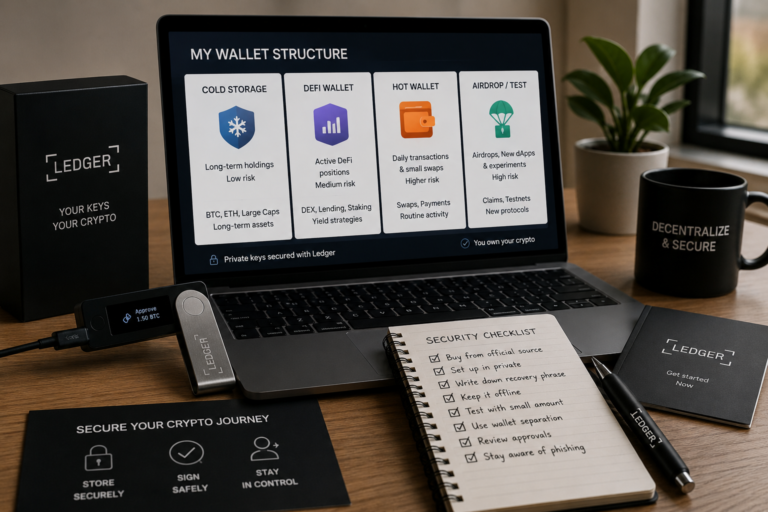
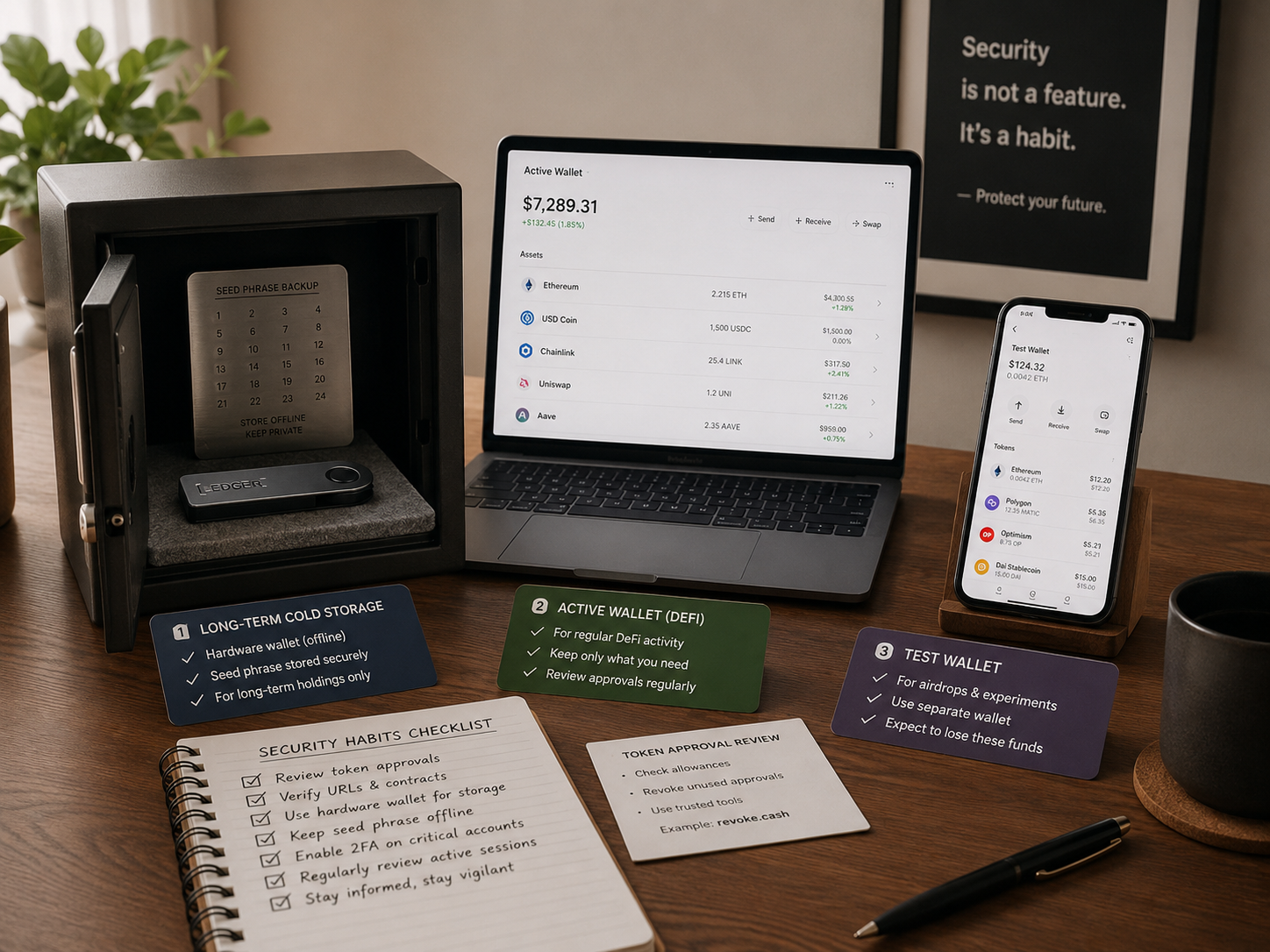
Layer 1: Wallet Separation
The first layer of the best crypto security stack is wallet separation.
Using one wallet for everything is one of the most common mistakes in crypto.
A safer structure is simple:
| Wallet Type | Purpose | Risk Level |
|---|---|---|
| Cold wallet | Long-term holdings | Low interaction |
| Active wallet | Regular DeFi or trading activity | Medium interaction |
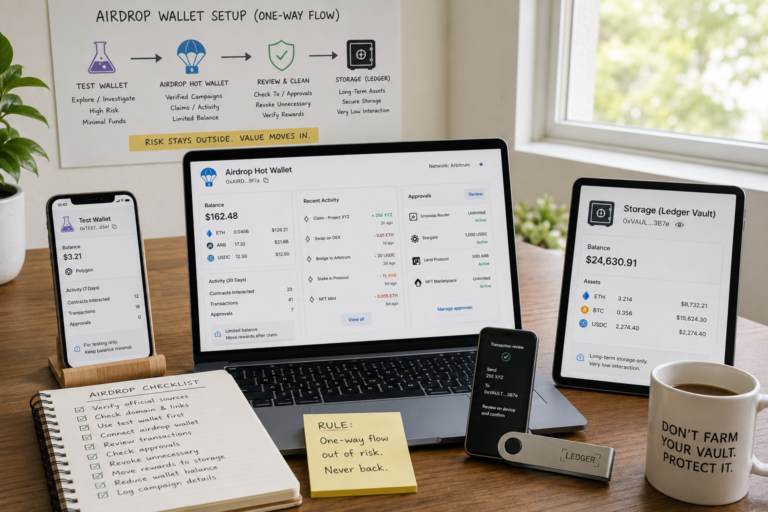
| Test wallet | Airdrops, new dApps, experimental protocols | High interaction |
This matters because risk should not be shared across every activity.
A test wallet can interact with new protocols. An active wallet can handle smaller balances for normal activity. A cold wallet should avoid unnecessary dApp connections and hold long-term assets.
The core principle is:
Do not expose long-term holdings to short-term experimentation.
This one habit can prevent a small mistake from becoming a full portfolio loss.
For a deeper explanation, see BlockCodex’s guide: “Best Ways to Secure Crypto: 7 Practical Layers Without Overcomplicating It”.
Layer 2: Hardware Wallet for Long-Term Holdings
A hardware wallet is one of the most important tools in a crypto security stack because it keeps private keys away from internet-connected devices.
Ledger explains that its devices store private keys offline inside a Secure Element chip, isolated from the computer or phone used to interact with crypto applications.
That matters because most everyday devices are exposed to more risk:
- Browser extensions
- Malware
- Phishing pages
- Compromised downloads
- Fake wallet prompts
- Malicious links
- Clipboard attacks.
A hardware wallet does not remove all risk, but it improves custody by separating private key storage from internet activity.
Ledger as a Practical Security Layer
For investors looking for a straightforward long-term storage setup, a Ledger hardware wallet can be a practical option because it combines offline key storage with transaction verification through a dedicated signing device.
Ledger devices are useful for:
- Long-term holdings
- Higher-value crypto positions
- Reducing exposure to browser malware
- Separating private keys from laptops and phones
- Confirming transaction details before signing
- Supporting multiple assets through Ledger Live and connected wallet integrations.
The important point is not to treat Ledger as a complete security solution. A Ledger device protects private keys, but it cannot protect against every bad decision. If a user signs a malicious approval or stores the seed phrase online, the stack is still weak.
A good Ledger-based setup looks like this:
- Ledger for long-term storage
- Hot wallet for smaller active transactions
- Test wallet for airdrops and unknown dApps
- Offline seed phrase backup
- Regular approval reviews.
For a broader comparison, you can internally link to “Best Hardware Wallets (2026): Ledger vs Alternatives for Secure Crypto Storage”.
Layer 3: Seed Phrase Protection
A seed phrase is not a password.
It is the recovery key to the wallet. If someone gets it, they can restore the wallet elsewhere and move the funds.
The most common seed phrase mistakes are basic:
- Saving it in screenshots
- Storing it in cloud notes
- Sending it through messaging apps
- Typing it into a website
- Keeping it next to the hardware wallet
- Relying on a single fragile paper copy.
A stronger approach is simple:
- Write it offline
- Never photograph it
- Never upload it
- Never share it with support
- Store it separately from the device
- Consider metal backup for larger holdings
- Protect it from fire, water, and theft.
The seed phrase should be treated like the asset itself.
If the recovery phrase is weakly protected, the wallet setup is weak, even if the device is secure.
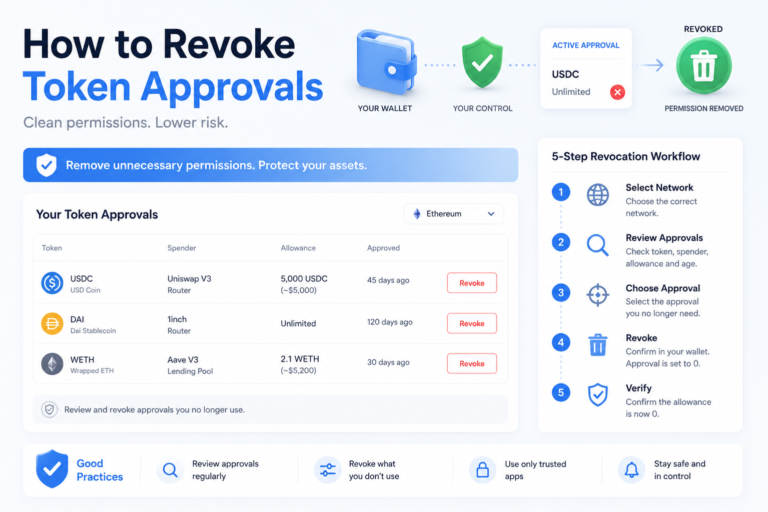
Layer 4: Token Approval Management
Many crypto investors focus on private keys but forget about approvals.
That is dangerous.
When users interact with DeFi protocols, bridges, NFT marketplaces, and trading tools, they often grant smart contracts permission to spend tokens from their wallet.
Sometimes approvals are limited. Sometimes they are unlimited.
Old approvals can remain active long after the user forgets about them. If a contract becomes compromised or if the user approved a malicious contract, assets can be exposed.
A practical approval routine should include:
- Reviewing token approvals monthly
- Revoking permissions no longer needed
- Avoiding unlimited approvals when possible
- Using a separate wallet for risky dApps
- Checking spender addresses before approving
- Avoiding approvals from unknown websites.
This is one of the most underrated layers of the best crypto security stack.
A wallet can look safe because funds are still visible, while hidden permissions quietly increase risk.
For more context, see BlockCodex’s article: “7 Critical Crypto Security Mistakes That Cost Investors Millions”.
Layer 5: Transaction Verification Before Signing
Crypto security often fails at the moment of signing.
A user connects a wallet, sees a prompt, and clicks approve without fully understanding what the transaction does.
That is exactly what attackers want.
Before signing, investors should ask:
- What contract am I interacting with?
- What token is being approved?
- Is the approval limited or unlimited?
- Is this a transfer or just a signature?
- Does the domain match the official project?
- Is the wallet prompt consistent with what I expected?
- Am I being rushed?
This is where hardware wallets help, but only if the user actually reads the transaction details.
A secure signing habit is simple:
If the transaction is unclear, do not sign.
Crypto transactions are usually final. Slowing down is part of the security stack.
Layer 6: Phishing Protection and Device Hygiene
Phishing is not only a beginner problem.
Experienced users can still be tricked when a fake site looks legitimate, a social account is compromised, or a “claim” page creates urgency.
Common phishing vectors include:
- Fake airdrops
- Fake wallet support
- Cloned dApps
- Malicious browser ads
- Discord announcements from compromised accounts
- Fake token migration pages
- Telegram support scams
- Malicious downloads.
A practical defense includes:
- Bookmarking official websites
- Avoiding links from DMs
- Checking domains carefully
- Using separate browser profiles
- Keeping extensions minimal
- Updating software from official sources
- Avoiding unknown downloads
- Using password managers for exchange accounts.
The objective is not paranoia. The objective is friction.
A good security stack makes risky actions harder to perform accidentally.
Layer 7: Monitoring and Routine Reviews
Crypto security is not a one-time setup.
Wallets interact with new protocols. Approvals accumulate. Devices age. Firmware updates appear. Scams evolve. Portfolio size changes.
A simple monthly review can improve security significantly.
Review:
- Wallet approvals
- Active DeFi positions
- Large balances in hot wallets
- Seed phrase storage condition
- Hardware wallet firmware source
- Connected dApps
- Exchange account security
- Suspicious token transfers
- Unusual wallet activity.
This is where many investors fail. They build a setup once, then ignore it.
The best crypto security stack is maintained over time.
Security is not only the tool. It is the routine.
| Investor Type | Recommended Stack |
|---|---|
| Beginner holder | Hardware wallet, offline seed backup, basic wallet separation |
| Active DeFi user | Hardware wallet, hot wallet, test wallet, approval reviews |
| Airdrop farmer | Separate airdrop wallet, no main wallet exposure, domain checks |
| Large portfolio investor | Hardware wallet, multisig consideration, metal backup, monitoring |
| Team / treasury | Multisig, access controls, operational procedures, signer policies |
The best approach is progressive.
Start with wallet separation and hardware custody. Then add approval reviews, better backups, monitoring, and more advanced controls if the portfolio grows.
Security should match risk level.
What a Strong Security Stack Does Not Do
A strong stack does not make crypto risk disappear.
It does not protect against:
- Bad investments
- Protocol insolvency
- Impermanent loss
- Smart contract exploits
- Stablecoin depegs
- Malicious governance
- Signing a bad transaction knowingly
- Sharing the seed phrase.
This matters because many investors misunderstand hardware wallets.
A hardware wallet protects private keys. It does not automatically protect every transaction.
The stack must include behavior, verification, and separation.
Conclusion
The best crypto security stack is practical, layered, and maintainable.
It does not need to be overcomplicated.
The best crypto security stack is the one investors can actually understand, maintain, and use consistently.
A strong setup usually includes:
- Wallet separation
- A Ledger or other hardware wallet for long-term holdings
- Offline seed phrase protection
- Token approval reviews
- Careful transaction verification
- Phishing protection
- Regular monitoring.
The strongest security advantage comes from reducing single points of failure.
One compromised hot wallet should not drain long-term holdings. One fake airdrop should not expose the whole portfolio. One old approval should not remain invisible forever. One rushed signature should not happen without verification.
Crypto security is not about fear.
It is about designing a system where mistakes are contained.
That is what a real security stack does.