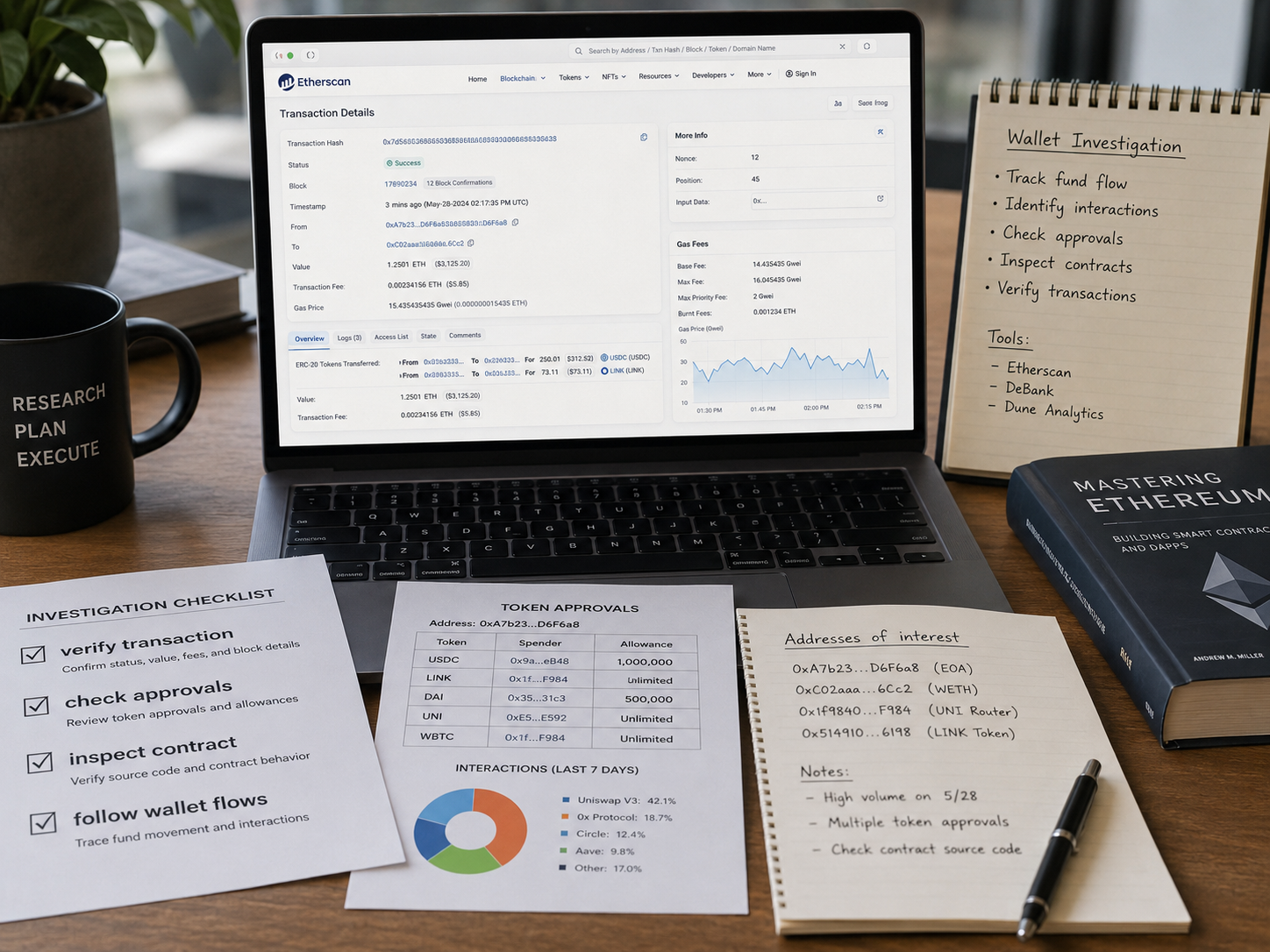
Blockchain explorers are one of the most important tools in crypto, but most investors use them only at the surface level.
They paste a transaction hash, check whether a transfer succeeded, and leave.
That is useful, but it is only the beginning.
A blockchain explorer can help investors verify transactions, analyze wallet behavior, inspect token contracts, review approvals, track exchange flows, and understand whether on-chain activity reflects real usage or noise.
In a market full of narratives, dashboards, and social media claims, blockchain explorers provide something more valuable: raw evidence.
They do not tell investors what to think. They show what happened on-chain.
The key is learning how to interpret that information correctly.
Table of Contents
Why Blockchain Explorers Matter
Crypto markets are transparent by design, but transparency does not automatically create understanding.
A public blockchain can show:
- Transactions
- Wallet balances
- Contract interactions
- Token transfers
- Gas fees
- Block data
- Contract source code
- Token approvals
- Validator or miner activity.
But raw data can be misleading if it is not interpreted in context.
For example, a large token transfer may look bearish if it goes to an exchange. But it may also be internal exchange movement, custody restructuring, OTC settlement, or collateral management.
This is why blockchain explorers are best used as investigation tools, not signal machines.
Etherscan describes itself as a blockchain explorer, search, API, and analytics platform for Ethereum and other EVM-compatible chains, with its API V2 supporting 60+ chains under a single account and API key system.
That matters because explorer literacy is no longer limited to Ethereum. The same core skills can help investors understand activity across multiple ecosystems.
1. Start with the Transaction Hash
The transaction hash is the most basic unit of blockchain verification.
When a transaction is submitted, it receives a unique identifier. On explorers such as Etherscan, users can paste that hash to see whether the transaction succeeded, failed, or remains pending.
A transaction page usually shows:
- Transaction status
- Block confirmation
- Sender address
- Receiver address
- Token transferred
- Gas fee paid
- Contract interacted with
- Timestamp
- Input data.
Etherscan explains that a transaction is a cryptographically signed instruction that changes the blockchain state, and block explorers track transaction details across the network.
This is useful because it separates facts from assumptions.
If someone claims they sent funds, the transaction hash confirms whether the transaction exists. If a swap failed, the explorer can show whether it reverted. If gas was spent but no token was received, the transaction details can help explain why.
The first skill is simple: Never rely only on screenshots. Verify the transaction.
2. Read Wallet Addresses Like Behavior Profiles
A wallet address is not just a balance.
It is a behavioral history.
When analyzing an address, investors can review:
- Current token holdings
- Transaction history
- NFT activity
- DeFi interactions
- Exchange deposits
- Contract approvals
- Stablecoin movements
- Counterparties.
This makes wallet analysis useful for understanding behavior.
For example:
- Repeated exchange deposits may suggest potential selling
- Repeated withdrawals to cold storage may suggest accumulation
- Frequent DeFi interactions may show active strategy rotation
- Many small incoming transfers may indicate airdrop farming
- Interactions with risky contracts may show exposure.
The mistake is reading a wallet as a static portfolio.
A wallet is better understood as a timeline of decisions.
For deeper wallet-level analysis, BlockCodex covers this in “How to Analyze Whale Activity: 7 On-Chain Signals Investors Should Track”.
3. Check Token Transfers Separately from Native Transactions
One common beginner mistake is confusing native transactions with token transfers.
On Ethereum, a wallet may show little ETH movement while still having significant ERC-20 activity.
That is because token transfers are contract interactions.
A proper explorer workflow should check:
- Native coin transfers
- ERC-20 token transfers
- NFT transfers
- Internal transactions
- Contract calls.
This matters because some activity can be hidden from a quick glance.
For example, a DeFi user may not “send” ETH directly, but they may swap tokens, provide liquidity, borrow assets, claim rewards, or interact with bridges through smart contracts.
If investors only look at the top-level transaction list, they can miss the actual economic movement.
4. Use Token Approval Checkers Before Interacting with DeFi
Token approvals are one of the most overlooked security risks in crypto.
When users interact with DeFi protocols, NFT marketplaces, or bridges, they may grant contracts permission to spend tokens from their wallet. Sometimes the approval is limited. Sometimes it is effectively unlimited.
Etherscan’s Token Approvals page lists contracts approved to spend an address’s tokens, and its “at risk amount” shows what could be vulnerable if those contracts were hacked.
That makes approval checking a practical security habit.
Investors should review approvals when:
- They use a new dApp
- They interact with unknown contracts
- They finish using a protocol
- They hold meaningful balances
- They suspect phishing exposure.
This is not only a technical step. It is a behavioral defense.
For a broader security framework, see BlockCodex’s guide “Best Ways to Secure Crypto: 7 Practical Layers Without Overcomplicating It”
5. Inspect Smart Contracts Before Trusting a Token
Smart contract pages can reveal important information.
On an explorer, investors can often check:
- Whether source code is verified
- Contract creator address
- Token supply
- Holder distribution
- Contract functions
- Upgradeability
- Proxy contracts
- Ownership status
- Recent contract interactions.
Etherscan explains that token contract code must be verified before token information can be updated, allowing the public to audit and read the deployed contract.
This matters because many scam tokens rely on users never checking the contract.
Red flags may include:
- Unverified source code
- Unusual mint functions
- Owner privileges
- Blacklist functions
- High concentration among few holders
- Fake token names copied from real projects
- Newly deployed contracts with aggressive promotion.
A verified contract does not guarantee safety.
But an unverified or suspicious contract should increase caution immediately.
6. Compare On-Chain Activity with the Narrative
Blockchain explorers help investors verify whether a narrative matches reality.
If a project claims rapid adoption, investors can check whether:
- Active wallets are increasing
- Contract interactions are rising
- Token transfers are organic
- Liquidity pools are active
- Smart contracts are being used
- Large holders are distributing or accumulating
- Activity is concentrated in a few wallets.
This is where explorer analysis becomes more powerful.
The question is not only “is there activity?”
The better question is:
Who is active, what are they doing, and does it support the project’s narrative?
For example, a token may claim strong community demand, but explorer data may show that most transfers come from a few wallets, exchange movements, or incentive farming.
This is why raw transaction counts should never be interpreted alone.
For a deeper explanation, see BlockCodex’s article “What On-Chain Activity Really Tells Us About Network Usage”.
7. Track Fees, Gas, and Network Conditions
Explorers also help investors understand network conditions.
On Ethereum, Etherscan’s charts page tracks network data such as pending transactions, network utilization, transaction fees, and node statistics. Its charts page recently showed 7-day network utilization around 50.51% and 7-day pending transactions around 688,885, illustrating how explorers can provide live network context.
This matters because fees and congestion shape user behavior.
High fees can push activity toward Layer 2s or alternative chains. Low fees can encourage more frequent interactions. Network utilization can influence user experience, transaction timing, and protocol activity.
For investors, fee data can help answer:
- Is network demand rising?
- Are users priced out?
- Is activity moving to cheaper execution layers?
- Are apps still usable during congestion?
- Is revenue coming from real blockspace demand?
Explorers make these questions measurable.
Practical Blockchain Explorer Workflow
A professional workflow should avoid jumping to conclusions.
Use this sequence:
| Step | What to Check | Why It Matters |
|---|---|---|
| Transaction hash | Status, sender, receiver, gas | Confirms what happened |
| Address page | History, balances, counterparties | Shows behavior |
| Token transfers | ERC-20 / NFT movement | Reveals hidden activity |
| Approvals | Contract permissions | Identifies wallet risk |
| Contract page | Verification, functions, holders | Checks token risk |
| Flow direction | To exchange, bridge, protocol | Interprets intent |
| Network charts | Fees, congestion, activity | Adds market context |
This structure turns explorers from simple search tools into on-chain investigation systems.
Using Koinly After Verifying Data on Blockchain Explorers
Blockchain explorers are excellent for raw verification. They help investors confirm transaction hashes, inspect wallet activity, review token approvals, and follow smart contract interactions directly on-chain. But once activity is spread across several wallets, exchanges, chains, and DeFi protocols, explorers become difficult to manage manually.
This is where Koinly can fit naturally into the workflow. After using blockchain explorers to verify what happened on-chain, Koinly helps consolidate that activity into a structured portfolio and tax-tracking system.
Koinly supports 900+ integrations across exchanges, wallets, and blockchains, and allows users to import data through API connections, public wallet addresses, xpub/ypub/zpub keys, and CSV files. It also supports DeFi, staking, lending, futures, NFTs, and mining activity, depending on the imported data and transaction type.
For investors using blockchain explorers regularly, Koinly can be useful in three practical ways:
- Transaction consolidation: bringing exchange trades, wallet transfers, and on-chain activity into one place
- Portfolio visibility: tracking holdings, gains, losses, income, and performance across multiple wallets
- Tax preparation: generating localized crypto tax reports for supported jurisdictions, including tax reports for 20+ countries according to Koinly’s tax reporting page.
The important point is that Koinly does not replace blockchain explorers. Explorers remain the best tool for verifying raw on-chain facts. Koinly is more useful after that verification step, when investors need to organize fragmented data, identify missing cost basis, track transfers across wallets, and prepare cleaner records.
For example, an investor might use Etherscan to confirm a DeFi transaction, check token approvals, or inspect a contract interaction. Then, they can use Koinly to import the wallet history, categorize the transaction, and include it in a broader portfolio or tax workflow.
This combination creates a stronger process: blockchain explorers verify the evidence, while Koinly helps structure the records.
Get in koinly Here.
Common Mistakes When Using Blockchain Explorers
Even experienced users make mistakes.
Common errors include:
- Assuming every exchange inflow means selling
- Ignoring internal transactions
- Trusting token names instead of contract addresses
- Confusing fake tokens with real ones
- Not checking token approvals
- Assuming verified contracts are automatically safe
- Reading one transaction without broader context
- Ignoring liquidity and market structure.
The biggest mistake is treating explorers as answer machines.
They show evidence. Analysis still requires judgment.
Conclusion
Blockchain explorers are essential for serious crypto research.
They allow investors to verify transactions, analyze wallets, inspect smart contracts, review token approvals, monitor network conditions, and compare narratives with actual on-chain behavior.
But the real skill is not opening a transaction page.
The real skill is interpretation.
A transaction hash tells you what happened. A wallet history shows behavior. A token approval reveals hidden risk. A smart contract page exposes design details. Network charts show demand and congestion.
Used correctly, blockchain explorers turn crypto from a narrative-driven market into something more transparent and testable.
They do not remove uncertainty.
But they reduce blind trust.
And in crypto, that is a major advantage.