Crypto airdrops can be useful. They can reward early users, decentralize token ownership, and help protocols bootstrap communities.
But they also attract some of the most aggressive scams in crypto.
The challenge is simple: legit crypto airdrops and malicious airdrop campaigns often look similar at first glance. Both use landing pages, eligibility checks, wallet connections, social announcements, and claim windows. The difference is not always obvious to beginners.
That is why finding legitimate airdrops is not about chasing every “free token” opportunity. It is about building a process that filters signal from noise before you connect your wallet.
A good airdrop strategy answers three questions:
- Is the project real?
- Is the claim process safe?
- Is the reward worth the risk and effort?
Most investors focus only on the third question. That is where problems begin.
Table of Contents
Why Legit Crypto Airdrops Require More Than Hype
Airdrops became part of crypto culture because some major protocols rewarded early participation. But the success of past airdrops created a second market: people now farm points, test protocols, bridge assets, mint NFTs, provide liquidity, and complete tasks hoping to qualify for future rewards.
This behavior is not automatically bad. It can help users discover new networks and applications.
But it also creates incentives for scammers.
Chainalysis explains that crypto drainers are phishing tools designed for Web3. Instead of stealing usernames and passwords, drainers often impersonate crypto projects, push users to connect wallets, and trick them into signing approvals that allow funds to be stolen instantly.
That is the core risk with airdrops: the danger is not only the token. The danger is the wallet interaction.
A fake airdrop does not need to hack a blockchain. It only needs to convince the user to sign the wrong transaction.
The First Filter: Verify the Project Before the Airdrop
Before checking eligibility, verify the project.
A legitimate airdrop usually has some combination of:
- official website and documentation
- active product or testnet
- visible team or credible backers
- clear community channels
- previous development history
- known ecosystem integrations
- consistent branding across platforms.
A scam usually has gaps:
- vague website
- copied branding
- fake partner logos
- urgent countdown timers
- “connect wallet now” as the main call to action
- no documentation
- anonymous social accounts created recently.
The most important rule: Never start with the claim page. Start with the project.
If the project itself is unclear, the airdrop should be treated as high risk.
Airdrop farming should be research-driven, not link-driven.
Check the Source of the Announcement
Many fake airdrops spread through compromised accounts, fake ads, Telegram groups, Discord messages, or replies under official posts.
A legitimate campaign should be confirmed through official channels:
| Source | Risk Level | What to Check |
|---|---|---|
| Official project website | Lower | Domain, documentation, announcement page |
| Official X account | Medium | Handle, account history, linked website |
| Discord / Telegram | Higher | Announcement channel, admin verification |
| Paid search ads | High | Fake domains often buy ads |
| DMs and comments | Very high | Treat as suspicious by default |
The safest path is to navigate manually from the project’s official website or verified social profile.
Do not click random claim links.
Do not trust “support agents.”
Do not sign transactions from DMs.
This may sound basic, but phishing works because users act fast.
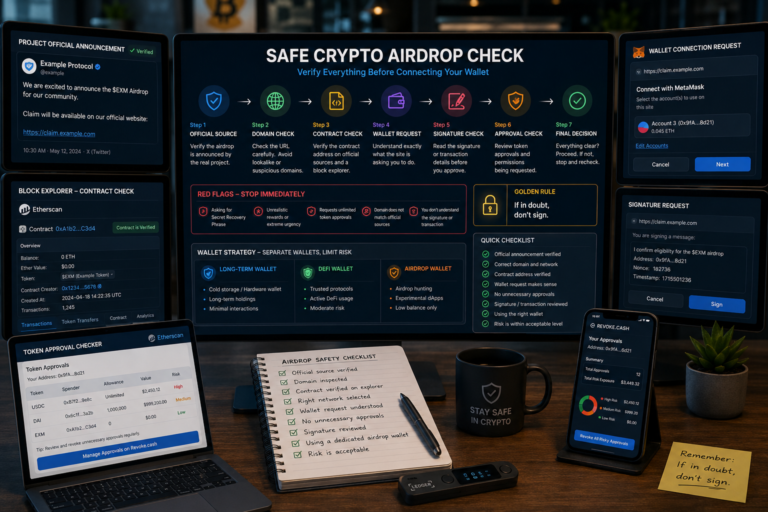
Wallet Safety: Use a Separate Airdrop Wallet
One of the smartest ways to search for legit crypto airdrops is to separate wallet risk.
Never use your main wallet to test unknown campaigns.
A simple structure works better:
- Vault wallet: long-term holdings, no airdrop interactions
- Daily wallet: normal DeFi or ecosystem use
- Airdrop wallet: testing, points, claims, and new dApps.
This limits damage if something goes wrong.
A fake claim page cannot drain assets that are not in the connected wallet. That does not make the interaction safe, but it limits the blast radius.
For a deeper breakdown of wallet segmentation, see BlockCodex’s guide “Best Ways to Secure Crypto Without Overcomplicating It.”
This is the security principle most airdrop farmers ignore: the goal is not to avoid all risk. The goal is to ensure one bad click does not destroy the whole portfolio.
Read the Transaction Before Signing
Airdrop scams often rely on one behavior: users approve without reading.
Before signing, check:
- Does the transaction transfer assets?
- Does it request unlimited token approvals?
- Is the contract verified?
- Is the domain correct?
- Is it asking for seed phrase information?
- Is it asking you to “verify” your wallet through a strange signature?
A legitimate airdrop claim may require a wallet signature or transaction. But it should not ask for your seed phrase, private key, recovery phrase, or unnecessary token permissions.
A strong red flag is any transaction that gives an unknown contract permission to spend tokens from your wallet.
If the wallet prompt is unclear, stop.
This connects with BlockCodex’s security article “Crypto Security Failures: 7 Human Risks Most Investors Still Ignore” because many crypto losses happen at the point of user approval rather than from broken code.
Evaluate the Airdrop Economics
Not all legit crypto airdrops are worth pursuing.
Some campaigns are real but inefficient.
Before spending time or capital, check:
- expected reward size
- eligibility criteria
- network fees
- bridge costs
- time required
- lock-up periods
- token supply and vesting
- whether rewards are diluted by too many participants.
CoinGecko’s analysis of major airdrops found that 23 out of the 50 biggest airdrops — 46% — reached peak token price within the first two weeks after the airdrop date.
That does not mean every airdrop should be sold immediately. But it shows why airdrop strategy should include exit planning. Many airdrop tokens face early sell pressure because recipients receive free or low-cost tokens and may sell into initial liquidity.
The important insight: Finding a legit airdrop is only step one. Managing the token after receiving it is a separate decision.
Watch for “Too Easy” Airdrops
Some airdrops are designed to reward real usage. Others are designed to harvest wallet approvals.
Be cautious when an airdrop offers large rewards for minimal effort, especially if the project is unknown.
Red flags include:
- “everyone is eligible” claims
- guaranteed reward promises
- fake screenshots of large allocations
- no clear eligibility logic
- claim page not linked from official docs
- urgent “last chance” pressure
- request for seed phrase
- request to download unknown software.
Real airdrops usually have trade-offs. They reward past activity, testnet participation, liquidity provision, governance involvement, ecosystem usage, or points-based engagement. They usually do not require users to rush blindly into a claim page.
Use Research Tools, but Do Not Outsource Judgment
Airdrop tracking platforms can help discover opportunities, but they should not replace due diligence.
Useful research sources include:
- official project docs
- ecosystem blogs
- DeFiLlama for protocol activity
- blockchain explorers
- CoinGecko Learn airdrop guides
- project governance forums
- analytics dashboards.
CoinGecko maintains an airdrop guide section that tracks and explains different airdrop campaigns and reward programs, which can be useful for discovery.
But discovery is not verification.
A listed opportunity can still require wallet safety checks, contract review, and project analysis.
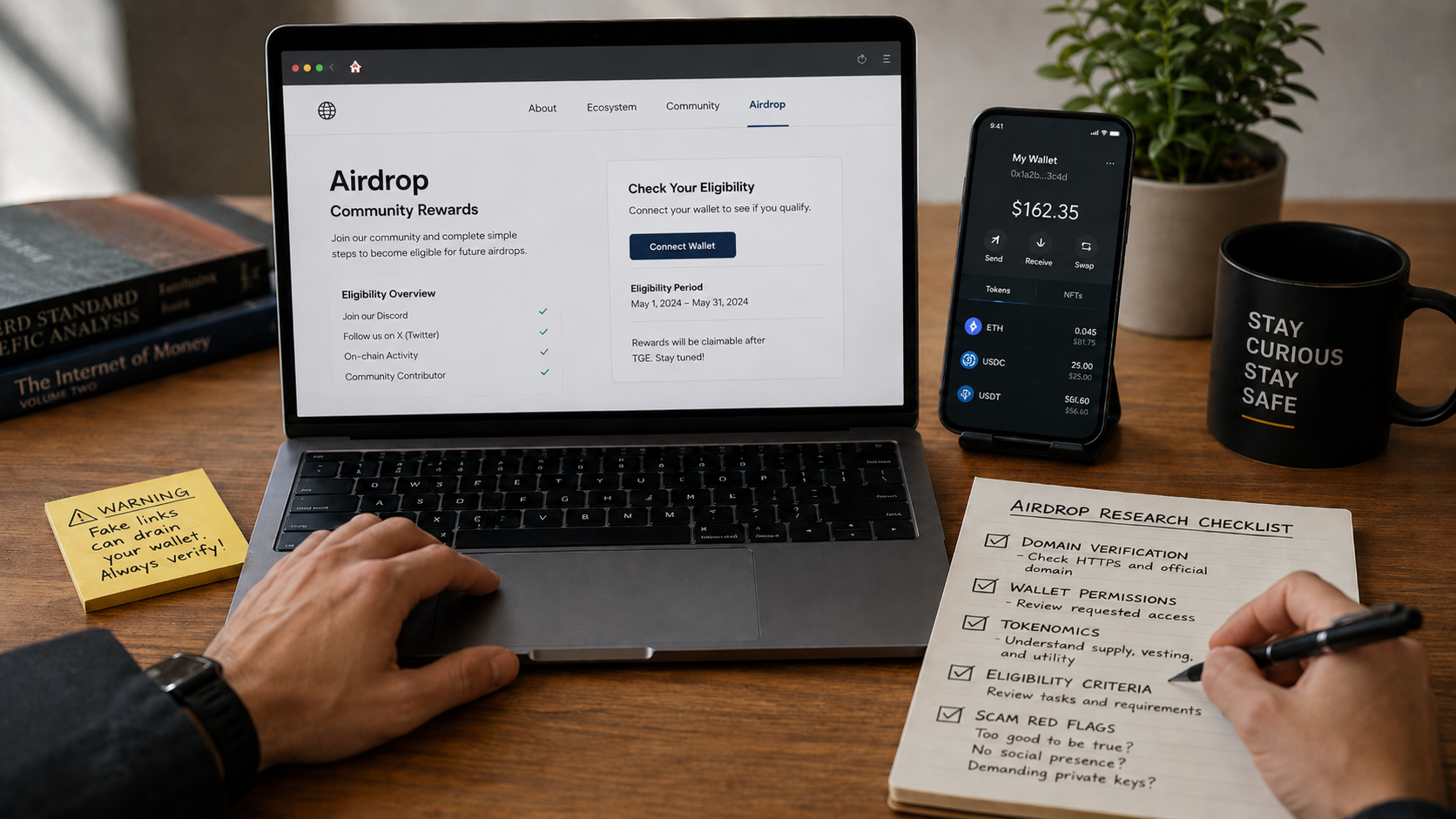
Practical Checklist for Finding Legit Crypto Airdrops
Before interacting with any airdrop, check:
| Question | Why It Matters |
|---|---|
| Is the project real? | Filters fake claim pages |
| Is the announcement official? | Reduces phishing risk |
| Is the domain correct? | Prevents clone-site attacks |
| Am I using a separate wallet? | Limits downside |
| What transaction am I signing? | Prevents malicious approvals |
| Are rewards realistic? | Avoids fake allocation traps |
| Is eligibility transparent? | Reduces scam likelihood |
| Does the tokenomics make sense? | Helps plan post-claim decisions |
Airdrop farming becomes safer when treated like a risk process, not a treasure hunt.
Conclusion
Legit crypto airdrops can be valuable, but they require discipline.
The safest approach is not to chase every claim link. It is to verify the project, confirm the announcement, use a separate wallet, inspect transactions, and evaluate whether the reward is worth the risk.
The most dangerous airdrops are not always the obvious scams. They are the ones that look professional enough to make users stop thinking.
In crypto, free tokens are never truly free if the claim process exposes your wallet.
The better approach is simple:
Research first.
Connect carefully.
Sign slowly.
Protect long-term holdings.
That is how investors find legit crypto airdrops without turning the search for rewards into unnecessary security risk.