Crypto ecosystem failure rarely happens overnight.
Most ecosystems do not collapse because of one bad week, one token unlock, or one bear market. They usually fail through a slower process: developers leave, liquidity becomes shallow, incentives stop working, users do not return, and applications fail to create enough real demand.
From the outside, the decline can look sudden. A token price falls, TVL drops, social activity disappears, and the ecosystem is declared “dead.” But underneath, the warning signs often appeared much earlier.
A crypto ecosystem is not just a blockchain. It is a network of developers, users, liquidity providers, applications, infrastructure, and incentives. When those layers reinforce each other, the ecosystem grows. When they stop reinforcing each other, decline begins.
The key question is not simply why crypto ecosystems fail.
The better question is: Which part of the ecosystem flywheel breaks first — and can it recover?
Table of Contents
Crypto Ecosystem Failure Starts When the Flywheel Stops
Healthy ecosystems grow through compounding feedback loops.
The basic flywheel looks like this:
| Growth Layer | Healthy Signal | Failure Signal |
|---|---|---|
| Developers | More useful applications | Builders leave or stop shipping |
| Users | Repeat usage | One-time speculation |
| Liquidity | Capital stays | Liquidity exits after incentives |
| Infrastructure | UX improves | Friction remains high |
| Security | Trust compounds | Exploits damage confidence |
| Revenue | Apps capture value | Activity creates no economics |
The strongest ecosystems do not rely on one layer. They compound across several.
Developers build applications. Applications attract users. Users attract liquidity. Liquidity improves market depth. Better liquidity attracts more applications. Over time, this creates network effects.
Failure begins when that loop weakens.
For example:
- incentives attract liquidity but not users
- users arrive for speculation but do not return
- developers build apps but cannot retain demand
- liquidity grows but is concentrated and unstable
- security incidents reduce trust
- infrastructure remains too difficult for normal users.
A chain can still look active during this stage, especially if token price or short-term narratives are strong. But the underlying system becomes fragile.
Reason 1: Growth Is Built on Incentives, Not Product Demand
Incentives can help bootstrap early ecosystems.
Grants, liquidity mining, points programs, rewards, and airdrop campaigns can bring users and capital into a new network. Used carefully, they create experimentation and early liquidity.
But incentives become dangerous when they replace product demand.
A weak ecosystem often depends on:
- liquidity mining
- airdrop farming
- temporary rewards
- unsustainable yields
- artificial activity targets
- short-term developer grants without retention.
The problem is simple: rewards can rent activity, but they cannot guarantee loyalty.
When incentives decline, mercenary capital leaves. Users move to the next opportunity. TVL falls. Protocols that looked active suddenly become empty.
This is why investors should always ask:
Would this ecosystem still be active if rewards disappeared?
If the answer is no, the growth is fragile.
This connects directly with BlockCodex’s guide on “How to Read TVL in Crypto: What It Really Signals About Capital and Risk,” where TVL is treated as capital presence — not necessarily capital conviction.
Reason 2: Developers Leave Before Users Notice
Developer activity is one of the earliest signals of ecosystem health.
Users often react to price. Developers react to opportunity, tooling, funding, community quality, and long-term technical conviction.
Electric Capital’s 2024 Developer Report analyzed 902 million code commits across 1.7 million repositories. It found that total crypto developers declined 7% in 2024, while established developers with more than two years of experience grew 27% year over year and contributed 70% of all code.
This matters because developer quality is often more important than headline developer count.
A failing ecosystem may still attract temporary builders during hype cycles, hackathons, or grant programs. But if serious developers stop building, the application layer weakens.
Warning signs include:
- fewer meaningful launches
- inactive GitHub repositories
- declining ecosystem grants
- poor documentation
- weak tooling
- limited developer community support
- teams migrating to other chains.
The deeper insight: Developer retention is a stronger signal than developer attraction.
An ecosystem can bring developers in with grants. Keeping them requires real users, reliable infrastructure, and credible long-term opportunity.
Reason 3: Liquidity Becomes Shallow or Fragmented
Liquidity is the economic base of a crypto ecosystem.
Without liquidity, applications struggle. DEXs become inefficient. Lending markets become thin. Stablecoin activity weakens. Users face higher slippage. Developers have less reason to build financial applications.
But not all liquidity is equal.
A failing ecosystem often shows:
- declining TVL
- weak stablecoin supply
- shallow DEX liquidity
- liquidity concentrated in one or two protocols
- high incentives required to keep capital
- poor volume after rewards disappear.
A chain may still report activity, but if usable liquidity is thin, the ecosystem becomes difficult to operate inside.
The most dangerous pattern is headline liquidity without depth.
For example, an ecosystem may show a decent TVL number, but most capital may be locked in one protocol, tied to incentives, or denominated in volatile native assets. That liquidity can disappear quickly during stress.
For a deeper framework, see BlockCodex’s article “Liquidity in Crypto Markets: 7 Critical Misconceptions Investors Still Get Wrong.”
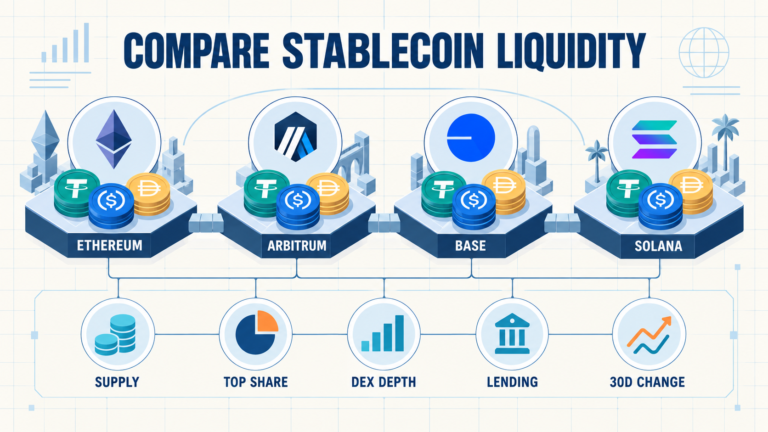
Reason 4: Stablecoin Liquidity Never Becomes Deep Enough
Stablecoins are the working capital of crypto ecosystems.
They allow users to:
- Trade
- Hedge volatility
- Lend and borrow
- Settle payments
- Manage treasury balances
- Move between applications without leaving the chain.
An ecosystem without meaningful stablecoin liquidity often struggles to support real financial activity.
The a16z State of Crypto 2025 report highlighted that stablecoins powered $46 trillion in total transaction volume and $9 trillion in adjusted annual transactions, showing their role as core crypto infrastructure.
That scale matters because stablecoins are no longer just trading tools. They are becoming settlement rails and liquidity infrastructure.
For ecosystem analysis, the question is not only whether stablecoins exist on a chain.
The better question is: Can stablecoin liquidity support real usage across multiple applications?
Failure signals include:
- Low stablecoin supply
- Liquidity concentrated in bridges
- Weak payment usage
- Few stablecoin pairs
- Low lending demand
- Limited institutional stablecoin adoption.
If users constantly need to bridge out to access liquidity, the ecosystem loses internal momentum.
Reason 5: Applications Generate Activity but Not Retention
A crypto ecosystem can produce impressive activity and still fail.
That happens when usage is shallow.
Examples include:
- Airdrop farming
- Memecoin speculation
- Bot activity
- Short-term trading spikes
- NFT mint cycles
- Temporary points campaigns.
These activities can increase transactions, active addresses, and social visibility. But they do not automatically create durable demand.
The key metric is not peak activity.
It is return behavior.
Do users come back after the incentive ends?
Do they use multiple applications?
Do they keep liquidity inside the ecosystem?
Do protocols generate fees without constant subsidies?
Do developers build second-generation products?
A failing ecosystem often has one viral moment but no durable application layer.
This is why ecosystem analysis should separate:
- Activity from retention
- Transactions from revenue
- Users from repeat users
- TVL from sticky capital.
For investors comparing ecosystem exposure, this also connects to “Best Crypto Portfolio Tracking Setups: 7 Practical Frameworks for Real Control,” because portfolio risk depends not only on asset prices, but also on chain-level liquidity, protocol exposure, and ecosystem durability.
Reason 6: Security Incidents Break Trust
Security failures can permanently weaken ecosystem confidence.
A single exploit does not always kill an ecosystem. Many strong networks have survived hacks. But repeated security failures can create a perception that the ecosystem is unsafe.
Chainalysis reported that nearly $2.2 billion was stolen from crypto platforms in 2024, marking another year where crypto hacking losses exceeded $1 billion.
Security matters because trust is a form of infrastructure.
Users may tolerate volatility. Developers may tolerate early technical limitations. But if users believe funds are unsafe, liquidity becomes harder to retain.
Security-related failure signals include:
- Repeated protocol exploits
- Bridge hacks
- Weak audits
- Poor incident response
- Admin key compromises
- Phishing-heavy user environment
- Unreliable wallet or dApp interfaces.
The deeper point is that ecosystem security is not only about code. It includes custody, bridges, wallet UX, user education, and operational discipline.
That is why BlockCodex covers this separately in “Crypto Security Failures: 7 Human Risks Most Investors Still Ignore.”
Reason 7: The Ecosystem Has No Clear Differentiation
Some ecosystems fail because they never answer a basic question:
Why should developers, users, and capital choose this network instead of another?
In bull markets, differentiation can look unnecessary. Liquidity is abundant. Users chase rewards. Developers experiment everywhere.
But during tougher conditions, weak positioning becomes visible.
A fragile ecosystem may depend on vague narratives such as:
- “faster chain”
- “lower fees”
- “better community”
- “next Ethereum”
- “institutional-ready”
- “AI ecosystem” without real applications.
Those narratives may attract attention, but they do not create defensible growth unless tied to real advantages.
Durable ecosystems usually develop clearer positioning:
- Ethereum: security, liquidity, institutional familiarity;
- Solana: high-throughput execution and consumer-scale activity;
- Bitcoin: monetary premium and settlement credibility;
- Layer 2s: Ethereum-aligned scalability;
- appchains: application-specific control.
Not every ecosystem needs to dominate everything. But it needs a reason to exist.
Without differentiation, liquidity and developers eventually move somewhere else.
What Investors Should Track Before an Ecosystem Fails
Crypto ecosystem failure is usually visible before the market fully prices it.
Important warning signals include:
| Signal | Why It Matters |
|---|---|
| Developer decline | Fewer builders means fewer future apps |
| Falling stablecoin supply | Less usable capital inside the ecosystem |
| Incentive-dependent TVL | Liquidity may leave when rewards stop |
| Low retention | Users are not returning organically |
| Weak fee generation | Activity may not create economic value |
| Security incidents | Trust and liquidity weaken |
| Poor differentiation | Ecosystem lacks a durable reason to exist |
The most dangerous situation is when several of these signals appear together.
For example:
- TVL is falling
- incentives remain high
- developers stop shipping
- stablecoin liquidity weakens
- users only appear during campaigns
- security incidents damage confidence.
At that point, the ecosystem may still have a token, community, and narrative — but the underlying flywheel is already breaking.
Research Tools Can Help Detect Ecosystem Weakness
Ecosystem failure is difficult to detect manually because signals are spread across developer data, liquidity dashboards, protocol revenue, wallet behavior, and stablecoin flows.
This is where analytics platforms can help.
A tool like Nansen can be useful for monitoring wallet behavior, capital concentration, and token flows across ecosystems. It does not predict failure automatically, but it can help investors identify whether activity is broad-based or concentrated among a small number of actors.
Other tools such as DeFiLlama, Token Terminal, Artemis, Messari, and Electric Capital’s developer reports can help complete the picture.
The key is to avoid relying on one dashboard.
Ecosystem risk is multi-layered, so the analysis must be multi-layered too.
Conclusion
Crypto ecosystem failure is rarely caused by one single factor.
It usually happens when the growth flywheel stops working.
Developers lose conviction. Liquidity becomes shallow. Stablecoins fail to deepen. Applications attract users but not retention. Incentives replace real demand. Security incidents damage trust. The ecosystem fails to differentiate.
A weak ecosystem can still look alive for a while, especially during speculative markets.
But durable ecosystems survive because they create repeatable demand.
They retain developers. They keep liquidity. They support useful applications. They reduce friction. They maintain trust. They give users and builders a reason to stay.
For investors, the lesson is simple:
Do not ask only whether an ecosystem is active.
Ask whether its activity is becoming durable.
That is the difference between temporary momentum and real ecosystem strength.