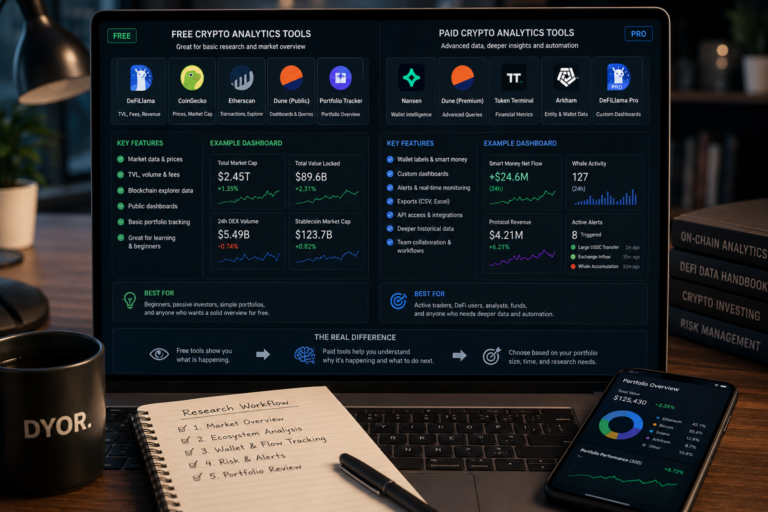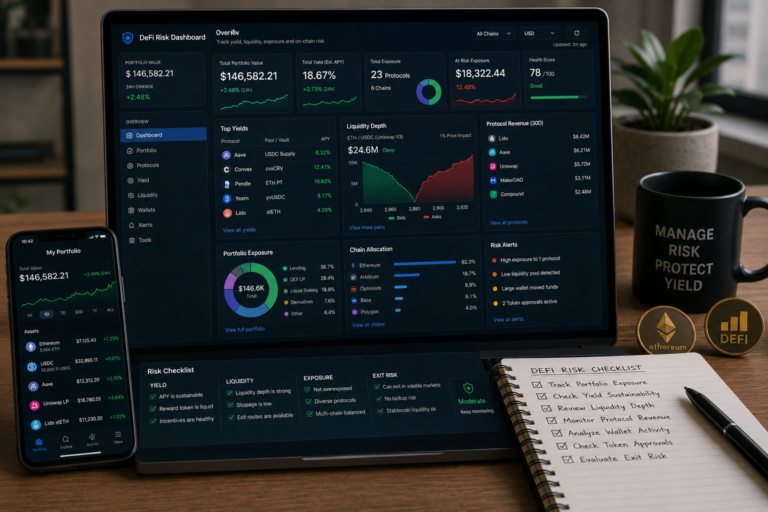
Understanding how to evaluate a crypto project is one of the most critical skills in crypto investing.
Unlike traditional markets, most crypto assets operate without standardized disclosures, making independent analysis essential. The difference between sustainable returns and major losses often comes down to structured due diligence.
This guide provides a practical and repeatable framework to evaluate a crypto project using:
- security assessment
- tokenomics analysis
- on-chain data
- governance structure
Quick Crypto Project Evaluation Checklist
Before diving deeper, here’s a high-level framework:
| Layer | What to Check |
|---|---|
| Product | Real use case & demand |
| Tokenomics | Supply, inflation, incentives |
| On-chain data | Users, activity, distribution |
| Team | Transparency & governance |
| Security | Audits & vulnerabilities |
| Liquidity | Market depth & unlocks |
| Competition | Positioning & differentiation |
Why You Must Evaluate a Crypto Project Before Investing
Crypto assets combine:
- venture capital risk
- open-source software risk
- monetary experimentation
- extreme market volatility
Without structured crypto project evaluation, investors rely on narrative rather than data.
Step 1: Problem–Solution Fit
Start with the fundamentals.
Ask:
- What problem does the project solve?
- Is blockchain necessary?
- Who are the real users?
- Is there measurable demand?
🚨 Red flag: vague utility or purely speculative incentives.
Step 2: Tokenomics Analysis
Tokenomics is central to how to evaluate a crypto project.
Key components:
Supply Mechanics
- total supply
- circulating supply
- emission rate
Allocation
- team & investor share
- vesting schedules
Utility
- governance
- staking
- fee distribution
👉 Unsustainable emissions often lead to price collapse after incentive phases.
Step 3: On-Chain Analysis
On-chain data reveals real usage.
Key metrics:
- active addresses
- transaction growth
- TVL (for DeFi)
- holder distribution
👉 Healthy projects show:
- organic growth
- distributed ownership
- consistent activity
For a deeper understanding of how blockchain data reflects real user behavior, you can explore our detailed guide on
👉 “What On-Chain Activity Really Tells Us About Network Usage”
This will help you interpret raw on-chain metrics beyond surface-level indicators.
Step 4: Team & Governance
Evaluate control and transparency.
Ask:
- Is the team public?
- Who controls treasury funds?
- Is governance decentralized?
👉 Governance centralization is a major hidden risk.
Step 5: Security & Smart Contract Risk
Security is critical.
Check:
- audit reports
- bug bounty programs
- exploit history
👉 Audits reduce risk but do not eliminate it.
You can verify audits via platforms like CertiK.
Step 6: Liquidity & Market Structure
Liquidity affects risk and exit ability.
Analyze:
- exchange listings
- trading volume consistency
- liquidity pool depth
- token unlock schedules
👉 Low liquidity = high manipulation risk.
Step 7: Competitive Positioning
No project exists in isolation.
Ask:
- Who are the competitors?
- What is the unique advantage?
- Is there a network effect?
👉 GitHub activity can indicate real development progress.
Which Crypto Projects Are Worth Investing In?
After applying this framework, strong projects typically show:
- clear product–market fit
- sustainable tokenomics
- growing on-chain activity
- transparent governance
- strong liquidity
👉 Weak projects usually rely on:
- hype
- unsustainable rewards
- concentrated ownership
Tool Spotlight
Nansen
Advanced analysis tools improve crypto project evaluation by tracking real capital flows.
Nansen helps:
- identify “smart money” wallets
- monitor token distribution
- detect unusual activity
Advanced Insight: Token Velocity and Value Accrual
One overlooked factor is token velocity.
If tokens are constantly sold without mechanisms for:
- locking
- staking
- utility demand
👉 long-term value remains weak.
Common Mistakes
- confusing price growth with adoption
- ignoring vesting schedules
- trusting unaudited protocols
- overlooking governance risks
Conclusion
Learning how to evaluate a crypto project is not optional—it is essential for long-term success.
The market rewards structured analysis, not speculation.
By combining tokenomics, on-chain data, and risk evaluation, investors can move from reactive decisions to informed strategies.
FAQ
What is the most important factor in crypto project evaluation?
There is no single factor, but poor tokenomics and weak security are common failure points.
Are audits enough?
No. They reduce risk but cannot eliminate it.
How long should I analyze a project?
Ideally across multiple market cycles and token unlock events.