The best ways to secure crypto are not always the most complex.
Many investors assume that strong crypto security requires advanced technical knowledge, multisig infrastructure, air-gapped devices, or professional custody setups. Those tools can be useful, but most crypto losses do not start with extremely sophisticated attacks.
They often start with simpler failures:
- a seed phrase stored in the wrong place
- a fake wallet prompt
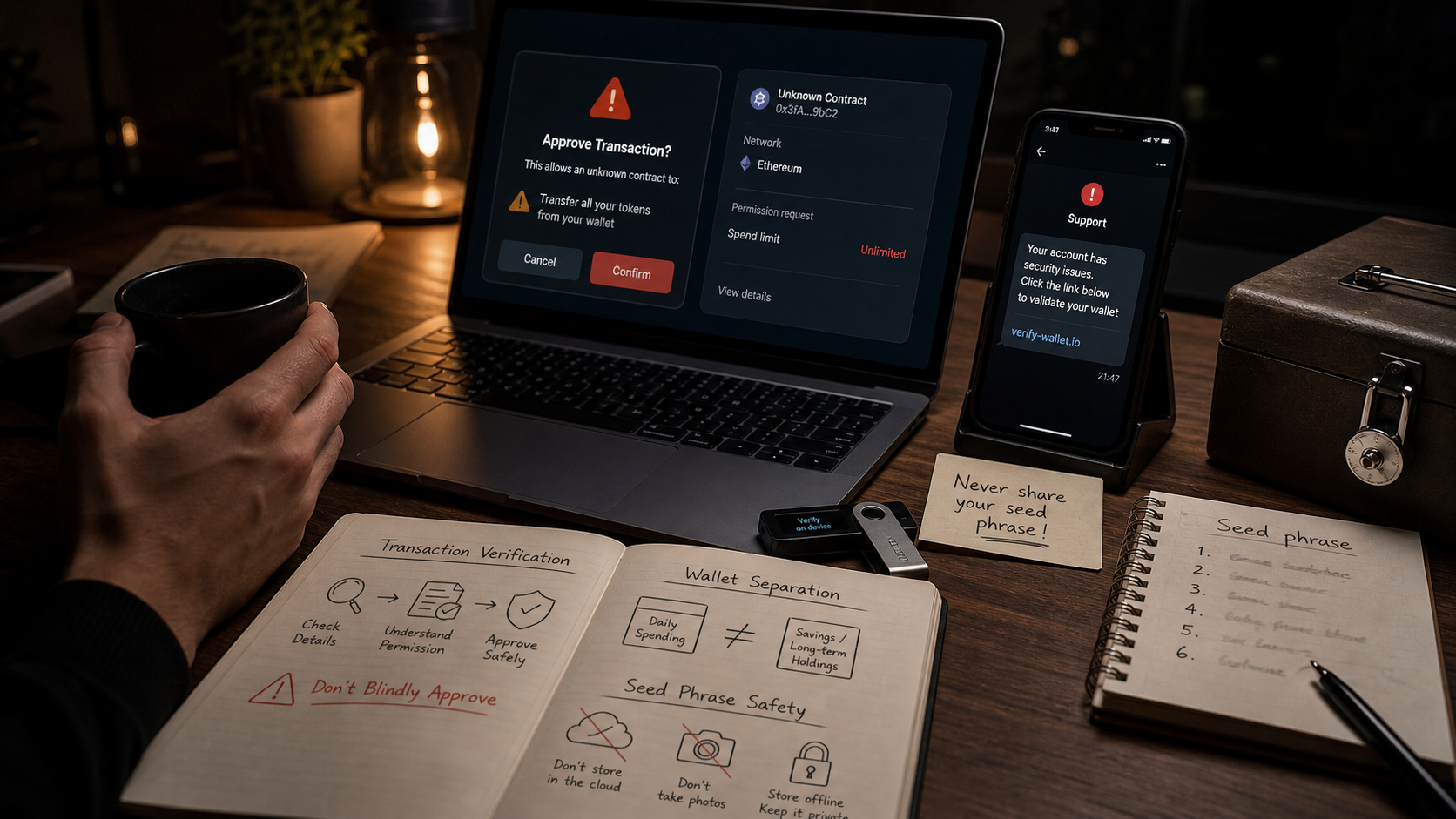
- an unlimited token approval
- a phishing link
- a hot wallet holding too much capital
- no separation between daily usage and long-term storage.
Crypto security becomes much easier when it is treated as a layered system instead of a single product. The goal is not to build a perfect setup. The goal is to reduce the number of ways one mistake can drain everything.
That is the difference between complicated security and resilient security.
Table of Contents
Why the Best Ways to Secure Crypto Start with Simple Habits
Crypto security is no longer a niche concern.
According to Chainalysis, $2.2 billion was stolen from crypto platforms in 2024, with private key compromises accounting for 43.8% of stolen crypto that year. This shows that access control and key protection remain among the most important security layers in the industry.
CertiK’s 2024 Web3 security report also identified private key compromises as a major loss category, with $855.4 million stolen across 65 incidents.
The lesson is clear: investors should not focus only on smart contract exploits. They must also secure the points where human behavior meets wallet access.
1. Separate Your Wallets by Purpose
One of the best ways to secure crypto is to avoid using a single wallet for everything.
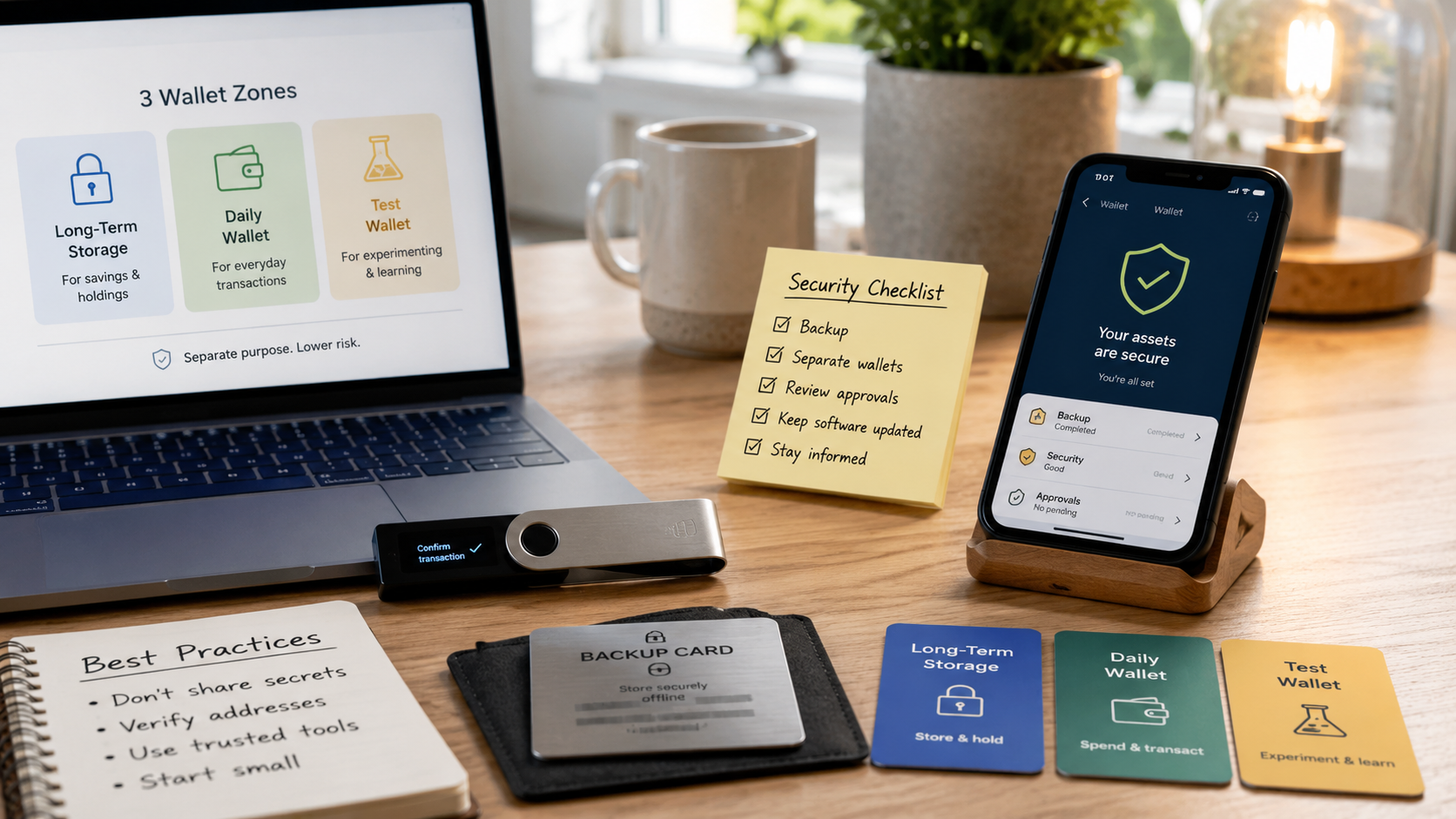
A simple wallet structure can reduce risk immediately:
| Wallet Type | Purpose | Risk Level |
|---|---|---|
| Cold wallet | Long-term holdings | Low interaction |
| Hot wallet | Daily usage | Higher interaction |
| Testing wallet | New dApps / airdrops | High risk |
This structure limits the damage if one wallet is compromised.
A hot wallet can be used for small amounts and frequent interaction. A cold wallet should be used for larger balances and long-term storage. A test wallet should be used for unknown dApps, airdrops, or experimental protocols.
The core principle is simple:
never expose your long-term holdings to your highest-risk activity.
This is not complicated. It is segmentation.
For a deeper breakdown of wallet risk models, see BlockCodex’s guide: “Best Hardware Wallets (2026): Ledger vs Alternatives for Secure Crypto Storage”.
2. Use a Hardware Wallet for Long-Term Holdings
A hardware wallet is not magic, but it solves one important problem: it keeps private keys isolated from internet-connected devices.
Ledger explains that its devices store private keys offline inside a Secure Element chip, separated from malware that may exist on a computer or phone.
This makes hardware wallets especially useful for:
- long-term holdings;
- higher-value assets;
- DeFi positions requiring safer signing;
- accounts you do not want exposed to browser malware.
A practical setup can be simple:
- hardware wallet for long-term holdings;
- hot wallet for daily transactions;
- separate wallet for testing unknown apps.
Ledger can fit naturally into this stack because it combines offline key storage with broad asset support and Ledger Live for portfolio visibility. For investors who want a simple but stronger custody layer, a Ledger hardware wallet can reduce exposure to private key theft without requiring an overly complex setup.
Get your own Ledger Hardware Wallet Here: https://shop.ledger.com/?r=7b4e916079bc
The important point is not the brand alone. The important point is the security model: private keys should not live on the same device used for browsing, messaging, and clicking links.
3. Protect the Seed Phrase Like the Asset Itself
A seed phrase is not a password.
It is the recovery key to the wallet.
If someone gets it, they do not need your device. They can restore the wallet elsewhere and move the assets.
The most common seed phrase mistakes are basic:
- storing it in screenshots;
- saving it in cloud notes;
- sending it by message;
- keeping only one fragile paper copy;
- sharing it with fake support agents.
A better approach:
- write it offline;
- store it away from internet-connected devices;
- avoid photos or cloud backups;
- keep it protected from fire, water, and theft;
- never type it into a website.
For large holdings, investors may consider metal backup storage or geographically separated backups. But for most people, the first step is simpler: keep the seed phrase offline and never digitize it.
4. Treat Every Wallet Approval as a Security Decision
Many crypto users focus on private keys but ignore token approvals.
That is a mistake.
When users interact with DeFi protocols, NFT marketplaces, bridges, or trading tools, they may grant contracts permission to spend tokens. Sometimes those permissions are limited. Sometimes they are effectively unlimited.
This creates invisible risk.
A wallet can look safe while still carrying old approvals that allow a contract to move funds later.
To reduce this risk:
- avoid unlimited approvals when possible;
- review approvals regularly;
- revoke unused permissions;
- use a separate wallet for risky interactions;
- verify contract addresses before signing.
The biggest improvement is behavioral: do not approve transactions automatically.
If a wallet prompt is unclear, stop.
For more context on how approvals and user behavior create security failures, see BlockCodex’s article: “Crypto Security Failures: 7 Human Risks Most Investors Still Ignore”
5. Avoid Signing Under Pressure
Phishing does not work only because users are careless.
It works because attackers create urgency.
Common tactics include:
- “claim now” messages;
- fake airdrops;
- fake wallet support;
- fake security alerts;
- compromised social media accounts;
- malicious sponsored search results.
The goal is to make the user sign quickly.
The best defense is to slow down.
Before signing:
- check the domain;
- verify the request;
- read the wallet prompt;
- confirm the transaction purpose;
- avoid links from DMs or comments.
Crypto security often fails at the moment of signing, not at the moment of coding.
6. Keep Long-Term Storage Boring
Good security should be boring.
A long-term storage wallet should not:
- test new protocols;
- claim random airdrops;
- approve unfamiliar contracts;
- connect to every dApp;
- hold assets needed for daily trading.
The fewer interactions it has, the fewer risks it absorbs.
A simple long-term setup might look like this:
- Ledger or another hardware wallet;
- seed phrase stored offline;
- no random dApp connections;
- small hot wallet for active usage;
- periodic review of wallet activity.
This setup is not extreme. It is practical.
7. Build a Security Routine, Not a One-Time Setup
Crypto security is not something you configure once and forget.
Markets change. Wallets interact with new apps. Protocols upgrade. Old approvals remain active. Devices get replaced. Phishing tactics evolve.
A simple monthly routine can help:
- check wallet approvals;
- review active DeFi positions;
- verify backup condition;
- update wallet firmware only from official sources;
- confirm that large balances are not sitting in hot wallets;
- review whether any wallet has unnecessary exposure.
This does not require hours. It requires discipline.
The best security system is the one investors actually maintain.
What Investors Should Avoid
Some security advice becomes too complex too quickly.
Not every investor needs multisig, custom nodes, air-gapped signing, or institutional custody.
Those setups can be powerful, but they can also introduce new failure points if the user does not understand them.
Avoid these common mistakes:
- using one wallet for everything;
- storing seed phrases digitally;
- approving transactions without reading them;
- relying only on audits;
- holding large balances in hot wallets;
- ignoring old token approvals;
- assuming hardware wallets protect against every mistake.
A hardware wallet protects private keys. It does not protect users from signing malicious transactions.
That distinction matters.
Conclusion
The best ways to secure crypto are practical, layered, and repeatable.
Strong security does not require unnecessary complexity. It requires reducing the impact of mistakes.
The best ways to secure crypto are usually the ones that reduce exposure without making the setup too difficult to maintain.
A resilient setup usually includes:
- wallet separation;
- hardware wallet custody for long-term holdings;
- offline seed phrase protection;
- approval management;
- phishing awareness;
- boring long-term storage;
- regular security checks.
Crypto security fails most often when one weak point controls everything.
The goal is to avoid that.
Security is not about becoming paranoid. It is about designing a setup where one bad click, one bad approval, or one compromised wallet does not destroy the entire portfolio.