Most investors think crypto security failures happen because protocols are badly coded, smart contracts are exploited, or blockchains break.
That does happen. But it is not the full picture.
A large share of crypto losses comes from something less technical and more uncomfortable: human behavior. Private keys are exposed. Seed phrases are stored badly. Users sign malicious approvals. Teams centralize too much control. Investors trust fake interfaces, fake support agents, or fake “urgent” wallet prompts.
The blockchain may work exactly as designed — and funds can still disappear.
This is what makes crypto security different from traditional finance. In crypto, users often become their own bank, their own custody provider, and their own transaction approval layer. That creates freedom, but it also shifts security responsibility directly onto the user.
The key insight is simple: most crypto security risks are not only about code. They are about the interaction between code, wallets, interfaces, incentives, and human decision-making.
Table of Contents
Crypto Security Failures Often Start Before the Exploit
When people hear “crypto hack,” they often imagine a smart contract vulnerability. But many incidents begin much earlier.
Security failures can start with:
- a compromised private key;
- a phishing link;
- a malicious browser extension;
- a fake wallet prompt;
- a leaked seed phrase;
- an employee with excessive access;
- a user approving the wrong transaction.
Chainalysis reported that $2.2 billion was stolen from crypto platforms in 2024, with private key compromises accounting for 43.8% of stolen crypto that year. That matters because private key compromise is not always a protocol-level failure — it is often a custody, access-control, or operational security failure.
The implication is important: improving smart contract code alone does not solve crypto security. If the signing key, admin wallet, or user seed phrase is compromised, technical correctness becomes irrelevant.
The Private Key Problem: One Secret Controls Everything
Private keys are the foundation of crypto ownership.
That is also the problem.
In traditional finance, access can be reversed, frozen, disputed, or recovered through institutional processes. In crypto, a private key often functions as final authority. If someone gets access to it, they can move funds without asking permission from anyone.
This creates a security model where one mistake can be catastrophic.
Common weak points include:
- seed phrases stored in screenshots;
- keys saved in cloud notes;
- hot wallets used for large balances;
- teams sharing admin wallets;
- poor multisig discipline;
- weak operational procedures.
CertiK’s 2024 Web3 security report identified private key compromises as one of the largest loss categories, with about $855.4 million stolen across 65 incidents.
The lesson is not just “use a hardware wallet.” The deeper lesson is that custody design matters. A secure wallet is only one part of the system. Backup storage, signing habits, transaction review, and separation between hot and cold funds matter just as much.
For a deeper breakdown of custody design, see BlockCodex’s guide: “Best Hardware Wallets (2026): Ledger vs Alternatives for Secure Crypto Storage”.
Phishing Is Not a Beginner Problem
Many investors underestimate phishing because they think it only targets inexperienced users.
That is wrong.
Phishing works because it exploits urgency, trust, and repetition. Even experienced users can sign the wrong transaction when they are tired, distracted, or interacting with a familiar-looking interface.
Modern crypto phishing is not limited to fake emails. It includes:
- fake airdrop pages;
- cloned dApps;
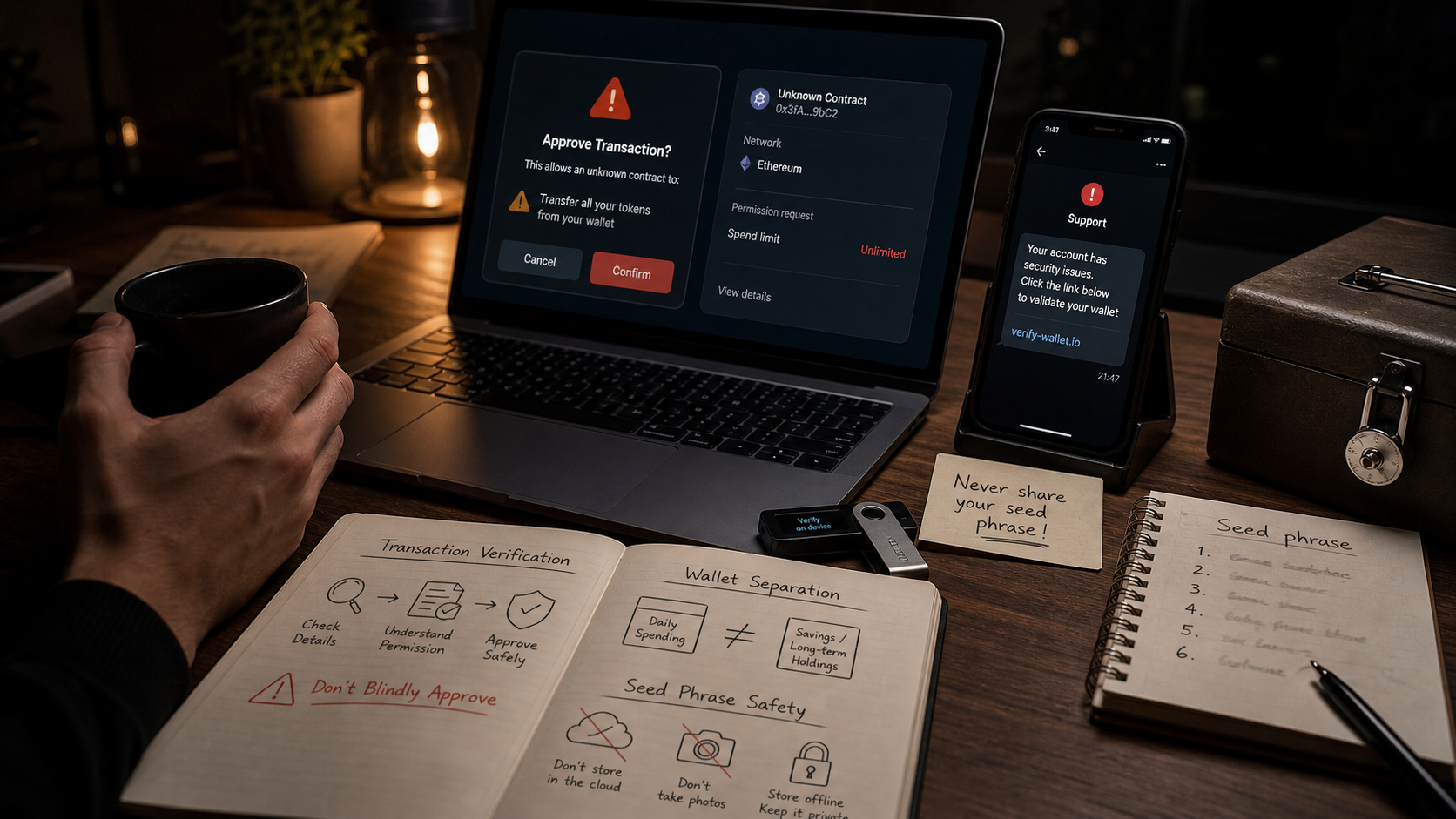
- malicious token approval requests;
- fake support accounts;
- wallet-drainer websites;
- compromised Discord or X accounts;
- sponsored search results impersonating real projects.
The technical side of phishing may be sophisticated, but the failure point is often behavioral: the user signs something they do not fully understand.
This is why wallet security should focus less on “never make mistakes” and more on reducing the blast radius of mistakes.
Practical protections include:
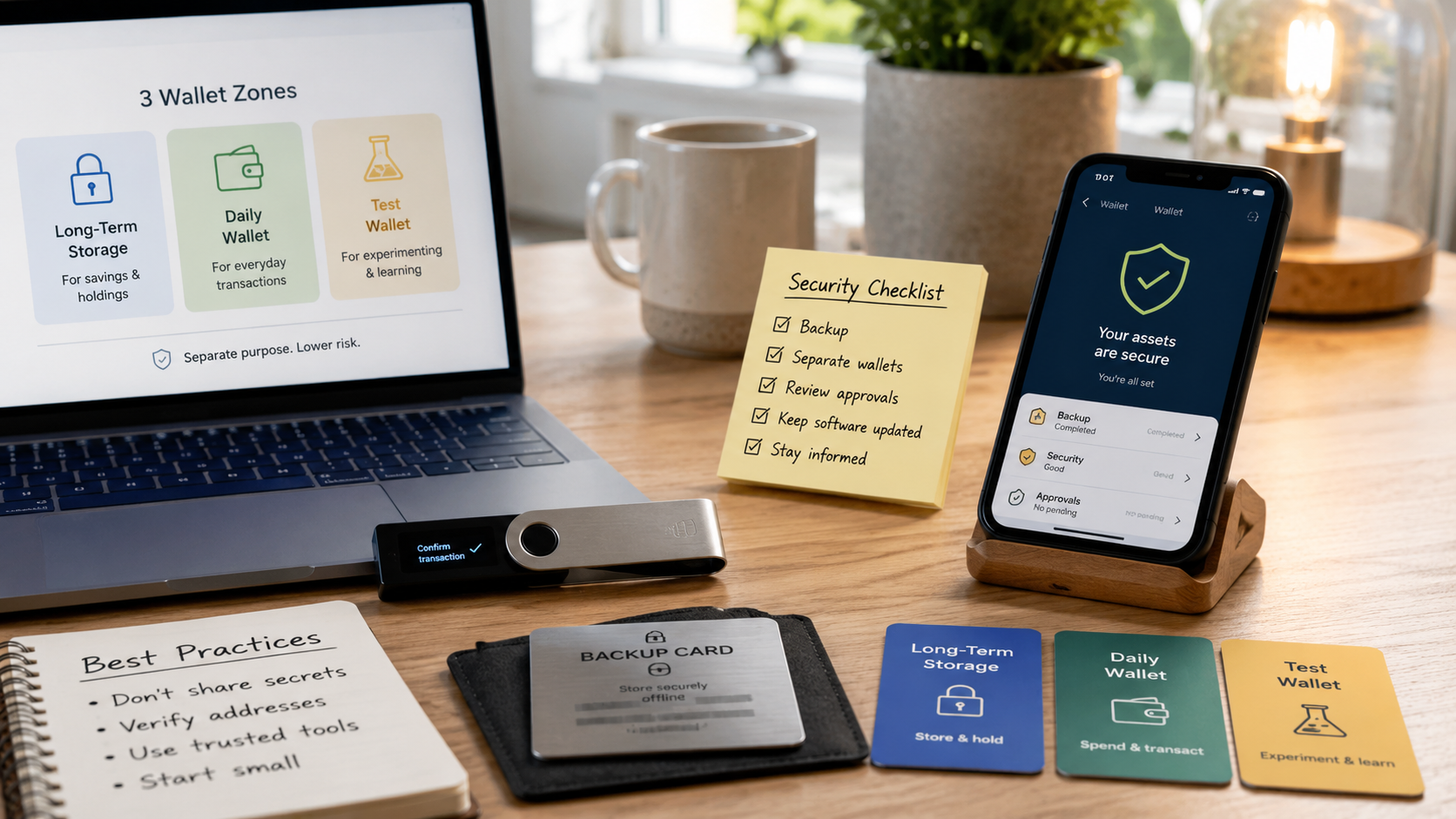
- separating daily-use wallets from vault wallets;
- avoiding large balances in hot wallets;
- using hardware wallets for high-value assets;
- reviewing approvals regularly;
- bookmarking official dApps;
- never signing transactions from links sent by strangers.
The point is not paranoia. It is risk segmentation.
Token Approvals Create Invisible Risk
One of the most misunderstood areas of crypto security is token approvals.
When users interact with DeFi protocols, NFT marketplaces, bridges, or trading apps, they may grant smart contracts permission to spend tokens from their wallet. Sometimes that permission is limited. Sometimes it is effectively unlimited.
This creates a hidden security layer.
A wallet may look safe because funds are still visible, but old approvals may allow malicious or compromised contracts to drain assets later.
This is especially dangerous because users often forget:
- which contracts they approved;
- whether approval amounts were unlimited;
- whether a protocol later became compromised;
- whether a fake interface requested approval.
This is not always a smart contract exploit. Sometimes the user gave permission weeks earlier.
That is why periodic approval reviews should be part of a normal security routine.
A useful rule: if a wallet holds meaningful capital, it should not be the same wallet used to test unknown dApps, claim random airdrops, or interact with high-risk contracts.
Security Is a System, Not a Product
A common mistake is treating security like a product purchase.
Buy hardware wallet → safe.
Use multisig → safe.
Choose audited protocol → safe.
This is too simplistic.
Security depends on the whole system:
| Security Layer | What Can Fail |
|---|---|
| Wallet custody | Seed phrase exposure, device compromise |
| Transaction signing | Malicious approvals, fake interfaces |
| Protocol access | Admin key compromise, upgrade risk |
| User behavior | Phishing, rushed decisions |
| Operational design | Poor wallet separation, weak backups |
This is why two investors can use the same wallet but have completely different security outcomes.
One may store the seed phrase offline, split funds across wallets, and review every transaction. Another may keep screenshots in cloud storage and approve every prompt from a hot wallet.
Same tool. Different risk profile.
Why Audits Do Not Eliminate Crypto Security Failures
Audits matter, but they do not remove risk.
A smart contract audit can identify known vulnerabilities, design weaknesses, and dangerous assumptions. But it cannot guarantee that:
- users will avoid phishing;
- admin keys will remain secure;
- future upgrades will be safe;
- interfaces will not be compromised;
- teams will manage permissions properly.
Many investors misunderstand audits as a binary signal: audited equals safe, unaudited equals unsafe.
A better interpretation is:
Audits reduce known technical risk, but they do not eliminate operational, governance, or user-level risk.
This matters especially in DeFi, where protocols may depend on upgradeable contracts, external oracles, multisigs, bridges, and third-party integrations.
For investors analyzing protocol risk more broadly, this connects directly with BlockCodex’s guide: “How to Evaluate a Crypto Project (2026): 7 Steps for Smarter Investing”.
The Investor Framework: How to Reduce Real Security Risk
Instead of asking “is this safe?”, investors should ask more precise questions:
1. What happens if this wallet is compromised?
If the answer is “I lose everything,” the setup is fragile.
2. What approvals has this wallet granted?
Old approvals are often ignored until it is too late.
3. Is this wallet used for both storage and experimentation?
That is usually a bad design.
4. Who controls protocol upgrades?
Admin keys and multisigs can become central points of failure.
5. Can I verify the interface?
Fake websites are one of the easiest ways to turn a secure wallet into an empty wallet.
This approach shifts security from a checklist to a threat model.
The Main Misconception: Security Is Not Just About Avoiding Hacks
The biggest misunderstanding is thinking crypto security is only about preventing “hackers.”
In reality, crypto security is about controlling decision points.
Every signature is a decision.
Every approval is a decision.
Every wallet connection is a decision.
Every backup method is a decision.
The blockchain may be decentralized, but user behavior remains highly centralized around a few moments of trust.
That is where most failures happen.
Conclusion
Most crypto security failures are not purely technical. They happen at the intersection of private keys, interfaces, approvals, custody habits, and human judgment.
Smart contract risk matters, but it is only one part of the security stack.
The more important lesson is that crypto security must be designed as a system:
- separate hot and cold wallets;
- protect seed phrases properly;
- review approvals;
- avoid signing under pressure;
- verify interfaces;
- understand custody risks;
- treat every transaction as final.
In crypto, security does not fail only when code breaks.
It fails when users, teams, or systems create a single weak point that attackers can exploit.
That is why the strongest security advantage is not only technical knowledge — it is disciplined behavior.