The best crypto tools stack is not a collection of impressive dashboards.
It is a control system.
One tool helps detect that something changed. Another explains the market mechanism behind the change. A third verifies the underlying transaction, while portfolio and security tools determine whether the signal matters to the investor and how any resulting action should be executed safely.
Without that sequence, investors often collect more information without improving their decisions. They check prices on several platforms, compare nearly identical charts, receive dozens of alerts and eventually act on whichever signal feels most convincing.
The problem is rarely a lack of data.
It is the absence of a clear handoff between tools.
A serious investor should be able to explain why every application exists inside the research process. When two paid platforms perform the same job, one may be redundant. When a dashboard produces information that never changes a decision, it may be unnecessary. When market analysis remains disconnected from portfolio exposure, tax records or wallet security, the stack is incomplete.
A stronger setup covers seven layers:
- Market orientation.
- Price structure and execution.
- Derivatives and leverage.
- Capital and wallet flows.
- Blockchain verification.
- Portfolio and tax records.
- Wallet security and permissions.
The objective is not to use every tool every day. It is to know which tool should answer the next question.
Table of Contents
A Crypto Tools Stack Is Not a Shopping List
Many tool comparisons start with product features.
A more useful approach starts with failure.
What could go wrong with the decision?
An investor might research the wrong token contract, mistake leveraged activity for spot demand, buy into a market with poor depth, misinterpret an exchange transfer, forget how much portfolio exposure already exists or approve a dangerous smart-contract permission from a high-value wallet.
Different tools reduce different failures.
| Layer | Main Question | Core Tools | Failure It Helps Prevent |
|---|---|---|---|
| Market orientation | What asset and market am I examining? | CoinGecko | Researching the wrong asset, pair or venue |
| Price and execution | What is price doing, and can I trade efficiently? | TradingView and venue order books | Confusing a chart signal with executable liquidity |
| Derivatives | Is leverage driving the move? | CoinGlass | Mistaking speculation or liquidations for organic demand |
| Capital flows | Where are assets, stablecoins and wallets moving? | CryptoQuant, DeFiLlama and Nansen | Reading activity without understanding its source |
| Verification | What actually happened on-chain? | Etherscan and other explorers | Trusting labels, screenshots or social posts without evidence |
| Portfolio and tax | What does the event mean for my own exposure and records? | Koinly | Losing track of balances, cost basis and transaction history |
| Security | How can I act without exposing the wider portfolio? | Ledger and Revoke.cash | Turning a correct analysis into a costly authorization mistake |
This structure changes how tools are evaluated. A product is valuable when it performs one job reliably and hands the investigation to the next layer.
The stack should follow the decision.
The decision should not follow the stack.
Layer 1: CoinGecko for Market Orientation
CoinGecko is the map at the entrance of the research process.
Before analyzing wallet flows, derivatives or ecosystem growth, an investor needs to establish basic context:
- Which token is being researched?
- What is the official contract?
- What is the circulating supply?
- Where does the token trade?
- Which pairs carry most of the activity?
- Is the market concentrated on one exchange?
- How do market capitalization and fully diluted valuation compare?
- Does the asset trade on centralized exchanges, DEXs or both?
CoinGecko provides market prices, token metadata, historical data, exchange information and on-chain DEX coverage. Its API also supports market and exchange data across centralized and decentralized venues.
That makes it useful for orientation, but not for final interpretation.
A token may display high aggregate volume while most usable liquidity sits on one venue. A large market capitalization does not prove that the asset can absorb a realistically sized order. The platform may show where activity exists, but investors still need to inspect the specific market they intend to use.
A good opening note might contain:
Asset:
Official contract:
Category:
Market capitalization:
Circulating and total supply:
Main spot venues:
Main derivatives venues:
Research question:
This creates a stable starting point before specialized analytics begin.
CoinGecko tells the investor what market exists.
The next layer determines how that market behaves.
Layer 2: TradingView for Price Structure and Execution Context
TradingView is the visual analysis layer.
It helps investors compare price action across exchanges, review spot and perpetual pairs, examine volume at different price levels, build multi-chart layouts and create alerts around conditions that matter to the research thesis. Its current feature set includes volume profiles, volume footprints, screeners, drawing tools and cloud-based alerts.
The platform is most valuable when it is used to answer a defined question.
For example:
- Is the breakout visible across several credible spot venues?
- Is the perpetual contract moving before the spot market?
- Did volume expand near an important price level?
- Is volatility increasing while liquidity deteriorates?
- Is the asset outperforming its ecosystem or merely following the market?
- Did price absorb a large flow event or react immediately?
A chart can reveal the market response, but it cannot fully explain the cause. That interpretation may require CoinGlass for leverage, CryptoQuant for exchange flows or a block explorer for transaction-level verification.
TradingView should therefore be treated as the visual control room, not the entire research department.
Market Depth Still Needs a Venue-Level Check
A good chart does not guarantee good execution.
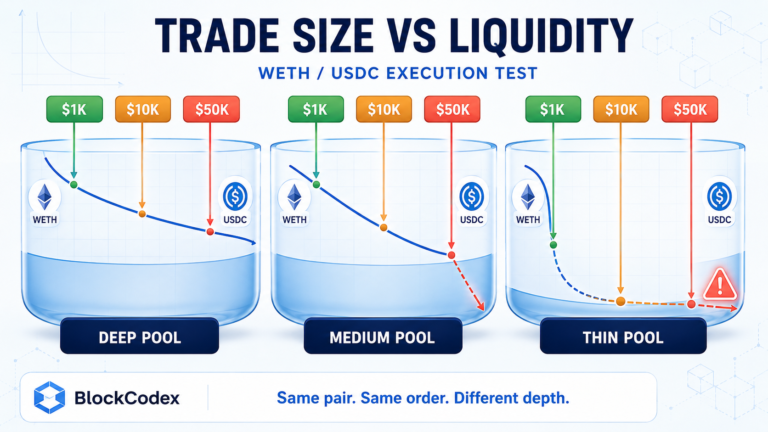
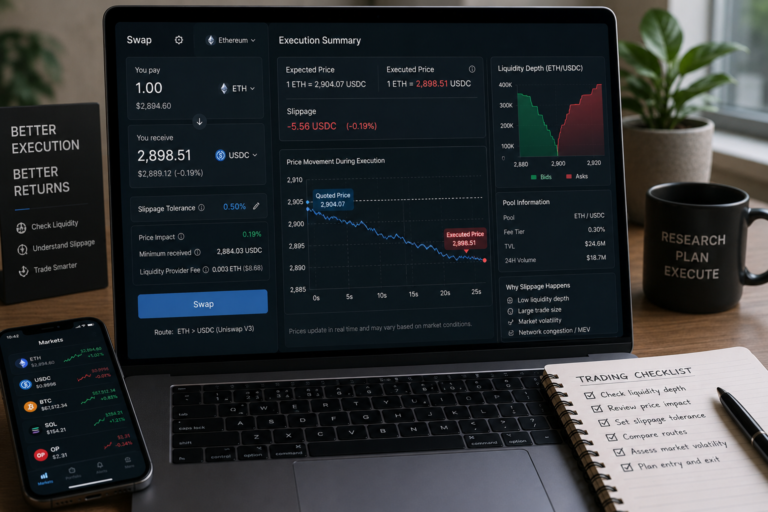
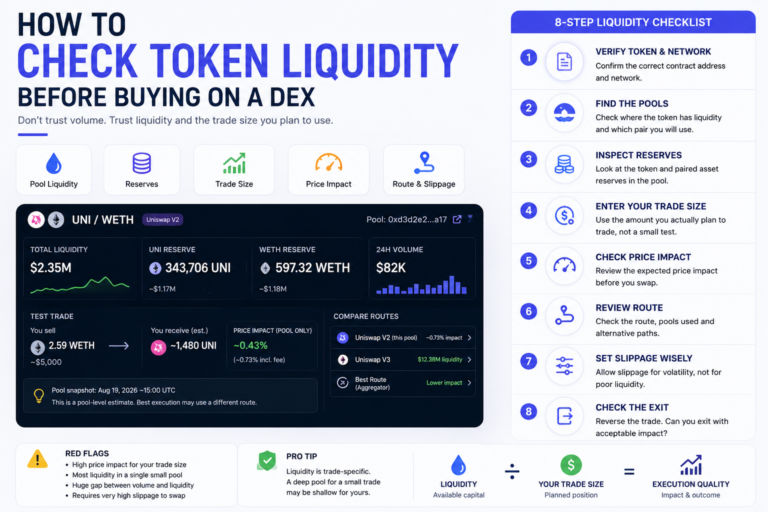
Before entering a position, investors should review the order book or swap quote on the actual venue they plan to use. Market depth, spreads, available liquidity and expected slippage determine whether the visible price can support the full trade.
This distinction is covered in What Is Market Depth in Crypto?, where liquidity is evaluated relative to the intended position rather than through volume alone.
A useful workflow is:
- Identify the price structure on TradingView.
- Open the exact exchange pair or DEX route.
- Estimate the execution for the intended position.
- Compare entry and exit conditions.
- Reduce the position when liquidity is weaker than the chart suggests.
The chart creates the hypothesis.
Execution data decides whether the hypothesis is tradable.
Natural TradingView affiliate placement
Investors who need multi-chart layouts, more alerts and advanced volume tools can compare the available plans here:
Explore TradingView plans for advanced crypto market analysis
A paid plan is most defensible when charting and alerts already form part of a repeated workflow. Paying for more indicators without a clear process usually adds complexity rather than insight.
Layer 3: CoinGlass for Leverage and Derivatives Risk
CoinGlass explains what a price chart often hides.
Its derivatives data includes open interest, funding rates, futures volume, long and short liquidations, exchange-level positioning and liquidity information. These metrics help investors distinguish a spot-supported move from one driven primarily by leveraged contracts.
The core metrics answer different questions:
| Metric | Main Question |
|---|---|
| Perpetual volume | How much derivative activity occurred? |
| Open interest | How much contract exposure remains open? |
| Funding | Which side is paying to maintain its position? |
| Liquidations | How much activity came from forced exits? |
| Exchange distribution | Where is leverage concentrated? |
| Liquidity around price | Where could forced orders accelerate movement? |
Suppose an asset rises 15% in one day.
TradingView confirms the breakout, but CoinGlass shows that open interest increased rapidly, funding became strongly positive and perpetual volume expanded much faster than spot volume. The market may continue rising, yet the move is becoming increasingly dependent on leveraged longs.
The same price gain would have a different structure if spot volume led, open interest grew moderately and funding remained controlled.
This is why CoinGlass should not be used to search for one bullish or bearish number. Open interest, funding, price and liquidations need to be interpreted together.
BlockCodex develops this relationship in Spot Volume vs Perpetual Volume in Crypto.
CoinGlass is the pressure gauge of the stack.
It shows where leverage is building and where it may be forced to leave.
Layer 4: CryptoQuant, DeFiLlama and Nansen for Capital Flows
“Capital flow” can refer to several different things.
Coins may move toward an exchange. Stablecoins may enter a blockchain ecosystem. Liquidity may migrate between protocols. A labeled fund may accumulate a token, while a large wallet may simply reorganize custody.
Using one flow tool for every question creates weak conclusions.
A stronger stack separates three types of flow.
CryptoQuant: Exchange-Related Flows
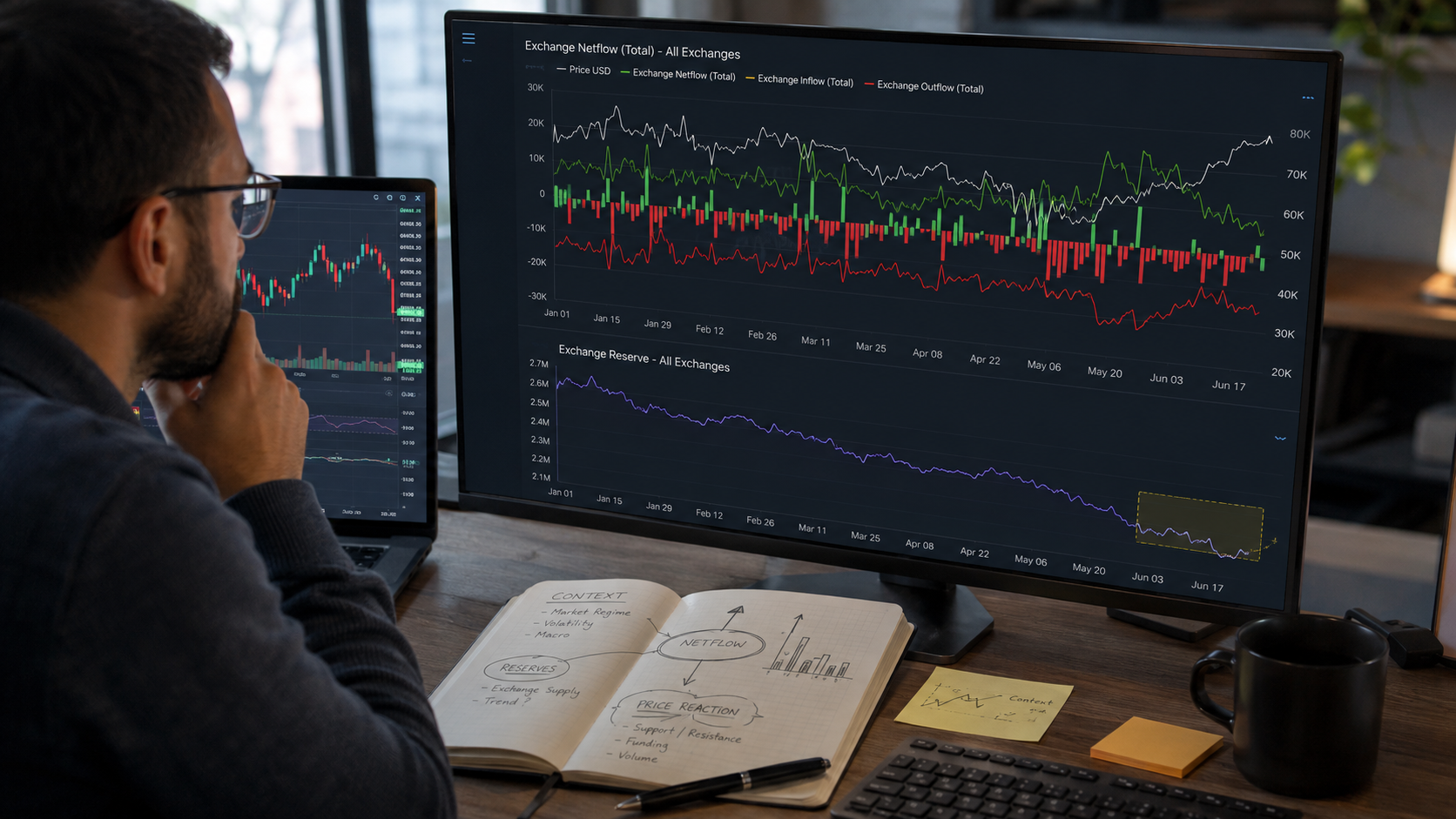
CryptoQuant is useful for examining assets moving into and out of identified exchange wallets.
Its exchange inflow metric measures assets transferred into exchanges, while netflow calculates the difference between inflows and outflows. Its documentation also distinguishes spot-exchange interpretation from derivatives-exchange collateral movements.
CryptoQuant can help investigate:
- Exchange inflows and outflows.
- Exchange netflows.
- Exchange reserves.
- Stablecoin movements.
- Large deposits and withdrawals.
- Miner-related activity.
- Derivatives collateral flows.
The limitation is interpretation.
An exchange deposit can represent potential selling, but it may also involve collateral management, market making, custody restructuring or internal exchange operations. One large transfer should rarely become a direct price prediction.
The stronger question is whether the flow persists and whether price, liquidity and other market participants confirm its significance.
DeFiLlama: Ecosystem and Protocol Flows
DeFiLlama maps capital inside DeFi.
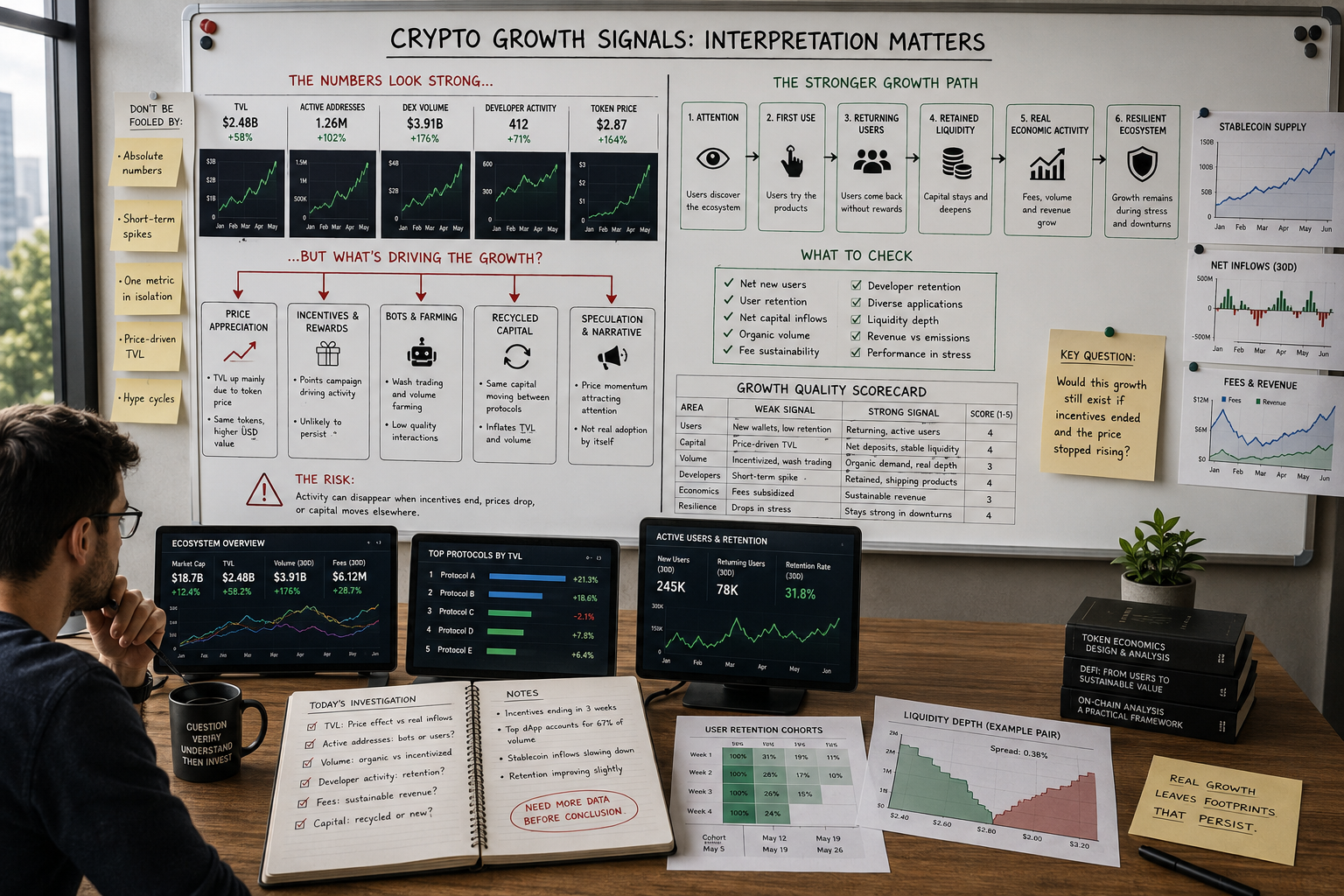
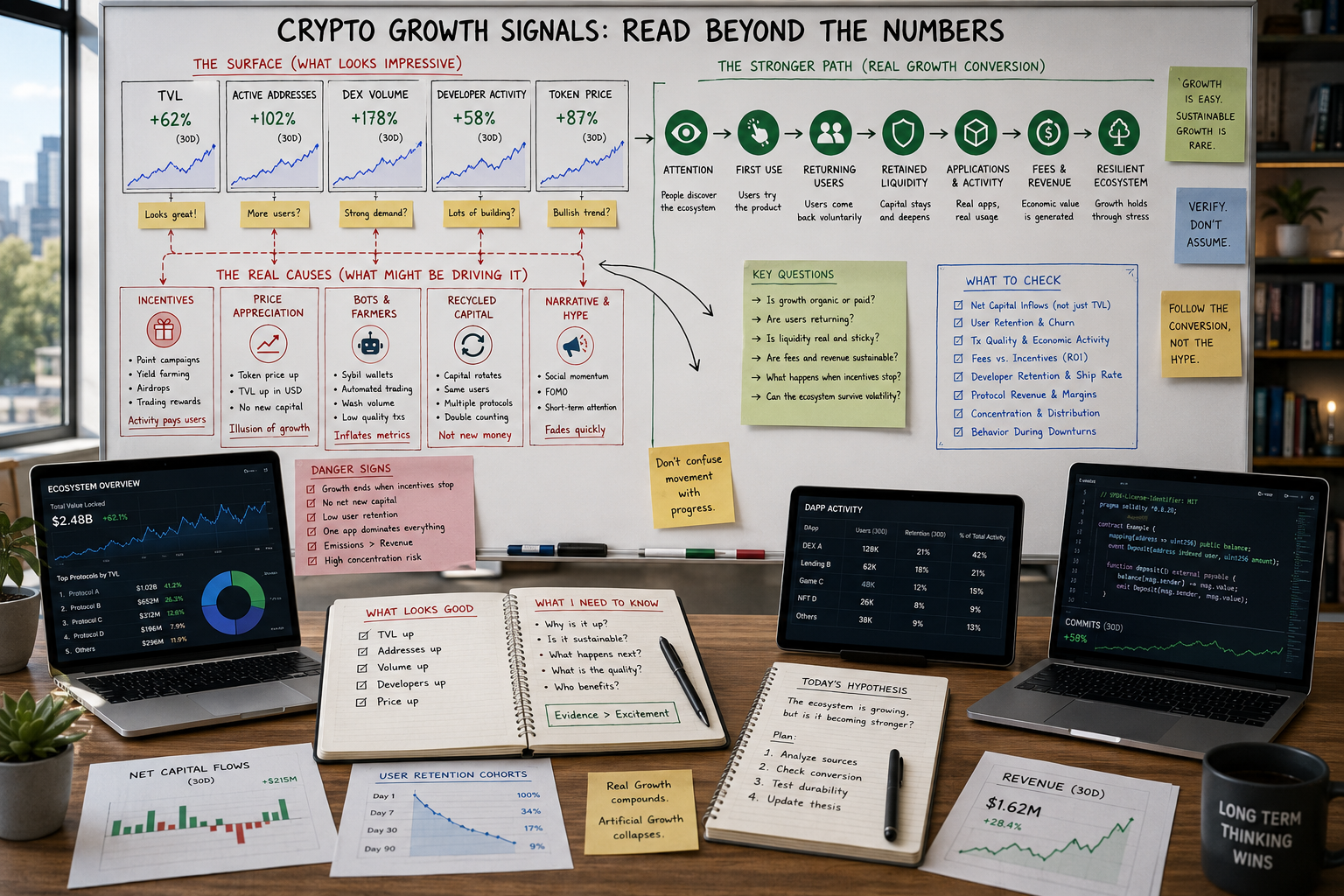
Its dashboards include TVL, stablecoin supply, DEX activity, protocol fees, revenue and other ecosystem metrics. This allows investors to compare whether capital, usage and economics are improving together rather than relying on one headline figure.
DeFiLlama is particularly useful for questions such as:
- Is stablecoin liquidity entering the ecosystem?
- Is TVL increasing because of deposits or asset prices?
- Which protocols control most of the capital?
- Is DEX volume accompanied by deeper liquidity?
- Are fees and protocol revenue improving?
- Is capital diversified or concentrated in one application?
- Does activity remain after incentives decline?
The platform provides the map, but not every interpretation.
TVL is not the same as immediately executable liquidity. DEX volume is not proof of organic demand. Fees and revenue also need to be distinguished because the amount users pay is not always the amount retained by the protocol.
Nansen: Wallet and Entity Context
Nansen adds behavioral context to blockchain addresses through wallet labels, entity groupings, Smart Money classifications, watchlists and alerts. Its tools can help identify wallet activity, token flows and changes in the behavior of selected addresses or groups.
This is valuable when the question is not simply where tokens moved, but who may be associated with the movement.
Nansen can help investigate:
- Wallet accumulation and distribution.
- Fund or whale activity.
- Stablecoin rotations.
- Early token buyers.
- DeFi position changes.
- Cross-chain movements.
- Custom wallet alerts.
- Holder composition.
A wallet label remains context, not proof of intention.
A profitable wallet may be hedged elsewhere, providing liquidity, managing client funds or operating with a completely different time horizon. Even Nansen’s Smart Money classifications can change as wallet behavior and performance evolve.
The platform should help answer:
Who may be behind the activity, and what alternative explanations remain?
It should not reduce the conclusion to:
A labeled wallet bought, so I should buy.
Choosing Between the Three
Most investors do not need paid access to all three.
Choose according to the recurring research problem:
| Main Research Need | Best Starting Tool |
|---|---|
| Exchange deposits and reserves | CryptoQuant |
| DeFi liquidity and protocol economics | DeFiLlama |
| Wallet identity and entity behavior | Nansen |
| Broad ecosystem comparison | DeFiLlama |
| Bitcoin market flows | CryptoQuant |
| Whale and Smart Money monitoring | Nansen |
A serious stack minimizes overlap.
The investor should pay for the deepest bottleneck, not every available dashboard.
Natural Nansen affiliate placement
Investors who regularly spend time identifying wallets or monitoring labeled entities can explore the platform here:
Explore Nansen for wallet labels, flows and Smart Money analysis
This placement should use a normal product link when no active affiliate or referral agreement exists.
Layer 5: Blockchain Explorers for Verification
Analytics tools compress blockchain activity into readable metrics.
A blockchain explorer returns the investigation to the underlying evidence.
Etherscan provides search, analytics and API functionality for Ethereum and EVM-compatible chains, including token transfers, wallet activity and contract information. Its token-transfer endpoints can retrieve ERC-20 and NFT movements associated with an address.
Explorers are useful for verifying:
- Transaction hashes.
- Sender and recipient addresses.
- Token contracts.
- Transfer direction.
- Contract interactions.
- Transaction status.
- Token approvals.
- Wallet balances.
- Contract source verification.
- Timing and transaction sequence.
Suppose Nansen identifies a large wallet transfer and CryptoQuant records an exchange inflow. Before constructing a market narrative, the investor can inspect the transaction directly.
Was the destination actually an exchange deposit address? Did several transfers occur? Was the token bridged, swapped or merely transferred between related wallets? Did the wallet interact with a contract immediately afterward?
The explorer does not always reveal intent.
It does prevent the analysis from depending entirely on a screenshot or third-party label.
BlockCodex explains the practical process in How to Use Blockchain Explorers Like a Pro.
Every important flow should eventually reach this layer.
Dashboards suggest.
Explorers verify.
Layer 6: Koinly for Portfolio and Tax Continuity
Market analysis remains incomplete until it reaches the investor’s own portfolio.
A signal that appears important at the market level may be irrelevant when the investor has no exposure. A moderate liquidity problem becomes much more serious when several wallets and DeFi positions depend on the same asset or ecosystem.
Koinly connects portfolio organization with transaction and tax records. Its official documentation describes the ability to consolidate activity from exchanges, wallets and blockchains, track balances, calculate gains and losses and prepare tax-oriented reports. It is not a wallet and does not replace professional tax advice.
This layer should help answer:
- What assets do I actually own?
- Where are they held?
- What is the total ecosystem exposure?
- Which transfers occurred between my own wallets?
- What is the acquisition history?
- Which gains or losses have been realized?
- Which activities may represent income?
- Is transaction history complete?
- Which wallets or exchanges are missing?
The value comes from continuity.
A trade recorded today may affect cost basis years later. A wallet transfer imported incorrectly can produce a false disposal. Missing exchange history can make future gains difficult to reconstruct.
Koinly can organize the data it receives, but it cannot restore history that was never imported. Users still need to review balances, warnings, unmatched transfers and complex DeFi transactions.
The process is examined in detail in Koinly Portfolio Tracking: How It Helps Organize Wallets, DeFi and Tax Data.
Natural Koinly affiliate placement
Investors managing several wallets, exchanges or DeFi positions can test whether Koinly improves their transaction organization here:
Organize your crypto portfolio and tax records with Koinly
The CTA fits naturally after the reader understands the problem being solved. Koinly should be positioned as the portfolio and recordkeeping layer, not as a market-prediction tool.
Layer 7: Ledger and Revoke.cash for Security
The final layer protects the action.
A strong market thesis, accurate wallet analysis and perfectly reconciled portfolio can still end badly if the investor signs the wrong transaction, exposes a recovery phrase or allows one high-interaction wallet to control the entire portfolio.
Security needs two different controls:
- Protection of the private keys and signing process.
- Management of smart-contract permissions already granted.
Ledger for Hardware-Backed Signing and Storage
A Ledger signer stores private keys inside its hardware security environment and requires transaction confirmation on the device. Current Ledger security features also include Clear Signing, which can translate supported smart-contract interactions into human-readable information, and Transaction Check on compatible flows and devices. Coverage still depends on wallet and dApp support, so not every interaction will necessarily display the same level of detail.
The correct role of Ledger is not to make every dApp safe.
It is to create a stronger signing and custody boundary for assets that should not depend entirely on an internet-connected phone or computer.
A practical architecture can include:
- A Ledger-protected vault for long-term holdings.
- A separate active account for established DeFi.
- A limited hot wallet for higher-interaction activity.
- A disposable test wallet for uncertain applications.
This prevents every claim page, experimental protocol and token approval from reaching the most valuable assets.
The broader architecture is explained in Best Crypto Security Stack.
Revoke.cash for Permission Review
A hardware wallet protects private keys, but smart-contract permissions can remain active after an interaction.
Token approvals allow a dApp or contract to access a specified token from the wallet. Revoke.cash lets users inspect and revoke these permissions across more than 100 supported networks. Revoking an approval requires an on-chain transaction and therefore normally incurs a network gas fee.
Permission review is especially important after:
- Airdrop claims.
- New DeFi protocols.
- Liquidity provision.
- NFT marketplaces.
- Token migrations.
- Bridge interactions.
- Applications that are no longer used.
- Suspicious or unclear wallet requests.
Disconnecting a dApp is not the same as revoking a token approval. MetaMask’s documentation confirms that an approval gives a dApp permission to access and move a specified token on the user’s behalf.
BlockCodex provides a complete workflow in How to Check Token Approvals Before Using DeFi.
Natural Ledger affiliate placement
Investors who want to separate long-term storage from active wallet interactions can compare the available Ledger devices here:
Compare Ledger devices for a safer crypto storage setup
The recommendation remains balanced because the article does not present hardware custody as a substitute for transaction review, wallet separation or approval management.
The Best Crypto Tools Stack in Practice
The stack becomes easier to understand when it is used as one investigation.
Imagine that a mid-cap token rises 18% within several hours and trading volume increases sharply.
Step 1: Establish the Market
CoinGecko confirms the contract, circulating supply, main trading venues and whether volume is concentrated on one exchange.
The investor discovers that most spot activity occurs on two venues, while perpetual volume is much larger than spot turnover.
Step 2: Examine Price and Execution
TradingView shows that the breakout began on the perpetual pair before appearing on the main spot market.
The venue order book also reveals that ask liquidity is relatively thin. The price may have moved partly because the market could not absorb aggressive buyers efficiently.
Step 3: Add Leverage
CoinGlass shows rapidly increasing open interest, strongly positive funding and a wave of short liquidations.
The move now looks less like broad accumulation and more like a leverage-led breakout accelerated by thin liquidity.
Step 4: Investigate Capital Flows
CryptoQuant shows no broad exchange outflow pattern supporting long-term accumulation. Nansen identifies one labeled wallet buying, but several other large holders are transferring tokens toward exchanges.
The evidence remains mixed.
Step 5: Verify the Transactions
Etherscan confirms that one widely shared “whale accumulation” transaction was actually a transfer between addresses associated with the same entity.
The headline was technically based on a real transaction, but the interpretation was weak.
Step 6: Check Personal Exposure
Koinly shows that the investor already has significant exposure to the same ecosystem through three assets and a DeFi position.
A new purchase would increase concentration more than the investor initially realized.
Step 7: Decide and Execute Safely
The investor decides not to chase the initial breakout. Instead, an alert is created for normalized funding, stronger spot participation and improved market depth.
Any eventual purchase will be transferred to the appropriate wallet, while the active trading wallet remains separated from long-term storage.
No individual tool produced the final decision.
The handoffs between tools did.
Three Crypto Tool Stacks for Different Investors
Not every serious investor needs the same setup.
The Lean Research Stack
This setup suits investors who want strong basic coverage without several paid subscriptions.
| Layer | Tool |
|---|---|
| Market orientation | CoinGecko |
| Charts | TradingView free plan |
| Derivatives | CoinGlass public dashboards |
| DeFi | DeFiLlama |
| Verification | Blockchain explorers |
| Portfolio | Koinly tracking or a structured spreadsheet |
| Security | Separate wallets, Revoke.cash and hardware storage where appropriate |
This stack requires more manual work, but it can answer many important questions.
The main limitation is monitoring. Free plans may offer fewer alerts, less historical depth and limited wallet labeling.
The Balanced Serious-Investor Stack
This is the strongest setup for many active investors.
| Layer | Suggested Setup |
|---|---|
| Market baseline | CoinGecko |
| Price and alerts | TradingView paid plan |
| Derivatives | CoinGlass |
| On-chain specialization | CryptoQuant or Nansen |
| DeFi | DeFiLlama |
| Verification | Etherscan and relevant chain explorers |
| Portfolio and tax | Koinly |
| Security | Ledger, separated hot wallets and Revoke.cash |
The key word is or.
Paying for both CryptoQuant and Nansen may make sense for a professional researcher, but many individual investors should choose the platform that solves their recurring problem.
The Active DeFi Stack
A DeFi-focused investor needs stronger protocol, wallet and security coverage.
| Layer | Suggested Setup |
|---|---|
| Market context | CoinGecko and TradingView |
| Ecosystem liquidity | DeFiLlama |
| Wallet behavior | Nansen |
| Verification | Etherscan and multichain explorers |
| Position records | Koinly |
| Approval management | Revoke.cash |
| Custody | Ledger vault plus separated active wallets |
This stack places less emphasis on Bitcoin exchange metrics and more on protocol positions, liquidity, wallet permissions and cross-chain exposure.
How to Build the Best Crypto Tools Stack Without Overpaying
A serious stack can still become an expensive form of procrastination.
Before subscribing to another platform, identify the exact bottleneck.
A useful sentence is:
I currently spend too much time or accept too much uncertainty when trying to ______.
Examples include:
- Identify exchange-related wallets.
- Compare derivatives positioning.
- Monitor several price conditions.
- Reconstruct transaction history.
- Track DeFi exposure.
- Review wallet approvals.
- Compare protocol economics.
- Prepare tax records.
A paid tool becomes easier to justify when it solves that sentence consistently.
The following questions help prevent unnecessary overlap:
| Question | What It Tests |
|---|---|
| Which decision does this tool improve? | Practical relevance |
| Is the information available elsewhere for free? | Uniqueness |
| How often will I use it? | Frequency |
| Does it reduce manual research time? | Efficiency |
| Does it add independent evidence? | Analytical value |
| Will its alerts change a predefined decision? | Monitoring quality |
| Does another paid tool already perform this role? | Redundancy |
| Can I explain the conclusion without showing its dashboard? | Genuine understanding |
The last question is particularly useful.
When an investor cannot explain the conclusion without pointing at the interface, the tool may be creating dependence rather than insight.
BlockCodex explores this problem in Why Better Tools Do Not Automatically Make Better Crypto Investors.
Alerts Should Monitor Decisions, Not Activity
A large tool stack can generate an exhausting number of notifications.
Price moves, exchange inflows, whale transfers, funding changes, liquidations, protocol deposits and wallet approvals can all trigger alerts. Without a decision framework, the investor spends the day reacting to events that have no material effect on the portfolio.
Every alert should be connected to a rule.
Weak alert:
Notify me whenever a whale moves more than €1 million.
Stronger alert:
Flag a large exchange inflow when spot depth is weakening, funding is elevated and the wallet has previously distributed during rallies.
The second alert is more selective because it represents a condition that could change the thesis.
A useful alert should contain:
- The monitored signal.
- The threshold.
- The supporting condition.
- The relevant position.
- The decision that may change.
- The action required after verification.
Monitoring should reduce uncertainty.
It should not create a second market made entirely of notifications.
The Stack Needs a Written Output
Dashboards are temporary.
A written conclusion preserves the reasoning.
After completing research, record:
Research Question
What uncertainty was being investigated?
Evidence
Which signals were observed across market, derivatives, flows and on-chain activity?
Alternative Explanation
What other mechanism could produce the same data?
Portfolio Impact
Which holdings or strategies are affected?
Liquidity and Exit
Can the position be changed efficiently?
Security Implication
Which wallet and permission controls are required?
Decision
Buy, sell, reduce, wait, monitor or investigate further.
Invalidation Condition
What future evidence would change the conclusion?
This note transforms a group of tools into a repeatable research process.
Without it, the investor may remember the decision but forget the assumptions that produced it.
Common Crypto Tools Stack Mistakes
Paying for Several Versions of the Same Data
Multiple dashboards may repackage similar exchange feeds or public blockchain information. More interfaces do not always mean more independent evidence.
Using Analytics Without Verification
Wallet labels and exchange-flow estimates are useful, but important claims should be checked through the underlying transaction when possible.
Confusing Market Analysis With Portfolio Management
Knowing that a token is exposed to liquidation risk does not reveal how much of the investor’s own capital depends on it.
Treating Tax Records as a Year-End Problem
Missing wallet history becomes harder to reconstruct as time passes.
Treating a Hardware Wallet as a Scam Detector
Hardware-backed signing improves key protection and transaction verification, but the user can still authorize a harmful action.
Collecting Alerts Without Decision Rules
An alert that never changes a decision is mostly noise.
Refusing to Retire a Tool
A platform that was useful two years ago may become redundant as the portfolio, strategy and competing products evolve.
A Quarterly Crypto Tools Audit
The stack should be reviewed every few months.
Ask:
- Which tools influenced an actual decision?
- Which subscriptions were barely used?
- Which alerts were repeatedly ignored?
- Where did research still require excessive manual work?
- Which portfolio records remain incomplete?
- Are wallet roles still clear?
- Have active approvals accumulated?
- Does the hardware-storage setup still match the value being protected?
- Are two tools performing the same job?
- Which layer remains weakest?
The objective is not to preserve the stack.
It is to preserve the process.
Tools can be replaced as products improve, portfolios change and new market structures emerge. The core questions remain stable: what happened, why it happened, whether it matters and how to act without creating unnecessary exposure.
Final Thoughts
The best crypto tools stack does not make investors omniscient.
It makes their uncertainty more organized.
CoinGecko establishes the market. TradingView reveals price structure, while venue-level liquidity shows whether the position is realistically tradable. CoinGlass explains leverage, CryptoQuant and DeFiLlama map different forms of capital movement, and Nansen adds wallet context. Blockchain explorers return the analysis to raw evidence.
Koinly connects those market decisions to portfolio and tax history. Ledger and Revoke.cash protect the final layer by separating important assets and managing the permissions created through on-chain activity.
Each tool has a limited job.
That limitation is a strength when the stack is designed properly.
A serious investor does not need every premium platform. They need enough independent evidence to challenge a thesis, enough portfolio visibility to understand the consequences and enough security discipline to prevent one authorization mistake from reaching everything.
The edge is not owning more tools.
It is knowing exactly when to hand the question from one tool to the next.