Whale transfer analysis begins with an uncomfortable fact: a blockchain records movement, not motive. On November 28, 2022, one Bitcoin transaction moved approximately 127,351 BTC from a Binance-labeled address to a destination that Whale Alert initially described as an unknown wallet. The alert valued the transfer at about $2.06 billion.
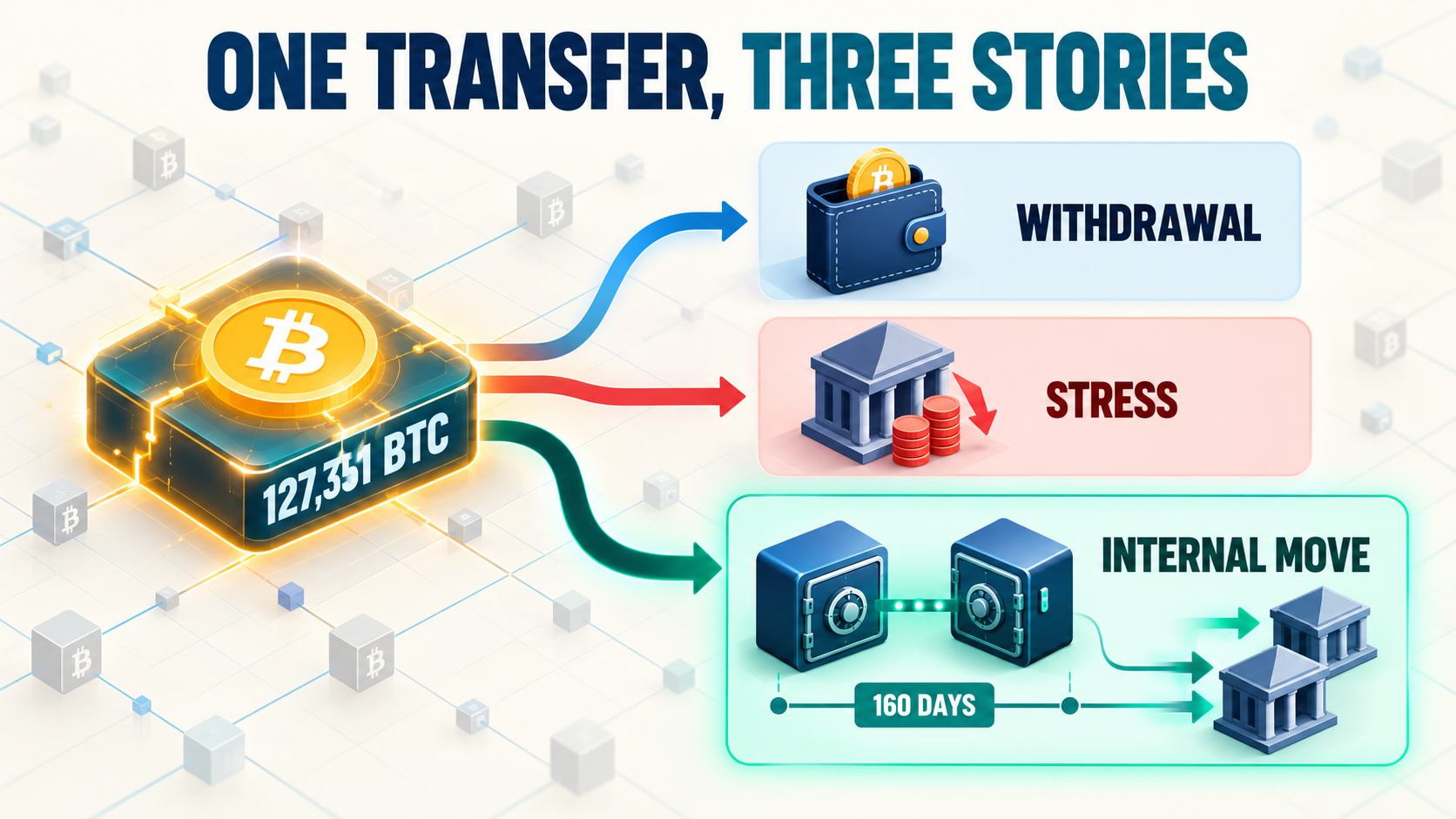
That single observation could support at least three stories. A large customer might have withdrawn to self-custody. Binance might have been moving reserves during a period of market stress. Or the exchange might have been transferring funds between wallets it controlled as part of an operational or proof-of-reserves process.
This transaction-level case study tests those interpretations against the evidence available before and after the alert. It separates what the blockchain proves, what public labels suggest and what Binance later claimed. The purpose is not to predict a price move or recommend an action; it is to show how a plausible narrative should change when stronger evidence arrives.
Whale Transfer Analysis Starts With the Transaction Facts
The transaction identifier is a2df8acfab675fed1ad1b97e9dbef8d259510315ffb651c0c1de1bdff4a7730e. It was confirmed on November 28, 2022 at 10:01:35 UTC. The main input address, 3M219KR5vEneNb47ewrPfWyb5jQ2DjxRP6, was labeled Binance. The main output sent 127,351.05702497 BTC to 3JJmF63ifcamPLiAmLgG96RA599yNtY3EQ.
| Observed field | Recorded value | What it establishes |
|---|---|---|
| Timestamp | November 28, 2022, 10:01:35 UTC | When the transfer was confirmed |
| Main sender | Binance-labeled address | The spent funds came from an address attributed to Binance |
| Main destination | Initially described as unknown; currently labeled Binance-coldwallet | The public attribution changed after the alert |
| Main output | 127,351.05702497 BTC | The quantity moved to the destination address |
| Second output | 0.082899 BTC to another Binance-labeled address | A likely change output, not a second billion-dollar recipient |
| Transaction fee | 0.000026 BTC | The network fee, not evidence of the transfer’s purpose |
| Alert valuation | Approximately $2.06 billion | A contemporaneous dollar estimate, not realized trading volume |
The Whale Alert transaction page now attributes both receiving addresses to Binance, but the historical alert described the large destination as unknown. This is not a minor editorial detail. An “exchange to unknown wallet” headline implies an external withdrawal, while “exchange to exchange cold wallet” describes an internal movement.
Bitcoin’s transaction model also matters. The Bitcoin Developer Guide explains that transactions spend existing unspent outputs in full and commonly return surplus funds through a change output. An output is therefore not automatically a distinct external beneficiary, and an address label is not embedded in Bitcoin consensus data.
Three Stories the Same Bitcoin Whale Transfer Could Support
A sound whale transaction analysis does not choose the most dramatic explanation first. It states the competing hypotheses, records what each one predicts and then checks those predictions against subsequent evidence.
Story 1: A large holder withdrew to self-custody
At alert time, this was plausible. The sender was attributed to Binance, the main destination was reported as unknown and the transfer moved outward in one very large output. If the destination belonged to a customer or institution, the transaction could have represented a withdrawal from exchange custody.
That interpretation predicts a genuinely external destination. Later spending could vary, but attribution should not resolve into an address controlled by Binance without contrary evidence. The destination’s current Binance-coldwallet label and its later transfer to two Binance-labeled addresses weaken the withdrawal story substantially.
Story 2: Binance was draining or repositioning reserves under stress
The scale made a stress narrative easy to construct. Binance had published an on-chain BTC reserve balance of 582,485.9302 BTC for its November 22 snapshot, so the 127,351 BTC output was equivalent to approximately 21.9% of that disclosed figure. The transaction also occurred shortly after the collapse of FTX, when exchange reserves and withdrawals were under intense scrutiny.
Yet size alone does not identify financial stress. A genuine reserve drain would be more convincing if the funds moved to external counterparties, dispersed across withdrawals or reached destinations with observable selling or settlement activity. Instead, the main balance remained together for roughly 160 days and was later routed to addresses attributed to Binance.
Story 3: Binance moved funds internally for an audit or wallet-control test
This explanation was also available close to the event. Binance had announced its first proof-of-reserves system on November 25, three days before the transfer. After the alert circulated, then-CEO Changpeng Zhao said the movement was part of a proof-of-reserves audit and that Binance had been asked to send a specified amount to itself to demonstrate control of the wallet.
The statement supplies a motive, but it should not be treated as blockchain proof. The ledger can show that the funds moved and that the recipient later behaved like a Binance-controlled wallet. It cannot show an auditor’s instruction, an internal ticket or the purpose for which the transaction was authorized.
Evidence Test 1: Wallet Labels Changed the Narrative
Labels are off-chain claims attached to on-chain objects. They may be based on exchange disclosure, known deposit patterns, clustering, public reports or an explorer’s proprietary research. They are useful, but they can be incomplete at the time of an alert and revised later.
Here, the temporal sequence is more informative than either label viewed alone. At the moment of public attention, the destination appeared unknown. Today, the same destination is labeled Binance-coldwallet. The new attribution does not retroactively make the first description dishonest; it shows why an unlabeled address should be treated as unresolved rather than external by default.
This principle is central to BlockCodex’s broader guide to how to analyze whale activity. A sender label can identify one side of a transfer, but the economic meaning depends on the recipient, entity relationships, follow-on behavior and the confidence attached to each label.
Evidence Test 2: Follow the Funds Beyond the Alert
The destination address received the 127,351 BTC output on November 28, 2022 and retained essentially that balance until May 7, 2023. That holding period was approximately 160 days. The absence of intermediate dispersal is inconsistent with an immediate sale, a broad wave of customer withdrawals or rapid settlement through several counterparties.
On May 7, the address spent 127,351.05703122 BTC in transaction 6345aad1147bee45c9b35c58e043459d45c122a52de57ee596dad5917a0c5855. The follow-on transaction sent 117,351.05645141 BTC to an address labeled Binance-coldwallet and 10,000 BTC to an address labeled Binance-wallet.
| Follow-on evidence | Observation | Interpretive effect |
|---|---|---|
| Holding period | About 160 days with no major dispersal | Weakens the immediate sale or withdrawal-wave narratives |
| Next spend | The complete balance was moved in one transaction | Looks more like treasury or wallet operations than retail distribution |
| 117,351 BTC output | Destination labeled Binance-coldwallet | Supports continued Binance control |
| 10,000 BTC output | Destination labeled Binance-wallet | Supports an internal wallet split |
Later labels are not infallible, but the combination is strong: one consolidated receipt, a long dormant period and a later full-balance split into two Binance-attributed destinations. That pattern gives the internal-transfer hypothesis much more explanatory power than it had from Binance’s statement alone.
Evidence Test 3: Compare the Transfer With Exchange Context
Binance’s November 25 proof-of-reserves announcement reported 582,485.9302 BTC in on-chain reserves against customer net balances of 575,742.4228 BTC, using a November 22 snapshot. The timing supports the possibility that the November 28 movement was connected to the same process.
But a self-published reserve snapshot is context, not independent proof of purpose or solvency. It does not reveal every liability, establish ownership of all displayed assets or verify the claimed auditor instruction. The most defensible conclusion is narrower: the public proof-of-reserves process makes an internal control test plausible, while the address history later corroborates continued Binance control.
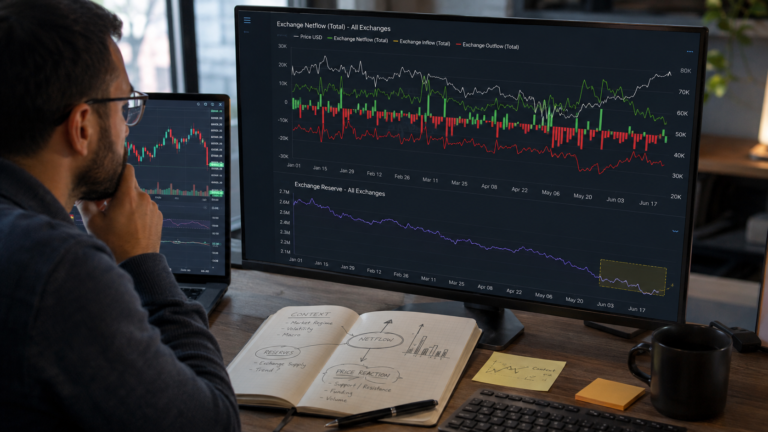
Exchange inflow and outflow metrics require the same discipline. BlockCodex’s guide to exchange inflow in crypto explains that flows between known exchange wallets can reflect reorganization, consolidation or custody operations rather than customer deposits and withdrawals. Entity-adjusted flows should exclude internal transfers whenever attribution permits.
Evidence Test 4: Market Size Is Not Market Impact
The alert’s $2.06 billion valuation was large enough to attract attention. CoinMarketCap’s historical snapshot for November 28, 2022 reported Bitcoin at $16,217.32, with approximately $27.74 billion in 24-hour volume and a daily change of -1.38%. The transfer’s notional value was about 7.4% of that reported daily volume.
That comparison establishes scale, not executable impact. Reported market-wide volume is not the same as order-book depth at a specific venue, and an on-chain wallet transfer is not a market sell. There is no output in the transaction that records an order, sale price or exchange matching event.
Attributing the day’s price move to this Bitcoin whale transfer would therefore exceed the evidence. To argue for direct market impact, a researcher would need a credible path from the receiving wallet to a trading venue, matching timing, trade-flow evidence and sufficient liquidity analysis. None of those conditions is established by the transfer alone. The broader BlockCodex framework on why on-chain metrics need market context explains why price, liquidity and positioning must be tested separately from ledger activity.
Narrative vs Evidence Scorecard
| Possible story | Evidence that initially supported it | Evidence against it | Final weight |
|---|---|---|---|
| External customer or institutional withdrawal | Binance sender; destination initially described as unknown | Current Binance-coldwallet label; 160-day consolidation; later spend to Binance-labeled destinations | Low |
| Emergency reserve drain or liquidity stress | Exceptional size; post-FTX environment; large share of the published reserve snapshot | No rapid dispersal or external destination; long hold; later internal wallet split | Low after follow-on evidence |
| Internal wallet move connected to proof of reserves | PoR launch three days earlier; contemporaneous Binance statement | The stated auditor instruction cannot be verified from the chain | High for internal movement; moderate for the exact stated motive |
The distinction in the final row matters. The evidence strongly supports continued Binance control, but the specific reason remains partly dependent on Binance’s public account. A high-confidence entity classification should not be inflated into certainty about organizational intent.
A Repeatable Whale Transfer Analysis Workflow
- Freeze the original observation. Record the transaction ID, block time, inputs, outputs, fees, labels and the wording used by the alert at the time.
- Separate ledger facts from annotations. Amounts and scripts are on-chain; entity labels, dollar valuations and motive claims are external interpretations.
- Write competing hypotheses. Include at least one ordinary operational explanation before treating a large transfer as a market signal.
- State what each story predicts. A withdrawal, internal rotation and sale should produce different counterparties, holding periods and follow-on paths.
- Trace the next meaningful spend. Do not stop at the alert. Look for consolidation, dispersion, exchange deposits, bridge use or prolonged dormancy.
- Check labels across time and sources. Preserve the original label and record later revisions rather than silently replacing history.
- Add exchange and market context. Compare the transfer with reserve disclosures, known operational events, executable liquidity and price behavior without confusing correlation with causation.
- Report confidence by claim. Entity control, transaction purpose and market impact may deserve different confidence levels.
This workflow turns an alert into an on-chain transaction case study. It also protects the analysis from hindsight bias: the final explanation is not inserted into the original moment, and the initial uncertainty remains visible.
What This Exchange Wallet Movement Cannot Prove
The reconstructed exchange wallet movement supports an internal Binance transfer, but several claims remain outside the blockchain’s reach. The transaction does not prove who inside the organization authorized it, whether an independent auditor requested it, what accounting treatment was used or whether Binance was solvent.
It also cannot prove the absence of a customer claim on the assets. A centralized exchange can control private keys while users retain contractual claims against it. Address control and beneficial ownership are related questions, not interchangeable ones.
Finally, current labels may change as attribution improves. Reproducible research should therefore preserve transaction IDs, timestamps and observed paths—the immutable evidence—while dating every entity label and organizational statement used to interpret them.
Final Takeaway From This Whale Transfer Analysis
This whale transfer analysis began with one accurate but incomplete fact: 127,351 BTC moved from a Binance-labeled address to a destination described as unknown. Three stories were initially plausible because the transaction recorded value movement without motive.
Follow-on evidence changed the balance. The destination is now attributed to Binance, held the funds together for about 160 days and later sent the complete balance to two Binance-labeled wallets. That makes an internal movement the best-supported interpretation and sharply reduces the weight of the external-withdrawal and emergency-drain stories.
The exact proof-of-reserves explanation remains a reported motive rather than an on-chain fact. That is the broader lesson: a strong analysis does not force every claim into a single confidence level. It shows what happened, tests what might explain it and stops where the evidence stops.
Frequently Asked Questions
What was the 127,351 BTC Binance transfer?
It was a Bitcoin transaction confirmed on November 28, 2022 that sent approximately 127,351 BTC from a Binance-labeled address to a destination initially reported as unknown. The destination is now labeled Binance-coldwallet and later sent the balance to two other Binance-labeled addresses.
Did the transfer prove that a whale withdrew from Binance?
No. That was one plausible interpretation of the initial alert, but the later labels and follow-on transaction support continued Binance control. The evidence is more consistent with an internal wallet movement.
Was the transaction part of a proof-of-reserves audit?
Changpeng Zhao said it was a self-transfer performed for a proof-of-reserves audit. The timing and later address behavior are consistent with an internal control test, but the auditor instruction and exact operational purpose cannot be independently proven from the blockchain.
Can a whale transfer predict Bitcoin’s price?
Not by itself. An on-chain transfer does not record whether assets were sold, and reported market volume is not executable liquidity. Price-impact claims require destination, timing, trading-flow and market-depth evidence.
Why can wallet labels change after a transfer?
Labels are external attributions built from disclosures, transaction patterns, clustering and research. New evidence can identify an address that was previously unknown, so every label should be dated and treated according to its confidence.
Sources and Methodology
This case study uses the original Bitcoin transaction and contemporaneous Whale Alert record, the destination address history and its May 7, 2023 follow-on transaction, Binance’s November 25, 2022 proof-of-reserves announcement, Changpeng Zhao’s public explanation, the Bitcoin Developer Guide and CoinMarketCap’s November 28 historical market snapshot. Percentages were calculated from the cited historical values. Wallet labels were checked on September 22, 2026 and may change as attribution providers update their records.