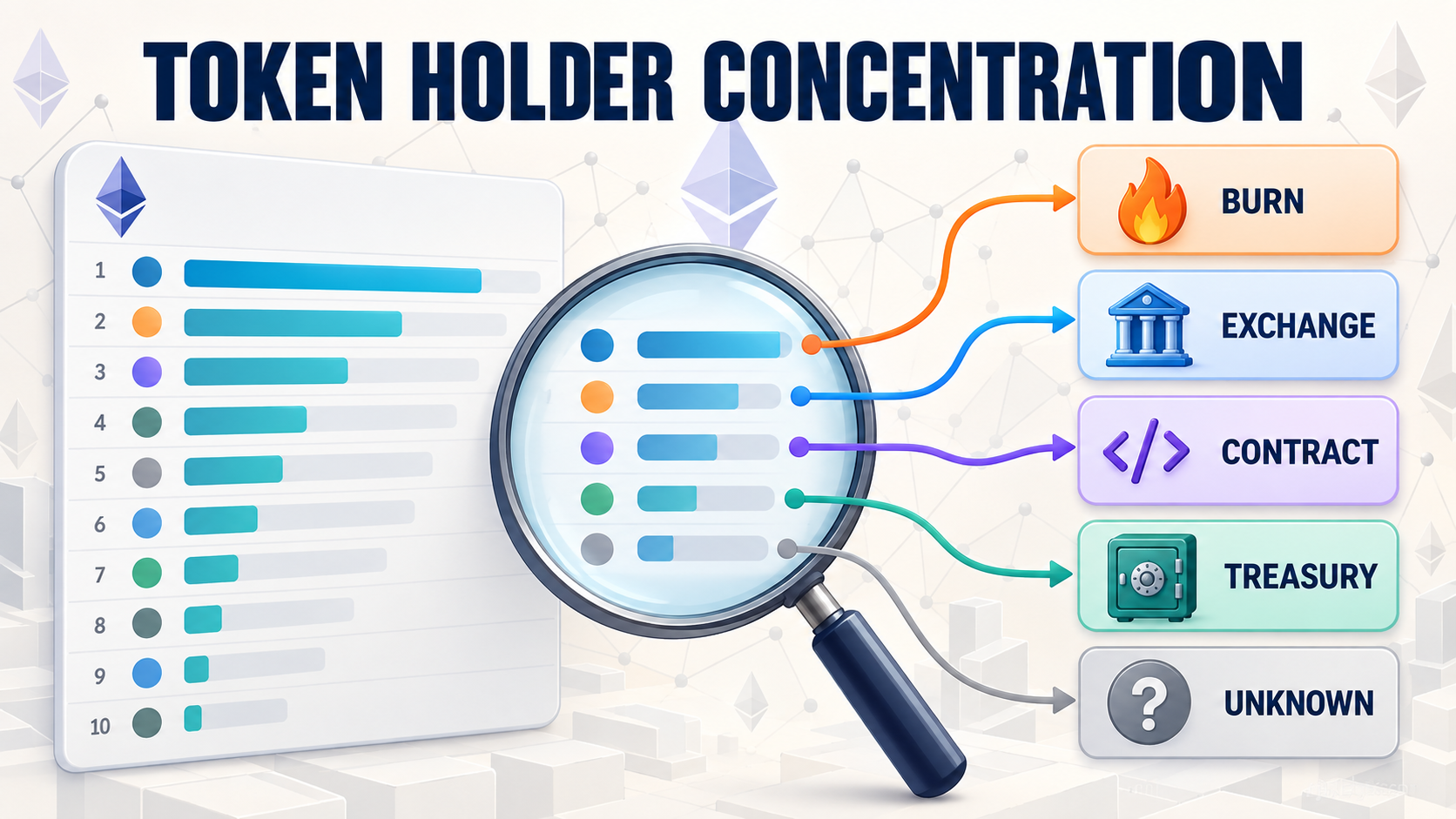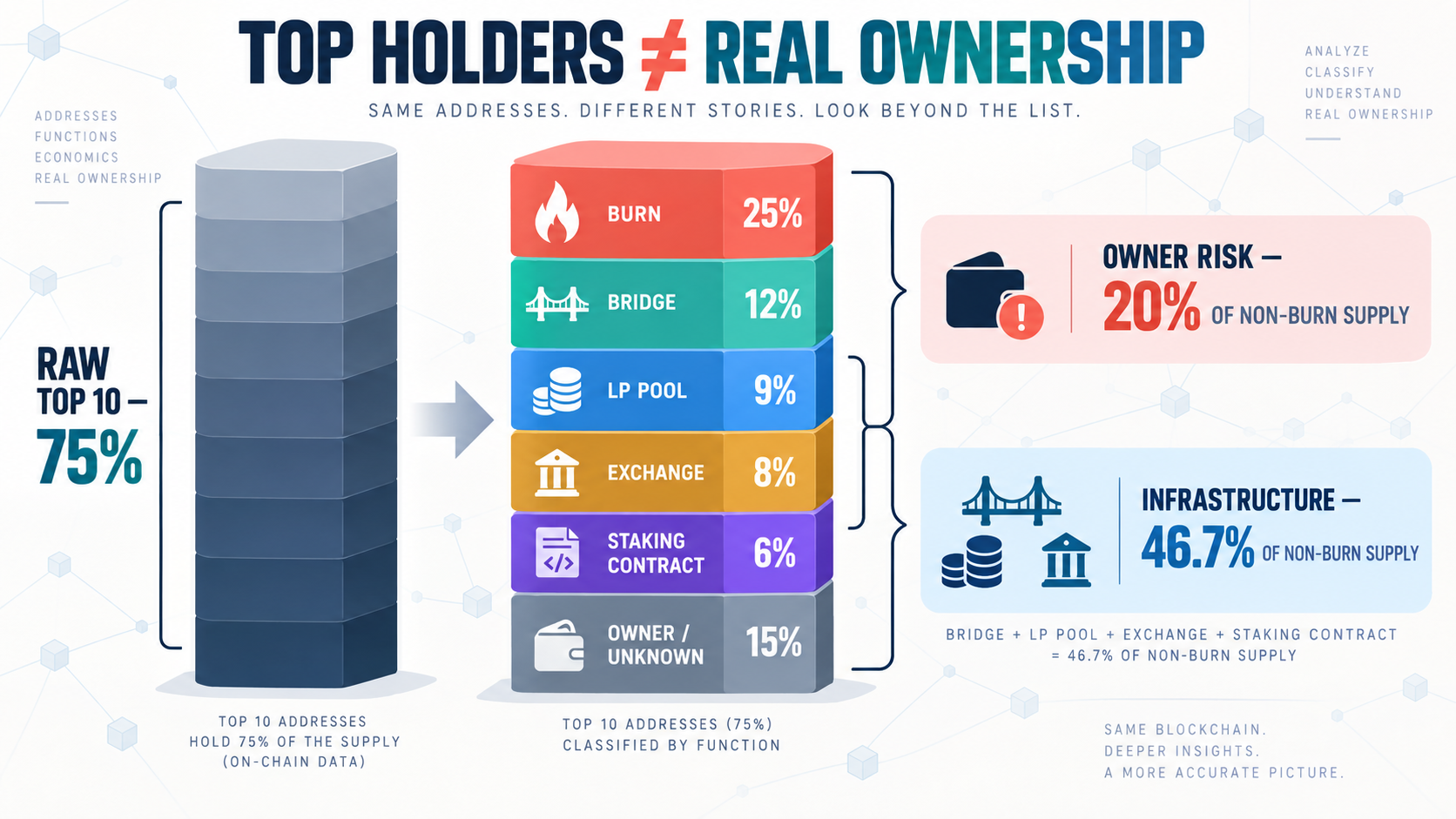
Token holder concentration in crypto is often summarized with one number: the percentage of supply held by the top ten addresses. The calculation may be arithmetically correct while the ownership conclusion is wrong. A blockchain records balances by address, but an address can be a burn destination, bridge escrow, liquidity pool, exchange wallet, staking contract, treasury or independent holder.
That difference matters because “the top ten addresses hold 75%” does not mean “ten people control 75%.” The first statement describes where tokens sit. The second makes an unproven claim about beneficial ownership and control.
This article develops a repeatable classification framework and tests it with a controlled 100-million-token example. The objective is not to manufacture a single “true ownership” percentage, but to separate what the ledger proves from what the available labels only suggest.
Token Holder Concentration in Crypto Measures Addresses First
The ERC-20 standard defines totalSupply() and balanceOf(address). The second function returns the token balance assigned to an account; it does not identify the people or entities with an economic claim on that balance. Etherscan then indexes these balances and orders holders by quantity and percentage.
This makes a holder list useful raw evidence. It is not an ownership registry. One organization may control several addresses, while a single custodian address may aggregate balances associated with thousands of customers.
The same distinction applies throughout on-chain research. BlockCodex’s guide to why investors misread on-chain data explains how an accurate raw metric can still support a weak interpretation when its definition and context are ignored.
Why Top Token Holders May Not Be Independent Owners
Before interpreting top token holders, classify the function of each address. The categories below do not all disappear from the analysis; instead, each answers a different economic question.
Burn or null addresses
Tokens sent to a recognized inaccessible address may remain visible in a holder ranking even though they are not expected to return to circulation. This is different from a token contract that destroys units and reduces totalSupply(). In either case, the analyst should verify the mechanism rather than infer it from a nickname such as “dead.”
A documented inaccessible balance can be excluded from an active-control denominator, but the raw total-supply result should remain available so another researcher can reproduce the adjustment.
Bridge escrow
Many bridges use a lock-and-mint model: assets are locked on the source chain while a corresponding representation is minted on the destination chain. The escrow can rank as a large holder without behaving like an investor, yet its balance still represents cross-chain claims and bridge security, redemption and accounting risks.
Liquidity pools
An automated market maker pool holds reserves supplied by liquidity providers. A large pool balance therefore supports market liquidity rather than proving that the contract is an independent whale, although researchers still need to identify who controls the corresponding liquidity positions and whether they can be withdrawn.
Exchange and custodian wallets
A centralized exchange address can combine inventory, operational funds and customer-attributed balances. Treating it as one owner overstates beneficial ownership, while ignoring it understates custody risk. Report the balance separately because dependence on one venue can still affect withdrawals, market access and sell-side liquidity.
Protocol, staking and vesting contracts
A contract address is a technical type, not an economic classification. A staking vault may aggregate many depositors, while a vesting contract may hold tokens for one team. Identify the role, withdrawal rules, administrators, beneficiaries and upgrade controls before deciding how to count it.
Treasuries, market makers and unknown wallets
A disclosed treasury or market maker is attributable to an entity, but its balance can still create control or liquidity risk. An unknown address may be an individual, custodian, unlabeled contract or part of a cluster. Keep Unknown as a valid classification rather than inventing an identity.
A Classification Framework for Token Holder Distribution
A useful token holder distribution review records three separate attributes: what the address technically is, what economic function it appears to serve and how confident the attribution is. This prevents “contract,” “exchange” or “whale” from becoming catch-all labels.
| Address category | Likely economic meaning | Treatment in ownership analysis | Evidence to seek |
|---|---|---|---|
| Documented burn or inaccessible address | Tokens unavailable for ordinary control | Show in raw results; exclude from active-control denominator only with evidence | Contract behavior, official disclosure, transaction history |
| Bridge escrow | Backing for tokens or claims on another chain | Separate from independent owners; retain as infrastructure exposure | Official bridge contracts, mint/burn or lock/unlock flows |
| AMM pool | Trading reserves supplied by LPs | Separate from whales; investigate control of liquidity positions | Verified pool contract, paired asset, LP or position ownership |
| Exchange or custodian | Aggregated customer and operational balances | Do not equate address with one owner; report custody concentration | Explorer label, official proof, deposit and withdrawal patterns |
| Staking, vesting or protocol contract | User deposits or allocated tokens under rules | Classify by beneficiaries and control, not by contract status alone | Verified code, documentation, admin roles, unlock conditions |
| Treasury or team multisig | Project-controlled reserves | Include in control-risk analysis | Official allocation, multisig signers, governance and unlocks |
| Known fund or market maker | Independent entity or contracted liquidity provider | Include, while noting mandate and possible hedging | Public attribution, contracts, repeated counterparties |
| Unknown address | Unattributed balance | Include as unresolved concentration; do not invent identity | Funding source, counterparties, timing and cluster evidence |
Labels are evidence, not certainty. Etherscan notes that owner and public labels are applied to known exchanges, projects, public figures and service categories. Labels can be incomplete, and the absence of a label does not prove that an address is an independent wallet.
Original Adjusted Holder Concentration Example
The following dataset is controlled and hypothetical. It does not describe a real token, blockchain or current market. A fixed total supply of 100 million units makes every percentage auditable and lets the classification method be tested without mixing the lesson with a changing live snapshot.
| Rank | Balance | Share of total supply | Classification | Ownership interpretation |
|---|---|---|---|---|
| 1 | 25M | 25% | Documented burn/null address | Not active controllable supply in this model |
| 2 | 12M | 12% | Bridge escrow | Cross-chain backing for multiple users |
| 3 | 9M | 9% | AMM liquidity pool | Reserves associated with liquidity providers |
| 4 | 8M | 8% | Exchange custody | Aggregated customer and operational balances |
| 5 | 6M | 6% | Staking contract | Deposits attributed to multiple stakers |
| 6 | 5M | 5% | Treasury multisig | Project-controlled balance |
| 7 | 4M | 4% | Unknown wallet A | Unresolved independent-control risk |
| 8 | 3M | 3% | Unknown wallet B | Unresolved independent-control risk |
| 9 | 2M | 2% | Known market maker | Attributable entity with a liquidity mandate |
| 10 | 1M | 1% | Unknown wallet C | Unresolved independent-control risk |
The raw top-ten balance is 75 million tokens, so the raw top-ten concentration is 75%. That is a correct address-level result. Describing it as ten whales controlling three-quarters of supply would be incorrect because 60 million tokens sit in the documented burn address or identified infrastructure and custody addresses.
Layer 1: raw address concentration
75M ÷ 100M = 75%
This layer answers where balances are recorded. It is reproducible but does not distinguish accessible supply, shared infrastructure or economic ownership.
Layer 2: burn-adjusted top-ten footprint
Remove the documented 25-million burn balance from both the top-ten numerator and the active-supply denominator:
(75M − 25M) ÷ (100M − 25M) = 50M ÷ 75M = 66.7%
The percentage remains high because the bridge, pool, exchange, staking contract, treasury and large wallets are still part of the non-burn supply. Notice that an adjusted percentage does not have to be lower than the raw result; changing the denominator can move the ratio in either direction.
Layer 3: candidate independent-control concentration
For a narrower control-risk view, the numerator includes the treasury, three unknown wallets and known market maker. It excludes the bridge, AMM pool, exchange and multi-user staking contract from the candidate-independent-owner numerator, while retaining all non-burn tokens in the denominator:
(5M + 4M + 3M + 2M + 1M) ÷ 75M = 15M ÷ 75M = 20%
This adjusted holder concentration is not “the real ownership percentage.” It is a defined risk measure: 20% of non-burn supply sits in the largest balances that the model attributes to a treasury, a known entity or unresolved wallets. The market maker may hold for clients, the unknown wallets may be related, and the treasury’s control may depend on multisig and governance rules.
Keep infrastructure exposure visible
The bridge, liquidity pool, exchange and staking contract together contain 35 million tokens. Relative to the 75-million non-burn denominator, that is 46.7%. Calling these addresses “excluded” and then forgetting them would hide meaningful infrastructure, custody and redemption dependencies.
| Measurement | Numerator | Denominator | Result | What it means |
|---|---|---|---|---|
| Raw top-ten concentration | 75M | 100M total supply | 75% | Balance placement across ten addresses |
| Burn-adjusted top-ten footprint | 50M | 75M non-burn supply | 66.7% | Top-ten footprint after documented inaccessible tokens are removed |
| Candidate independent-control concentration | 15M | 75M non-burn supply | 20% | Largest treasury, known-entity and unknown balances in the model |
| Identified infrastructure and custody | 35M | 75M non-burn supply | 46.7% | Bridge, pool, exchange and staking dependencies |
How to Calculate Crypto Ownership Concentration Without Hiding Assumptions
Start by defining the question. “Where is supply recorded?” requires a raw address ratio. “How much active supply sits in large balances?” may justify a burn-adjusted denominator. “How much may be controlled by a limited set of decision-makers?” requires entity attribution, contract analysis and explicit confidence levels.
- Freeze the snapshot: record the chain, token contract, block or timestamp, total supply and top-N cutoff.
- Preserve the raw result: sum the selected address balances before applying classifications.
- Label function and evidence: separate technical address type from economic role and record the source of each attribution.
- Choose the denominator: state whether it is total, circulating, non-burn or another reproducible supply base.
- Group entities cautiously: merge addresses only when evidence supports common control.
- Publish multiple layers: show raw concentration, active-supply concentration, candidate owner concentration and infrastructure exposure.
- Retain unknowns: uncertainty belongs in the result, not outside it.
The denominator is as important as the numerator. Removing a bridge, pool or exchange from both sides creates a “free-float” metric but also removes tokens economically attributable to users. Keeping them in the non-burn denominator while separating their function is usually more transparent.
When Holder Concentration Becomes a Material Risk
No universal top-ten threshold proves that a token is safe or dangerous. Concentration becomes more concerning when large balances are liquid, weakly disclosed, controlled by a small signer set, close to unlock dates or large relative to executable market depth.
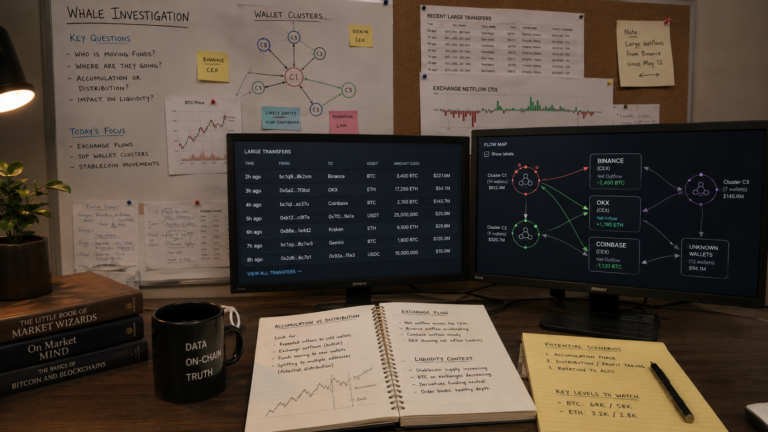
Behavior provides another layer. Repeated transfers from a treasury or unknown cluster toward exchanges may matter more than a dormant balance, but destination context is essential. The BlockCodex guide on analyzing whale activity explains how to combine labels, exchange flows, timing and liquidity rather than treating one transfer as intent.
Researchers should also test whether ownership concentration creates governance power. Delegation, quorum rules, voting contracts and multisig thresholds may produce control that a basic holder ranking cannot show.
What an Adjusted Concentration Model Cannot Prove
Wallet classification reduces obvious errors, but it does not reveal every beneficial owner. One person can split tokens across many wallets; several people can share a multisig; a custodian can commingle customer and corporate balances; and related contracts can create overlapping claims.
Public labels can lag operational changes, so contract upgrades, migrations, bridges and exchange wallet rotations require periodic review. Present adjusted concentration as a model with assumptions rather than identity proof: it makes uncertainty visible but cannot eliminate it.
A Practical Review Checklist
- Confirm the chain and official token contract.
- Record a dated top-holder snapshot and the supply denominator.
- Separate externally owned accounts from contracts, then classify each contract’s role.
- Verify burn, bridge, pool, exchange, staking, vesting and treasury labels with primary evidence.
- Keep raw address concentration before calculating any adjustment.
- Report custody and infrastructure exposure instead of silently deleting it.
- Group wallets only when common control is supported.
- Mark uncertain addresses as Unknown and document attribution confidence.
- Compare balances with unlocks, governance control, recent flows and liquidity.
Holder classification is one part of broader due diligence. BlockCodex’s framework for evaluating a crypto project connects distribution evidence with the product, team, security, liquidity and documented claims.
Final Takeaway on Token Holder Concentration in Crypto
Token holder concentration in crypto is meaningful only when the analyst states what is being concentrated: address balances, active supply, attributable entities, governance control or infrastructure exposure. A raw top-ten percentage answers the first question and cannot automatically answer the others.
The controlled example makes the gap concrete. The same ledger produces 75% raw top-ten concentration, 66.7% burn-adjusted top-ten footprint, 20% candidate independent-control concentration and 46.7% identified infrastructure and custody exposure. None is a substitute for the others.
The most defensible conclusion is therefore layered. Preserve the raw list, classify address functions, show every numerator and denominator, retain uncertainty, and describe only the ownership claims the evidence can support.
Frequently Asked Questions
Do the top ten token holders represent ten people?
No. They represent ten addresses in the selected holder ranking. Those addresses may include contracts, exchanges, bridges, pools, treasuries or multiple wallets controlled by one entity.
Should exchange wallets be excluded from concentration analysis?
They should be separated from independent-owner estimates, not erased. An exchange address can aggregate many customers, but a large balance still reveals custody, withdrawal-channel and market-access concentration.
Should liquidity pool addresses count as whales?
Usually not as independent owners. A pool contract holds trading reserves associated with liquidity providers. Researchers should classify the pool separately and investigate who can withdraw or control the underlying liquidity positions.
What is adjusted holder concentration?
It is a concentration ratio recalculated under explicit classification and supply assumptions. A defensible version states which addresses were removed or regrouped, why they were treated that way, and which denominator was used.
Can a holder list prove real token ownership?
No. It can show balances and support attribution when combined with labels, contract roles and transaction evidence. It cannot by itself prove beneficial ownership, identity or coordinated control.