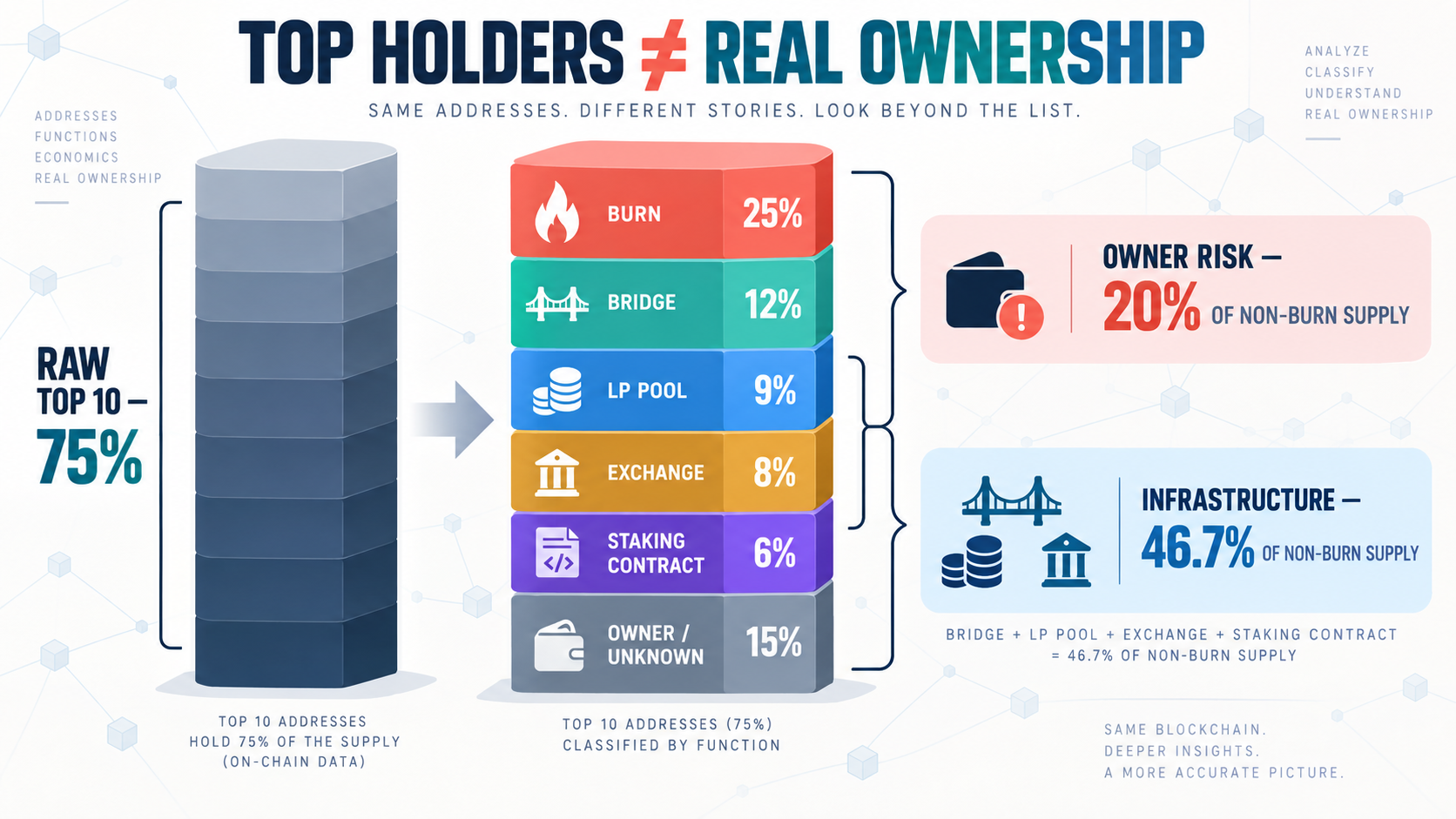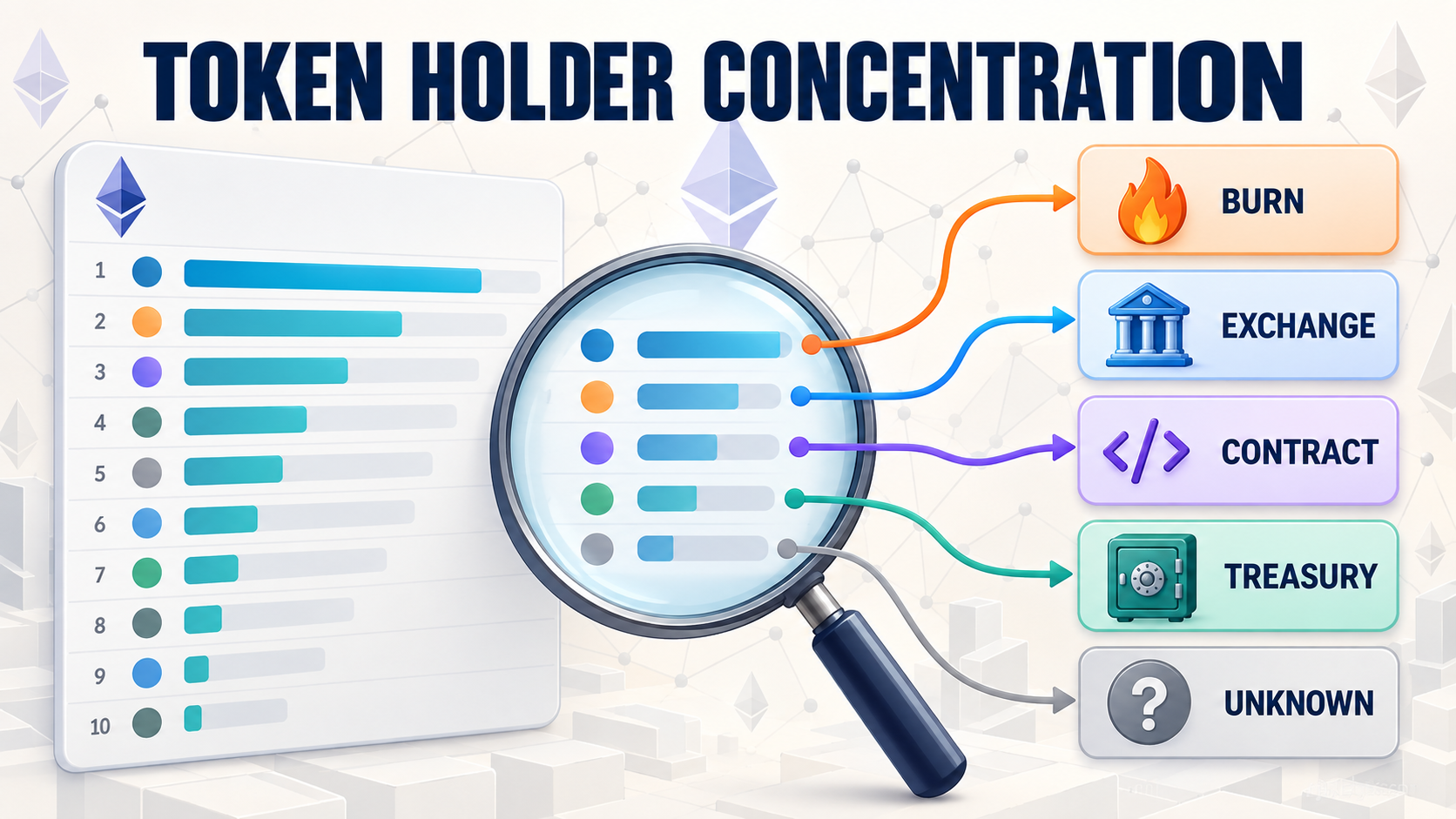
Check token holder concentration on Etherscan before buying an ERC-20 token, but do not stop at the percentages in the Holders tab. A large balance may belong to an exchange serving thousands of customers, a burn address, a protocol contract, a project treasury or one unidentified holder. Those categories do not create the same risk.
The useful question is therefore not simply, “What percentage do the top ten addresses hold?” It is, “Who appears to control those balances, how confident is the label, and which supply denominator answers my question?” This guide provides a repeatable Etherscan workflow and tests it on a dated SHIB snapshot.
Check Token Holder Concentration on Etherscan: What the List Shows
An ERC-20 contract maintains balances for Ethereum addresses. The ERC-20 standard defines totalSupply() and balanceOf(address), while transfers update the distribution recorded by the contract. Etherscan indexes that state and says its Holders tab orders token holders by their respective quantity and percentage.
That makes the list a strong starting point, not a finished ownership map. An address is an on-chain account, not necessarily one person. One entity can control several addresses, while one exchange address can represent balances attributable to many customers.
This distinction keeps the article separate from a broad tokenomics review. BlockCodex’s guide to reading tokenomics like an analyst covers supply, allocation and unlocks; the workflow here answers one narrower question: how concentrated is the current ERC-20 balance distribution, after obvious address types are classified?
Step 1: Verify the Token Contract Before Reading Holders
Start with the contract address published by the project’s official website or documentation. Paste that address into Etherscan, open the correct Token Tracker page and confirm the token name, symbol, contract address and token standard before using the holder list.
Do not search only by ticker. Duplicate names and imitation tokens can lead to a valid-looking page for the wrong contract. The general BlockCodex blockchain explorer guide explains why contract-level verification should come before interpretation.
For the case study below, the token is SHIBA INU on Ethereum, contract 0x95aD61b0a150d79219dCF64E1E6Cc01f0B64C4cE. The example is methodological; it is not a recommendation to buy, sell or avoid SHIB.
Step 2: Open the Holders Tab and Record the Snapshot
On the token page, select Holders. Record the inspection time, reported total supply and balances of the top addresses because the ranking can change after transfers, burns, exchange reshuffling or treasury movements.
For a quick screen, capture at least the top ten rows. For a smaller token, inspect more rows if the top ten account for only a modest share or if several related wallets appear just outside the first page. A percentage without a date is difficult to reproduce.
The basic calculation is:
Raw top-N concentration = sum of the top N address balances ÷ contract-reported total supply × 100
This raw ratio answers how much supply sits at a limited number of addresses. It does not yet answer how much one whale, one team or one coordinated group controls.
A reliable crypto token concentration review preserves that raw result, then adds classifications instead of replacing the original data. This keeps the calculation reproducible while making the ownership interpretation more precise.
Step 3: Classify Each Large Address
Open every material holder in a new tab and record the public name tag, whether Etherscan identifies the account as a contract, and any project documentation that supports the label. Etherscan’s metadata documentation shows that name tags can include entity and sector labels such as Coinbase and Exchange, but a label should still be treated as attribution evidence rather than infallible proof.
| Category | What to verify | Why it changes interpretation |
|---|---|---|
| Exchange or custodian | Public exchange name tag, repeated deposits and withdrawals, known operational cluster | One address can aggregate balances associated with many customers |
| Treasury or team | Official allocation documents, multisig owners, vesting or governance contracts | Control may be concentrated even if tokens are not moving |
| Burn or null | Recognized burn address plus project or transaction evidence | Tokens intended to be inaccessible should not be treated as an active whale position |
| Smart contract | Contract badge, verified code, protocol role and depositor claims | A pool, bridge or staking contract may represent many beneficial owners |
| Unknown | No reliable public attribution | The balance remains a concentration risk, but its owner and intent are unconfirmed |
Use Unknown when the evidence is incomplete. Transaction patterns can support a hypothesis, but they do not prove that an address belongs to a person, fund or insider. BlockCodex’s article on how to analyze whale activity provides the next step for studying behavior after the holder type has been assessed.
Original Test: Classifying SHIB’s Top Ten Holders
The table below uses a public rich-list snapshot last updated on September 13, 2026 at 08:33 UTC. The balances were checked against a reported total supply of approximately 999.98 trillion SHIB, while the public Binance labels were corroborated with Etherscan address pages. Blank or unsupported identities remain Unknown.
This ERC-20 holder distribution test uses the ten individual rows rather than accepting an aggregated concentration label without checking its components. The top token holders are then regrouped only when the public attribution is strong enough to support that decision.
| Rank | Address | Balance | Share of total supply | Public label | Manual category |
|---|---|---|---|---|---|
| 1 | 0xdead…206942069 | 410.44T SHIB | 41.04% | Null / burn address | Burn or null |
| 2 | 0x02e220…74b481e | 62.61T SHIB | 6.26% | None confirmed | Unknown |
| 3 | 0x40b387…418e489 | 39.27T SHIB | 3.93% | None confirmed | Unknown |
| 4 | 0x5a52e9…270efcb | 37.60T SHIB | 3.76% | Binance 28 | Exchange or custodian |
| 5 | 0xa023f0…dfc947e | 27.40T SHIB | 2.74% | None confirmed | Unknown |
| 6 | 0x1d4896…5030270 | 16.16T SHIB | 1.62% | None confirmed | Unknown |
| 7 | 0xa7060a…1471fa9 | 15.45T SHIB | 1.55% | None confirmed | Unknown |
| 8 | 0x47ac0f…507a6d503 | 9.24T SHIB | 0.92% | Binance-Peg Tokens | Exchange / bridge custody |
| 9 | 0xf97781…7441acec | 7.00T SHIB | 0.70% | Binance 8 | Exchange or custodian |
| 10 | 0x611f7b…5ddfb09d | 6.79T SHIB | 0.68% | None confirmed | Unknown |
Adding the ten individual balances produces about 631.96 trillion SHIB, or 63.20% of the reported total supply. Read alone, that number could be summarized as “ten whales control nearly two-thirds of SHIB.” The classification shows why that statement would be misleading.
| Category inside the top ten | Balance | Share of total supply | Share of non-burn supply |
|---|---|---|---|
| Burn or null | 410.44T SHIB | 41.04% | Excluded from active-holder calculation |
| Binance-labeled custody infrastructure | 53.84T SHIB | 5.38% | 9.13% |
| Unknown addresses | 167.68T SHIB | 16.77% | 28.44% |
| Confirmed treasury addresses | None identified in this top-ten sample | — | — |
| Confirmed protocol contracts | None identified in this top-ten sample | — | — |
After removing the burn/null balance from both numerator and denominator, ranks two through ten hold approximately 37.58% of non-burn supply. Within that adjusted denominator, Binance-labeled addresses represent about 9.13%, while addresses left Unknown represent about 28.44%. Rounding can create differences of a few hundredths of a percentage point.
This still does not prove that six individual whales control 28.44%. Several unknown addresses could belong to one entity, or one address could be a custodian whose public label is missing. The correct conclusion is narrower: a material share of non-burn SHIB supply in the top ten lacked confirmed attribution in this snapshot.
Step 4: Compare Address Concentration with Entity Concentration
Address-level rankings can split one entity across multiple rows. In the SHIB example, three top-ten addresses carry Binance-related labels. Counting them as three independent whales would overstate the number of separate decision-makers, while ignoring their common label would understate Binance-related custody concentration.
Create a second table that groups only high-confidence related addresses. Keep a confidence column and do not merge wallets solely because they transfer to the same destination. Shared counterparties can reflect exchanges, routers, bridges or popular protocols rather than common ownership.
A useful report therefore contains both measures: raw address concentration and high-confidence entity concentration. The gap between them reveals how much the holder list depends on custodians, contracts or fragmented operational wallets.
Step 5: Add Control, Liquidity and Time Context
Holder concentration becomes decision-relevant when it is connected to control and exit conditions. Check whether treasury tokens are locked, whether large unknown wallets are moving toward exchanges, whether a contract represents user deposits, and whether available market depth could absorb a material transfer.
A concentrated token is not automatically fraudulent or uninvestable. Concentration becomes more concerning when large balances are liquid, controlled by a small identifiable group, weakly disclosed, moving toward exchanges or large relative to market liquidity. A dispersed holder list can also be misleading if related wallets are controlled by the same entity.
Repeat the snapshot over time. A one-day ranking shows state; a monthly series shows whether insiders are distributing, exchanges are accumulating custody balances, burns are changing the denominator or unknown wallets are becoming more concentrated.
Common Mistakes When Reading Etherscan Token Holders
- Calling every top address a whale: exchanges, bridges and contracts can represent many users.
- Including burn balances as active ownership: this inflates apparent controllable concentration.
- Removing every contract automatically: a team-controlled vesting contract may still create concentrated control.
- Treating public labels as permanent truth: labels can be incomplete, delayed or revised.
- Guessing the identity of unknown wallets: activity patterns are clues, not proof of ownership.
- Ignoring the denominator: total supply, circulating supply and non-burn supply answer different questions.
- Using concentration as a price prediction: distribution describes structure, not future market direction.
A Practical Pre-Buying Checklist
- Obtain the official ERC-20 contract address.
- Open the correct Etherscan Token Tracker and Holders tab.
- Record the timestamp, total supply and top ten balances.
- Classify exchanges, treasuries, burn addresses, contracts and unknown wallets.
- Group related addresses only when attribution is supported.
- Calculate raw and burn-adjusted concentration with visible denominators.
- Check unlocks, recent transfers and market liquidity before interpreting risk.
- Save the snapshot and repeat the analysis later.
Final Takeaway
Learning to check token holder concentration on Etherscan is less about reading one percentage than building a defensible classification. The Holders tab shows where balances sit, but labels, contract roles, entity grouping and the chosen supply denominator determine what that distribution means.
The SHIB test makes the difference visible. A raw top-ten figure near 63.20% falls to about 37.58% when the labeled burn/null balance is removed from both sides of the calculation, and the remaining concentration still divides between Binance-related custody and unattributed addresses. That is a more precise conclusion than calling every large address a whale.
Frequently Asked Questions
Does Etherscan show the real owners of ERC-20 tokens?
No. Etherscan shows addresses and may provide public name tags or labels for known entities. An unlabeled address does not reveal a verified person, and one labeled exchange address can represent balances associated with many customers.
Is high top-ten concentration always a red flag?
No universal threshold proves that a token is unsafe. The interpretation depends on whether the balances belong to burn addresses, exchanges, protocol contracts, locked treasuries or unknown wallets, as well as the token’s liquidity and unlock structure.
Should burn addresses be excluded from holder concentration?
Exclude a burn balance from an active-control calculation only when the burn classification has adequate evidence, and remove it from both numerator and denominator. You can still report the raw total-supply ratio separately for transparency.
Can several top-holder addresses belong to the same entity?
Yes. Exchanges, funds, market makers, projects and custodians can operate multiple addresses. Merge them only when public labels, official disclosures or strong on-chain evidence support the relationship, and record the confidence level.