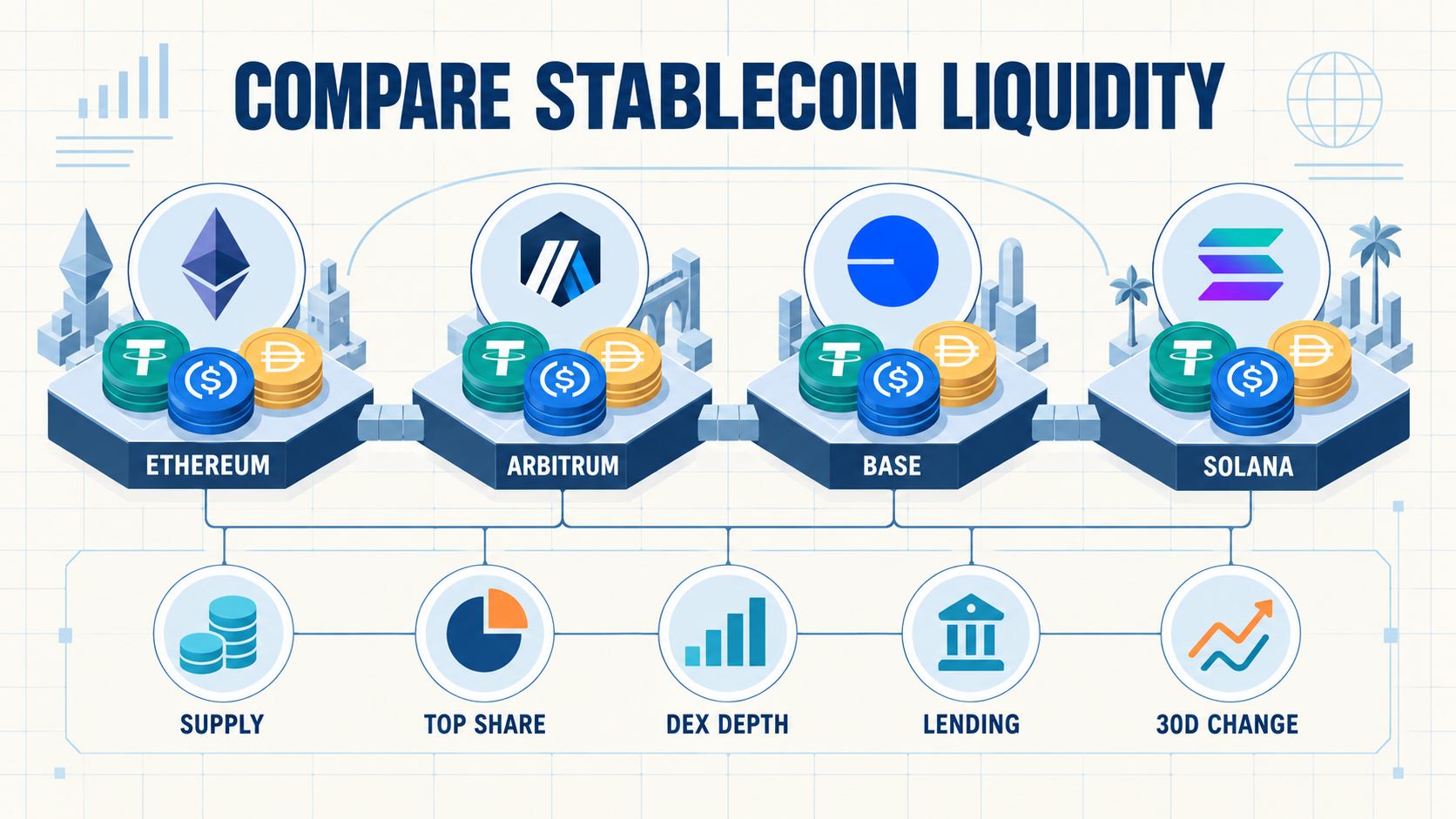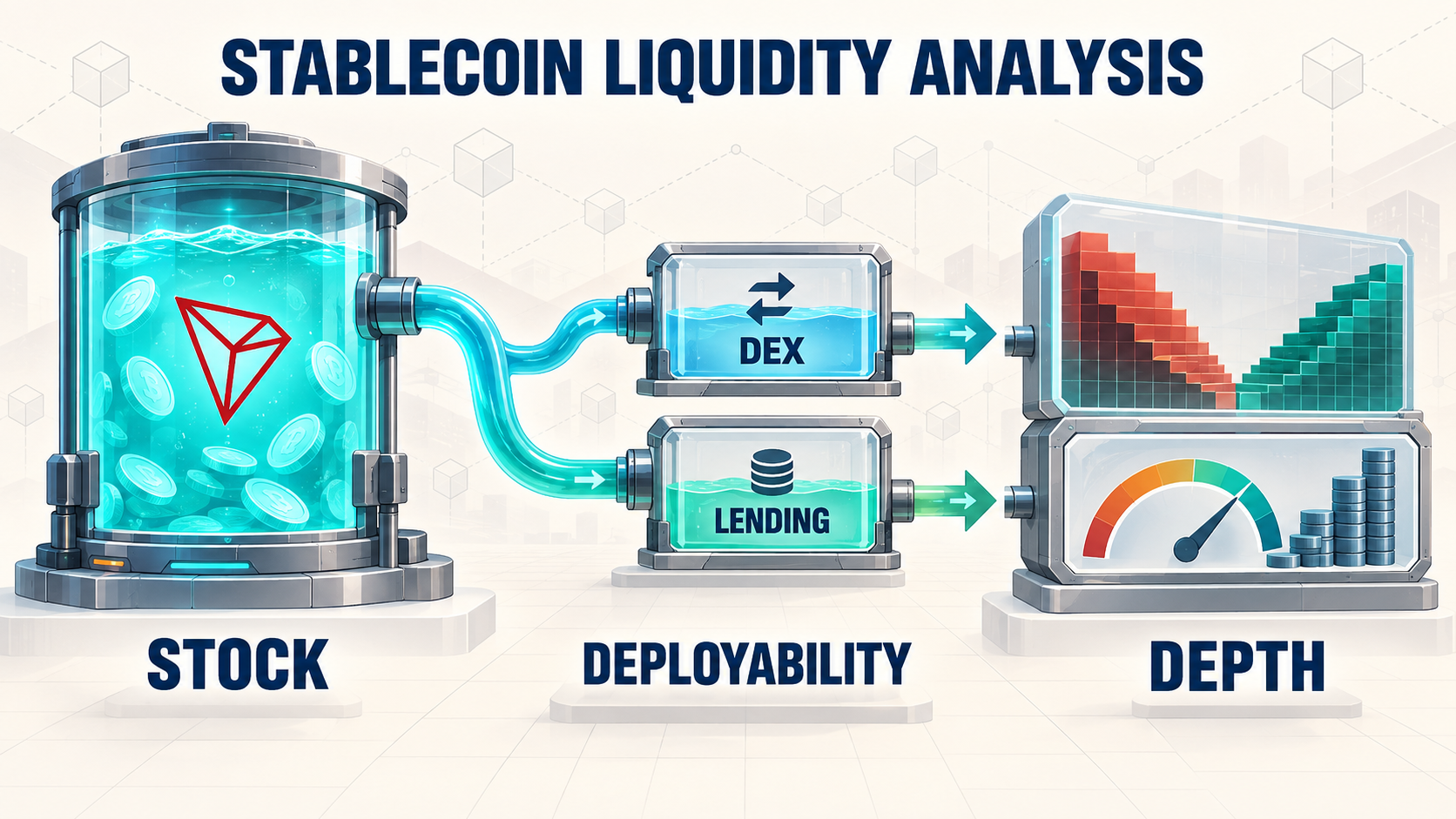
Stablecoin liquidity analysis becomes useful only when supply is connected to what that capital can do. A rising stablecoin balance can strengthen settlement capacity, but it does not automatically create deeper DEX markets, more borrowable liquidity or cheaper execution.
That distinction changes how stablecoin growth should be interpreted. Supply answers how much exists on a chain. DEX depth asks how efficiently users can trade. Lending liquidity asks whether capital is available and demanded inside credit markets.
This article builds a three-layer framework around those different functions: stock, deployability and depth. It then applies the framework to Tron, where a very large and growing stablecoin stock coexists with a much smaller on-chain trading and lending footprint.
Stablecoin Liquidity Analysis Needs Three Layers
No single stablecoin metric captures economic relevance. The same dollar can support settlement, sit passively in a wallet, enter a liquidity pool, secure a loan or move between exchanges, and each use leaves a different data trail.
| Layer | Core Question | Useful Metrics | What the Layer Cannot Prove Alone |
|---|---|---|---|
| 1. Stock | How much stablecoin value exists on the chain? | Total supply, 30-day change, leading asset share | Whether the capital is active or accessible to DeFi |
| 2. Deployability | Where can that stock be used? | DEX TVL, lending TVL, protocol count, supported assets | Whether a particular order or loan can be absorbed |
| 3. Depth | How much activity can markets handle at acceptable cost? | Price impact, slippage, available cash, active loans, utilization | How liquidity will behave during a future stress event |
The three layers should remain separate. Adding DEX TVL to lending TVL can double-count capital that moves through connected protocols, while both categories contain assets other than stablecoins. Ratios are therefore diagnostic screens, not an accounting reconciliation.
Why Stablecoin Supply Growth Is Only the First Signal
Stablecoin supply is a stock measured at a point in time. Growth can indicate that more dollar-like value is available for transfers, payments, market-making, collateral or risk management. It can also reflect issuance that remains concentrated in a small number of wallets or use cases.
The economic meaning depends on the chain. A payments-oriented network may host a large stablecoin balance because users value cheap and frequent settlement. A DeFi-oriented network may direct a larger share of a smaller balance into pools, collateral markets and borrowing.
Neither model is inherently superior. The analytical mistake is to treat supply growth as proof of every type of liquidity at once.
BlockCodex’s article on stablecoins as an ecosystem growth layer explains why these assets can support several economic functions. The framework here narrows the question further by testing where the stock becomes tradable or credit-active.
The Tron Data Divergence
Tron offers a useful test because its stablecoin stock is large, concentrated and still growing. For reproducibility, the calculations below were captured on September 10, 2026 at approximately 09:55 UTC from DeFiLlama’s public stablecoin, protocol and DEX-volume datasets.
The stablecoin universe is limited to assets classified in the peggedUSD field. This matters because DeFiLlama’s interface can also include stablecoins linked to other currencies when displaying a USD-valued headline. The restricted universe produces a figure that may differ slightly from the live website total.
| Metric | Tron | Ethereum Control | What the Comparison Tests |
|---|---|---|---|
| USD-pegged stablecoin supply | $93.81B | $148.44B | Size of the stock |
| 30-day supply change | +$2.55B (+2.80%) | +$1.19B (+0.81%) | Direction and pace of growth |
| Leading stablecoin share | USDT: 98.35% | USDT: 49.47% | Asset concentration |
| DEX TVL | $505.2M | $4.11B | Broad pool-capital proxy |
| DEX TVL / stablecoin supply | 0.54% | 2.77% | Relative trading deployment |
| 30-day DEX volume | $1.33B | $38.21B | Trading activity, not depth |
| Lending TVL | $3.72B | $30.51B | Broad credit deployment |
| Lending TVL / stablecoin supply | 3.97% | 20.55% | Relative credit-market footprint |
Source: BlockCodex calculations using DeFiLlama’s stablecoin dataset, its protocol dataset and chain-level DEX-volume endpoint. Values are rounded. Ethereum is included only as a control for scale and is not presented as a universal benchmark.
The divergence is substantial. Tron held about 63% as much USD-pegged stablecoin supply as Ethereum in this snapshot, but roughly 12% as much DEX TVL and 12% as much lending TVL. Its 30-day DEX volume was about 3.5% of Ethereum’s despite the much smaller gap in stablecoin stock.
Those ratios do not prove that Tron’s stablecoins are idle. They show that headline supply and the measured DeFi footprint are performing different economic roles.
Layer One: Tron Has a Large but Concentrated Stock
Tron’s USD-pegged stablecoin supply was approximately $93.81 billion, up $2.55 billion over the prior-month observation. Growth of 2.80% exceeded the percentage increase recorded for the Ethereum control.
USDT represented 98.35% of the selected Tron universe. That concentration can improve network effects because wallets, exchanges and payment routes converge on one liquid unit. It also means the headline is overwhelmingly a USDT story rather than broad growth across several stablecoins.
This layer supports a clear conclusion: Tron has a large and expanding dollar-like settlement stock. It does not yet answer how much of that stock is available inside DEX or lending contracts.
Layer Two: Only Part of the Stock Is DeFi-Deployable
Protocols classified as DEXs held approximately $505.2 million on Tron, equivalent to 0.54% of the selected stablecoin stock. The ratio is deliberately described as a proxy because DEX TVL includes TRX and other non-stable assets.
Tron’s lending category held about $3.72 billion, or 3.97% of stablecoin supply. Nearly all material lending TVL in the snapshot was concentrated in JustLend. This creates venue concentration even though the underlying stablecoin stock is much larger.
The result is not that only 4.51% of Tron’s stablecoins are usable. DEX and lending TVL cannot be added cleanly, and they do not cover centralized exchanges, payment activity, treasury balances or peer-to-peer transfers. The result is narrower: DeFi deployment is small relative to the available stock under these category definitions.
This distinction connects directly to liquidity fragmentation and conditional exit capacity. Capital can exist at the network level without being located in the venue, pair or lending market a user needs.
Layer Three: Depth Requires Activity and Execution Evidence
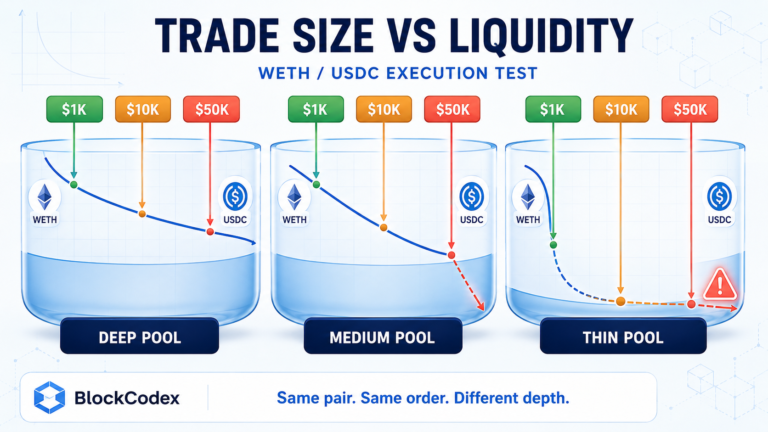
DEX TVL indicates that pool capital exists, but it cannot confirm the execution cost of a specific trade. The 30-day Tron DEX volume was approximately $1.33 billion, showing activity, yet volume accumulated over a month is different from liquidity available at one moment.
SUN.io’s official documentation explains that its AMMs use different pricing mechanisms. SunSwap V2 uses a constant-product model, concentrated-liquidity versions allocate capital within ranges, and SunCurve is optimized for stablecoin swaps. The same aggregate TVL can therefore produce different price impact depending on the pool, route and active liquidity range.
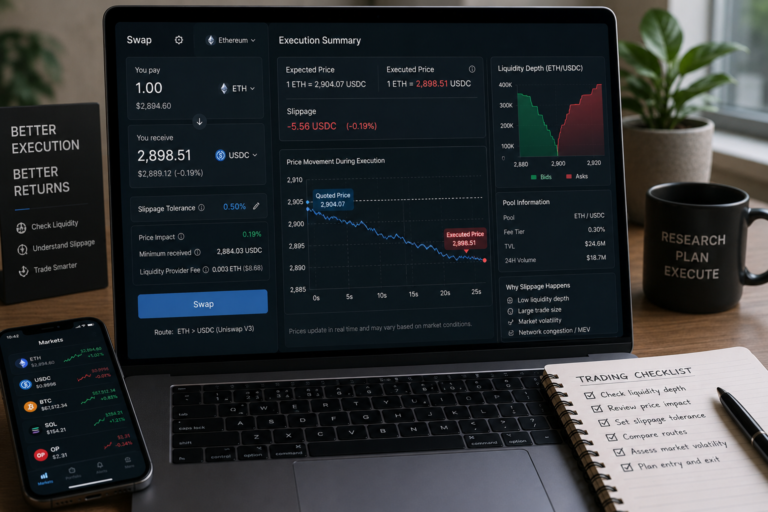
The dataset used here cannot confirm current slippage for a specific USDT, USDD or USDC order. That requires a live quote for a defined pair and trade size at publication time. A credible depth test would record expected output for $10,000, $100,000 and $1 million swaps, including fees, route fragmentation and price impact.
The same caution applies to credit. DeFiLlama reported about $198.9 million in active JustLend loans against approximately $3.72 billion in protocol TVL, an aggregate borrowed-to-TVL screen of roughly 5.34%. This is not the utilization rate of every JustLend market because each asset has its own cash, supply and borrowing conditions.
JustLend’s official API documentation exposes market-level cash and total borrows, while its borrowing guide defines utilization as the share of supplied liquidity currently borrowed. Market-level data is therefore the correct next step when the research question concerns USDT borrowing capacity rather than protocol-wide scale.
Supply, DEX Depth and Lending Liquidity Answer Different Questions
| If You Want to Measure… | Start With… | Then Verify… |
|---|---|---|
| Settlement capacity | Supply, distribution and transfer activity | Wallet concentration, transaction values and destination labels |
| Tradability | DEX TVL and supported routes | Live quotes, slippage, active ranges and pool concentration |
| Credit availability | Lending deposits and supported collateral | Available cash, active loans, utilization, caps and liquidation depth |
| Economic intensity | DEX volume, borrowing and fees | Persistence, incentives and activity relative to available capital |
This prevents a common category error. Supply is a balance, volume is a flow, TVL is deposited capital and depth is an execution condition. BlockCodex’s guide to TVL versus volume in DeFi provides the broader distinction between capital presence and usage intensity.
What Would Change the Tron Interpretation?
The conclusion should be updated if Tron’s DEX or lending footprint grows materially faster than stablecoin supply. Rising stablecoin-pool depth, broader lending competition, higher market-level utilization and lower price impact across standardized trade sizes would all indicate that more of the stock is becoming economically deployable.
The opposite pattern would also matter. Continued supply growth alongside stagnant DEX depth, limited borrowing and increasing venue concentration would strengthen the conclusion that the marginal stablecoin is serving settlement or custody more than DeFi activity.
Both outcomes can be economically relevant. The framework is designed to identify the function, not to force every chain into the same definition of success.
Final Takeaway
A useful stablecoin liquidity analysis does not ask whether supply, DEX depth or lending liquidity is the single best metric. It asks how the three layers connect.
Tron’s September 2026 snapshot shows why that connection matters. The chain combined a large, growing and highly concentrated USDT stock with a much smaller measured DEX and lending footprint. That pattern supports strong settlement relevance but does not, by itself, demonstrate equivalent trading depth or credit demand.
Stablecoin growth matters most when the metric matches the economic job being studied. Supply measures capacity. Deployment shows access. Depth reveals whether that access remains usable when transaction size or borrowing demand increases.
Frequently Asked Questions
Does stablecoin supply measure liquidity?
It measures the available stock, which is one component of liquidity. It does not show whether the stablecoins are inside tradable pools, available to borrow or concentrated in wallets and venues that a user cannot access.
Is DEX TVL the same as stablecoin market depth?
No. DEX TVL can include volatile assets and inactive concentrated-liquidity ranges. Market depth must be tested for a specific pair, route and trade size using expected price impact and slippage.
What makes stablecoin lending liquidity economically meaningful?
Deposits need to be available in the desired asset, while borrowing demand, utilization, interest rates and liquidation capacity should remain sustainable. High lending TVL with little active borrowing can indicate available credit, but not necessarily strong credit demand.
Why use Tron for this case study?
Tron combines one of the largest stablecoin stocks with strong USDT concentration and a comparatively smaller measured DeFi footprint. That makes the chain useful for separating settlement capacity from DEX and lending deployment.