Learning how to verify an exchange deposit on-chain is one of the simplest ways to avoid overreacting to whale alerts.
A large transaction appears, the destination is labelled Binance or Coinbase, and the conclusion quickly becomes: a whale just deposited millions of dollars to sell. The blockchain may confirm that the transfer happened, but it does not automatically confirm the story built around it.
The sender may already belong to another exchange. The destination may be an exchange deposit address rather than a trading wallet. The transfer may be an internal consolidation. The asset may be a stablecoin rather than BTC or ETH. In some cases, what looks like a major new exchange inflow is simply infrastructure moving funds between wallets it already controls.
The solution is to trace the transaction rather than interpret the headline.
What Does It Mean to Verify an Exchange Deposit On-Chain?
Verifying an exchange deposit means establishing what can actually be demonstrated from blockchain data.
At minimum, you want to identify the asset transferred, the originating wallet, any intermediary address, the final destination, the exchange attribution and what happened immediately after the transfer.
That process separates three very different statements:
A large transaction occurred.
A large transaction reached an exchange-controlled address.
A whale moved assets to an exchange and may be preparing to sell.
The blockchain can often verify the first two. The third usually requires much more evidence.
This distinction is particularly important when reading whale alerts. BlockCodex’s guide to how to analyze whale activity explains why wallet size alone is rarely enough to establish intent. Transaction tracing adds another layer by identifying where the assets actually came from and where they ended up.
Start With the Transaction Hash, Not the Headline
The transaction hash should be your starting point.
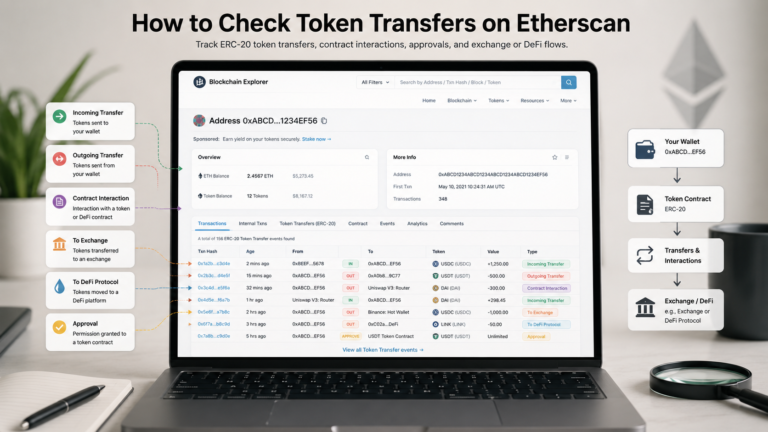
On Ethereum, opening the hash in Etherscan gives you a permanent record containing the transaction status, timestamp, originating address, destination or interacted contract, token transfers and transaction logs.
For a simple native ETH transfer, the From and To fields can be relatively straightforward.
ERC-20 transfers require more care.
A USDT transaction, for example, technically interacts with the USDT smart contract. The economically relevant recipient appears in the token transfer event rather than simply in the transaction’s top-level To field.
This is one reason investors sometimes misread explorers.
The correct question is not simply: Where does the To field point?
It is: Which address ultimately received the asset?
For readers who want a broader explorer workflow, How to Use Blockchain Explorers Like a Pro covers the difference between transaction data, token transfers, address histories and contract interactions.
Step 1: Confirm the Asset and Amount
Before analyzing the destination, establish what actually moved.
This sounds obvious, but the economic interpretation changes completely depending on whether the transfer contains BTC, ETH, a stablecoin, a liquid staking token or a small-cap asset.
A $10 million BTC deposit to a spot exchange potentially increases sell-side inventory.
A $10 million USDT deposit potentially increases purchasing liquidity.
The dollar amounts can look identical while the market implications point in opposite directions.
Also distinguish token quantity from dollar value. A transaction containing billions of units of a low-priced token can look enormous without representing particularly large capital. The token transfer event should therefore be your reference for:
- Asset
- Quantity
- Recipient
- Token contract
- Timestamp
Once those details are confirmed, move to wallet attribution.
Step 2: Inspect the Destination Label Carefully
A labelled destination provides useful evidence, but labels should be interpreted precisely. Suppose Etherscan identifies an address as:
- Binance Deposit
- Binance 14
- Coinbase
- Kraken
or another known exchange entity.
That is much stronger evidence than an unlabeled address because the explorer is associating the wallet with an exchange entity.
However, “Binance Deposit” and “Binance 14” do not necessarily describe the same operational role.
A deposit address may receive assets before they are consolidated into a larger exchange-controlled wallet. A hot wallet may be used for operational withdrawals. Another wallet may function primarily as treasury or settlement infrastructure.
So the label tells you who appears to control the wallet.
It does not automatically tell you why the transaction happened.
Step 3: Trace the Sender Backward
This is where many whale-alert interpretations fail.
Once you see assets reaching an exchange, click the sending address.
Do not assume it belongs to an investor.
Check its transaction history, labels, funding source and previous interactions.
A supposedly bearish “$5 million transfer to Binance” becomes a completely different story if the sender is already labelled as another Binance wallet.
The same applies if the source belongs to another exchange, custodian, market maker, bridge or protocol treasury.
The key distinction is between ownership movement and operational movement.
If funds move from an independent wallet into exchange infrastructure, the transaction may represent a genuine new exchange deposit.
If funds move between addresses already associated with the same exchange, there may be no new exchange supply at all.
If funds move from Exchange A to Exchange B, supply changed venue, but it did not necessarily move from private custody into the exchange system for the first time.
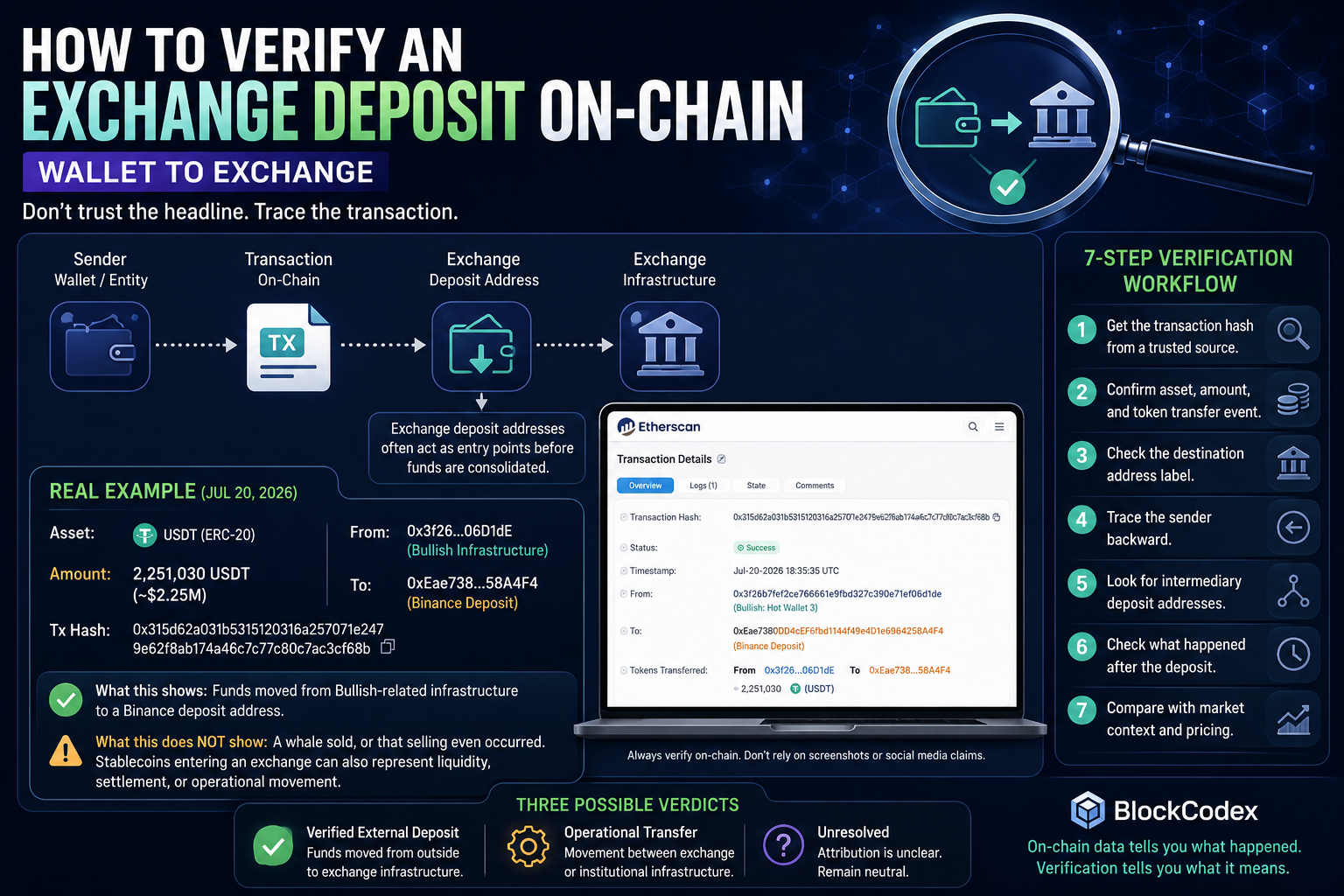
BlockCodex Transaction Check: A $2.25 Million Transfer to Binance
A real Ethereum transaction from July 20, 2026 shows why tracing the origin matters.
Transaction hash:
0x315d62a031b5315120316a257071e2479e62f8ab174a46c7c77c80c7ac3cf68b
The transaction moved approximately 2.251 million USDT into an address labelled by Etherscan as a Binance deposit address.
At first glance, a headline could easily read:
“$2.25 million transferred to Binance.”
That statement is technically compatible with the destination.
But tracing the sender changes the interpretation.
The token transfer originated from an address Etherscan associates with Bullish infrastructure. The transaction record identifies Bullish-related addresses on the sending side and Binance’s deposit infrastructure on the receiving side.
So this was not evidence of an anonymous whale suddenly moving $2.25 million from self-custody into Binance.
It was an exchange-associated transfer reaching another exchange’s deposit infrastructure.
That distinction is the entire point of transaction-level verification.
What the Transaction Actually Establishes
The blockchain lets us establish several things with confidence.
The transfer succeeded.
The asset was USDT.
The amount was roughly 2.25 million USDT.
The receiving address was labelled as Binance deposit infrastructure.
The sending side was associated with Bullish rather than an unidentified private wallet.
What it does not establish is that an individual whale was preparing to sell crypto.
In fact, because the transferred asset was already a stablecoin, the simplistic “large deposit equals sell pressure” interpretation would make even less sense.
The transaction may relate to exchange liquidity, settlement, treasury movement, market-making operations or another operational process. The blockchain record alone does not identify which of those purposes applied.
The important result of the investigation is therefore not a prediction.
It is the elimination of a weak narrative.
Step 4: Look for an Intermediary Deposit Address
Exchange deposits do not always move directly from an external wallet into a recognizable hot wallet.
A common structure can look more like this:
External wallet → Exchange deposit address → Exchange consolidation wallet
That intermediate step matters.
If your whale alert captures only the second transaction, you could mistakenly interpret an exchange’s internal sweep as a new deposit.
Suppose a deposit address has accumulated $4 million from users and later sends the entire balance to an exchange consolidation wallet.
The $4 million consolidation is a real blockchain transfer.
But counting it as $4 million of fresh exchange inflow would double-count activity that had already entered the exchange system earlier.
The correct point of entry is the transaction where externally controlled funds first reached exchange-controlled infrastructure.
This is why transaction tracing should sometimes move backward several hops rather than stopping at the first labelled exchange wallet.
Step 5: Check What Happened After the Deposit
After confirming that a genuine external deposit occurred, look forward.
Did the asset remain at the deposit address?
Was it swept into a known exchange wallet?
Was it transferred again?
Did the sender make several similar deposits?
Did other addresses linked to the same entity behave similarly?
Follow-on activity helps determine whether you are observing an isolated transfer or part of a larger operational pattern.
Repeated transfers of similar size at regular intervals, for example, may resemble settlement or treasury operations more than discretionary whale behavior.
A one-off transfer from a wallet that has held an asset untouched for several years is structurally different.
Context comes from the transaction sequence, not simply the largest number visible on the screen.
Do Not Confuse a Deposit With a Sale
Even a perfectly verified deposit does not prove that selling occurred.
This is the next analytical boundary.
If 5,000 ETH moves from a long-dormant private wallet to a spot exchange, you have strong evidence that the ETH became more accessible to the exchange’s trading infrastructure.
That may increase potential sell-side supply.
But the blockchain cannot show whether the holder later sold the ETH through the exchange’s internal order book.
Once assets enter a centralized exchange, much of the subsequent trading occurs off-chain inside the exchange’s own accounting system.
The most defensible wording is therefore: The assets reached exchange-controlled infrastructure.
Not: The whale sold.
That distinction is also central to understanding exchange inflow in crypto. Exchange deposits describe positioning and availability, not completed market intent.
Step 6: Compare the Transfer With Normal Wallet Behavior
A large number is not automatically unusual.
Some exchange addresses process enormous amounts every day.
Market makers can move millions between venues as part of normal inventory management. Treasury wallets may periodically rebalance balances. Deposit aggregators can consolidate thousands of individual user deposits.
Instead of asking whether the transaction is large in absolute terms, compare it with the history of the sending and receiving addresses.
Does the sender routinely make transfers of similar size?
Does the destination receive hundreds of comparable transactions?
Is the timing periodic?
Is the sender newly active after months of inactivity?
Relative abnormality is often more informative than the dollar amount.
A $20 million transfer from a wallet that routinely moves $100 million may be operational noise.
A $5 million transfer from a previously dormant wallet can deserve much more attention.
Step 7: Only Then Check the Market Reaction
Price should be examined after the transaction has been classified.
For a genuine BTC or ETH deposit from an independent wallet to a spot exchange, compare the transaction timestamp with short-term price behavior, spot volume, liquidity and subsequent exchange flows.
The goal is not to prove causality from a chart.
It is to test whether the market behaved consistently with your hypothesis.
Imagine a large BTC deposit reaches a spot exchange and Bitcoin immediately remains firm while strong spot demand absorbs the move. The deposit occurred, but its apparent supply pressure did not dominate price discovery.
Now imagine repeated large deposits arrive while market depth weakens and price begins falling.
The context becomes more meaningful because several independent observations are moving in the same direction.
For stablecoin transfers such as the Bullish-to-Binance example, the relevant interpretation is different. USDT entering an exchange is not direct BTC sell-side supply, so forcing a bearish Bitcoin reaction onto the event would be analytically weak.
The asset determines what market reaction is worth checking.
A Five-Minute Exchange Deposit Verification Workflow
When a large exchange transfer appears, the process does not need to become an investigation lasting hours.
Start with the transaction hash and identify the actual token transfer. Confirm the asset, amount and timestamp, then inspect the receiving address and determine whether its exchange attribution is credible.
Next, open the sender. Identify whether it appears independent or already belongs to an exchange, custodian, protocol, bridge or known entity.
If a deposit address sits between the original wallet and a larger exchange wallet, trace backward until you find the point where control appears to change.
Then inspect subsequent transactions to understand whether the movement resembles a one-off deposit or routine infrastructure behavior.
Only after those steps should you compare the event with market conditions.
This workflow changes the question from “Is this whale transfer bullish or bearish?” to something far more useful:
What actually moved, who appears to control each side, and what changed economically after the transaction?
The Three Verdicts You Should Use
Not every investigation needs a bullish or bearish conclusion.
A more useful system has three possible outcomes.
Verified External Exchange Deposit
The funds originated outside identifiable exchange infrastructure and reached an address credibly attributed to an exchange.
This confirms a genuine deposit, although not a sale.
Exchange or Operational Transfer
Both sides, or the transaction path, indicate exchange-controlled, institutional or operational infrastructure.
The transfer is real, but treating it as fresh whale supply would be misleading.
Unresolved
The addresses cannot be attributed confidently enough to establish ownership or destination.
This is a valid conclusion.
Uncertainty is preferable to inventing a wallet identity because an alert account attached a dramatic caption to the transaction.
Why Transaction-Level Verification Matters
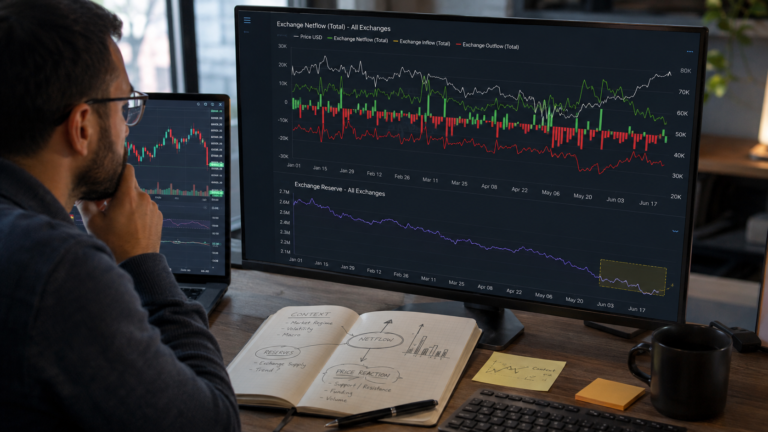
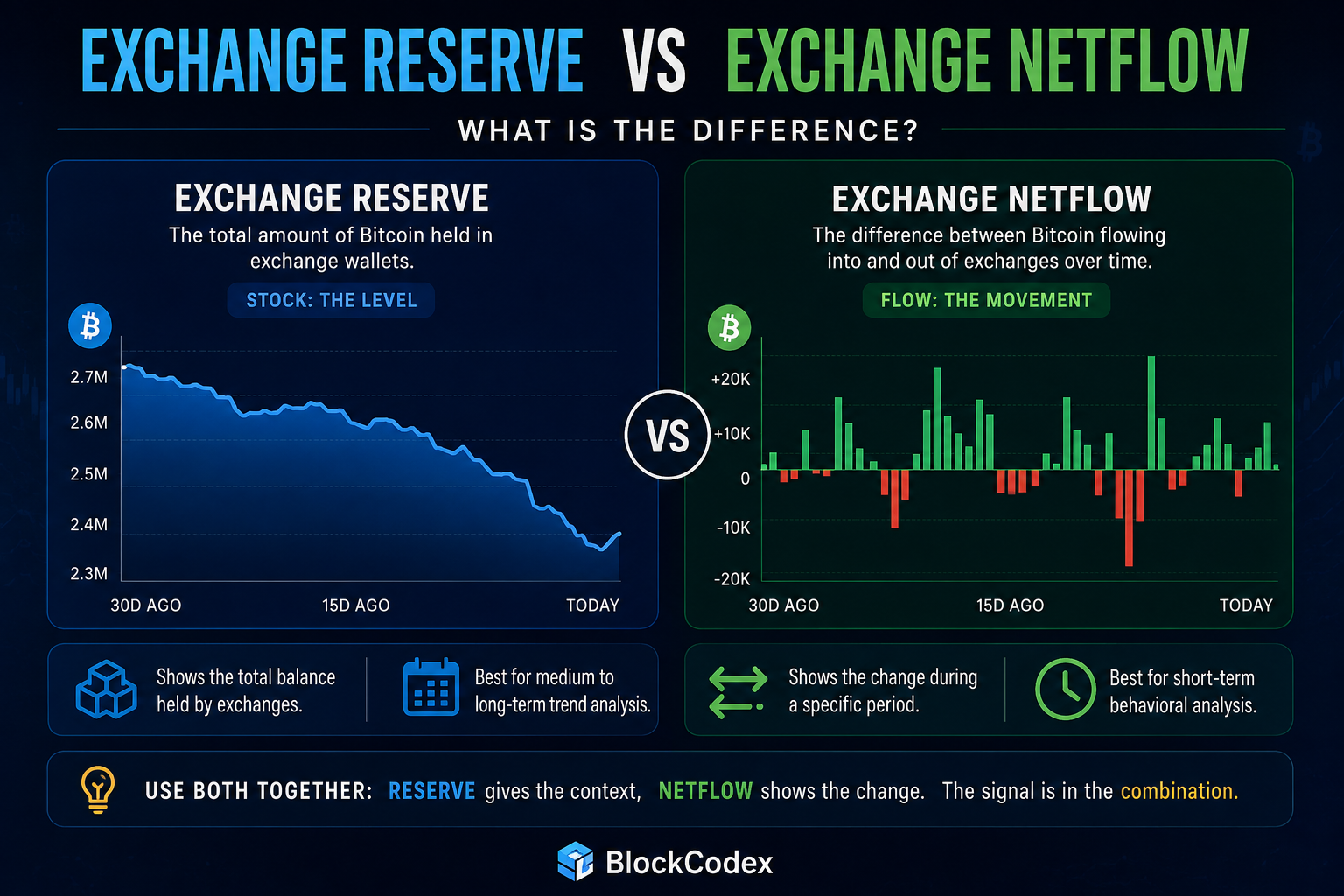
Aggregate exchange-flow metrics are useful because they compress millions of blockchain movements into readable indicators.
The cost of aggregation is that individual mechanisms disappear.
Transaction-level analysis does the opposite.
It is slower, but it allows you to examine the actual path followed by funds and challenge assumptions hidden inside an aggregate signal.
That makes the two approaches complementary.
Exchange flows tell you where activity is changing at scale.
Explorer-level verification tells you whether a specific event means what observers claim it means.
For unusual transactions, that distinction can be the difference between identifying a genuine behavioral shift and reacting to routine exchange infrastructure.
Final Thoughts
Learning to verify an exchange deposit on-chain means refusing to stop at the destination label.
A transaction reaching Binance does not automatically mean a whale deposited funds. A transaction labelled as an exchange inflow does not prove selling. And a multi-million-dollar movement can still be routine operational activity if the sender already belongs to exchange infrastructure.
The verification process is straightforward: confirm the token transfer, identify the destination, trace the sender backward, inspect intermediary addresses, examine follow-on activity and only then compare the event with market behavior.
The July 2026 transaction examined here demonstrates why that work matters. More than $2 million in USDT reached Binance deposit infrastructure, but tracing the sender showed that the movement originated from Bullish-associated infrastructure rather than from an unidentified private whale.
The blockchain did not make the original transfer less real.
It made the interpretation more precise.
And that is the purpose of serious on-chain research.