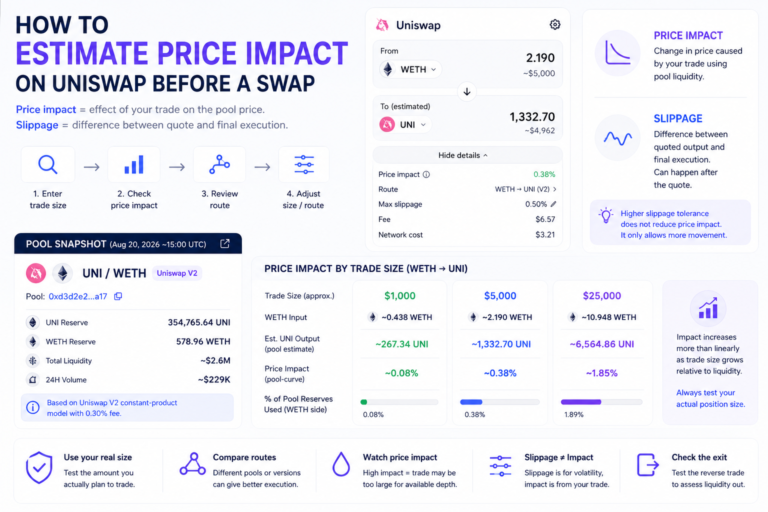
Crypto trade size liquidity is easier to understand with an actual order than with another definition of market depth.
A market can look perfectly liquid when you test $1,000 and become surprisingly expensive at $50,000. The token has not changed. The liquidity pool has not disappeared. What changed is the size of the position asking that liquidity to execute.
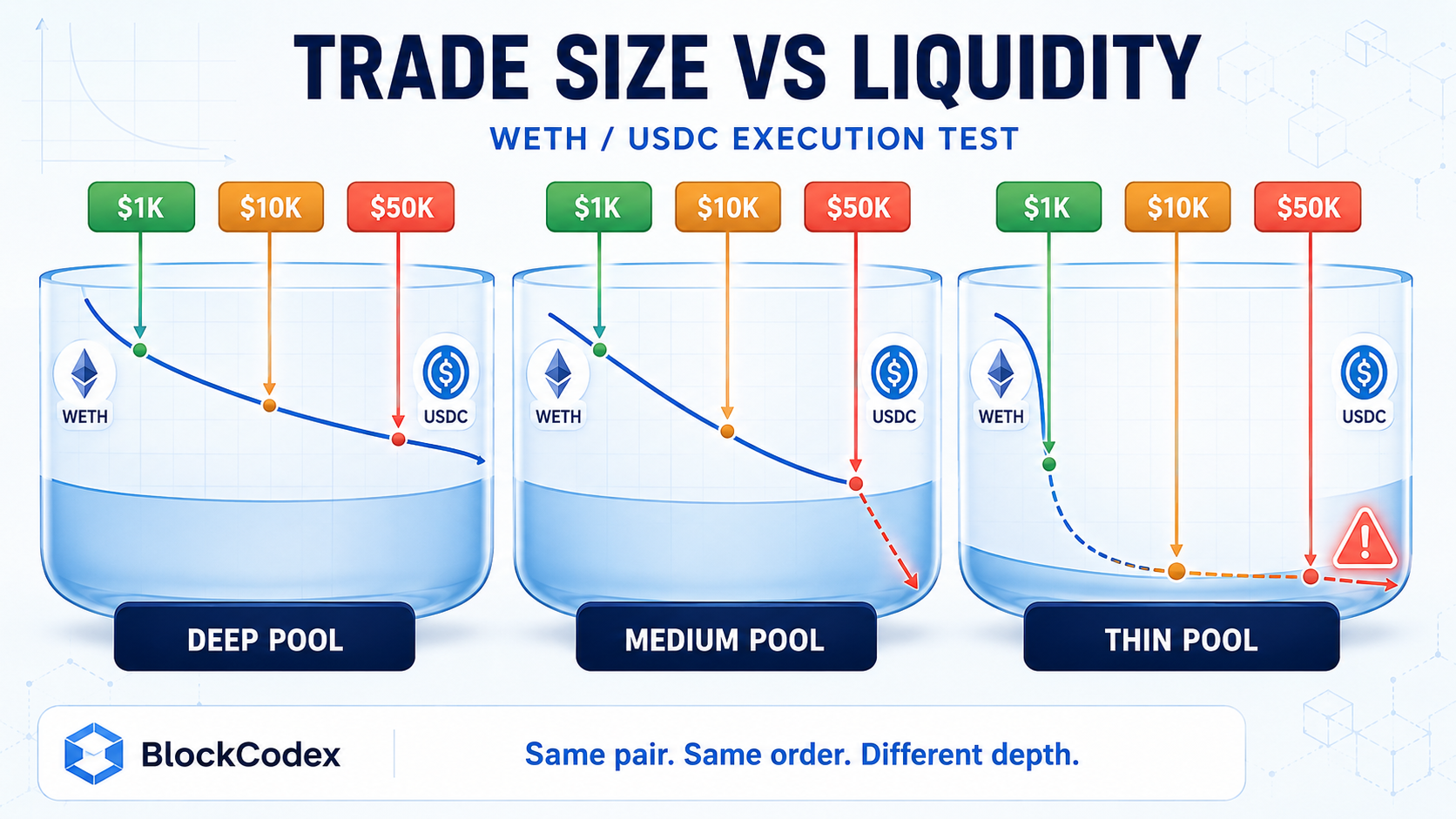
To measure that effect, BlockCodex ran the same controlled experiment across three WETH/USDC constant-product pools with very different amounts of liquidity.
The test uses three USDC purchases of WETH: $1,000, $10,000 and $50,000.
The result is a useful reminder that liquidity is not a property you can describe with a simple yes or no. It is a relationship between available depth and the amount you want to trade.
Crypto Trade Size Liquidity Test: The Experiment
The goal was not to identify the “best DEX.”
We wanted to isolate one variable: how execution changes when the same economic trade meets different levels of available liquidity.
All three pools use WETH/USDC and the V2-style constant-product model. That allows us to apply the same methodology rather than comparing fundamentally different AMM designs.
The three markets represent very different liquidity environments:
| Pool | Network | Approx. Pool Liquidity | USDC Reserve | WETH Reserve |
|---|---|---|---|---|
| Uniswap V2 WETH/USDC | Ethereum | $17.78M | 8.87M USDC | 4,641.23 WETH |
| Uniswap V2 WETH/USDC | Base | $1.13M | 564,604 USDC | 300.89 WETH |
| SushiSwap V2 WETH/USDC | Base | $7.14K | 3,575 USDC | 1.9003 WETH |
These are intentionally not three equally competitive venues.
That is the point.
One represents deep liquidity, one is materially smaller but still usable for moderate orders, and one demonstrates what happens when trade size overwhelms the pool.
The calculations use the pool reserves observed during our August 2026 research session, the constant-product formula and a 0.30% swap fee.
Gas costs are excluded.
Router optimization is excluded.
The purpose is to measure direct pool execution, not simulate what an aggregator would ultimately choose.
The Raw Results
Here is what happens when $1,000, $10,000 and $50,000 of USDC are pushed directly through each pool.
| Pool | Trade | Est. WETH Received | Effective Price per WETH | Pool-Curve Impact |
|---|---|---|---|---|
| Deep — Uniswap V2 Ethereum | $1,000 | 0.5216 WETH | $1,917 | 0.01% |
| Deep — Uniswap V2 Ethereum | $10,000 | 5.2106 WETH | $1,919 | 0.11% |
| Deep — Uniswap V2 Ethereum | $50,000 | 25.9364 WETH | $1,928 | 0.56% |
| Medium — Uniswap V2 Base | $1,000 | 0.5304 WETH | $1,885 | 0.18% |
| Medium — Uniswap V2 Base | $10,000 | 5.2210 WETH | $1,915 | 1.77% |
| Medium — Uniswap V2 Base | $50,000 | 24.4109 WETH | $2,048 | 8.83% |
| Thin — SushiSwap V2 Base | $1,000 | 0.4144 WETH | $2,413 | 27.89% |
| Thin — SushiSwap V2 Base | $10,000 | 1.3987 WETH | $7,149 | 278.87% |
| Thin — SushiSwap V2 Base | $50,000 | 1.7731 WETH | $28,199 | 1,394.33% |
The table exposes something that headline liquidity numbers often hide.
A $1,000 trade is almost invisible to the deep Ethereum pool. At $50,000, execution is still reasonably close to the starting reserve price.
Move the same order into the medium-sized Base pool and the story changes. The $1,000 trade remains manageable, but $50,000 pushes the direct-pool execution price dramatically higher.
In the thin SushiSwap pool, even $1,000 is already too large relative to available liquidity.
By $50,000, the theoretical direct trade is economically absurd.
$1,000: Small Does Not Mean Small Everywhere
Start with the smallest transaction.
In the $17.78 million Ethereum pool, a $1,000 purchase creates approximately 0.01% of pool-curve price impact before separating out the trading fee.
That is effectively negligible for this experiment.
The $1.13 million Base pool also handles $1,000 reasonably well, although impact rises to roughly 0.18%.
Now look at the $7,140 SushiSwap pool.
A $1,000 order creates roughly 27.9% of pool-curve impact.
The trade itself is only $1,000. Nothing about that number sounds particularly large in crypto.
Relative to a pool containing only around $3,575 USDC on one side, however, it is enormous.
This is why absolute position size tells you very little without market depth.
A “small trade” exists only relative to the liquidity available to execute it.
$10,000: The Medium Pool Starts Showing Its Limits
At $10,000, the separation becomes clearer.
The deep Ethereum pool still experiences only about 0.11% of curve impact. Execution moves slightly away from the starting reserve ratio, but liquidity comfortably absorbs the order.
The medium Base pool reaches roughly 1.77%.
That difference is already meaningful.
An investor who tested the market with $1,000 and then assumed a $10,000 position would behave similarly would be wrong. The second trade consumes a much larger portion of the quote-side reserve.
The thin pool effectively breaks down as a realistic direct execution venue.
A theoretical $10,000 direct swap would return only around 1.40 WETH, producing an effective price above $7,000 per WETH in our calculation.
No rational router should voluntarily choose that route if meaningful alternative liquidity exists.
But that extreme result is useful.
It shows exactly what “not enough liquidity” means in execution terms.
$50,000: Market Depth Becomes the Trade
At $50,000, liquidity is no longer a background characteristic.
It becomes the central part of the transaction.
The deep Ethereum pool returns an estimated 25.94 WETH at an effective price of roughly $1,928 per WETH. The curve impact remains around 0.56%.
The medium pool behaves very differently.
The same $50,000 input receives approximately 24.41 WETH at an effective price around $2,048. Pool-curve impact rises to roughly 8.83%.
Same asset pair.
Same trade direction.
Same nominal $50,000 position.
Very different execution.
The thin pool demonstrates the extreme end. Its USDC reserve before the trade is only around $3,575. Attempting to force $50,000 directly through it pushes the constant-product curve toward depletion of the WETH side.
The formula still produces an output.
That does not mean the trade makes economic sense.
This distinction is crucial when interpreting automated market makers: mathematically executable does not mean economically executable.
The Same Token Does Not Have One Liquidity Level
WETH is one of the most widely traded crypto assets.
Yet our experiment produced radically different outcomes using the same economic pair.
That is because liquidity belongs to a market, not simply to an asset.
It belongs to a specific pool, venue, network and moment.
This is the same reason market depth in crypto should be evaluated at the execution point rather than inferred from market capitalization or total daily volume.
Saying “ETH is liquid” can be generally true while still being useless for a specific transaction.
The better question is:
How much liquidity exists in the route that will actually execute my trade?
Liquidity Does Not Scale Linearly With Position Size
Another important result is the shape of the deterioration.
Increasing trade size tenfold does not simply increase price impact tenfold in every case.
The AMM pricing curve becomes progressively less favorable as more of one reserve is consumed.
In the medium pool, our estimated curve impact progresses from approximately:
| Trade Size | Pool-Curve Impact |
|---|---|
| $1K | 0.18% |
| $10K | 1.77% |
| $50K | 8.83% |
The relationship becomes increasingly important as the order grows relative to reserves.
This is one reason investors can be misled by screenshots showing excellent execution for tiny test swaps.
The relevant quote is not what happens at $100.
It is what happens at the position size you intend to trade.
Effective Price Reveals What Percentage Metrics Can Hide
Price impact percentages are useful, but effective price makes the cost easier to understand.
The deep pool moves from a reserve-ratio price near $1,911 per WETH to an effective execution price of about $1,928 for the $50,000 trade, including the pool fee.
The medium pool starts near $1,876 but produces an effective price above $2,048 for the same $50,000 input.
That is roughly $120 more per WETH than the deep-pool execution.
The difference is not because WETH suddenly became fundamentally more valuable on Base.
It is the cost of asking a smaller liquidity pool to absorb a relatively large transaction.
This is why execution quality deserves to be measured in dollars as well as percentages.
Volume Would Not Have Told Us This
Trading volume can help identify active markets, but it does not answer the question tested here.
Volume measures transactions that already occurred over a period.
Our experiment asks something different:
What would happen if this trade arrived now?
A market can process substantial daily volume through thousands of small transactions while still offering poor execution for one large order.
Conversely, a deep pool can have modest recent volume yet comfortably absorb the position you want to execute.
This is why BlockCodex treats fake volume in crypto as a market-structure problem rather than merely a data-quality problem. Volume becomes useful only when it is compared with depth, spreads and actual execution.
The trade is the test.
Why a Real Router Would Avoid the Worst Outcomes
There is an important limitation to this experiment.
A modern DEX router does not necessarily force your entire order into one pool.
If another pool provides better execution, the router can select it. Depending on the protocol and route, execution may also be split across liquidity sources.
That means the $50,000 SushiSwap example should not be interpreted as a prediction that a real aggregator would make someone pay $28,000 per WETH.
It probably would not use that isolated pool for the entire order if alternatives were available.
The experiment instead answers a narrower question:
What is this specific pool capable of absorbing on its own?
That is valuable because routing can sometimes hide fragmentation. An interface may produce a reasonable final quote by assembling liquidity from several places even though no individual market is particularly deep.
For larger positions, understanding that fragmentation matters because routes can change, pools can lose liquidity and execution can deteriorate under stress.
Liquidity Fragmentation Changes the Meaning of “Total Liquidity”
The Base examples make this particularly clear.
WETH/USDC liquidity exists across multiple DEXs, pool versions and fee tiers. Adding all of those values together can produce an impressive headline number.
But a transaction cannot necessarily treat every dollar as one perfectly unified pool.
Routing, fees, network state, AMM design and active liquidity determine what portion is actually usable for a specific order.
Fragmentation becomes more important during stress because several traders may attempt to use the same best route simultaneously.
BlockCodex’s analysis of DeFi liquidity risk explores this distinction between visible liquidity and liquidity that remains usable when exits become crowded.
Total liquidity is an inventory statistic.
Execution liquidity is a trading condition.
Slippage Is Still a Separate Problem
The calculations above freeze the pool state.
That is deliberate.
We want to measure the impact created by the trade itself without adding market movement between quote and execution.
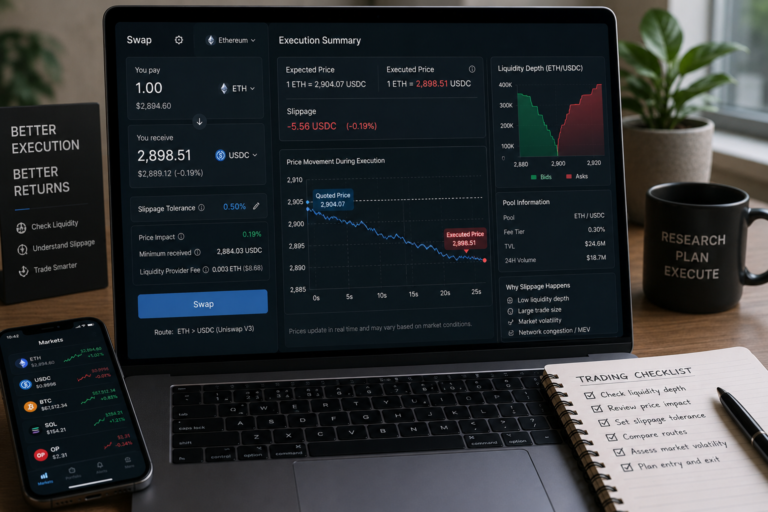
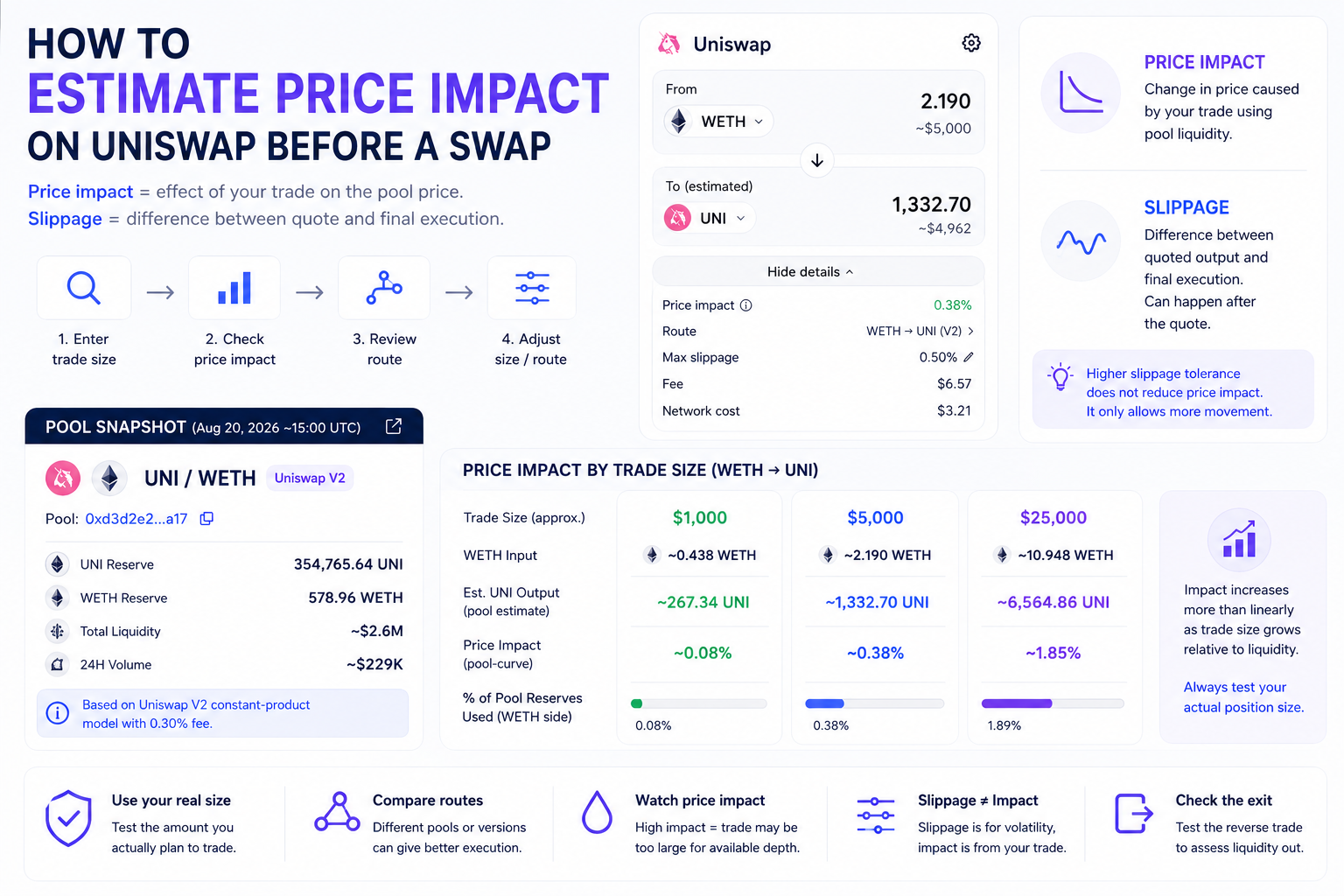
Real transactions introduce another variable: slippage.
If the pool changes after your quote is generated, the eventual outcome may differ further. That additional deterioration is not the same thing as the price impact produced by your own order.
The distinction matters because increasing slippage tolerance cannot repair shallow liquidity.
As explained in BlockCodex’s guide to slippage in crypto, slippage tolerance determines how much quote deterioration you are prepared to accept before execution fails.
If your $50,000 transaction already creates severe price impact, giving the transaction permission to tolerate even more movement does not solve the underlying problem.
What the Experiment Says About Position Sizing
The most useful conclusion from this research is not that deep pools are better than shallow pools.
Everyone already knows that.
The important finding is how quickly a position can move from reasonable to oversized depending on the execution venue.
A $1,000 position was negligible in our deepest pool, manageable in the medium pool and already problematic in the smallest pool.
A $50,000 position remained relatively efficient in the deepest market while becoming expensive in the medium market and effectively unusable in the thin one.
This makes liquidity a position-sizing constraint.
Your portfolio may tell you that you can afford a $50,000 position.
The market may tell you that you cannot efficiently trade one.
Those are different questions.
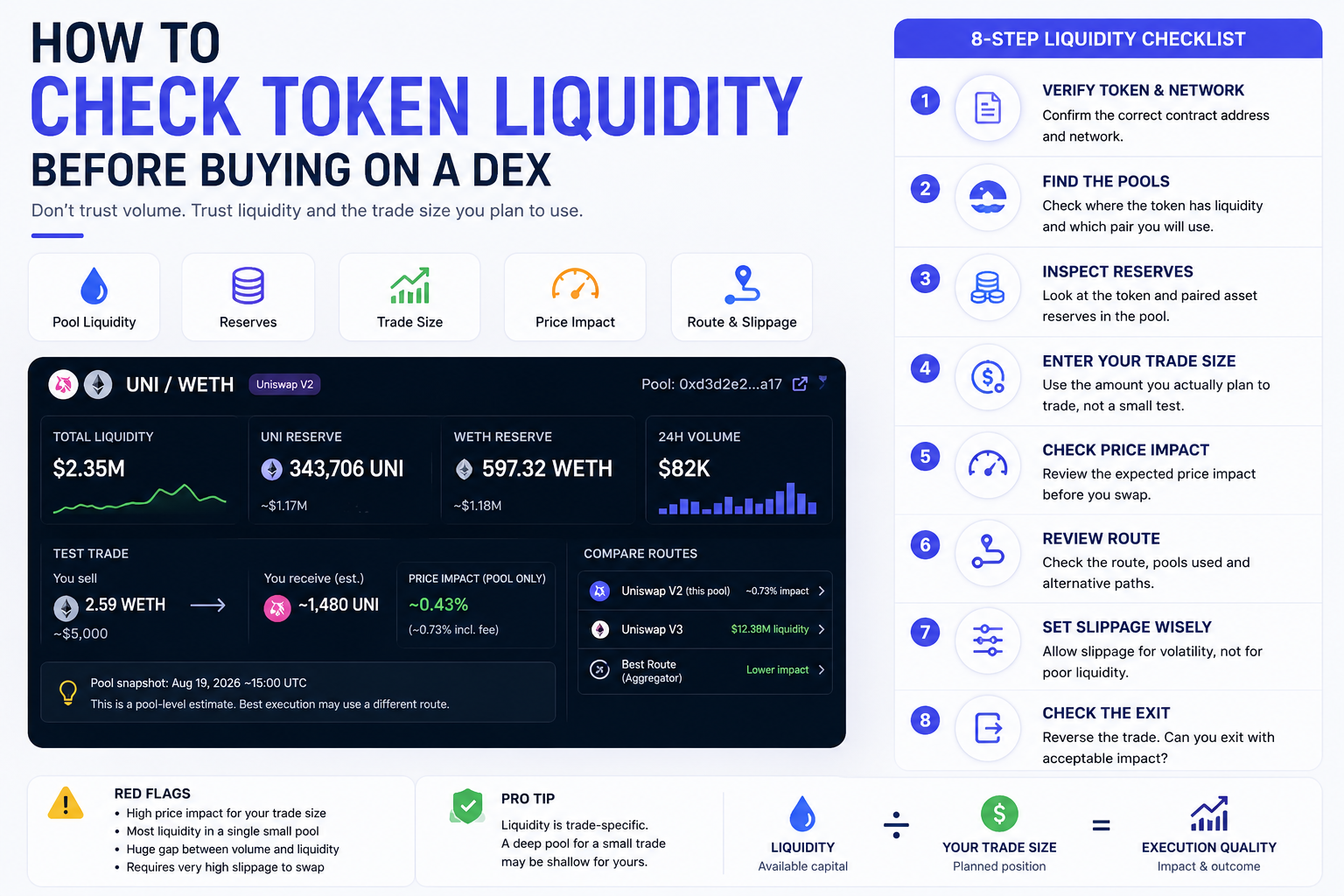
A Better Way to Test Your Own Position
Before making a meaningful DEX trade, start with the amount you actually intend to execute.
Then compare it with smaller and larger test sizes.
If you plan to trade $10,000, inspect what happens at $1,000, $10,000 and perhaps $25,000. If the execution curve deteriorates sharply around your target, you have identified a liquidity boundary.
Next, inspect alternative routes and pools.
Finally, reverse the direction.
A market that lets you enter efficiently today may not let you exit the same position efficiently if liquidity falls or other traders rush for the same door.
The question is never only whether the asset can be bought.
It is whether your full position can be entered and exited under realistic conditions.
Final Thoughts
The $1K, $10K and $50K test turns crypto liquidity from an abstract concept into something measurable.
In the deep WETH/USDC pool, all three trades remained relatively small compared with available reserves. In the medium pool, execution deteriorated visibly as position size increased. In the smallest pool, even the $1,000 test overwhelmed enough of the available liquidity to make the trade unattractive.
The asset was essentially the same.
The trade direction was the same.
Only the size of the order relative to the available market changed.
That is why liquidity should never be evaluated without position size.
A market is not simply liquid or illiquid.
It is liquid enough — or not liquid enough — for the trade you are asking it to execute.