Active addresses are one of the most widely used measures of blockchain adoption. When the number rises, the usual conclusion is simple: more people must be using the network.
The underlying data may be accurate, but that conclusion is often too strong. A blockchain records addresses, transactions and contract interactions. It does not provide a verified count of individual people.
One person can control several addresses. One exchange address can represent thousands of customers. Bots can operate large wallet clusters, while smart contracts may appear in some activity counts even though they are software rather than users.
The gap between active addresses vs real users is therefore not a minor technical detail. It changes how investors should interpret network growth, application adoption and ecosystem quality.
Active Addresses vs Real Users: The Short Answer
An active address is a blockchain account that meets a provider’s activity rules during a defined period. Depending on the dataset, that may mean sending or receiving value, participating in a ledger change, calling a smart contract or interacting with a selected group of application contracts.
A real user is a person or organization behind that activity. Blockchains generally do not reveal that identity layer directly, which means active addresses can be used as a proxy for participation but not as a literal headcount.
This distinction creates two opposite errors. Address counts can overstate adoption when one user operates many wallets, bots generate activity or protocols create operational addresses. They can also understate adoption when a custodian, exchange or smart account aggregates activity for many people behind one on-chain address.
The safest interpretation is:
Active addresses measure observable accounts under a stated methodology. They do not measure verified human users.
Why the Definition of “Active” Changes the Result
There is no universal active-address standard across every blockchain and analytics platform. Providers decide which events qualify, which address roles are included, whether failed transactions count, how contracts are treated and whether the metric describes a whole network or one application.
That does not make the data unreliable. It means the methodology is part of the metric and must be read before comparing numbers.
Coin Metrics: Participants in Ledger Changes
Coin Metrics defines its AdrActCnt metric as the number of unique addresses active as either the recipient or originator of a ledger change during the interval. All parties to the qualifying ledger change are counted, while an address appearing several times is counted once.
This is a network-data definition. It aims to standardize activity across different blockchain accounting models, but it is still a count of ledger identifiers rather than verified people.
Coin Metrics also separates active contract addresses into another metric where supported. That distinction matters on programmable chains because contract activity and user-controlled account activity answer different questions.
Glassnode: Successful Senders and Receivers
Glassnode’s Active Addresses metric counts unique addresses active as a sender or receiver in successful transactions. Its documentation also lists an Active Addresses (with contracts) variant that includes addresses involved as senders, receivers or called smart contracts.
The difference is not theoretical. Glassnode documented a methodology change for Ethereum and Arbitrum in 2025: the standard active-address metric moved to unique senders and receivers, while the contract-inclusive behavior remained available through the separate variant.
The same blockchain activity can therefore produce different counts inside the same provider, depending on whether the research question concerns transacting addresses or the broader set of contracts touched by execution.
Glassnode also publishes an Active Entities metric that clusters addresses estimated to be controlled by the same network entity. This moves closer to economic participants than a raw address count, but the provider states that the result relies on proprietary heuristics and can change as clustering improves.
Token Terminal: Protocol-Relevant Activity
Token Terminal uses a narrower application-level approach for active users. Its metric counts unique addresses interacting with a protocol’s business-relevant smart contracts during a 24-hour period.
This filter is useful when the goal is to measure customers of a specific application rather than every address moving on the underlying chain. A wallet swapping through a DEX may qualify for the DEX’s active-user metric, while a wallet making a simple peer-to-peer transfer on the same network would not.
The definition still counts addresses rather than identified individuals. The label “users” is convenient, but the unit remains an on-chain account that passed the provider’s protocol-specific filter.
Three Providers, Three Research Questions
| Provider and Metric | What Is Counted | Main Analytical Use | What It Cannot Prove |
|---|---|---|---|
Coin Metrics AdrActCnt | Unique originators or recipients of qualifying ledger changes | Broad network participation | How many people control the addresses |
| Glassnode Active Addresses | Unique senders or receivers in successful transactions | Successful transacting-address activity | Whether addresses belong to users, bots, exchanges or contracts |
| Glassnode Active Addresses (with contracts) | Successful senders, receivers and called contracts | Wider execution footprint on supported smart-contract networks | Human adoption, because contracts are included |
| Token Terminal Active Users | Unique addresses interacting with business-relevant protocol contracts | Application or protocol usage | Unique people, off-chain customers or unactioned intent |
None of these definitions is automatically superior. They are designed for different questions.
The mistake is placing the resulting figures in one ranking as though every provider counted the same population.
Ethereum Methodology Test: One Activity Set, Three Counts
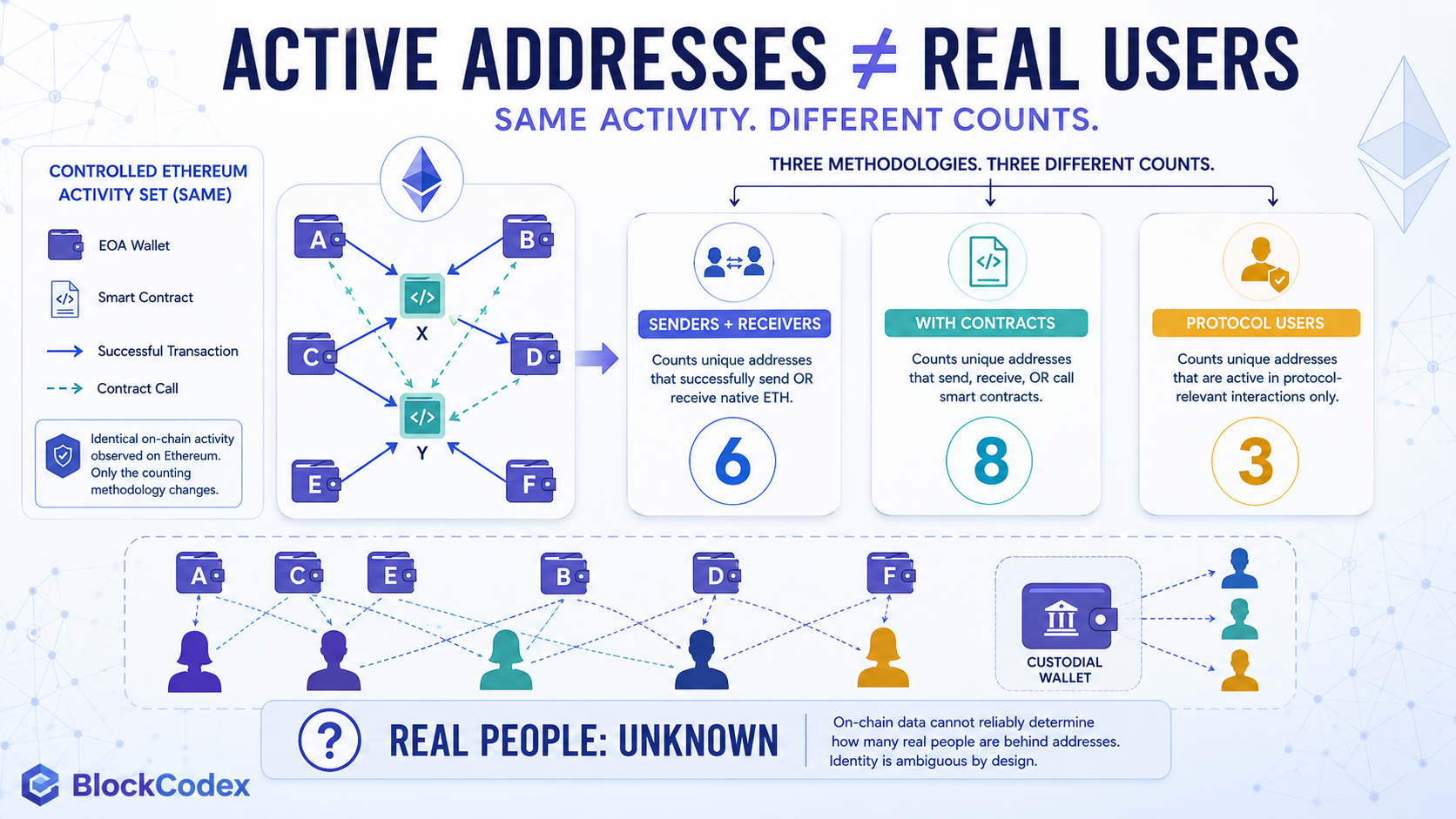
To isolate the methodology effect, consider a controlled Ethereum activity set. This is an illustrative counting test, not a live estimate of Ethereum users.
During the test interval:
- Four unique externally owned accounts send successful transactions.
- Three addresses receive ETH or tokens, with one recipient already present in the sender group.
- Two additional smart contracts are called during execution but are not part of the sender-receiver union.
- Three of the externally owned accounts interact with the business-relevant contracts of the DEX being studied.
The same observed activity now produces three different answers:
| Method Applied to the Same Ethereum Set | Count | Reason |
| Unique successful senders and receivers | 6 | Four senders plus three receivers, minus one overlapping address |
| Successful senders, receivers and called contracts | 8 | The same six addresses plus two additional contracts |
| DEX active addresses under a business-relevant-contract filter | 3 | Only three addresses interacted with the selected DEX contracts |
| Verified real users | Unknown | Address control and human identity are not established by the transactions |
The arithmetic is simple. The interpretation is not.
The figure of eight does not mean the network had more humans than the figure of three. It means the broader definition captured two contracts and activity outside the selected protocol filter. Conversely, the protocol-level figure does not describe total Ethereum participation; it describes activity relevant to that DEX.
This controlled example shows why a change in methodology can create apparent user growth or decline even when the underlying behavior has not changed.
One Person Can Produce Many Active Addresses
Creating an externally owned Ethereum account does not require registration or a verified identity. As Ethereum’s account documentation explains, an EOA is controlled through its private keys, while a contract account is controlled by code.
Nothing prevents one participant from controlling multiple EOAs. There are also legitimate reasons to do so: separating long-term holdings from DeFi activity, using different wallets for security, managing several strategies or interacting through temporary smart accounts.
The same structure can be used to manufacture apparent adoption. Airdrop farmers may distribute activity across many wallets, market-making systems can operate fleets of accounts, and bots can create or rotate addresses at a scale that does not correspond to new people.
An increase in unique wallet addresses is still an observable fact. What remains unproven is whether the increase represents new individuals, new automated accounts or existing users changing their wallet behavior.
One Address Can Represent Many Real Users
The measurement problem also works in the opposite direction.
A centralized exchange may combine customer funds inside a relatively small group of deposit, withdrawal and hot-wallet addresses. Thousands of customers can trade internally without every action reaching the blockchain, while a single on-chain withdrawal may aggregate demand generated by many accounts.
Custodians, payment processors and smart-account infrastructure create similar compression. The visible address is real, but treating it as one end user may significantly understate the number of people behind it.
This is why the relationship between addresses and users is not a fixed conversion ratio. It varies by network architecture, application type, custody model and user behavior.
Bots and Sybil Wallets Distort Growth Differently
Bot activity and Sybil activity are often grouped together, but they create different analytical problems.
A bot automates actions. It may use one address repeatedly or operate many accounts. Some bots provide economically useful services such as arbitrage, liquidation and market making, while others generate spam or game incentive systems.
A Sybil strategy divides control across multiple apparent identities. In crypto, this often appears when one participant creates many wallets to qualify for rewards, influence a vote or imitate broad adoption.
Both can raise active-address counts, but neither automatically makes the activity worthless. Arbitrage can improve market efficiency, and incentive campaigns can introduce genuine users. The relevant question is whether the activity persists and develops economic depth after the immediate opportunity disappears.
This is one reason BlockCodex’s analysis of why investors misread on-chain data treats active addresses as evidence that requires context rather than a self-contained adoption signal.
New Addresses Are Even Easier to Misread
New-address growth often sounds more persuasive than active-address growth because it appears to measure newcomers. The inference is still unsafe.
Coin Metrics notes in its documentation that new addresses can be cheaply or freely created on some networks and that the metric can be inflated by activity lacking economic relevance. It therefore provides a separate New Funded Address Count for addresses that appear for the first time with a non-zero balance.
Funding is a useful quality filter, but it does not establish a unique person. An existing user can fund several new wallets, while an exchange can create new deposit addresses for existing customers.
New addresses show that new identifiers entered the observable ledger. They do not tell us why those identifiers were created or whether the controllers were new to the ecosystem.
Why Cross-Chain Active-User Rankings Are Fragile
Comparing active addresses across chains can be useful only when the definitions and network designs are sufficiently comparable.
Low transaction fees make repeated activity and wallet experimentation cheaper. Account-based and UTXO-based chains expose activity differently. Some analytics datasets include recipients, contracts or internal execution roles, while others focus on transaction initiators.
Applications also shape the count. A network dominated by consumer payments will produce a different address pattern from one dominated by exchange settlement, high-frequency trading or gaming.
A leaderboard can therefore mix several effects:
- Actual changes in participation.
- Different address-accounting models.
- Bots and automated agents.
- Incentive-driven wallet creation.
- Custodial aggregation.
- Provider-specific inclusion rules.
- Changes in the metric methodology itself.
Cross-chain comparisons become stronger when the same provider, time window and definition are used consistently. Even then, the result should be described as comparable address activity, not a verified ranking of human users.
What Active Addresses Can Tell Investors
The limitations do not make active-address data useless. A consistent increase can reveal that more blockchain accounts are participating under the same measurement rules.
The signal becomes more credible when it appears across longer periods and aligns with other evidence. Rising active addresses accompanied by stronger retention, stablecoin usage, application diversity, liquidity and economically meaningful fees are harder to dismiss as a temporary campaign.
This is the broader framework used in BlockCodex’s guide to identifying whether a blockchain ecosystem is growing. User activity matters most when it reinforces other parts of the ecosystem instead of rising alone.
Active addresses are especially helpful for:
- Detecting changes in network participation.
- Comparing activity before and after an upgrade or application launch.
- Measuring whether usage persists after an incentive campaign.
- Identifying divergence between wallet activity and economic metrics.
- Building cohorts of new, returning and retained addresses.
The metric answers whether more qualifying addresses were active. It does not answer who controlled them or whether the activity created durable value.
A Better Framework for Estimating Real User Growth
No public on-chain framework can perfectly count people without introducing identity assumptions. Investors can still improve the estimate by combining several independent signals.
1. Start With the Exact Definition
Record the provider, time window, network, included address roles, treatment of contracts and successful-transaction requirement. If the definition is unclear, do not compare the number with another dataset.
2. Separate Network and Application Activity
A chain-level address count and a protocol-level active-user count describe different populations. Use network metrics to evaluate broad participation and application metrics to test product usage.
3. Measure Returning Cohorts
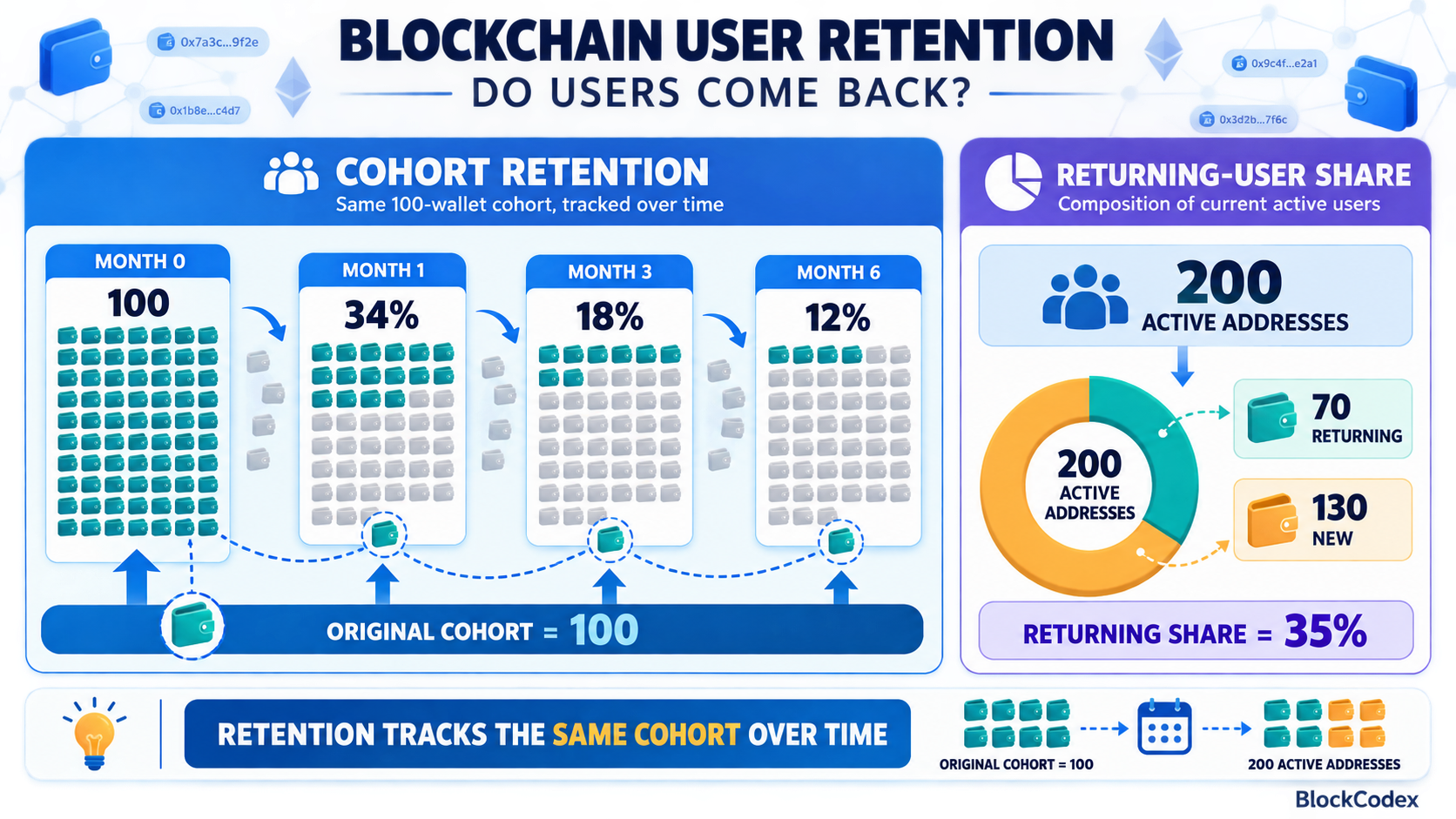
One-day activity can be created by a campaign. Weekly and monthly retention show whether the same addresses return after their first interaction.
Repeated addresses are not identical to repeated people, but retention is usually more informative than a single spike in new wallets.
4. Add Economic Filters
Compare address growth with fees, transaction value, stablecoin activity, DEX volume, protocol revenue and liquidity. Activity that generates no economic depth may still be real, but it supports a weaker adoption claim.
5. Check Concentration
Determine whether activity is spread across applications and address cohorts or concentrated around one contract, reward program or automated strategy. A broad base is harder for one campaign or actor to create.
6. Connect Usage With Development
New products can generate legitimate new activity, but shipping alone does not guarantee adoption. BlockCodex’s developer activity analysis explains why code becomes a stronger ecosystem signal only when applications attract returning users and economic demand.
7. State the Remaining Uncertainty
The final conclusion should match the evidence. “Active addresses increased under this methodology” is supportable. “The chain added the same number of new users” usually is not.
A Practical Interpretation Table
| Observed Pattern | Stronger Interpretation | Main Alternative Explanation |
| Active addresses and retention rise together | A larger address base is continuing to use the network | Bots may also persist |
| New addresses spike, then disappear | Short-lived acquisition or campaign activity | Airdrop farming or wallet rotation |
| Active addresses rise with fees and stablecoin use | Participation is gaining economic depth | Activity may be concentrated in one application |
| Transactions rise while active addresses stay flat | Existing addresses are becoming more active | Automation may be increasing |
| Active addresses rise while fees and value stay weak | More accounts are interacting at low economic intensity | Spam, subsidies or low-value activity |
| Protocol users rise while chain activity stays flat | Usage may be shifting toward one application | Provider scopes may not be comparable |
The table is not a scoring system. It is a reminder to test at least one competing explanation before turning address growth into an adoption claim.
Questions to Ask Before Trusting an Active-User Chart
Before using an active-address chart in an investment thesis, verify:
- What exactly qualifies an address as active?
- Are both senders and receivers counted?
- Are called smart contracts included?
- Are failed transactions excluded?
- Is the metric chain-wide or protocol-specific?
- Are unique addresses deduplicated across the full interval?
- Did the provider change its methodology?
- Could bots, Sybil wallets or incentives explain the increase?
- Could custodial addresses hide a larger off-chain user base?
- Do retention, fees, liquidity and application usage confirm the trend?
If those questions cannot be answered, the chart may still describe address activity accurately. It should not be presented as a precise count of people.
Final Thoughts
The debate over active addresses vs real users is not about rejecting on-chain data. It is about asking the metric to prove only what it can actually observe.
Coin Metrics, Glassnode and Token Terminal use defensible but different definitions because they measure different layers of blockchain activity. A ledger-wide count, a successful sender-receiver count and a protocol-filtered user count can all be correct at the same time.
The Ethereum methodology test demonstrates the consequence. The same controlled activity set produced counts of six, eight and three, while the number of real people remained unknown.
That uncertainty should remain visible in the conclusion. Active addresses can reveal participation, momentum and retention under a stable methodology. They become stronger when economic activity, liquidity, application diversity and repeat usage move in the same direction.
An address is evidence of on-chain activity. It is not proof of one human user.