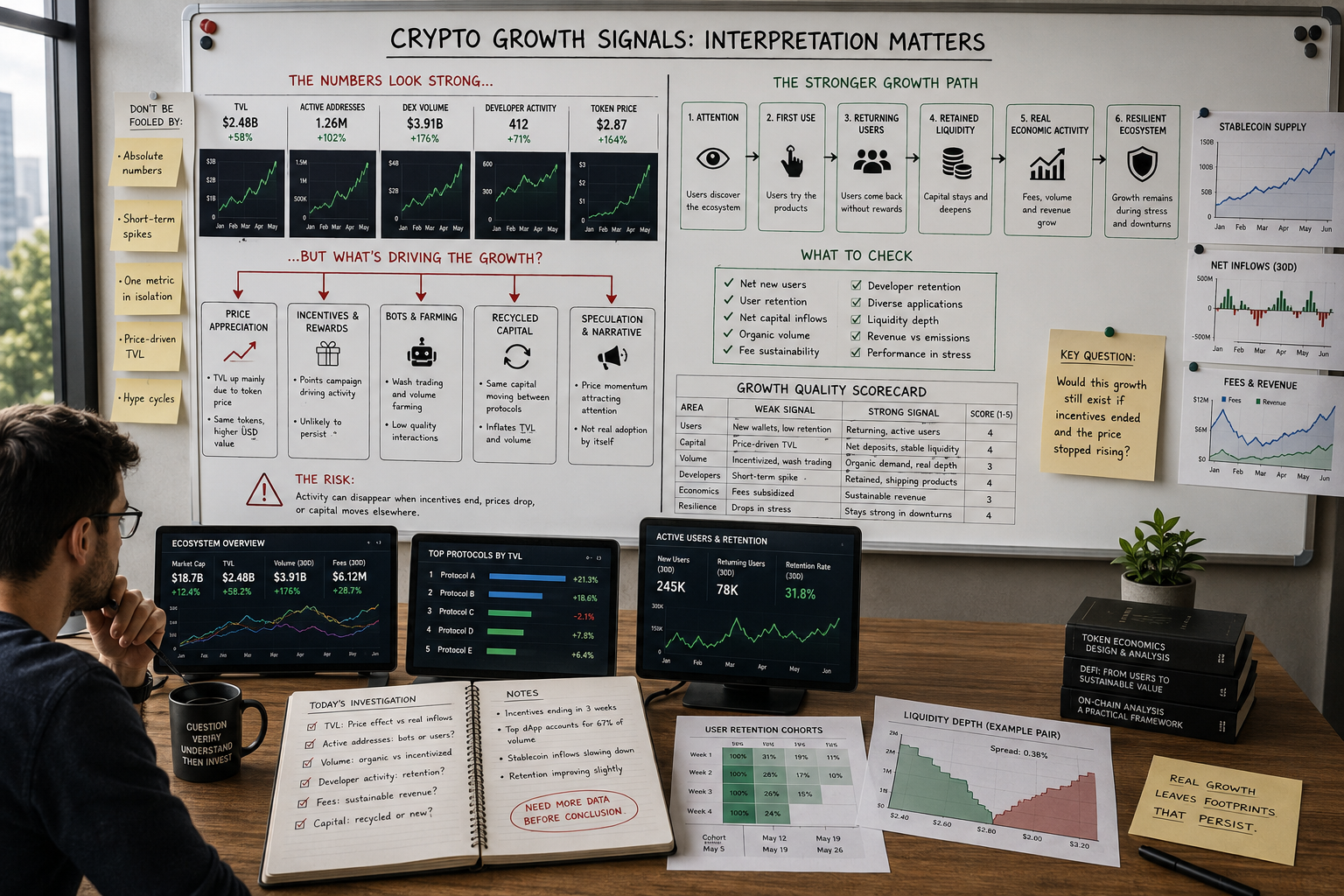
A blockchain can publish thousands of commits and still fail to produce anything people want to use.
Another ecosystem may have fewer visible repositories but a stable group of experienced developers maintaining infrastructure, improving wallets, supporting applications and solving problems that users encounter every day.
The second ecosystem may be healthier.
This is why developer activity crypto data is easy to quote but difficult to interpret. Investors often reduce it to one number: monthly developers, GitHub commits or new repositories. The number then becomes evidence that a chain is “building,” even when nobody checks what is being built, who is maintaining it or whether the work reaches real users.
Developer activity matters because developers create the infrastructure and applications through which future demand can emerge. Yet code is only the beginning of that process. A repository does not automatically become a product, a product does not automatically attract users, and user activity does not automatically create sustainable fees or liquidity.
The more useful question is therefore not: How many developers does this ecosystem have?
It is: Can this ecosystem convert developer attention into products that people continue to use?
That distinction turns developer activity from a promotional statistic into a meaningful ecosystem signal.
Table of Contents
Developer Activity Is a Pipeline, Not a Popularity Contest
Developer activity is often treated like a league table. One blockchain has more developers than another, so the first ecosystem is assumed to have stronger prospects.
Real development does not work that cleanly.
A developer may test an ecosystem for a weekend and never return. One contributor may submit dozens of minor commits, while another spends months developing a critical client, protocol integration or security improvement. A project may maintain hundreds of repositories because its code is fragmented, not because its developer community is unusually productive.
The strongest ecosystems move through a longer pipeline:
| Stage | What Is Happening | Stronger Evidence |
|---|---|---|
| Attention | Developers explore the ecosystem | New contributors and repositories |
| Onboarding | Developers begin building | Documentation usage, SDK adoption and initial contributions |
| Retention | Developers continue participating | Returning and established contributors |
| Shipping | Code becomes usable software | Releases, deployments and maintained products |
| Adoption | Users interact with the products | Active users, retention and transaction quality |
| Monetization | Activity creates economic value | Fees, revenue, liquidity and sustainable demand |
| Reinforcement | Success attracts more builders | New teams, integrations and supporting infrastructure |
A growing contributor count is useful at the top of the pipeline. It becomes much more meaningful when developers remain, ship products and attract users.
The pipeline is what investors should evaluate.
What the Latest Developer Data Actually Shows
The latest complete annual Electric Capital Developer Report currently available is its 2024 report, while the underlying Open Dev Data dashboard continues to publish updated ecosystem statistics. The annual study analyzed 902 million commits across 1.7 million repositories and identified 39,148 developers who explored crypto during 2024.
The headline developer count declined by 7% during that year, which could appear negative when viewed alone. However, developers with at least two years of crypto experience reached an all-time high, increased by 27% year over year and generated 70% of the measured commits. One in three developers also worked across multiple chains.
This is a useful example of why developer activity crypto analysis needs several layers.
The total population became smaller, but the most experienced group became larger and contributed most of the work. An investor looking only at the first number would conclude that development was weakening. An investor examining retention and contribution quality would see a more complicated picture.
Developer activity is not one trend.
New arrivals, established contributors, full-time teams and occasional experimenters can all move in different directions.
Why Commit Counts Are So Easy to Misread
A commit is a recorded change to a code repository.
That change might add a major feature, correct a security flaw, update documentation, adjust formatting, rename a file or change a few lines of configuration. Counting these actions without examining their context treats fundamentally different contributions as equivalent.
Commit counts can also be affected by:
- The way a team divides its work.
- Automated dependency updates.
- Repository migrations.
- Code formatting changes.
- Documentation edits.
- Several small commits replacing one larger change.
- One developer using multiple accounts.
- Work being performed in private repositories.
- Contributions spread across several related repositories.
- Merge and branch-management practices.
GitHub’s own repository insights separate contributor activity, commit frequency, additions, deletions, issues and pull requests rather than presenting one universal activity score. Its contributor graph also has limitations: it shows only the top contributors, excludes certain merge and empty commits and may omit contributions that were not merged into the default branch.
Commits are evidence that code changed.
They are not proof that the ecosystem improved.
1. Established Developers Matter More Than Tourist Developers
New developers are important because every ecosystem needs a fresh entry point.
However, new-developer growth is often influenced by hackathons, grants, market narratives, token incentives and temporary attention. The harder achievement is turning those first experiments into long-term participation.
A developer who returns month after month develops knowledge that cannot be reproduced instantly. They understand the architecture, tooling, unresolved bugs, governance process and expectations of the user community. They are also more likely to maintain libraries, review contributions and help newcomers become productive.
That creates a form of ecosystem memory.
Electric Capital’s 2024 findings are particularly revealing here. Although total developer numbers declined, established developers reached record levels and produced the majority of measured code.
A strong developer activity crypto review should therefore separate:
- First-time developers.
- Occasional contributors.
- Monthly active developers.
- Full-time developers.
- Contributors with one or more years of tenure.
- Contributors who remain through weaker market periods.
An ecosystem constantly replacing departing developers with new experimenters may look active without developing a durable technical base.
Retention reveals whether builders found enough value to stay.
2. The Contributor Base Should Extend Beyond One Core Team
A project can show consistent GitHub activity while depending almost entirely on its founding company.
That is not necessarily a problem during the early stages. Core protocol development often requires a concentrated team with deep technical knowledge. The risk appears when the wider ecosystem never develops meaningful independence.
A healthier contributor structure may include:
- Core protocol engineers.
- Independent application teams.
- Wallet developers.
- Infrastructure providers.
- Security researchers.
- Data and analytics teams.
- SDK and tooling maintainers.
- Community contributors.
- Validators or node-software developers.
- Integration teams from external protocols.
This distribution matters because one company can change priorities, lose funding, reduce headcount or abandon a product. A wider contributor network makes the ecosystem less dependent on one decision-maker.
GitHub’s contributor and activity views can help identify whether work is spread across several people and periods, although those views do not capture all private development or every contribution outside the default branch.
Investors should look beyond the main protocol repository. The question is whether an ecosystem of builders exists around the chain, not merely whether the chain’s original team still publishes code.
This broader network is one of the growth layers discussed in What Drives Growth in Crypto Ecosystems.
3. Repository Breadth Matters Only When the Pieces Connect
A large repository count can appear impressive.
It may indicate that an ecosystem supports wallets, developer libraries, applications, bridges, oracles, indexing services, infrastructure and educational resources. It can also mean that teams created many unfinished experiments, duplicate projects and abandoned hackathon repositories.
The number alone does not distinguish between those outcomes.
A stronger analysis asks whether the repositories form a working development environment.
For example:
- Can developers access maintained SDKs?
- Are wallet and RPC integrations reliable?
- Are testing tools available?
- Do applications share usable infrastructure?
- Are essential libraries maintained?
- Can developers find examples and documentation?
- Are external integrations being added?
- Do several teams depend on the same core tools?
- Are repositories receiving issues, reviews and releases?
An ecosystem becomes more valuable when its components reinforce each other.
A developer who wants to build a lending protocol needs more than a smart-contract language. They may also need wallets, price feeds, indexers, liquidity venues, stablecoins, security tools, documentation, testing environments and users willing to supply capital.
Repository breadth matters when it reduces the effort required to turn an idea into a working product.
A collection of disconnected code is not an ecosystem.
4. Shipping Matters More Than Motion
Some repositories are permanently active but rarely deliver a stable result.
Issues are opened, commits appear, branches change and roadmaps expand. From the outside, the project looks busy. Users, however, continue waiting for the same feature, integration or reliability improvement.
This is the difference between motion and shipping.
A useful developer review should examine:
- Release frequency.
- Version history.
- Deployed upgrades.
- Resolved issues.
- Pull-request review time.
- Security patches.
- Mainnet integrations.
- Documentation changes accompanying releases.
- Whether applications remain functional after upgrades.
- Whether previously announced products actually launch.
GitHub provides repository views for commits, pull requests, issues, pushes, merges, force pushes and branch changes. Those tools make it possible to inspect the development process rather than relying on a project’s promotional summary.
The analytical question is not whether the repository changes every week.
It is whether those changes improve something that developers or users can access.
Developer activity crypto metrics become much stronger when they connect to verifiable releases.
5. Developer Tooling Reveals Whether Growth Can Scale
An ecosystem can attract brilliant developers and still make their work unnecessarily difficult.
Poor documentation, unstable development environments, incompatible libraries and unreliable RPC infrastructure increase the cost of building. Teams spend time solving ecosystem-specific problems instead of improving their applications.
That friction affects retention.
A strong developer environment usually includes:
- Clear documentation.
- Maintained software development kits.
- Example applications.
- Testing frameworks.
- Reliable test networks.
- Debugging and simulation tools.
- Wallet and identity integrations.
- Indexing and data infrastructure.
- Security guidance.
- Responsive technical support.
- Predictable upgrade processes.
Tooling is not as visible as a token launch or a new application.
It is often more important.
Good tooling allows a small team to build quickly. Weak tooling means every team must recreate basic infrastructure, making the ecosystem expensive to enter and difficult to maintain.
This is also why new developer counts should be interpreted alongside retention. A marketing campaign can convince developers to attend a hackathon. The experience of building determines whether they return.
The best developer ecosystems make the second project easier than the first.
6. Applications Must Convert Code Into User Behavior
Developer activity is a leading indicator, not an automatic result.
Eventually, applications need to reach users.
This does not mean every developer contribution should immediately generate transactions or revenue. Core infrastructure, cryptography, client software and security research can take years to mature. Still, an ecosystem cannot rely indefinitely on the promise that usage will arrive later.
A practical analysis should connect development with:
- Application launches.
- Active users.
- Returning users.
- Stablecoin liquidity.
- DEX and lending activity.
- Fees generated.
- Protocol revenue.
- Transaction quality.
- Application diversity.
- User retention after incentives decline.
The relationship does not need to be immediate, but it should become visible over time.
An ecosystem with rising developer activity and improving user metrics is converting technical effort into adoption. An ecosystem with years of coding but few usable applications may have strong research output without a strong investment case.
This is where developer activity crypto analysis overlaps with ecosystem-growth analysis.
Developers create supply: infrastructure, applications and features.
Users determine whether that supply solves a real problem.
7. Development Through Weak Markets Is More Informative Than Bull-Market Activity
Bull markets make almost every ecosystem look active.
Token prices rise, treasury values improve, grant programs expand and new teams enter the industry. Developers can obtain funding more easily, while speculative users create demand for new applications.
The harder test comes after attention and token prices decline.
An ecosystem that keeps experienced developers, ships upgrades and maintains its applications during a weaker market is revealing something more durable than short-term excitement.
Useful questions include:
- Did core development continue after the token declined?
- Were important repositories maintained?
- Did applications close or remain operational?
- Did developer grants produce lasting teams?
- Did contributors return after their first project?
- Did security and infrastructure work continue?
- Did users remain after incentives weakened?
- Were roadmaps reduced realistically or quietly abandoned?
Development during difficult periods does not guarantee eventual success.
It does reveal commitment.
Many of the failure patterns explored in Why Some Crypto Ecosystems Fail appear when funding, builders and applications disappear together after market attention moves elsewhere.
The strongest ecosystems do not stop evolving when the narrative changes.
The Solana Example: Developer Growth Needs Market Confirmation
Electric Capital reported that Solana was the leading ecosystem for new developers in 2024 and that its developer count grew by 83% year over year. Ethereum remained the largest ecosystem for total developer activity globally, while one in three crypto developers worked across multiple chains.
The Solana result is significant, but the number should not be interpreted in isolation.
Its stronger analytical value comes from examining whether developer growth occurred alongside expanding applications, liquidity, users, trading activity and infrastructure. If those surrounding layers improve, developer onboarding becomes part of a broader ecosystem-growth pattern.
If they do not, the developer figure may simply reflect temporary attention.
This is the framework used in Is Solana Still Growing? Data Signals Behind the Network, where developer activity is treated as one signal among usage, liquidity, applications and economic activity.
The example also demonstrates the limits of blockchain league tables.
Solana can lead new-developer onboarding while Ethereum leads total activity. Both facts can be true because they describe different dimensions of ecosystem strength.
Developer Activity Crypto Analysis: What to Check on GitHub
Investors do not need to become software engineers to perform a basic repository review.
Start with the official repositories listed by the project. Confirm that they belong to the real organization rather than relying on a repository discovered through search.
Then examine a few practical areas.
Recent Releases
Look for actual versions, upgrade notes and deployment information. A repository can receive many commits without producing a release.
Contributor Distribution
Check whether several developers contribute consistently or whether nearly all work comes from one account.
Commit Consistency
Review activity across several months rather than one week. A sudden burst may reflect a migration, hackathon or major release rather than sustainable development.
Pull Requests and Reviews
Look at whether contributions are reviewed, discussed and merged. Healthy collaboration is more informative than raw commit volume.
Issues
Check whether users and developers report genuine problems, whether maintainers respond and whether important issues are eventually resolved.
Documentation
Documentation updates can be valuable when they accompany real product changes and make the ecosystem easier to build on.
Repository Connections
Inspect related libraries, dependencies, forks and external integrations. An ecosystem is stronger when other teams actively build around its core software.
GitHub’s Insights area provides contributor, commit, code-frequency and activity views, although some graphs are restricted for repositories with very large commit histories and do not capture every form of contribution.
The goal is not to audit the code.
It is to determine whether the public development story looks coherent.
A Practical Developer Activity Scorecard
A useful scorecard should measure the development pipeline rather than one headline statistic.
| Research Area | Stronger Signal | Warning Signal |
|---|---|---|
| New developers | Consistent onboarding over time | One campaign-driven spike |
| Retention | Established developers continue growing | Constant replacement of departing contributors |
| Contributor distribution | Several teams and independent maintainers | One company controls nearly all activity |
| Commit quality | Changes connect to releases and products | High activity with few usable outputs |
| Tooling | Maintained SDKs, documentation and testing | Developers rebuild basic infrastructure |
| Applications | Multiple active products | Many demos and few maintained applications |
| User conversion | Usage and retention follow product growth | Code expands while users remain absent |
| Economic conversion | Fees, liquidity and revenue improve | Activity depends permanently on subsidies |
| Downturn resilience | Development continues through weak markets | Teams disappear with token prices |
| Ecosystem breadth | Infrastructure and applications reinforce each other | Repositories remain disconnected |
The scorecard does not produce a perfect numerical ranking.
It prevents the analysis from being dominated by whichever developer statistic appears most impressive.
Red Flags Hidden Behind Strong Developer Numbers
One Team Creates Most of the Activity
The ecosystem may have capable engineers but limited independence.
Repository Counts Rise Faster Than Maintained Products
New projects may be easy to start and difficult to finish.
Commits Spike Around Grants or Hackathons
The activity may disappear when the campaign ends.
Developers Arrive but Do Not Return
Onboarding is working, but the experience of building may be weak.
Applications Launch Without Users
Technical supply is expanding without market demand.
User Activity Depends on Incentives
Developers may be building for temporary farming rather than durable usage.
Major Libraries Have Few Maintainers
Critical infrastructure can become a bottleneck or security risk.
Public GitHub Activity Becomes the Entire Investment Thesis
Private development may be invisible, but public commits alone still cannot prove adoption or economic value.
The presence of one red flag does not invalidate an ecosystem.
Several appearing together deserve closer attention.
What Developer Activity Cannot Tell Investors
Developer data cannot tell investors whether a token is fairly valued.
It cannot guarantee that an application will attract users, that a protocol is secure or that the ecosystem will generate sustainable revenue. It also cannot reveal every development effort because some teams work in private repositories or release code only after a product is ready.
The metric has another structural limitation: developers increasingly work across several chains. Electric Capital found that one in three crypto developers was already multichain in 2024, compared with fewer than one in ten in 2015.
A developer counted inside an ecosystem may therefore contribute only part of their time to it.
This makes exclusivity less useful as a measure. The more relevant question is whether the ecosystem remains important enough to retain attention, integrations and active products inside a multichain environment.
Developer activity is strongest as a directional signal.
It helps show where technical effort is accumulating and whether an ecosystem can continue producing. It should be combined with liquidity, usage, retention, fees, security and application quality before supporting an investment conclusion.
How Developer Activity Fits Into Ecosystem Growth
A growing ecosystem usually develops through reinforcement.
Better infrastructure attracts developers. Developers launch applications. Useful applications attract users and liquidity. User demand creates fees and business opportunities. Those opportunities attract more developers and infrastructure providers.
The process can also reverse.
Weak tooling frustrates teams. Applications fail to retain users. Liquidity leaves. Revenue declines. Funding becomes harder to obtain, and experienced contributors move elsewhere.
Developer activity sits near the beginning of both cycles.
It can signal that future products are being created, but only when the work survives long enough to reach users. That is why the best analysis follows the signal forward instead of stopping at the repository.
A practical conclusion might read:
Developer activity is expanding and established contributors are remaining active. Tooling and application breadth are improving, while stablecoin liquidity and user retention are beginning to follow. The ecosystem is showing a credible development-to-adoption pipeline, although economic activity remains concentrated in a small number of applications.
That conclusion is more informative than saying the chain has “many developers.”
Final Thoughts
Developer activity is one of the most valuable forward-looking signals in crypto, but it is also one of the easiest to turn into marketing.
A commit count can show that code changed. A developer count can show that people explored an ecosystem. Neither proves that the work produced reliable infrastructure, useful applications or sustainable demand.
The stronger analysis follows the full pipeline.
It looks at who stays, who ships, whether contributors extend beyond the founding team, whether tooling becomes easier to use and whether applications convert technical effort into returning users, liquidity and economic activity. It also asks whether development continues after incentives and market attention weaken.
This approach makes developer activity crypto data less exciting but much more useful.
The ecosystem with the most visible code is not automatically the ecosystem with the strongest future. The more important advantage belongs to the network that repeatedly turns builders into maintainers, maintainers into products and products into reasons for users to remain.
Developer activity is not the final signal.
It is the beginning of the conversion process.