Learning how to estimate price impact on Uniswap before a swap starts with a simple question: how large is your trade relative to the liquidity available to execute it?
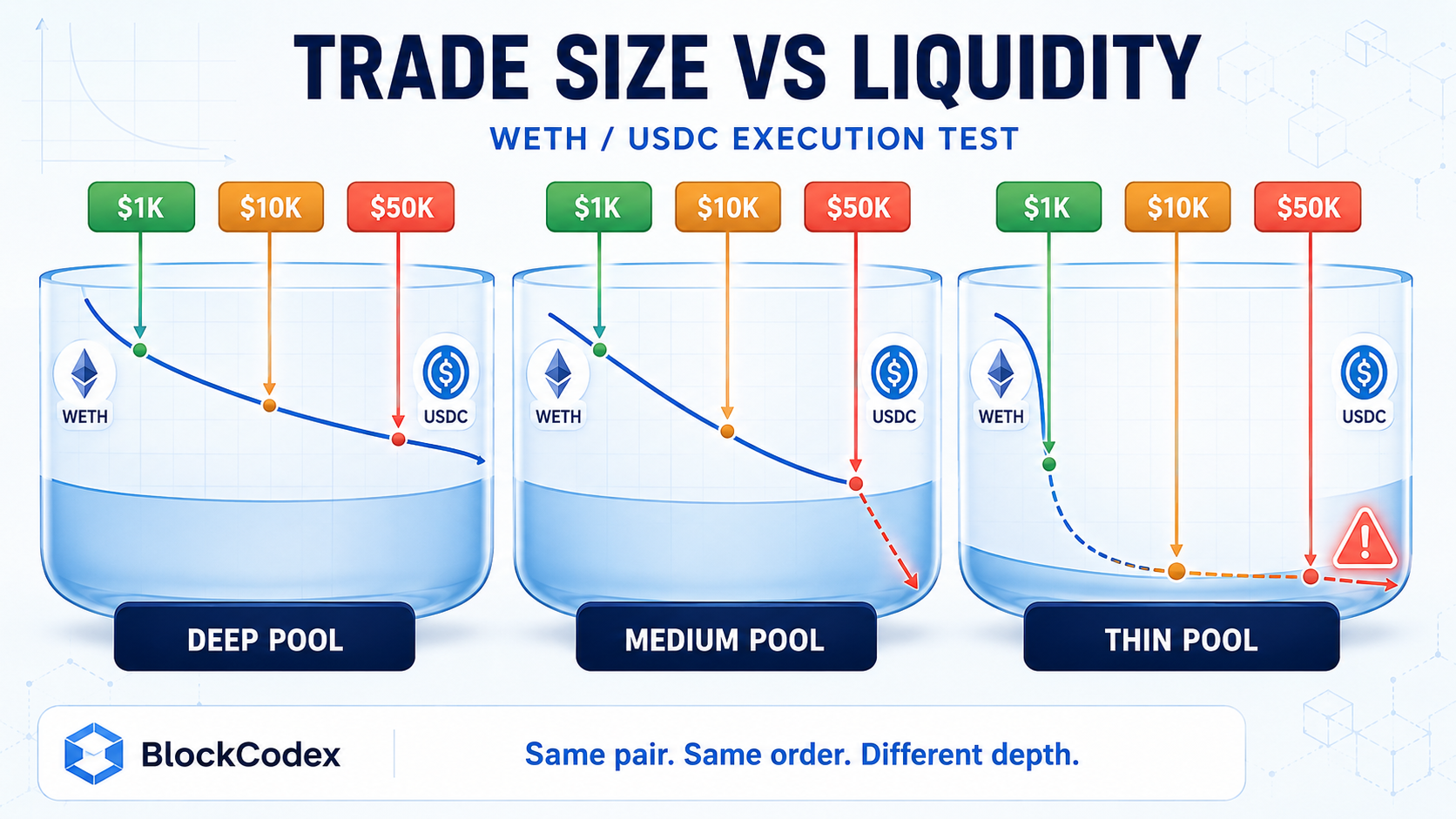
A $1,000 swap and a $25,000 swap can enter the same pool seconds apart and receive materially different execution. Nothing necessarily changed in the token itself. The larger transaction simply consumed more of the available liquidity and pushed further along the pool’s pricing curve.
That is price impact.
It is also why checking the quoted output for your actual position size is much more useful than asking whether a token has “high liquidity” in general.
Before submitting a Uniswap transaction, you should understand how much your own order changes the execution price, whether another route offers a better result, and how that differs from the slippage that may occur after the quote is generated.
How to Estimate Price Impact on Uniswap
The current Uniswap interface already exposes most of the information needed for a pre-trade check.
After entering a swap, expand the swap details and focus on:
| Field | What It Tells You |
|---|---|
| Price impact | How much your trade affects the available price |
| Order routing | Which pools and paths Uniswap intends to use |
| Max slippage | How much quote deterioration you allow after the quote |
| Fee | Trading fees associated with the route |
| Network cost | Blockchain execution cost |
These fields should not be interpreted independently.
If price impact is already high before the transaction is submitted, increasing max slippage does not fix the underlying liquidity problem. It merely allows the transaction to tolerate more movement before reverting.
The first diagnostic should therefore be trade size versus available liquidity.
What Price Impact Actually Measures
Price impact is the change in execution caused by your own transaction interacting with a liquidity pool.
Consider a simplified pool containing WETH and UNI.
When you buy UNI using WETH, WETH enters the pool and UNI leaves it. The ratio between the two reserves changes, so each additional unit of UNI becomes progressively more expensive as your transaction moves through the pricing curve.
A tiny order barely changes the reserves.
A large order changes them much more.
This creates an important distinction: price impact can exist even if nobody else trades while your transaction is being prepared.
The trade itself creates the effect.
That is different from slippage.
Price Impact vs Slippage: Do Not Confuse Them
Price impact and slippage can both worsen execution, but they come from different mechanisms.
Price impact originates from your order consuming liquidity.
Slippage refers to the difference between the quote you expected and the execution ultimately received because market conditions can change after the quote is produced.
Suppose Uniswap estimates that your swap will receive 1,000 tokens.
If the size of your transaction relative to liquidity caused that quote to be worse than the current market price, that deterioration includes price impact.
If market conditions then change while the transaction is pending and you finally receive 995 tokens, the additional difference relates to slippage.
This distinction matters because the solutions are different.
High price impact may require reducing the position size, splitting execution or finding deeper liquidity.
Slippage tolerance controls how much subsequent quote movement you are willing to accept.
For a deeper explanation of the second concept, see What Is Slippage in Crypto and Why It Matters?.
Start With the Trade Size You Actually Plan to Use
One of the easiest ways to underestimate price impact is testing the wrong amount.
If you intend to swap $10,000, checking a $100 quote tells you almost nothing about your real execution.
Enter the intended amount.
Then increase and decrease it.
For example, compare:
$1,000
$5,000
$25,000
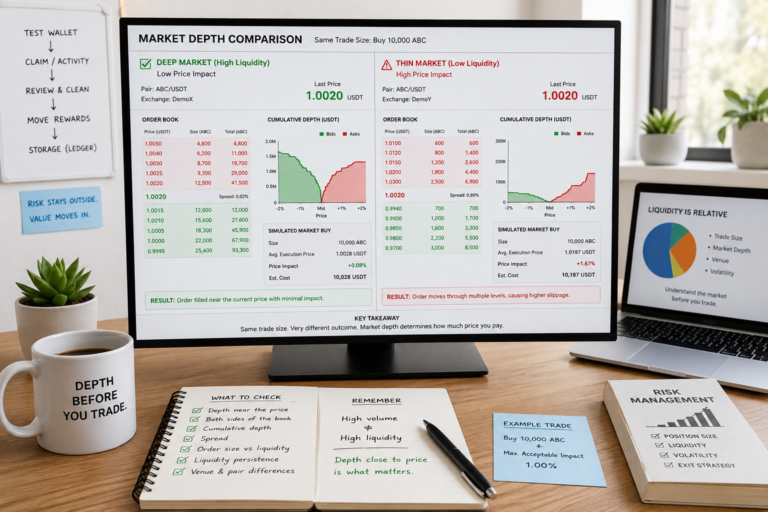
If liquidity is deep relative to all three orders, execution should deteriorate relatively slowly.
If the market is thin, the larger quotes will expose the weakness quickly.
This simple size test is often more useful than staring at a total liquidity figure because it converts an abstract pool statistic into an execution outcome.
BlockCodex Live Pool Test: $1K vs $5K vs $25K
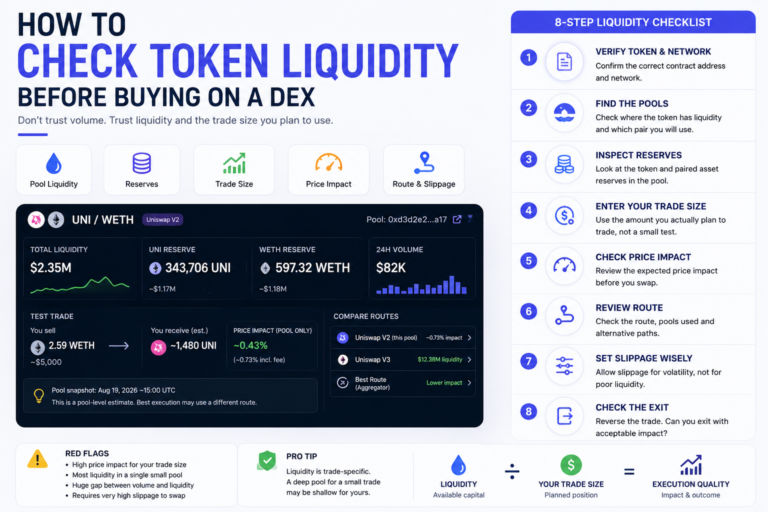
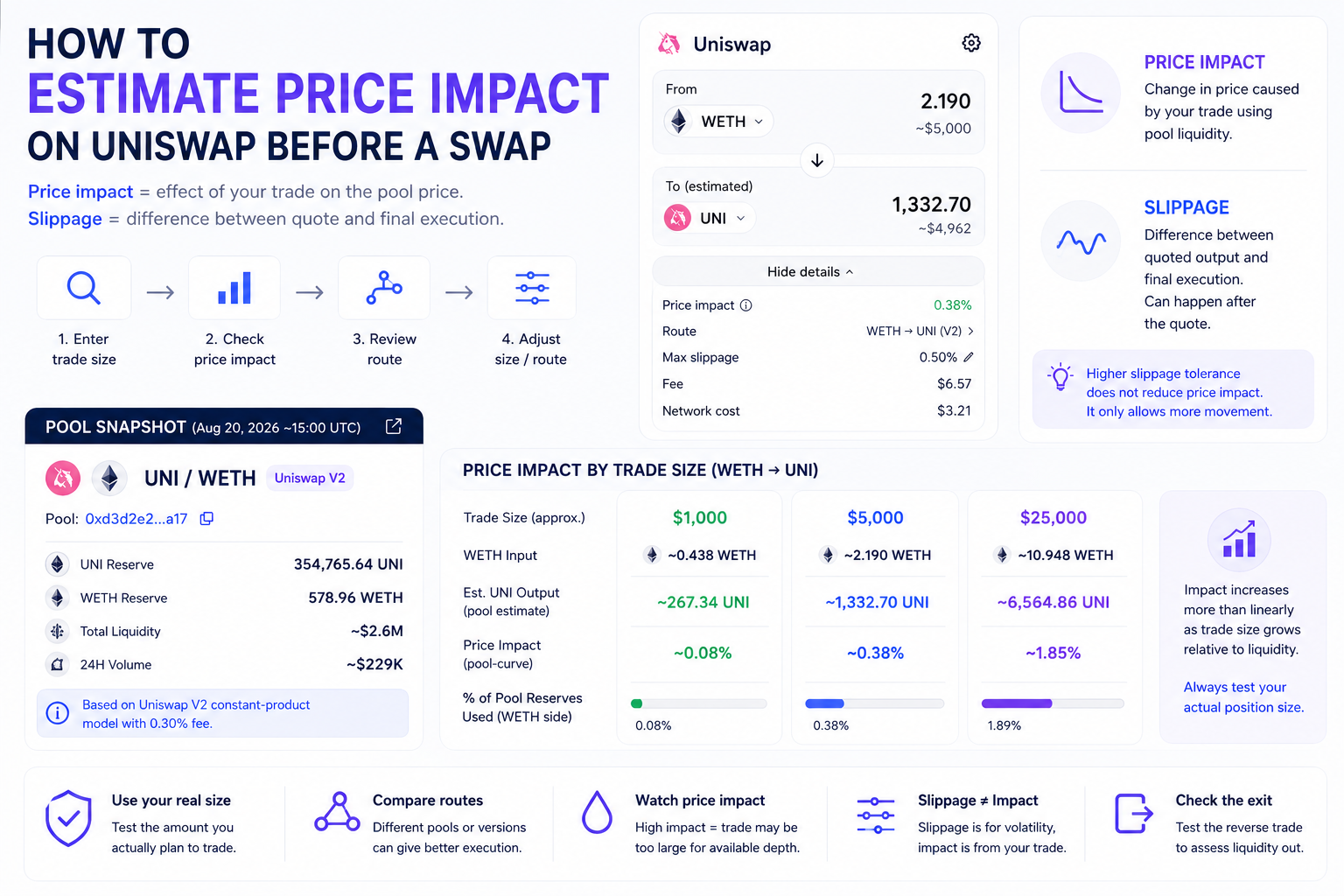
To illustrate the relationship, BlockCodex checked the Ethereum UNI/WETH Uniswap V2 pool on August 20, 2026.
At the snapshot, the pool contained approximately:
| Pool Metric | Snapshot |
|---|---|
| UNI reserve | 354,765.64 UNI |
| WETH reserve | 578.96 WETH |
| Total liquidity | ~$2.6 million |
| Pool | UNI/WETH |
| Protocol | Uniswap V2 |
| Pool address | 0xd3d2e2692501a5c9ca623199d38826e513033a17 |
Instead of testing one arbitrary swap, we used the same reserve snapshot to estimate three WETH-to-UNI purchases.
The calculations use the Uniswap V2 constant-product mechanism and the pool’s 0.30% swap fee. They are pool-level estimates, not live Uniswap Auto Router quotes.
| Approx. Trade Size | WETH Input | Estimated UNI Output | Pool-Curve Price Impact |
|---|---|---|---|
| $1,000 | ~0.438 WETH | ~267.34 UNI | ~0.08% |
| $5,000 | ~2.190 WETH | ~1,332.70 UNI | ~0.38% |
| $25,000 | ~10.948 WETH | ~6,564.86 UNI | ~1.85% |
The pattern matters more than any individual number.
The $25,000 order is 25 times larger than the $1,000 order, but the deterioration does not remain at the tiny impact observed for the smaller transaction. The larger order consumes a much more meaningful share of available liquidity, pushing execution further along the pricing curve.
That is exactly why price impact must be tested at the position size you actually intend to trade.
Why Price Impact Does Not Increase Linearly
It would be convenient if doubling a trade simply doubled its price impact.
AMM liquidity does not work that way.
In a constant-product pool, each unit removed changes the ratio between the two assets. As the transaction gets larger, the next unit is purchased at a progressively different price.
The result is a curve rather than a straight line.
Small transactions relative to reserves stay close to the current pool price.
Larger transactions travel further along the curve.
This means position sizing becomes increasingly important as the trade approaches a meaningful percentage of usable liquidity.
A trader who ignores this relationship can see a token priced at $1 on a chart while receiving an effective execution price materially above $1 when trying to establish a large position.
The token price did not suddenly become inaccurate.
The position was too large for the available depth.
The Pool Estimate Is Not Necessarily the Quote Uniswap Will Give You
This is an important limitation of the BlockCodex experiment.
Modern Uniswap execution is not restricted to one V2 pool.
The Auto Router can evaluate liquidity across multiple Uniswap protocol versions and may split a transaction across different pools or use intermediate tokens when doing so improves the result after considering liquidity, fees and network costs.
A $25,000 UNI trade may therefore receive a better effective quote than our isolated V2 calculation.
That does not make the pool calculation useless.
It shows what would happen if the trade relied on that specific liquidity source.
The router answers a different question:
Can the available market provide a better path?
This is why checking token liquidity before buying on a DEX should include both pool-level analysis and the actual route selected by the interface.
Check the Route When Price Impact Changes
Suppose you enter $1,000 and Uniswap selects a direct route.
You increase the trade to $25,000 and the route changes.
That is useful information.
The router may have determined that pushing the entire larger order through the original pool would create unnecessary price impact. Splitting the transaction or using another pool can improve execution.
A route might therefore look like:
WETH → UNI
or involve several liquidity sources rather than one simple pool.
Do not assume a more complex route is automatically worse. The additional route may exist precisely because no single pool offers the best execution for your position size.
What matters is the amount you receive after fees and network costs.
Why Total Pool Liquidity Can Still Mislead You
Our UNI/WETH example had roughly $2.6 million of liquidity.
That number is useful context, but it does not directly tell you the impact of a $1,000, $5,000 or $25,000 transaction.
Different AMM designs allocate liquidity differently.
Uniswap V2 liquidity operates across the full pricing curve, while concentrated-liquidity versions can position liquidity within selected price ranges. Two pools displaying the same total dollar liquidity can therefore provide different usable depth around the current market price.
This is why an executable quote is ultimately more useful than a headline liquidity number.
The relationship between trade size and available depth is also central to market depth in crypto. Liquidity becomes meaningful when measured against the amount you need to transact.
When Should Price Impact Worry You?
There is no universal percentage that makes every swap good or bad.
A professional rebalance, an emergency exit, a small-cap token purchase and a highly liquid stablecoin swap have different constraints.
Instead of searching for one magic threshold, ask whether the execution cost is acceptable for the trade you are making.
If increasing your position from $1,000 to $5,000 barely changes execution, the available market is handling the additional size relatively well.
If moving from $5,000 to $10,000 suddenly causes a sharp deterioration, you have discovered an important liquidity boundary.
The useful signal is not simply “price impact is 1%.”
It is how execution changes as your position size changes.
What to Do When Price Impact Is Too High
The first response should not be increasing slippage.
Reduce the transaction size and generate another quote.
If impact falls materially, trade size is a major part of the problem.
Next, inspect the routing. Another liquidity source may offer better execution.
You can also reconsider whether the position itself is appropriate for the market. If buying the desired amount already moves the price substantially, selling the same position later may become even more difficult during stress.
That exit problem is often overlooked.
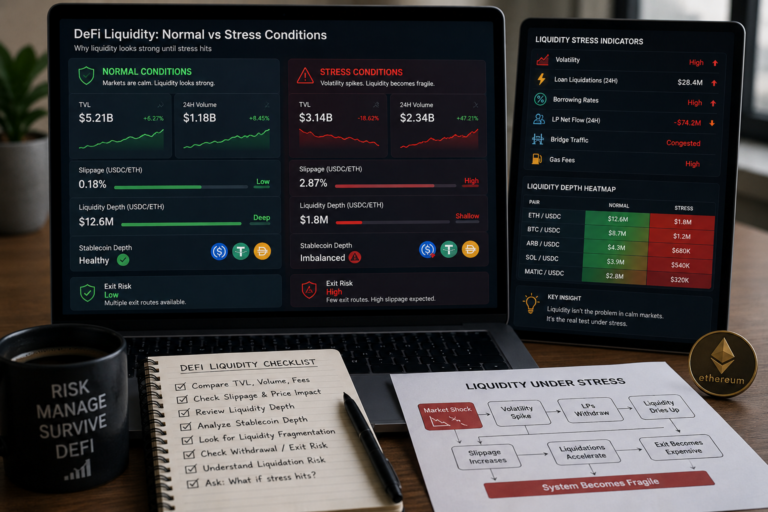
Thin liquidity can look manageable while entering gradually in calm conditions and become painful when many holders try to leave simultaneously. BlockCodex examines this broader problem in Why DeFi Liquidity Looks Strong Until Stress Hits.
Why Raising Slippage Does Not Reduce Price Impact
This deserves its own warning because the two settings are frequently confused.
Imagine your swap already has 3% price impact.
Changing max slippage from 0.5% to 5% does not make the pool deeper and does not restore the price consumed by your own order.
It changes the amount of additional deterioration the transaction may tolerate after the quote.
In other words:
Price impact describes the cost created by interacting with the available liquidity.
Slippage tolerance defines how much further deterioration you are willing to accept before execution should fail.
A high-slippage setting can make a difficult transaction easier to execute.
It does not make that transaction cheaper.
A Better Pre-Swap Price Impact Test
Before any meaningful Uniswap swap, generate several quotes rather than one.
Start with your intended amount, then compare a smaller and larger position.
If your target is $5,000, you might inspect $1,000, $5,000 and $10,000.
Watch how the expected output and price impact change.
Then expand the swap details and inspect the order routing, fee, network cost and max slippage.
If the target trade creates materially worse execution than the smaller test, ask whether the market is deep enough for your position.
If the route changes at larger sizes, determine whether Uniswap is accessing additional liquidity to improve execution.
Finally, reverse the trade.
Estimate what your position would look like if you needed to sell rather than buy.
The entry quote tells you whether you can get in.
The reverse quote starts telling you whether you can get back out.
Price Impact Is Really a Position-Sizing Signal
Price impact is normally presented as an execution statistic.
It is also a position-sizing signal.
If your planned order meaningfully moves the market, the position may be large relative to the available liquidity even if it is small relative to your portfolio.
That relationship can matter more than market capitalization.
A token can have a billion-dollar valuation while the specific DEX market you are using has limited usable depth.
Conversely, a relatively small token can support a modest retail order perfectly well if your trade remains tiny relative to its active liquidity.
This is why execution should be evaluated before the transaction rather than explained after a poor fill.
Final Thoughts
Knowing how to estimate price impact on Uniswap means testing your trade against the liquidity that will actually execute it.
Do not start with an arbitrary threshold. Start with the position size you intend to use.
Generate several quotes. Compare how execution changes as the order grows. Inspect the route rather than assuming one pool handles the entire swap, and keep price impact separate from slippage.
The BlockCodex UNI/WETH test makes the relationship visible. Using the same V2 pool snapshot, a roughly $1,000 purchase produced only about 0.08% of pool-curve impact, while a $25,000 trade pushed the estimate toward 1.85%.
- Same asset.
- Same pool.
- Same moment.
- Different position size.
That is the core lesson behind Uniswap price impact: liquidity does not simply exist or disappear. The amount that matters is the amount available relative to the trade you are asking the market to execute.